
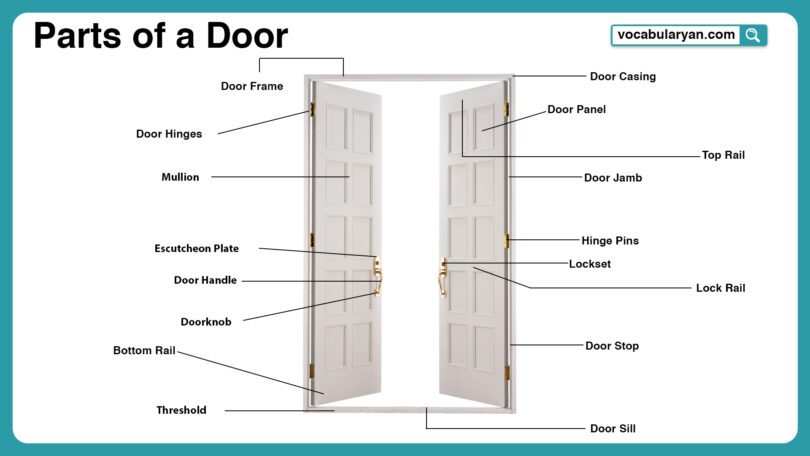
A door holds a moving panel inside a fixed frame, secured by hinges on one side and a lockset on the other, with trim and thresholds finishing the gaps around it. The parts below cover each piece involved, from the structural frame down to the small pins that hold the hinges together.
Names of Parts of a Door
- Door Frame: the outer structure that supports the door and keeps it in place, including the jambs, head, and threshold that together form the doorway opening.
- Door Panel: the main moving part of the door that swings open and closed, made of wood, metal, or glass depending on the design and function of the door.
- Door Casing: decorative trim fitted around the frame, hiding the gap between the wall and the frame and giving the doorway a finished appearance.
- Top Rail: the top horizontal part of the door panel, providing support and structure that helps keep the panel sturdy.
- Lock Rail: a horizontal section at the center height of the door panel, where the lockset is installed for security.
- Bottom Rail: a horizontal rail at the lower part of the door panel, adding extra stability and structural balance.
- Door Jamb: the vertical parts of the door frame where the hinges and lockset are installed, keeping the door aligned properly as it opens and closes.
- Mullion: a vertical bar that separates door panels in double doors, or adds a design element in decorative doors.
- Door Stop: a small strip attached to the door frame that prevents the door from swinging too far and protects the wall behind it.
- Door Sill: the structural base member running along the bottom of the frame, forming the foundation that the threshold sits on top of.
- Threshold: the finished strip fitted over the sill at the bottom of the doorway, sealing the gap and acting as a barrier against drafts, water, and dust.
- Door Hinges: metal joints that connect the door panel to the door frame, allowing the door to swing open and close.
- Hinge Pins: the pins inside each hinge that hold its two halves together, enabling smooth, stable door movement.
- Lockset: a set of components, typically including the latch, lock, and handle, installed together to secure the door.
- Door Handle: a lever-style grip used to open or close the door with a single push or pull, needing no twisting motion.
- Doorknob: a rounded grip that turns to release the latch, allowing the door to open.
- Escutcheon Plate: a decorative metal plate surrounding the lock and handle, giving a finished look while protecting the surface underneath from scratches.
Interesting Facts About Doors
- The oldest known door in the world is a Neolithic wooden door found near Zurich, Switzerland, dated to around 3,063 BC, making it roughly 5,000 years old.
- Many modern doors use electronic locks for enhanced security.
- Some Asian doors slide open instead of swinging, saving space.
- Bank vault doors rank among the heaviest and most secure doors built today.
- Doors in castles were often reinforced with iron to prevent break-ins.
FAQs
Q1. Why is a door frame important?
A door frame holds the door in place and keeps the whole assembly square, ensuring proper support and smooth operation every time the door opens or closes.
Q2. What is the difference between a doorknob and a door handle?
A doorknob is a rounded grip that requires twisting to release the latch, while a door handle is a lever that releases the latch with a push or pull, needing less grip strength to operate.
Q3. What is the purpose of a threshold?
A threshold seals the gap at the bottom of a doorway, keeping dust, drafts, and water from entering the room and helping weatherproof the entrance.
Q4. What is the difference between a door sill and a threshold?
A door sill is the structural base member built into the bottom of the frame, while a threshold is the finished strip fitted on top of the sill to seal the remaining gap. The sill provides the foundation; the threshold provides the visible, weatherproofing surface.
Q5. What is a lockset?
A lockset is the complete assembly used to secure a door, typically combining a latch, a lock mechanism, and a handle or knob into one installed unit rather than three separate parts.
Q6. What is the oldest known door in the world?
The oldest known door in the world is a Neolithic wooden door discovered near Zurich, Switzerland, in 2010. Tree-ring analysis dated it to approximately 3,063 BC, making it considerably older than any door found in Egyptian tombs.

Leave a Comment