
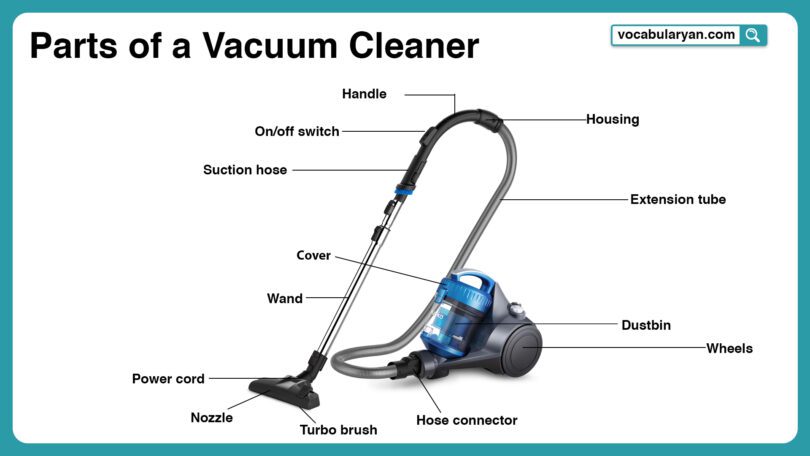
A vacuum cleaner pulls in dust and debris using a motor-driven suction system, then traps that debris in a filter and a dustbin before releasing clean air back out. The parts below cover each piece that makes this process work, from the handle you grip to the wheels that carry the machine across the floor.
Names of Parts of a Vacuum Cleaner
- Motor: drives the fan that creates suction, pulling air and debris in through the nozzle. Its power output determines how strong the vacuum’s suction feels during use.
- Handle: the part held while guiding the vacuum across different surfaces, giving grip and control. Many handles also carry the on/off switch within easy reach of the thumb.
- On/Off Switch: a button or switch on the handle or main body that turns the vacuum on or off. Some models add extra buttons here for suction strength or brush roll control.
- Suction Hose: flexible and tube-shaped, connecting the wand or nozzle to the main body and carrying pulled-in dirt and dust back toward the dustbin. Its flexibility lets the nozzle reach around furniture and into corners.
- Wand: also called an extension tube, a long, rigid tube that extends the vacuum’s reach for cleaning floors, ceilings, and other hard-to-reach areas without bending down. Some wands detach into shorter sections for easier storage.
- Nozzle: the opening positioned at the floor end of the hose or wand, where dust and debris first enter the vacuum. Many vacuums include interchangeable nozzles suited to carpet, hardwood, or upholstery.
- Turbo Brush: a rotating brush attachment that agitates carpet fibers, loosening embedded dirt and pet hair before the suction pulls it away. It works especially well on thick carpets and rugs where dirt sits deep in the fibers.
- Filter: catches dust and fine particles that would otherwise blow back into the room before exhaust air leaves the vacuum. Many modern vacuums use a HEPA filter, capable of trapping extremely small particles and allergens.
- Power Cord: a long cable connecting the machine to a wall outlet, supplying the electricity the motor needs. Corded models rely entirely on this cable, while cordless models use a battery instead.
- Hose Connector: locks the suction hose securely to the main body where the two pieces meet. This connection needs to stay airtight, or suction strength drops noticeably.
- Housing: also called the cover, the vacuum’s outer body, enclosing and protecting the motor, filter, and dust collection system inside. It shields these internal parts from impact and keeps loose debris from escaping the machine.
- Dustbin: collects the dirt and dust pulled in during cleaning. Bagged models store this debris in a disposable bag, while bagless models use a reusable, emptyable container instead.
- Wheels: small rolling wheels that let the vacuum move across floors and carpets as it is pushed or pulled during use. Larger wheels generally roll more smoothly over thick carpet and uneven flooring.
Interesting Facts About Vacuum Cleaners
- One of the first powered vacuum cleaners was invented in 1901 and ran on a gasoline engine.
- Modern vacuum cleaners often use HEPA filters to trap small dust particles and allergens.
- Some advanced vacuums are robotic, cleaning floors automatically without a person guiding them.
- Guinness World Records certifies the HYLA GST Swarovski Edition, priced at $21,900 and covered in over 32,000 Swarovski crystals, as the most expensive vacuum cleaner in the world.
- Vacuum cleaners with wet and dry functions can clean liquid spills as well as dust.
FAQs
Q1. What does the motor do in a vacuum cleaner?
The motor powers the fan that generates suction, pulling air and debris in through the nozzle and hose. A stronger motor generally produces more powerful suction, though filter condition and airflow design also affect real-world performance.
Q2. What is the function of a turbo brush in a vacuum cleaner?
A turbo brush is a rotating brush that agitates carpet fibers, loosening embedded dirt, dust, and pet hair so suction can pull it away. It works especially well on thicker carpets and rugs where dirt settles deep into the fibers.
Q3. How does a vacuum cleaner work?
A vacuum cleaner works by using its motor to create suction, pulling dust and debris in through the nozzle. That debris then passes through a filter, which traps fine particles, before settling into the dustbin for later disposal.
Q4. What is the difference between a bagged and bagless vacuum cleaner?
A bagged vacuum cleaner stores collected dirt in a removable, disposable bag, while a bagless vacuum collects it in a reusable dustbin that gets emptied and rinsed. Bagless models reduce ongoing bag costs but require more frequent hands-on cleaning of the dustbin itself.
Q5. Is the wand the same part as the extension tube?
Yes. Wand and extension tube both refer to the same long, rigid tube that extends a vacuum’s reach, and manufacturers use the two terms interchangeably depending on the brand.
Q6. What is the most expensive vacuum cleaner in the world?
The Guinness World Records-certified most expensive vacuum cleaner is the HYLA GST Swarovski Edition, priced at $21,900 and hand-set with more than 32,000 Swarovski crystals. A separate 24-karat gold-plated model has been marketed by its seller at $1 million, but that price has never been independently certified as a record.

Leave a Comment