
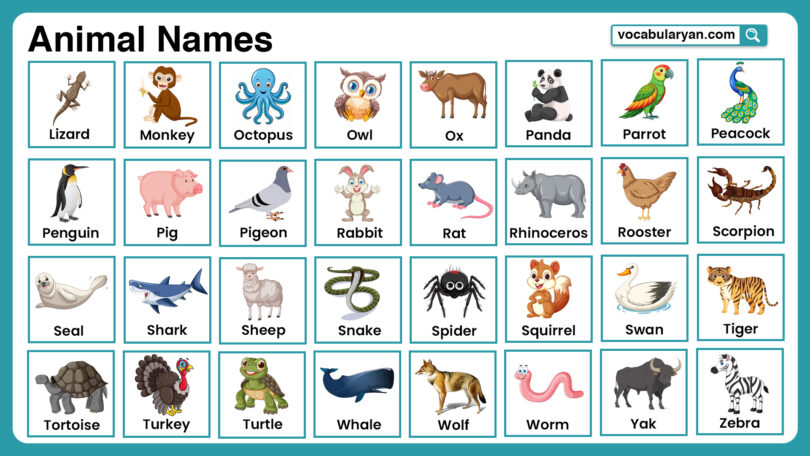
Animals live in homes, farms, forests, deserts, and oceans, each with a shape, sound, and habitat that sets it apart. The names below group by where each animal lives and what kind of animal it is.
Animal Names by Habitat and Type
The animal names below group by habitat and biological type, so each entry belongs to one clear category rather than several overlapping labels.
Pet Animal Names
- Dog: The dog has fur, padded paws, sharp hearing, and a strong sense of smell. It barks, runs, guards the home, and follows scents, and its size ranges from a tiny lap dog to a large working breed.
- Cat: Quiet movement makes the cat easy to recognize. Its soft paws, sharp claws, whiskers, and bright eyes let it climb, jump, stalk small prey, and land carefully after a leap.
- Rabbit: Long ears and strong back legs give the rabbit its familiar shape. It hops quickly, eats grass, hay, leaves, and vegetables, and often hides in a burrow or thick grass when it feels unsafe.
- Hamster: Round cheeks, short legs, and steady night movement make the hamster easy to recognize as a small pet. It stores food in its cheek pouches and spends much of the night running, digging, or hiding in tunnels.
- Guinea Pig: A guinea pig has a rounded body, short legs, soft fur, and a gentle squeaking call. It eats hay and vegetables and stays active in calm, social groups.
- Goldfish: The goldfish moves smoothly through tanks, bowls, and garden ponds. Its orange, yellow, white, or mixed coloring stands out underwater, especially when its fins and tail catch the light.
- Budgie: Small size and lively chirping make the budgie easy to notice. Green, yellow, blue, and white markings are common, and its curved beak is built for cracking seeds.
- Ferret: The ferret has a long body, short legs, and restless curiosity. It slips through corners and tunnels quickly, sniffing and squeezing into tight spaces with ease.
- Hedgehog: Sharp spines cover the hedgehog’s small body. When it senses danger, it curls into a tight ball so the spines protect its soft face and belly.
Parrots, turtles, and geckos live as pets too, described under Bird Names and Reptile Names.
Farm Animal Names
- Cow: A cow has a large body, hooves, a long tail, and steady, unhurried movement. Cows graze in fields and pastures, move slowly in herds, and are known for producing milk.
- Goat: Strong hooves and a narrow face suit the goat’s habit of climbing. Goats eat grass, leaves, shrubs, hay, and rough plants that many other farm animals avoid.
- Sheep: The sheep carries a thick, woolly coat and grazes with a gentle, unhurried manner. Sheep move in flocks across fields and hills, staying close together for safety.
- Horse: Long legs, a flowing mane, and a strong back give the horse its graceful shape. Horses are known for speed, for pulling and riding work, and for steady movement across open land.
- Donkey: Long ears and a careful, deliberate walk make the donkey easy to identify. Donkeys carry loads across rough ground and announce themselves with a loud, braying call.
- Pig: A pig has a rounded body, short legs, a snout, and a keen sense of smell. It roots through soil, straw, and mud while searching for food.
- Chicken: Feathers, wings, claws, and a short beak shape the chicken’s body. Chickens scratch the ground for seeds, insects, and grain around coops and farmyards.
- Hen: The hen is a female chicken known for laying eggs. Hens cluck, peck at the ground, sit on nests, and move about the farmyard with their chicks.
- Rooster: A bright comb, pointed tail feathers, and a loud crow make the rooster stand out. Roosters usually crow early in the morning and stay alert to guard the flock.
- Turkey: The turkey is a large bird with a broad body and a fan-shaped tail. Male turkeys display bright skin around the head and neck along with a deep, gobbling call.
- Ox: An ox is a strong, trained cattle animal bred for heavy pulling. Oxen haul carts, plows, and other loads with steady, patient strength.
- Buffalo: Curved horns, strong shoulders, and a heavy body give the buffalo a powerful look. Many buffalo live near wetlands, fields, or grasslands, moving together in herds.
- Llama: The llama has a long neck, soft wool, and a tall, upright body. Llamas carry loads through mountain regions and often stand alert with their ears raised.
- Alpaca: Soft fleece and a gentle face make the alpaca easy to recognize. Its warm wool is valued for clothing, blankets, and soft fabric.
- Quail: A quail is a small ground bird with a round body and short wings. It hides quietly in grass and low plants, then bursts into fast, sudden flight when startled.
Ducks, geese, and bees are farm regulars too, described under Bird Names and Insect Names.
Wild Animal Names
- Lion: A lion is a large wild cat with golden fur, a powerful body, and a deep roar. Male lions grow thick manes around the head and neck, and lions typically live in groups called prides.
- Tiger: Orange fur and black stripes make the tiger instantly recognizable. It moves with power and stealth through forests, grasslands, and wetland edges while hunting large prey.
- Elephant: The elephant’s trunk, tusks, wide ears, and huge body give it a striking shape. It uses its trunk to drink, smell, lift food, touch other elephants, and pull down branches.
- Bear: A bear has thick fur, strong claws, and a heavy, powerful body. Bears eat a wide range of foods, including fish, berries, insects, roots, honey, and small animals.
- Zebra: Black and white stripes cover the zebra’s body from head to tail. Zebras live in open grasslands and often move in groups, where their stripes create a confusing pattern for predators.
- Giraffe: A very long neck, long legs, and a spotted coat make the giraffe one of the tallest land animals. Its height lets it reach leaves high up in trees, especially from acacia branches.
- Leopard: The leopard has a spotted coat, a muscular body, and impressive climbing skill. It often rests on tree branches and may drag its prey up into the branches to keep it safe from other predators.
- Wolf: Sharp teeth, thick fur, and strong legs suit the wolf’s long travel and pack life. Wolves rely on calls and body signals to coordinate while hunting or moving as a group.
- Deer: Slim legs and fast, springing movement help deer escape danger. Many male deer grow antlers, and deer graze on grass, leaves, twigs, and plants near forests and open fields.
- Fox: A pointed face, alert ears, and a bushy tail give the fox its sharp, watchful look. Foxes hunt small animals, birds, insects, and fruit, most often around dusk or at night.
- Gorilla: The gorilla has a broad chest, long arms, and a powerful body. Gorillas live in forest groups and feed mainly on leaves, stems, fruit, and shoots.
- Chimpanzee: A chimpanzee has long arms, a dark face, and notably clever behavior. It climbs trees with ease, uses its hands skillfully, and sometimes uses sticks or stones to reach food.
- Rhinoceros: Thick skin, a heavy body, and one or two horns on the nose define the rhinoceros. Rhinos graze across grasslands and open areas, often moving with surprising speed for their size.
- Hippopotamus: The hippopotamus has a barrel-shaped body, a wide mouth, short legs, and thick skin. Hippos spend much of the day in rivers and lakes to keep cool.
- Cheetah: A slim body, long legs, and black tear marks near the eyes make the cheetah built for speed. It holds the record among land animals for the fastest running across open grassland.
- Kangaroo: Strong back legs, a long tail, and a pouch give the kangaroo its familiar shape. It moves by hopping and uses its tail to keep its balance.
- Koala: Round ears, thick fur, and a large dark nose make the koala easy to spot. It lives almost entirely in eucalyptus trees and eats mostly eucalyptus leaves.
- Sloth: Long arms, curved claws, and famously slow movement define the sloth. It spends much of its life hanging from branches and feeding on leaves.
- Okapi: The okapi has a dark body and striped legs that resemble a zebra’s. It belongs to the giraffe family and moves through dense forest with quiet, careful steps.
- Hyena: A sloped back, powerful jaws, and a distinctive call mark the hyena. Hyenas hunt and scavenge in groups across open grassland, and their strong jaws let them crack bones other predators leave behind.
- Monkey: Gripping hands and, in many species, a long tail make monkeys agile tree-dwelling animals. They feed on fruit, leaves, insects, or small animals as they move through the branches.
- Squirrel: A squirrel has a bushy tail and quick, confident climbing skill. It stores nuts and seeds for later and often runs along trees, walls, and fences.
- Bat: A bat is a flying mammal with wings made of skin. Many bats hunt insects at night and rest hanging upside down during the day.
Sea Animal Names
- Whale: A whale is a huge sea mammal with flippers and a powerful tail. Whales breathe air through blowholes and rise to the surface between long, deep dives.
- Shark: Strong bodies, fins, sharp teeth, and powerful swimming make sharks famous ocean predators. Many hunt fish and other sea animals across open water or around reefs.
- Dolphin: The dolphin has a smooth body, a curved mouth, and playful, social movement. Dolphins breathe air and often swim in groups, rising to the surface together to take a breath.
- Octopus: An octopus has a soft body, eight arms, and strong suction cups on each one. It hides among rocks, changes color to match its surroundings, and squeezes into surprisingly narrow spaces.
- Jellyfish: A jellyfish has a soft, floating body and long, trailing tentacles. It drifts through the water with a gentle pulsing movement, often carried along by ocean currents.
- Squid: Long bodies, tentacles, and sudden bursts of movement define the squid. It can shoot a cloud of ink to escape danger and dart through the water with surprising speed.
- Crab: A crab has a hard shell, strong claws, and a distinctive sideways walk. Crabs often live near shores, rocks, mud, and sandy coastal areas.
- Lobster: The lobster has a hard shell, long antennae, and large claws. It lives on the ocean floor and hides among rocks or sea plants during the day.
- Starfish: A starfish usually has five arms and a rough body surface. It moves slowly across rocks, tide pools, and the seabed in search of food.
- Sea Turtle: A sea turtle has a shell, strong flippers, and a powerful swimming style. It travels long distances across the ocean and returns to sandy beaches to lay its eggs.
- Seal: Smooth bodies, flippers, and a thick layer of fat help seals live comfortably in cold water. Seals swim well and rest on rocks, ice, or beaches between dives.
- Walrus: A walrus has long tusks, thick whiskers, flippers, and a heavy body. It lives in cold northern waters and often gathers in large groups.
- Seahorse: A curled tail, small fins, and a horse-like head shape make the seahorse unusual among fish. It grips sea plants with its tail and moves slowly through shallow water.
- Stingray: The stingray has a flat body, wide fins, and a long, whip-like tail. It glides close to the sea floor, often blending in with the surrounding sand.
- Clownfish: Orange and white bands make the clownfish easy to recognize. It often lives among sea anemones in coral reef areas, protected by the anemone’s stinging tentacles.
- Eel: An eel has a long, snake-like body and a smooth, gliding swimming style. Many eels hide in rocks, mud, or coral during the day and hunt after dark.
Bird Names
- Eagle: Sharp eyes, wide wings, a hooked beak, and strong claws make the eagle a powerful hunter. It often glides over mountains, forests, or open land while searching for prey below.
- Owl: An owl has large eyes, soft feathers, and remarkably quiet flight. Many owls hunt at night, listening carefully for small animals moving through grass, trees, or snow.
- Parrot: Bright feathers and a curved beak give the parrot a vivid look. Some parrots copy sounds they hear and use their strong beaks to crack seeds and nuts.
- Sparrow: The sparrow is a small brown or gray bird often found near homes, gardens, and streets. It hops about quickly and feeds on seeds, crumbs, and tiny insects.
- Pigeon: A rounded body, short neck, and strong homing ability define the pigeon. Many pigeons live on rooftops, in parks, and around open city squares.
- Crow: Black feathers, a strong beak, and a loud caw make the crow easy to identify. Crows are notably clever birds that eat insects, grains, fruit, scraps, and even small animals.
- Duck: A duck has webbed feet, a flat bill, and waterproof feathers. It swims across ponds, lakes, and rivers, then walks with a waddling step once back on land.
- Goose: The goose has a long neck, webbed feet, and a loud honk. Geese often move in groups and can become quite noisy when guarding their space.
- Swan: A swan has a long, curved neck, broad wings, and a graceful swimming style. Many swans have white feathers, though black swans exist as well.
- Peacock: A peacock has bright blue-green feathers and a large, fan-shaped tail. The male spreads his tail in a striking display, showing off the eye-like patterns along its edge.
- Flamingo: Long legs, a long neck, and pink feathers make the flamingo stand out in shallow water. It feeds by filtering tiny food from mud and water with its curved bill.
- Ostrich: The ostrich is a large flightless bird with long legs and a long neck. It cannot fly, but it makes up for that by running faster than almost any other bird.
- Penguin: A penguin has flipper-like wings, a black and white body, and strong swimming ability. Penguins cannot fly, but they move through water with speed and remarkable control.
- Hawk: Sharp vision, a hooked beak, and strong claws suit the hawk’s hunting style. It hunts small animals and birds from a perch in a tree, a cliff edge, or high in open sky.
- Woodpecker: A woodpecker has a strong, chisel-like beak built for tapping tree bark. It searches for insects hidden inside wood and often makes a rapid, drumming knock as it works.
- Hummingbird: The hummingbird is tiny and remarkably fast, with wings that beat rapidly enough to blur. It drinks nectar from flowers while hovering steadily in the air.
- Falcon: Narrow, pointed wings and a sharp curved beak define the falcon. It dives at extremely high speed to strike prey in midair, one of the fastest hunting moves in nature.
Insect Names
- Ant: Tiny bodies and strong colony behavior make ants easy to notice. They move in long lines, carry food or soil back to the nest, and build homes underground, in wood, or near houses.
- Bee: A bee has wings, a striped body, and pollen-covered legs. Bees visit flowers to gather nectar, carry pollen between blooms, and make honey inside their hives.
- Wasp: A wasp has a narrow waist, wings, and a sharp sting. Many wasps hunt smaller insects for food and build paper-like nests from chewed wood fibers.
- Butterfly: Colorful wings and a delicate body define the butterfly. It drinks nectar from flowers and often rests with its wings spread wide in the sunlight.
- Moth: The moth often has softer or duller wings than a butterfly and usually flies at night rather than during the day. Many moths rest near lights, tree bark, or plants while waiting for dusk.
- Fly: A fly has two wings, large eyes, and quick, darting movement. Flies often gather around food, waste, warm spaces, and damp areas.
- Mosquito: Long legs, thin wings, and a needle-like mouthpart make the mosquito easy to recognize. Female mosquitoes feed on blood to develop their eggs, while both males and females also feed on plant nectar.
- Ladybug: A ladybug has a round body, red or orange wings, and black spots scattered across its back. It often feeds on aphids and crawls slowly over leaves and stems.
- Beetle: Hard wing covers and a tough body protect the beetle from most predators. Beetles live in soil, wood, plants, water, and countless other places around the world.
- Dragonfly: A dragonfly has a long body, large eyes, and strong transparent wings. It often flies near ponds, rivers, and wetlands while hunting tiny insects in midair.
- Grasshopper: Long back legs give the grasshopper its powerful jumping ability. It feeds on grass and leaves, and many species make a chirping sound by rubbing their legs against their wings.
- Praying Mantis: A praying mantis has long front legs folded like arms in prayer. It waits patiently and still, then catches insects with a sudden, sharp strike.
- Firefly: A firefly has a small body and a glowing abdomen. It flashes at night to signal other fireflies across warm fields, gardens, and wooded areas.
- Stick Insect: The stick insect has a thin body that closely resembles a twig. It hides among branches and leaves, relying on its shape as near-perfect camouflage.
Reptile Names
- Snake: The snake has a long body and no legs at all. It moves by sliding across the ground and often uses its tongue to sense scents carried in the air.
- Crocodile: A crocodile has thick scales, a long snout, strong jaws, and a powerful tail. It lives near rivers and wetlands, where it swims well and waits patiently near the water’s edge.
- Alligator: Broad snouts and armored bodies give alligators a heavy, powerful look. They spend much of their time in freshwater areas such as swamps, lakes, and slow-moving rivers.
- Lizard: A lizard usually has scales, four legs, a tail, and fast, darting movement. Many lizards live on rocks, walls, tree trunks, or warm open ground.
- Tortoise: The tortoise has a hard shell and lives mostly on land. It walks slowly, eats plants, and pulls its head and legs into its shell whenever it feels threatened.
- Turtle: A turtle has a shell and often spends much of its time in water. Some turtles swim well using webbed feet or flipper-like limbs built for life at sea.
- Chameleon: Gripping feet, a long tongue, and eyes that move independently of one another make the chameleon unusual. Many chameleons can change color and move slowly and deliberately through branches.
- Gecko: A gecko has large eyes and sticky toe pads built for gripping smooth surfaces. It climbs walls with ease, hides in warm places during the day, and hunts insects at night.
- Komodo Dragon: The Komodo dragon is a large monitor lizard with strong legs, sharp claws, and a powerful bite. It lives on a handful of Indonesian islands and hunts with surprising strength for its size.
- Iguana: An iguana has a long tail, rough scales, and a row of spines running along its back. It often eats leaves, flowers, and fruit found in the trees around it.
- Gila Monster: Black-orange markings and beaded skin make the Gila monster easy to spot. It lives in dry regions and moves slowly across rocky ground, storing fat reserves for lean times.
- Monitor Lizard: A monitor lizard has a long neck, strong claws, and a muscular tail. Some monitor lizards grow very large and move confidently both on land and in water.
Amphibian Names
- Frog: A frog has smooth skin, strong back legs, and a body built for jumping. Frogs often live near ponds and make croaking calls, especially after rain.
- Toad: Rougher skin and shorter legs usually separate a toad from a frog. Many toads live in gardens, fields, and damp places, where they feed on insects.
- Salamander: A salamander has a long body, soft skin, and a tail. It often hides under logs, leaves, stones, or wet ground during the day.
- Newt: The newt looks much like a small salamander and often spends time in water. Some newts display bright markings that warn predators they may be toxic.
- Caecilian: A caecilian has a long, worm-like body and no visible legs at all. Many live underground in tropical regions, moving through the soil in search of prey.
- Bullfrog: A bullfrog is a large frog with a notably deep call. It lives near ponds, lakes, and marshes, often waiting motionless near the water for insects or small prey.
- Tree Frog: Sticky toe pads help the tree frog climb plants and branches with ease. Many tree frogs have green bodies that blend closely with surrounding leaves.
- Axolotl: An axolotl has feathery gills, a wide head, and a soft, fully aquatic body. It stays in water throughout its life and keeps larval features that many other amphibians lose as adults.
- Tiger Salamander: Dark skin with yellow or olive markings gives the tiger salamander its name. It spends much of its time underground and only comes out in damp weather.
- Glass Frog: A glass frog has pale green skin and a partly transparent underside. It lives in humid forests near streams, where its coloring helps it stay hidden.
Desert Animal Names
- Camel: A camel has long legs, wide feet, and humps that store fat rather than water. Its body is built for dry land, long travel, and days spent with little water.
- Scorpion: Curved tails and sharp stingers make scorpions easy to identify. They hide under rocks, sand, and dry ground during the day and become active after dark.
- Rattlesnake: A rattlesnake has a long body, scales, and a rattling tail used as a warning. It shakes its tail sharply to alert enemies before it strikes.
- Fennec Fox: Huge ears and pale fur give the fennec fox its distinctive desert look. Its oversized ears release excess heat and sharpen its hearing across open, sandy spaces.
- Roadrunner: The roadrunner is a fast-running bird with long legs and a long tail. It eats insects, lizards, small snakes, and other desert prey it can outrun on foot.
- Coyote: A coyote has pointed ears, sharp teeth, and a lean, athletic body. It hunts small animals and adapts well to dry land, grassland, and even the edges of towns.
- Meerkat: The meerkat has a slim body, sharp claws, and a habit of standing upright to watch for danger. Meerkats live in groups and dig burrows into dry, open land.
- Jerboa: A jerboa has long back legs and a tiny body. It jumps across sandy ground in quick bounds and stays active mostly at night.
- Desert Tortoise: A desert tortoise has a hard shell and thick, sturdy legs. It digs burrows to escape the worst of the daytime heat and feeds on desert plants.
- Kangaroo Rat: Long back legs and a balancing tail help the kangaroo rat leap across dry ground. It survives on remarkably little water, drawing most of what it needs from its food.
Desert lizards and Gila monsters live here too, described under Reptile Names.
Rare Animal Names
- Pangolin: Overlapping scales protect the pangolin’s entire body. When threatened, it curls into a tight ball so its scales face outward, shielding its soft underside.
- Aye-Aye: The aye-aye is a small primate with large eyes, big ears, and one long, thin finger. It taps on wood to locate insects, then pulls them out of narrow holes with that finger.
- Platypus: A platypus has a duck-like bill, webbed feet, and a flat tail. It lays eggs, which is unusual among mammals, though it is still classified as one.
- Narwhal: A narwhal is a whale with a long, spiral tusk extending from its head. It lives in cold Arctic waters and moves beneath the sea ice for much of the year.
- Tarsier: Huge eyes, long fingers, and strong jumping legs define the tarsier. It hunts insects at night, leaping between branches high in the trees.
- Fossa: A fossa has a cat-like body and a long tail. It lives only in Madagascar, where it climbs skillfully while hunting through the forest.
- Saola: Long, straight horns and a slim body make the saola strikingly distinct. It is one of the rarest large mammals on Earth and lives in forested mountains.
- Quokka: The quokka is a small marsupial with round ears and a round face that often looks like it is smiling. It lives in parts of Australia and feeds mainly on plants.
- Tapir: A tapir has a heavy body and a short, flexible snout. It often lives near forests and water, feeding on leaves and fruit.
- Markhor: The markhor is a wild goat with large, spiraling horns. It climbs steep mountain slopes with confident, sure-footed hooves.
- Capybara: A capybara is the world’s largest rodent by far. It has a barrel-shaped body and typically stays near water in small groups.
- Harpy Eagle: Huge claws, a powerful body, and a feathered crest make the harpy eagle an imposing sight. It hunts in tropical forests and can catch prey as large as tree-dwelling monkeys.
Okapis and axolotls are rare too, described under Wild Animal Names and Amphibian Names.
Animal Groups by Size and Class
Big animals:
- Polar Bear: Thick white fur, strong paws, and a large body suit the polar bear’s cold home. It swims well over long distances and hunts across sea ice and coastal areas.
- Bison: A bison has a heavy head, thick shoulders, and a shaggy coat. It grazes across grasslands and often moves in large, wandering herds.
- Great White Shark: The great white shark has a powerful body, sharp teeth, and strong jaws. It patrols coastal waters as one of the ocean’s most famous predators.
Elephants, whales, hippos, rhinos, gorillas, and giraffes (described under Wild Animal Names and Sea Animal Names) and camels (Desert Animal Names) also rank among the biggest animals here.
Small animals:
- Mouse: A mouse is a tiny mammal with a pointed face, a long tail, and fast, darting movement. It often hides in small spaces and feeds on seeds, grains, or scraps.
- Mole: Tiny eyes and strong digging claws suit the mole’s life underground. It tunnels steadily through soil and feeds mostly on worms and insects.
- Finch: A finch is a small bird with a short beak and quick, fluttering flight. It often feeds on seeds and perches in shrubs or low trees.
- Snail: The snail has a soft body protected by a spiral shell. It moves slowly across surfaces, leaving a thin, wet trail behind it.
- Baby Turtle: A baby turtle has a small shell, tiny legs, and slow, careful movement. It typically heads toward water soon after hatching from its egg.
Hamsters, guinea pigs, squirrels, geckos, toads, and tree frogs are also small, described above.
Long-necked animals:
- Emu: An emu is a large flightless bird with long legs and a long neck. It runs quickly across open land, covered in shaggy brown feathers.
- Heron: The heron is a long-legged water bird with a long neck and a sharp bill. It waits motionless in shallow water, then strikes suddenly to catch a fish.
Giraffes, swans, ostriches, llamas, geese, flamingos, and alpacas (described under Wild Animal Names, Bird Names, and Farm Animal Names) and camels (Desert Animal Names) also have long necks.
Mammals across categories: dogs and cats live as pets, cows and horses work on farms, bats, elephants, kangaroos, monkeys, squirrels, and bears roam the wild, and whales and dolphins swim in the sea. All of these are mammals, though each belongs to a different habitat category above.
Short Animal Names
| Short Name | Meaning or Animal |
|---|---|
| Ox | Strong working cattle animal |
| Yak | Long-haired mountain animal |
| Ram | Adult male sheep |
| Ape | Tailless primate such as gorilla or chimpanzee |
| Boar | Wild pig or adult male pig |
| Cub | Young bear, lion, tiger, or fox |
| Pup | Young dog, seal, wolf, or several other animals |
| Calf | Young cow, elephant, whale, or giraffe |
| Kid | Young goat |
| Lamb | Young sheep |
| Fawn | Young deer |
| Hog | Pig, especially a larger one |
| Stag | Adult male deer |
| Doe | Adult female deer, rabbit, or goat in some uses |
| Buck | Adult male deer, goat, or rabbit in some uses |
| Sow | Adult female pig |
| Mare | Adult female horse |
These names are short, but many carry a specific meaning. A calf, lamb, kid, cub, and fawn are not separate species; they name young animals instead.
Animal Names A to Z
| Letter | Animal Names |
|---|---|
| A | Ant, Ape, Alligator, Antelope |
| B | Bear, Bee, Bat, Buffalo |
| C | Cat, Cow, Camel, Cheetah |
| D | Dog, Duck, Deer, Dolphin |
| E | Elephant, Eagle, Eel, Emu |
| F | Fox, Frog, Fish, Flamingo |
| G | Goat, Goose, Giraffe, Gorilla |
| H | Horse, Hen, Hamster, Hawk |
| I | Iguana, Impala, Ibex, Inchworm |
| J | Jaguar, Jellyfish, Jackal, Jay |
| K | Kangaroo, Koala, Kingfisher, Kudu |
| L | Lion, Leopard, Lizard, Lobster |
| M | Monkey, Mouse, Moose, Meerkat |
| N | Narwhal, Newt, Nightingale, Numbat |
| O | Owl, Octopus, Otter, Ostrich |
| P | Pig, Parrot, Penguin, Panther |
| Q | Quail, Quokka, Quetzal, Quoll |
| R | Rabbit, Rat, Rhino, Raccoon |
| S | Snake, Shark, Sheep, Squirrel |
| T | Tiger, Turtle, Turkey, Toad |
| U | Urial, Uakari, Umbrellabird |
| V | Vulture, Viper, Vicuna |
| W | Whale, Wolf, Walrus, Wombat |
| X | X-ray Tetra, Xerus |
| Y | Yak, Yellowjacket |
| Z | Zebra, Zebu, Zonkey |
FAQs
Q1. What are common animal names in English?
Common animal names include dog, cat, cow, horse, goat, sheep, lion, tiger, elephant, eagle, frog, snake, turtle, butterfly, bee, rabbit, monkey, duck, and bear.
Q2. What are pet animal names?
Pet animal names include dog, cat, rabbit, hamster, guinea pig, parrot, goldfish, turtle, ferret, budgie, hedgehog, and gecko.
Q3. What are farm animal names?
Farm animal names include cow, goat, sheep, horse, pig, chicken, duck, goose, donkey, rooster, ox, buffalo, llama, alpaca, turkey, quail, and bee.
Q4. What are wild animal names?
Wild animal names include lion, tiger, elephant, bear, zebra, giraffe, wolf, fox, deer, rhino, cheetah, leopard, gorilla, kangaroo, and hyena.
Q5. What are sea animal names?
Sea animal names include whale, shark, dolphin, octopus, crab, lobster, jellyfish, sea turtle, seahorse, squid, stingray, starfish, seal, walrus, eel, and clownfish.
Q6. What are bird names in English?
Bird names include eagle, owl, parrot, sparrow, pigeon, crow, duck, goose, swan, peacock, flamingo, penguin, hawk, falcon, and woodpecker.
Q7. What are reptile names?
Reptile names include snake, crocodile, alligator, lizard, tortoise, turtle, chameleon, gecko, iguana, Komodo dragon, and monitor lizard.
Q8. What are amphibian names?
Amphibian names include frog, toad, salamander, newt, caecilian, bullfrog, tree frog, axolotl, tiger salamander, and glass frog.
Q9. What are big animal names?
Big animal names include elephant, whale, hippopotamus, rhinoceros, polar bear, gorilla, giraffe, bison, camel, and great white shark.
Q10. What are small animal names?
Small animal names include mouse, hamster, guinea pig, squirrel, mole, gecko, toad, tree frog, finch, snail, and baby turtle.

Leave a Comment