
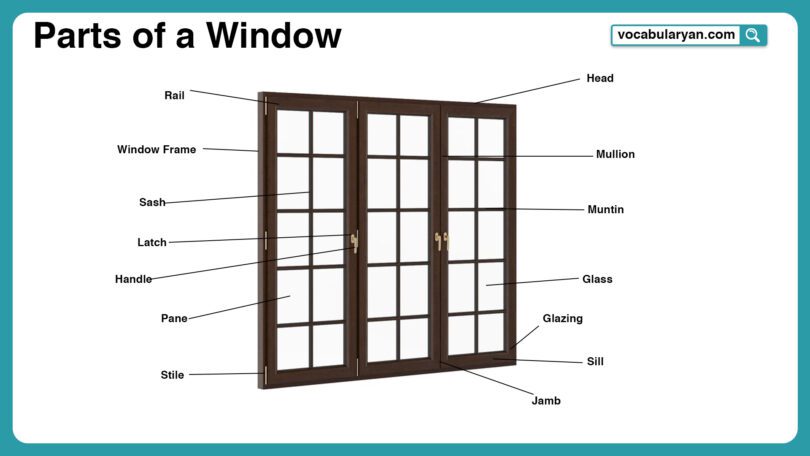
A window holds glass securely in place while allowing it to open, close, and lock, using a frame, a moving sash, and hardware that keeps both working smoothly for years. The parts below cover each piece involved, from the outer frame down to the handle you turn to open it.
Names of Parts of a Window
- Window Frame: the outer structure that surrounds and supports the entire window, made of vertical and horizontal components that form the border of the opening. It provides the strength that holds every other part in place.
- Sash: the movable or fixed frame that holds the glass panes, sitting inside the window frame. It allows the window to open, close, or remain fixed, depending on the design.
- Pane: one individual sheet of glass set within a sash. A window may hold a single large pane or several smaller panes divided by muntins.
- Glass: the transparent or translucent material every pane is made from, chosen for the visibility, insulation, and protection it provides against outside elements.
- Glazing: the process of fitting and sealing glass into a frame or sash rather than a physical part itself. Proper glazing improves insulation, reduces noise, and affects overall energy efficiency.
- Mullion: a vertical or horizontal bar that separates entire window units or sashes from one another, often found between two adjacent windows set side by side. It carries structural weight, unlike the thinner bars that divide panes within a single sash.
- Muntin: a thin bar that divides and supports multiple smaller panes within one window sash. Unlike a mullion, a muntin works at the scale of individual panes rather than separating whole window sections.
- Rail: the horizontal component of a window sash, reinforcing the structure and helping the sash move smoothly along its track.
- Stile: the vertical section of a window sash, supporting the rails and giving the sash its overall stability and durability.
- Head: the topmost horizontal section of the window frame, enclosing the upper part of the window and contributing to the frame’s structural integrity.
- Jamb: the vertical side parts of the window frame, providing attachment points for hinges and locks along with general support.
- Sill: the bottom horizontal component of the window frame, angled to drain water away and prevent it from entering the building.
- Handle: a lever or grip attached to the sash, letting the window be opened or closed by hand.
- Latch: a locking device that secures the window in its closed position, preventing both unauthorized entry and unwanted air leakage.
- Hinges: metal joints that attach one edge of the sash to the frame, letting the sash swing open like a door on casement and awning-style windows. Sliding and double-hung windows skip hinges entirely, relying on tracks instead.
Interesting Facts About Windows
- Glass windows were among the first used by the Romans, appearing as early as the 1st century AD.
- Stained glass windows in cathedrals were originally used to educate people through images, since many worshippers could not read.
- Modern double-pane windows provide better insulation and noise reduction than single-pane designs.
- Guinness World Records certifies the largest windows in the world as belonging to the Palace of Industry and Technology in Paris, each measuring 218 meters wide and 50 meters tall.
- Smart windows can adjust their opacity electronically to control how much light and heat pass through.
FAQs
Q1. What is the difference between a pane and glazing?
A pane is a single glass sheet set into a window, while glazing refers to the process of installing and sealing that glass into the frame. Glazing is a construction step, not a physical part you can point to on its own.
Q2. What is the purpose of a window sill?
A window sill provides structural support along the bottom of the frame and slopes to direct rainwater away from the building rather than letting it pool against the glass or seep inside.
Q3. Why do some windows have muntins?
Muntins divide a large glass area into smaller panes, which historically was necessary before manufacturers could produce large single sheets of glass affordably. Today they are often added mainly for their decorative appearance.
Q4. What is the difference between a mullion and a muntin?
A mullion separates entire window units or sashes from each other, often bearing real structural weight between two adjacent windows. A muntin works on a smaller scale, dividing individual panes within a single sash, and carries far less structural load.
Q5. What is the difference between a pane and glass?
Glass is the material itself, while a pane is one specific sheet of that material fitted into a sash. A single window might contain one large pane or several smaller panes, but all of them are made of glass.
Q6. Do all windows have hinges?
No. Hinges appear only on windows designed to swing open, such as casement and awning windows. Sliding and double-hung windows move along tracks instead and have no hinges at all.

Leave a Comment