
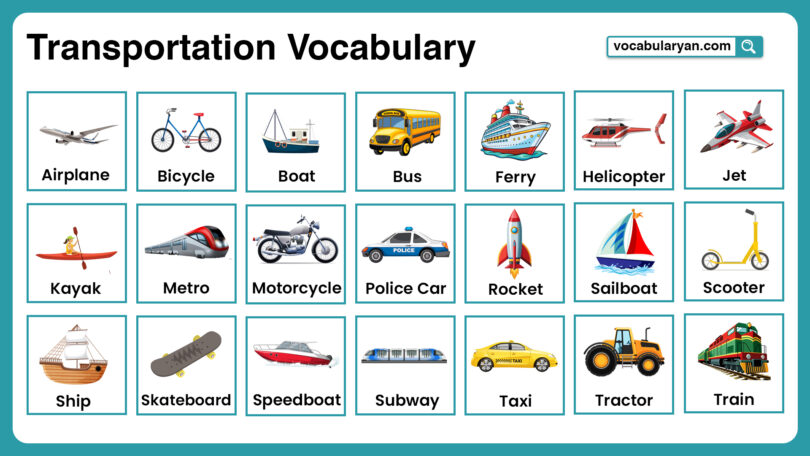
Transport moves people and goods by road, air, water, and rail, using vehicles built for a specific job: a car for a daily commute, a cargo ship for goods crossing an ocean, an ambulance for an emergency. The names below group by category, so a vehicle’s use and its typical setting stay connected.
What Counts as Transport
A vehicle counts as transport when it carries people or goods from one place to another, whether it runs on an engine, rails, water, or muscle power. This covers everyday road vehicles, public transport, aircraft, boats, trains, heavy machinery, and vehicles pulled by animals or people.
Road Transport Names
- Car: A car is a four-wheeled vehicle built to carry a small number of passengers on roads. It is the most common vehicle for daily commuting, errands, and family travel.
- Motorbike: A motorbike, also called a motorcycle, is a two-wheeled vehicle with an engine, ridden while straddling the seat. It moves through traffic more easily than a car and often costs less to run.
- Rickshaw: A rickshaw is a small, lightweight vehicle used to carry one or two passengers over short distances, traditionally pulled by a person on foot. In many cities today, the word refers to a motorized or cycle-powered version instead.
- Auto-Rickshaw: An auto-rickshaw is a three-wheeled motor vehicle with a small cabin, common for short trips in crowded city streets. It seats a driver and a few passengers behind a light canopy or frame.
- E-Rickshaw: An e-rickshaw is a battery-powered version of the auto-rickshaw, built for the same short city trips. It runs quietly and produces no exhaust while carrying passengers or light goods.
- Three-Wheeler: A three-wheeler is any small motor vehicle built on three wheels rather than four, often used as a taxi or delivery vehicle in dense urban areas. Its narrow body makes it easier to move through tight lanes and traffic.
- Taxi: A taxi is a car that carries paying passengers to a requested destination, usually marked with a sign, meter, or company logo. It can be hailed on the street, booked by phone, or ordered through an app.
- Jeep: A jeep is a rugged, boxy vehicle built for rough or uneven terrain, with high ground clearance and strong off-road capability. It is used for both daily transport and off-road travel in hilly or unpaved areas.
- Pickup Truck: A pickup truck has an enclosed cab in front and an open cargo bed at the back. It carries tools, furniture, produce, or other loads that would not fit inside a regular car.
- CNG Vehicle: A CNG vehicle runs on compressed natural gas instead of, or alongside, gasoline or diesel. Many taxis and auto-rickshaws are converted to CNG because the fuel burns cleaner and often costs less.
- Motor Scooter: A motor scooter is a small, step-through motorbike with a low seat and a floor for the rider’s feet. It works well for short city trips because of its light weight and low seat height.
Public Transport Names
- City Bus: A city bus is a large road vehicle that carries many passengers along a fixed route with regular stops. It is one of the most widely used forms of public transport in urban areas.
- Metro: The metro is an electric train system that runs mostly underground or on elevated tracks within a city. It moves large numbers of passengers quickly, avoiding street-level traffic entirely.
- Tram: A tram is a passenger vehicle that runs on rails set into city streets, sharing the road with cars and pedestrians. It stops frequently, much like a bus, but glides along a fixed track instead of steering freely.
- Subway: A subway is an underground train system used to move passengers quickly through a city without dealing with surface traffic. The word is common in American English, where other regions might say “metro” for the same system.
- Shuttle Van: A shuttle van carries a small group of passengers on a short, repeated route, such as between an airport and a parking lot or hotel. It typically holds more people than a car but far fewer than a bus.
- Shared Taxi: A shared taxi carries multiple unrelated passengers heading in a similar direction, splitting the fare between them. It is common on fixed routes in cities where full taxis are too costly for a single rider.
- Double-Decker Bus: A double-decker bus has two full levels of seating, one stacked above the other, to carry more passengers without a longer body. It is strongly associated with cities like London but is used in many places worldwide.
- Light Rail: Light rail is a rail-based passenger system that runs on tracks through a city, often at street level, carrying fewer passengers than a full subway but more than a bus. It usually runs on electricity delivered through overhead lines.
- E-Bus: An e-bus is an electric bus that runs on batteries rather than diesel or gas. It produces no tailpipe emissions and is increasingly common on city transit routes.
- Commuter Train: A commuter train carries passengers between a city center and its surrounding suburbs, usually running on a regular daily schedule. It is built for longer distances than a metro but shorter than an intercity train.
- Paratransit Van: A paratransit van provides shared, scheduled transport for passengers who need accessible seating or door-to-door pickup, often used by riders with disabilities. It typically has a ramp or lift built into the vehicle.
- Ride-Hailing Car: A ride-hailing car is a private vehicle booked through an app, such as Uber or Careem, rather than hailed on the street. The driver and route are usually shown to the passenger before the trip begins.
Passenger Vehicle Names
- Sedan: A sedan is a car with a separate trunk and a fixed roof, typically seating four to five people in two rows. It is one of the most common car body styles for daily driving.
- SUV: An SUV, short for sport utility vehicle, has a taller body, higher ground clearance, and often four-wheel drive compared to a standard car. It suits families and driving on rough or unpaved roads.
- Hatchback: A hatchback has a rear door that swings upward, giving access to a combined trunk and passenger area. Its shorter body makes it easier to park in tight city spaces.
- Coupe: A coupe is a car with two doors and a sloped, sportier roofline than a sedan. It usually seats fewer passengers, trading space for a lower, more streamlined shape.
- Convertible: A convertible has a roof that folds down or can be removed entirely, exposing the cabin to open air. Drivers choose it for open-air driving in good weather.
- Minivan: A minivan has a boxy body and sliding side doors, built to seat six to eight passengers with room for luggage. It is a common choice for families needing more space than a sedan.
- Microbus: A microbus is a small bus-like vehicle, larger than a van but smaller than a full-size bus, used for short group trips. It is common for shuttle services, school runs, and small tour groups.
- Limousine: A limousine is a long, stretched car with an enclosed passenger area, often used for formal events like weddings or airport transfers. Some models include a partition separating the driver from the passengers.
- Camper Van: A camper van is a van converted for overnight living, with a bed, small kitchen, and storage built into the cabin. It lets travelers sleep and cook without needing a separate tent or hotel.
- Tourist Coach: A tourist coach is a large, comfortable bus built for longer sightseeing trips, often with reclining seats, luggage space, and sometimes a restroom on board. It is common for group tours and long-distance travel.
- School Bus: A school bus carries students to and from school, easily recognized by its yellow color and flashing safety lights. Its route usually follows a fixed schedule of stops through a neighborhood.
- Shuttle Bus: A shuttle bus repeatedly runs a short, fixed route, similar to a shuttle van but with a larger passenger capacity. It is common between parking areas, airport terminals, or hotel complexes.
- Electric Car: An electric car runs entirely on a battery and electric motor instead of a gasoline or diesel engine. It produces no tailpipe emissions and is charged through a plug rather than filled at a fuel pump.
- Motorhome: A motorhome, also called an RV, is a self-contained vehicle built for both driving and living, with a bed, kitchen, and bathroom inside one body. It lets travelers stay overnight without towing a separate trailer.
- Van: A van is a boxy vehicle larger than a car, used to carry passengers, cargo, or a mix of both depending on how its interior is built. It is common for small business deliveries and larger family transport alike.
Cargo and Freight Transport Names
- Truck: A truck is a large road vehicle built to carry heavy goods rather than passengers. Its size and design vary widely depending on the type of cargo it carries.
- Lorry: A lorry is the British English term for a large goods truck, used the same way “truck” is used in American English. Both words describe the same category of heavy road vehicle.
- Container Truck: A container truck carries a large standardized shipping container on its trailer, the same kind used on cargo ships and trains. This lets goods move between ship, rail, and road without being unpacked.
- Flatbed Truck: A flatbed truck has an open, level cargo area with no sides or roof, suited to carrying oversized or irregularly shaped loads. Straps or chains secure the cargo in place during transport.
- Box Truck: A box truck has an enclosed rectangular cargo area built onto the chassis, protecting goods from weather during transport. It is common for moving furniture, retail deliveries, and small freight jobs.
- Dump Truck: A dump truck has a hydraulic bed that tilts upward to unload loose material such as sand, gravel, or demolition debris. It is a common sight at construction and excavation sites.
- Refrigerated Truck: A refrigerated truck carries a cooling unit built into its cargo area to keep perishable goods like food or medicine at a controlled temperature. It is essential for long-distance delivery of items that would spoil in an ordinary truck.
- Delivery Van: A delivery van carries smaller packages and goods on shorter routes, often making multiple stops in a single day. It is the vehicle most commonly associated with home package delivery.
- Cargo Van: A cargo van has an enclosed rear compartment with no side windows or seats, built purely to carry goods rather than people. Businesses use it for transporting tools, stock, or equipment.
- Freight Bike: A freight bike is a bicycle built with a large front or rear cargo area, used for short-distance deliveries in cities. It offers a lower-cost, lower-emission alternative to a delivery van for small loads.
- Pickup with Canopy: A pickup with canopy is a pickup truck fitted with a rigid cover over its cargo bed, protecting goods from weather and view. The canopy can often be locked for added security during transport.
- Articulated Truck: An articulated truck has a separate tractor unit connected to a trailer by a pivoting joint, allowing it to turn more sharply than a single rigid vehicle of the same length. It is common for long-haul freight on highways.
- Tractor-Trailer: A tractor-trailer, also known as a semi-truck, pairs a powerful front cab with a large detachable trailer. It is one of the primary vehicles used for hauling freight across long distances by road.
- Goods Carrier: A goods carrier is a general term for any truck built mainly to transport cargo rather than passengers. The term covers a wide range of sizes, from small delivery trucks to large highway haulers.
- Haul Truck: A haul truck is an extremely large, heavy-duty truck used at mining or quarry sites to move rock, ore, or soil. Its oversized tires and reinforced frame let it carry loads far beyond what a road-legal truck could handle.
Air Transport Names
- Airplane: An airplane is a powered aircraft with fixed wings, used to carry passengers or cargo through the air over long distances. It is the fastest common form of transport for both people and goods.
- Helicopter: A helicopter uses spinning overhead rotors instead of fixed wings, letting it take off, land, and hover without needing a runway. It is used for short trips, rescue missions, and reaching places planes cannot land.
- Jet: A jet is an aircraft powered by jet engines, which push it forward with high-speed exhaust rather than a spinning propeller. Most modern passenger airplanes are jets.
- Passenger Plane: A passenger plane is an airplane built specifically to carry travelers, with rows of seats, overhead storage, and space for checked luggage. It ranges in size from small regional aircraft to large long-haul jets.
- Private Jet: A private jet is a smaller aircraft owned or chartered by an individual, company, or small group rather than operated as part of a public airline. It allows more flexible scheduling and fewer passengers per flight.
- Cargo Plane: A cargo plane is built to carry freight instead of passengers, often with a wide body and a large loading door at the front or rear. It is used for shipping goods quickly across long distances.
- Drone: A drone is an unmanned aircraft controlled remotely or by onboard computer systems, without a pilot on board. It is used for photography, deliveries, inspections, and increasingly for carrying small cargo.
- Hot Air Balloon: A hot air balloon rises by heating the air inside a large fabric envelope, making it lighter than the surrounding air. It carries passengers in a basket beneath the balloon and drifts largely with the wind.
- Glider: A glider is an aircraft with no engine, kept aloft by rising air currents after being towed or launched into the sky. Pilots use it for quiet, unpowered flight rather than long-distance travel.
- Airbus: Airbus is a major manufacturer of passenger jets, and the name is often used informally to refer to one of its aircraft. Airbus planes are common on both short domestic routes and long international flights.
- Charter Plane: A charter plane is rented for a specific trip or group rather than flown on a fixed public schedule. It is common for private groups, sports teams, or business travel to less common destinations.
- Fighter Jet: A fighter jet is a fast military aircraft built for air combat, designed to carry weapons and maneuver at high speed. It differs sharply from civilian jets, which prioritize passenger comfort and fuel efficiency instead.
- Stealth Aircraft: A stealth aircraft is built with a shape and coating designed to avoid detection by radar. It is used in military operations where being seen would compromise the mission.
- Hang Glider: A hang glider is a lightweight, unpowered aircraft that a pilot flies while hanging in a harness beneath the wing. It launches by running off a slope or being towed into rising air.
Water Transport Names
- Boat: A boat is a small to medium watercraft used for travel, fishing, or recreation on rivers, lakes, or coastal waters. It is the broadest term in this category, covering many smaller vessel types.
- Ship: A ship is a large vessel built for long ocean voyages, carrying passengers, cargo, or both across open water. Its size and structure let it handle rougher seas than a boat can safely manage.
- Ferry: A ferry carries passengers, vehicles, or both across a relatively short stretch of water on a regular, scheduled route. It is common for crossing rivers, bays, or short stretches between islands.
- Yacht: A yacht is a private vessel built for leisure or racing rather than commercial cargo or passenger transport. It ranges from a modest sailboat to a large motorized vessel with cabins and crew.
- Cargo Ship: A cargo ship is built to carry goods rather than passengers, often loaded with shipping containers, bulk materials, or liquid cargo. It is the backbone of international trade, moving goods across oceans.
- Fishing Boat: A fishing boat is equipped with nets, lines, or traps for catching fish at sea or on inland waters. Its size ranges from a small one-person boat to a large commercial trawler.
- Cruise Ship: A cruise ship is a large passenger vessel built for vacation travel, with cabins, restaurants, and entertainment on board. It typically stops at several ports during a single voyage.
- Sailboat: A sailboat is propelled mainly by wind caught in one or more sails rather than an engine. It is used for both recreational sailing and competitive racing.
- Motorboat: A motorboat is powered by an engine rather than sails or oars, giving it more speed and control than a sailboat in calm conditions. It is common for both recreation and short practical trips on water.
- Speedboat: A speedboat is a small, lightweight motorboat built for high speed rather than passenger capacity or cargo space. It is common for racing, water sports, and quick trips across open water.
- Submarine: A submarine can travel both on the surface and fully underwater, using ballast tanks to control its depth. It is used for military, scientific, and exploration purposes.
- Catamaran: A catamaran has two parallel hulls connected by a deck, giving it more stability than a single-hulled boat of the same size. It is used for both sailing and motor-powered travel.
- Raft: A raft is a flat, often inflatable vessel, used for short trips, white-water travel, or emergency situations rather than long voyages. It has little to no steering or propulsion of its own beyond paddles or oars.
- Barge: A barge is a flat-bottomed vessel built to carry heavy or bulky cargo along rivers and canals, usually pushed or towed rather than self-propelled. It is common for transporting materials like coal, grain, or construction supplies.
- Jet Ski: A jet ski is a small personal watercraft ridden while sitting or standing, propelled by a jet of water rather than a propeller. It is used mainly for recreation and short bursts of high speed.
- Houseboat: A houseboat is built or converted for living aboard rather than for travel speed, often staying moored in one place for extended periods. It combines a home’s amenities with a floating hull.
- Tugboat: A tugboat is a small, powerful vessel used to push or pull larger ships that cannot maneuver well on their own, especially in harbors. Its strength comes from a compact, heavily built engine rather than its size.
- Container Ship: A container ship is a specialized cargo ship built to carry standardized shipping containers stacked in rows across its deck and hold. It is one of the primary vessels used in global trade.
- Canoe: A canoe is a narrow, lightweight boat propelled by one or more people paddling from a kneeling or seated position. It is used for calm-water travel, recreation, and short river trips.
Rail Transport Names
- Train: A train is a series of connected rail cars pulled or pushed along a fixed track, used to carry passengers, cargo, or both. It is one of the most efficient ways to move large numbers of people or heavy goods over land.
- Bullet Train: A bullet train is a high-speed passenger train capable of traveling much faster than a standard train, often exceeding 200 kilometers per hour. It is best known for services in Japan, though similar systems now run in several countries.
- Metro Train: A metro train is the rail vehicle used within a metro system, running mostly underground or on elevated tracks inside a city. It is built for frequent stops and short intervals between arrivals rather than long-distance travel.
- Freight Train: A freight train carries goods rather than passengers, often made up of many connected cars carrying containers, vehicles, coal, or other bulk cargo. It can stretch far longer than any passenger train.
- Monorail: A monorail runs on a single rail rather than the usual pair of parallel tracks, often elevated above the street. It is used in some cities and theme parks as a compact, space-saving transit option.
- Subway Train: A subway train is the rail vehicle that runs through an underground subway system, similar in function to a metro train. The term is more common in American English.
- Electric Train: An electric train draws its power from an overhead line or an electrified rail rather than burning diesel fuel onboard. It runs more quietly and produces no exhaust compared to older diesel trains.
- Steam Locomotive: A steam locomotive burns coal or wood to heat water into steam, which then drives the wheels through a piston system. It was the dominant form of rail power before diesel and electric trains replaced it.
- Passenger Train: A passenger train is built to carry travelers rather than freight, with rows of seats and, on longer routes, sleeping cars or dining cars. It ranges from short commuter services to multi-day long-distance journeys.
- Cable Car: A cable car is pulled along its track by a moving cable running beneath or beside it, rather than by its own engine. It is best known for climbing steep hills, such as in San Francisco.
- Express Train: An express train skips many or all of the smaller stops along a route to reach its destination faster than a regular train. It is used on busy routes where speed matters more than serving every station.
- Intercity Train: An intercity train connects two or more cities over a longer distance than a commuter train, usually with fewer stops along the way. It often includes more comfortable seating suited to longer journeys.
- Sky Train: A sky train is an elevated rail system that runs above street level on a raised track through a city. It avoids street traffic entirely while still serving stops throughout an urban area.
Small and Personal Transport Names
- Bicycle: A bicycle is a two-wheeled vehicle powered entirely by the rider pedaling, with no engine or motor. It is one of the most common and affordable forms of personal transport worldwide.
- Kick Scooter: A kick scooter has a narrow deck and two small wheels, moved by pushing off the ground with one foot while the other rests on the deck. It is common among children and for short adult commutes in cities.
- Skateboard: A skateboard is a flat board mounted on four small wheels, ridden while standing and pushed forward with one foot. It is used for both everyday short-distance travel and skateboarding as a sport.
- Hoverboard: A hoverboard is a self-balancing electric board with two wheels, steered by shifting body weight rather than steering with hands. Despite the name, it rolls on wheels rather than truly hovering above the ground.
- Electric Scooter: An electric scooter looks like a kick scooter but is powered by a battery and motor instead of pushing off the ground. It has become common for short trips in cities, often available to rent by the minute.
- E-Bike: An e-bike is a bicycle with a battery-powered motor that assists the rider’s pedaling, making hills and long distances easier to manage. Some models can also run on motor power alone at lower speeds.
- Segway: A Segway is a self-balancing, two-wheeled personal transporter that the rider steers by leaning forward, backward, or side to side. It is used for short trips and guided city tours.
- Mini Bike: A mini bike is a small motorized bike, lower and lighter than a standard motorbike, often ridden by younger riders or used for short recreational trips. It typically cannot reach the speeds of a full-size motorbike.
- Go-Kart: A go-kart is a small, low-to-the-ground vehicle with an open frame, built mainly for racing on closed tracks. It is used both recreationally and as an early step in motorsport training.
- Foldable Scooter: A foldable scooter is a kick scooter or electric scooter designed to fold down into a compact shape for easy carrying or storage. It suits commuters who combine scooting with public transport.
- Kids’ Tricycle: A kids’ tricycle has three wheels and pedals sized for a young child, offering more stability than a two-wheeled bicycle. It is usually a child’s first pedal-powered vehicle.
- Rollerblades: Rollerblades have a single row of wheels fixed beneath each boot, allowing faster, smoother gliding than traditional roller skates. They are used for fitness, recreation, and short-distance travel.
- Roller Skates: Roller skates have two pairs of wheels arranged side by side under each boot, offering more stability at slower speeds than rollerblades. They are common for recreational skating and rink sports.
- Wheelchair: A wheelchair is a seated mobility device with wheels, moved either by the rider’s own arms or by an electric motor. It provides mobility for people who cannot walk or walk only with difficulty.
Heavy Transport Names
- Bulldozer: A bulldozer is a heavy tractor fitted with a large blunt blade at the front, used to push soil, sand, or debris. It is common on construction sites for clearing and leveling ground.
- Excavator: An excavator has a hydraulic arm ending in a bucket, used for digging, lifting, and moving earth or rubble. Its cab can usually rotate a full circle without moving the base.
- Tractor: A tractor is a powerful vehicle built to pull or power farm equipment such as plows, trailers, and harvesting attachments. Its large rear wheels give it strong traction over soft or uneven ground.
- Cement Mixer: A cement mixer has a large rotating drum that keeps concrete moving and evenly mixed while it is transported to a construction site. The drum continues turning during the drive to stop the concrete from hardening early.
- Crane Truck: A crane truck combines a truck chassis with a mounted crane arm, letting it lift and move heavy loads without a separate stationary crane. It is common on construction sites needing mobility between jobs.
- Forklift: A forklift has two prongs at the front used to lift and carry pallets or heavy loads short distances, most often inside warehouses. Its compact size lets it maneuver in tight indoor spaces.
- Road Roller: A road roller has one or more heavy cylindrical drums that flatten and compact road surfaces, gravel, or freshly laid asphalt. It is a common sight on road construction and repair sites.
- Backhoe Loader: A backhoe loader combines a front-mounted loading bucket with a rear digging arm on one vehicle. This lets a single machine handle both loading and excavation tasks on smaller job sites.
- Grader: A grader has a long blade beneath its frame used to level and smooth soil or gravel surfaces before paving. It is commonly used to prepare roads before asphalt is laid.
- Harvester: A harvester is a large agricultural machine that cuts, gathers, and processes crops such as wheat or corn in a single pass through a field. It replaces what once took many workers with hand tools.
- Armored Vehicle: An armored vehicle has reinforced plating built to protect its occupants from gunfire or explosives. It is used by military forces, security companies, and some government agencies.
- Mining Truck: A mining truck is an oversized, heavy-duty truck built to haul rock, ore, or soil at mining or quarry sites. Its tires and frame are built far stronger than any standard road truck.
- Lowboy Trailer: A lowboy trailer has a very low deck height, letting it carry tall or oversized equipment, such as bulldozers or cranes, without exceeding road height limits. It is towed by a separate tractor unit.
Emergency Vehicle Names
- Ambulance: An ambulance transports sick or injured people to a hospital, equipped with medical supplies and space for a patient to lie down during the trip. It uses lights and sirens to move quickly through traffic in urgent situations.
- Police Car: A police car is used by law enforcement for patrol, emergency response, and transporting officers or suspects. It typically carries lights, sirens, and radio equipment built for quick coordination.
- Fire Truck: A fire truck, also called a fire engine, carries water, hoses, ladders, and equipment used to fight fires and handle other emergencies. Its size and equipment vary depending on whether it specializes in water supply, ladder rescue, or general response.
- Rescue Van: A rescue van carries specialized equipment for emergencies that fall outside routine ambulance or fire response, such as technical rescues. It is often staffed by a team trained for a specific type of hazard.
- Bomb Disposal Truck: A bomb disposal truck carries specialized tools, robots, and protective equipment used to safely handle or remove suspected explosives. It is operated by trained specialists rather than general emergency staff.
- Air Ambulance: An air ambulance is a helicopter or small airplane equipped to transport critically injured or ill patients quickly, especially over long distances or from hard-to-reach areas. It is used when ground transport would take too long to be safe.
- Patrol Bike: A patrol bike is a motorcycle used by police officers for traffic enforcement and quick movement through congested streets. Its smaller size lets it reach locations a car cannot easily access.
- Emergency SUV: An emergency SUV is a sport utility vehicle adapted for police, fire, or medical response, offering more off-road capability than a standard car. It is often used in areas with rough terrain or severe weather.
- Fire Brigade Jeep: A fire brigade jeep is a rugged, smaller emergency vehicle used to reach fires in areas a full-size fire truck cannot access, such as narrow lanes or rural terrain. It often carries basic firefighting equipment rather than a full water tank.
- Search and Rescue Boat: A search and rescue boat is built for locating and recovering people in danger on open water, rivers, or flooded areas. It is typically fast, stable, and equipped with safety and communication gear.
- Disaster Response Vehicle: A disaster response vehicle carries supplies, equipment, or personnel to areas affected by natural disasters or large-scale emergencies. It may be adapted from a truck, van, or SUV depending on the terrain it needs to cross.
Service Vehicle Names
- Garbage Truck: A garbage truck collects household and commercial waste, compacting it inside a sealed rear compartment as it moves along its route. It usually runs on a fixed weekly or daily collection schedule.
- Water Tanker: A water tanker carries a large volume of water in a sealed tank, used for supplying areas without piped water or for firefighting support. It is common in regions where regular water delivery is not available.
- Crane: A crane lifts and moves heavy materials using a long arm and cable system, either mounted on a vehicle or fixed at a construction site. It is essential wherever loads are too heavy to move by hand or forklift.
- Street Sweeper: A street sweeper uses rotating brushes and sometimes water spray to clean debris, dust, and litter from road surfaces. It is a common early-morning sight in cities before regular traffic begins.
- Tow Truck: A tow truck lifts or drags a disabled, illegally parked, or crashed vehicle onto its bed or hook for transport. It is called out for breakdowns, accidents, and parking violations alike.
- Postal Van: A postal van delivers letters and packages along a fixed daily route, typically operated by a national or regional postal service. Its compact size suits frequent stops in residential neighborhoods.
- Delivery Truck: A delivery truck carries goods from a warehouse or store to homes or businesses, often making many stops along a planned route. It ranges from small vans to mid-sized box trucks depending on the volume delivered.
- Mobile Workshop: A mobile workshop is a van or truck fitted with tools and equipment for repairs done on-site rather than in a fixed garage. It is used by technicians who travel to a customer’s location instead of the other way around.
- Road Repair Truck: A road repair truck carries the materials and tools needed to patch potholes, repaint lines, or fix damaged road surfaces. It often works alongside other heavy equipment like a road roller.
- Utility Pickup: A utility pickup is a pickup truck equipped with tool racks, compartments, or a small crane for use by tradespeople and utility workers. It combines everyday driving with on-site work capability.
- Electricity Service Truck: An electricity service truck carries the tools, cable, and often a raised bucket lift needed to repair or install power lines. Utility workers use the bucket to safely reach elevated wires and equipment.
- Snowplow: A snowplow has a large angled blade mounted on the front, used to push snow off roads and clear a path for traffic. It is essential for keeping roads usable in regions with heavy winter snowfall.
Animal-Pulled Transport Names
- Horse Cart: A horse cart is a wheeled vehicle pulled by one or more horses, traditionally used to carry people or goods before motor vehicles became common. It is still used today in some rural areas and for tourism or ceremonial events.
- Bullock Cart: A bullock cart is pulled by oxen and remains a common sight in rural farming areas, especially for moving crops or heavy goods short distances. Its wooden construction uses few parts, so repairs rarely need specialized tools.
- Donkey Cart: A donkey cart is a small cart pulled by a donkey, often used to carry modest loads over rough or hilly terrain. Donkeys are valued for this work because they are sturdy and manage difficult ground well.
- Camel Cart: A camel cart is pulled by a camel and used mainly in desert regions, where camels tolerate heat and long distances better than horses or oxen. It carries goods or passengers across sandy terrain that would challenge wheeled motor vehicles.
- Elephant Ride: An elephant ride carries passengers directly on a platform or saddle secured to an elephant’s back, traditionally used for transport or ceremony in parts of Asia. It has become more associated with tourism than everyday transport today.
- Ox Cart: An ox cart is pulled by one or more oxen and functions much like a bullock cart, common in farming communities for hauling crops, water, or building materials. Its slow, steady pace suits heavy loads over short distances.
- Reindeer Sleigh: A reindeer sleigh is pulled by reindeer across snow and ice, traditionally used by communities in Arctic and sub-Arctic regions. Its runners glide over snow rather than relying on wheels.
- Dog Sled: A dog sled is pulled by a team of trained dogs across snow, historically essential for transport and mail delivery in far northern regions. It remains in use today both for practical travel and competitive sled racing.
- Mule Carriage: A mule carriage is pulled by one or more mules, valued for their strength and endurance over difficult or steep terrain. It has traditionally served both passenger and cargo transport in mountainous regions.
Manual Transport Names
- Handcart: A handcart is a small cart pushed or pulled by hand, used to move goods short distances without any animal or engine power. It is common in markets, warehouses, and small delivery jobs.
- Pushcart: A pushcart is similar to a handcart, typically used by street vendors to carry and display goods for sale as they move through a market or street. Its light frame folds together and comes apart quickly for storage.
- Wheelbarrow: A wheelbarrow has a single wheel at the front and two handles at the back, letting one person carry and tip a load with balance rather than pure strength. It is common on construction sites and in gardening.
- Cycle Rickshaw: A cycle rickshaw is a passenger vehicle pedaled by a rider at the front, with a bench seat for one or two passengers behind. It remains common for short trips in many cities across South and Southeast Asia.
- Pedicab: A pedicab is a pedal-powered passenger vehicle similar to a cycle rickshaw, often used for short tourist or city trips in areas that restrict motor traffic. Some versions carry the driver in front and passengers in an attached side car.
- Trolley: A trolley is a small cart with wheels, pushed by hand to move light goods over short distances, such as luggage at an airport or groceries in a store. It requires no power source at all, relying entirely on being pushed by hand.
- Luggage Cart: A luggage cart is a small wheeled trolley designed to carry suitcases and bags through airports, train stations, or hotels. Passengers push it themselves rather than relying on porters.
- Bicycle Taxi: A bicycle taxi carries a passenger in a seat attached to or towed behind a bicycle, pedaled by the rider up front. It offers a low-cost, low-emission alternative to a motorized taxi for short trips.
- Fruit Vendor Cart: A fruit vendor cart is a small wheeled cart used to display and sell fruit directly on the street, moved by hand from one selling spot to another. It lets a vendor operate without a fixed shop location.
- Street Food Cart: A street food cart carries cooking equipment and ingredients for preparing and selling food directly on the street. It is common in cities worldwide as a low-cost way to start a food business.
FAQs
Q1. What is the difference between cargo and passenger vehicles?
A cargo vehicle, such as a delivery van or container truck, is built to carry goods and materials rather than people. A passenger vehicle, such as a sedan or a bus, is built with seating and comfort features designed for carrying people.
Q2. What is manual transport?
Manual transport refers to vehicles moved entirely by human effort rather than an engine or animal, such as a handcart, wheelbarrow, or cycle rickshaw. These vehicles are most common for short trips, market deliveries, and areas where motor vehicles are impractical.
Q3. Are animal-pulled vehicles still used today?
Yes. Bullock carts, horse carts, and camel carts remain common in rural and desert regions where they suit local terrain, cost, and farming needs better than motor vehicles. Some, like the horse carriage, also continue in cities for tourism or ceremonial use.
Q4. What is the difference between public and private transport?
Public transport, such as a city bus, metro, or tram, follows a fixed route and schedule and is shared by unrelated passengers. Private transport, such as a personal car or a chartered taxi, is used by one person, family, or group traveling on their own schedule.
Q5. What is the difference between a motorcycle and a motorbike?
Motorcycle and motorbike name the same two-wheeled, engine-powered vehicle; the choice between the two terms is mainly a matter of regional preference rather than a real difference in the vehicle itself.
Q6. What vehicles count as emergency vehicles?
Emergency vehicles include ambulances, fire trucks, police cars, and air ambulances, all built or equipped to respond quickly to urgent situations. Many carry lights, sirens, and specialized equipment suited to their specific emergency role.
Q7. What is heavy transport used for?
Heavy transport vehicles, such as bulldozers, excavators, and mining trucks, are built for construction, farming, and industrial work rather than everyday travel. Their size and power let them move earth, materials, or equipment far beyond what a standard vehicle could handle.

Leave a Comment