
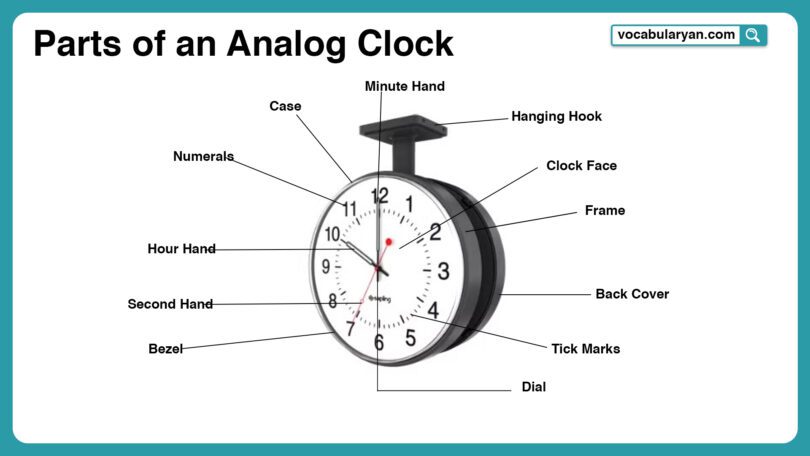
An analog clock shows time using three hands that rotate around a shared center point at different speeds, moving across a face marked with numbers and tick marks inside an outer case. The parts below cover each piece involved, from the hands you read to the small pivot that holds them all in place.
Parts of an Analog Clock
- Clock Face: also called the dial, the front surface of the clock displaying the numerals, hands, and tick marks. It is the main area a person reads to tell the time.
- Numerals: the numbers on the clock face that mark each hour. Some clocks use Roman numerals, while others use standard numbers, but either style marks the same twelve positions.
- Hour Hand: the shorter hand of the clock, pointing to the current hour. It moves slowly, completing one full trip around the face every 12 hours.
- Minute Hand: the longer hand of the clock, pointing to the current minute. It completes one full trip around the face every 60 minutes, moving noticeably faster than the hour hand.
- Second Hand: a thin, fast-moving hand that tracks seconds, completing one full rotation every 60 seconds. Some second hands sweep smoothly, while others tick forward with each passing second.
- Center Pivot: the small fixed point at the middle of the clock face where all three hands attach and rotate around. Every hand’s movement radiates from this single point, keeping them aligned as they turn at different speeds.
- Tick Marks: small lines or dots set around the edge of the clock face, marking individual minutes and seconds between the numerals. They let a reader judge the exact minute even without counting from the nearest number.
- Bezel: a rim or border surrounding the clock face, often used for protection and decoration. It holds the clock face and its covering glass or plastic in place.
- Case: also called the frame, the outer body that holds all the clock’s components together and gives the clock its overall shape and durability.
- Back Cover: a protective cover on the back of the clock, often removable to access the battery or winding mechanism. It keeps dust and damage away from the internal parts.
- Hanging Hook: a small hook or attachment at the top or back of the clock, used to hang the clock securely on a wall.
Interesting Facts About Analog Clocks
- Analog clocks have been in use for centuries, dating back to mechanical clocks from around the 13th century.
- The hour hand moves slower than the minute hand, completing one full cycle in 12 hours compared to the minute hand’s 60 minutes.
- Some clocks use Roman numerals instead of standard numbers on the face.
- The second hand on some clocks moves smoothly, while on others it ticks forward with each second.
- Most modern analog clocks use quartz technology to keep time accurately.
FAQs
Q1. What is the difference between an analog and a digital clock?
An analog clock uses moving hands and a marked face to show time, while a digital clock displays the time as numbers on a screen. Analog clocks are more traditional, while digital clocks are often quicker to read at a glance.
Q2. Why do analog clocks have three hands?
The three hands represent hours, minutes, and seconds, letting the clock measure time at three different levels of precision. The second hand allows for exact timing, while the hour and minute hands show the main time at a glance.
Q3. How do you read an analog clock?
Look at the hour hand to see the hour, the minute hand for minutes, and the second hand for counting seconds. If the hour hand sits between two numbers, the current time falls somewhere between those two hours.
Q4. What does the center pivot do?
The center pivot is the fixed point at the middle of the clock face where all three hands attach. It lets each hand rotate independently at its own speed while staying aligned to the same center.
Q5. Is a dial the same part as a clock face?
Yes. Dial and clock face both refer to the same front surface of the clock where the numerals, hands, and tick marks appear, and the two terms are used interchangeably.
Q6. What is the difference between a clock’s case and its frame?
Case and frame both refer to the same outer body that holds the clock’s components together and gives it its overall shape, so the two terms describe one part rather than two separate ones.

Leave a Comment