
Action verbs describe something a person, an animal or an object does, whether a movement, a spoken word, a thought or a physical change. This action verbs list gives 100 verbs in ten groups by meaning, each with a sample sentence, followed by an A to Z table. The groups run from movement and speech to thought, creation, sport and force, so any action verb is found by what it describes. Verbs that describe a state instead, such as be, seem and own, are not action verbs and are separated out in the comparison of action, linking and stative verbs.
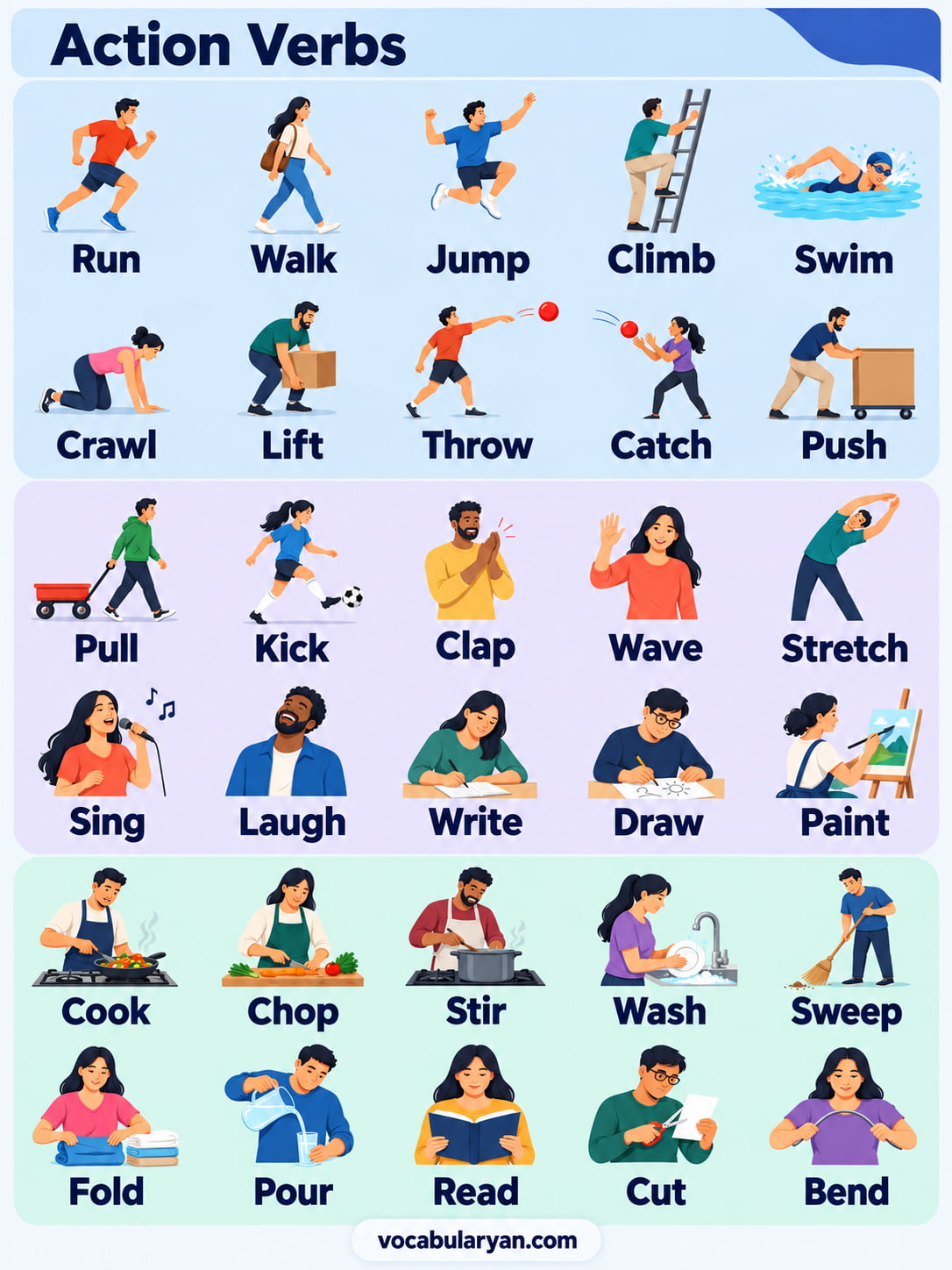
Action Verbs List: 100 Verbs by Meaning
The action verbs list has ten groups of ten verbs. Each group has its own table, and every verb appears in one group only.
Motion Verbs
Ten verbs describe the body moving from one place to another.
| Action verb | Sample sentence |
|---|---|
| Run | She runs along the river every morning. |
| Walk | They walked to the station. |
| Jump | The child jumped over the puddle. |
| Climb | We climbed the hill before sunset. |
| Swim | He swims forty laps each day. |
| Crawl | The baby crawled across the floor. |
| Leap | The deer leaped over the fence. |
| March | The band marched down the street. |
| Slide | The boy slid down the bank. |
| Hurry | She hurried to the platform. |
Hand and Body Verbs
Ten verbs describe actions made with the hands, arms, legs or whole body.
| Action verb | Sample sentence |
|---|---|
| Grab | He grabbed the rope. |
| Lift | She lifted the box onto the shelf. |
| Throw | The pitcher threw a fastball. |
| Catch | He caught the ball with one hand. |
| Push | They pushed the car to the roadside. |
| Pull | She pulled the door shut. |
| Kick | He kicked the ball into the net. |
| Clap | The audience clapped for a full minute. |
| Wave | The captain waved to the crowd. |
| Stretch | The runner stretched her legs. |
Speech and Sound Verbs
Ten verbs describe voice, conversation and sound.
| Action verb | Sample sentence |
|---|---|
| Speak | The mayor spoke at the opening. |
| Shout | The coach shouted across the field. |
| Whisper | She whispered the answer to him. |
| Announce | The school announced the results. |
| Explain | The teacher explained the rule. |
| Argue | The two lawyers argued for an hour. |
| Ask | He asked for directions. |
| Answer | She answered every question. |
| Sing | The choir sang in the hall. |
| Laugh | They laughed at the joke. |
Thinking Verbs
Ten mental action verbs describe a process in the mind that has a start and an end.
| Action verb | Sample sentence |
|---|---|
| Think | She thought about the offer overnight. |
| Decide | He decided to move abroad. |
| Plan | The team planned the launch. |
| Imagine | The child imagined a castle. |
| Calculate | The engineer calculated the load. |
| Analyze | Researchers analyzed the survey data. |
| Estimate | The agent estimated the repair cost. |
| Solve | She solved the puzzle in ten minutes. |
| Compare | He compared the two contracts. |
| Evaluate | The panel evaluated each proposal. |
Creation Verbs
Ten verbs describe making something that did not exist before.
| Action verb | Sample sentence |
|---|---|
| Build | The crew built a bridge. |
| Create | She created a new logo. |
| Design | He designed the poster. |
| Write | The author wrote three novels. |
| Draw | The student drew a map. |
| Paint | They painted the fence white. |
| Bake | She baked bread at dawn. |
| Sew | He sewed a button on the coat. |
| Compose | The musician composed a sonata. |
| Invent | The engineer invented a faster valve. |
Household and Cooking Verbs
Ten verbs describe daily work in the kitchen and around the house.
| Action verb | Sample sentence |
|---|---|
| Cook | He cooks dinner every evening. |
| Chop | She chopped the onions. |
| Stir | He stirred the soup. |
| Boil | They boiled the water. |
| Wash | She washed the dishes. |
| Sweep | He swept the porch. |
| Scrub | She scrubbed the floor. |
| Fold | He folded the towels. |
| Iron | She ironed the shirt. |
| Pour | He poured the tea. |
Sports Verbs
Ten verbs describe play in team and individual sports.
| Action verb | Sample sentence |
|---|---|
| Serve | She served an ace. |
| Dribble | He dribbled past two defenders. |
| Tackle | The defender tackled the striker. |
| Pitch | The rookie pitched six innings. |
| Sprint | The runner sprinted to the line. |
| Score | The striker scored twice. |
| Shoot | She shot from the corner. |
| Defend | The team defended its lead. |
| Race | The cyclists raced up the mountain. |
| Bowl | He bowled a perfect over. |
Perception Verbs
Ten verbs describe directed use of the eyes and ears.
| Action verb | Sample sentence |
|---|---|
| Watch | They watched the match. |
| Listen | She listened to the radio. |
| Stare | He stared at the screen. |
| Glance | She glanced at the clock. |
| Observe | Scientists observed the comet. |
| Search | The police searched the house. |
| Inspect | He inspected the engine. |
| Examine | The doctor examined the wound. |
| Peek | The child peeked through the curtain. |
| Scan | She scanned the document. |
Giving and Taking Verbs
Ten verbs describe objects and money passing between people.
| Action verb | Sample sentence |
|---|---|
| Give | She gave him a book. |
| Take | He took the bus. |
| Buy | They bought a house. |
| Sell | The shop sells tools. |
| Borrow | I borrowed a pen. |
| Lend | She lent him her car. |
| Send | He sent a letter. |
| Receive | We received your message. |
| Trade | The two clubs traded players. |
| Share | They shared the cost. |
Change-of-State Verbs
Ten verbs describe force acting on an object and changing its shape or state.
| Action verb | Sample sentence |
|---|---|
| Break | He broke the window. |
| Burn | The fire burned the roof. |
| Melt | The sun melted the snow. |
| Freeze | The cold froze the lake. |
| Cut | She cut the rope. |
| Tear | He tore the page. |
| Crush | The machine crushes the rock. |
| Bend | She bent the wire. |
| Shatter | The glass shattered on the floor. |
| Open | He opened the gate. |
Action Verbs A to Z
The A to Z version of the action verbs list puts the 100 verbs from the groups in alphabetical order and adds 11 more so that every letter except X has an action verb. S holds the most, and no common action verb begins with X.
| Letter | Action verbs |
|---|---|
| A | Analyze, Announce, Answer, Argue, Ask |
| B | Bake, Bend, Boil, Borrow, Bowl, Break, Build, Burn, Buy |
| C | Calculate, Catch, Chop, Clap, Climb, Compare, Compose, Cook, Crawl, Create, Crush, Cut |
| D | Decide, Defend, Design, Draw, Dribble |
| E | Estimate, Evaluate, Examine, Explain |
| F | Fly, Fold, Freeze |
| G | Give, Glance, Grab |
| H | Hit, Hurry |
| I | Imagine, Inspect, Invent, Iron |
| J | Juggle, Jump |
| K | Kick, Knock |
| L | Laugh, Leap, Lend, Lift, Listen |
| M | March, Melt, Mix |
| N | Nod |
| O | Observe, Open |
| P | Paint, Peek, Pitch, Plan, Pour, Pull, Push |
| Q | Question |
| R | Race, Receive, Run |
| S | Scan, Score, Scrub, Search, Sell, Send, Serve, Sew, Share, Shatter, Shoot, Shout, Sing, Slide, Solve, Speak, Sprint, Stare, Stir, Stretch, Sweep, Swim |
| T | Tackle, Take, Tear, Think, Throw, Trade |
| U | Unlock |
| V | Visit |
| W | Walk, Wash, Watch, Wave, Whisper, Write |
| Y | Yell |
| Z | Zip |
Transitive and Intransitive Verbs
A transitive action verb takes an object, and an intransitive action verb does not. Some verbs in the action verbs list work both ways, so the sentence decides the type.
| Action verb | As a transitive verb | As an intransitive verb |
|---|---|---|
| Write | She wrote a letter. | She writes every morning. |
| Eat | He ate an apple. | They are eating. |
| Open | He opened the door. | The door opened. |
| Break | She broke the cup. | The cup broke. |
| Run | He runs a shop. | He runs fast. |
| Read | I read the report. | I read at night. |
| Burn | The fire burned the roof. | The roof burned. |
| Sing | She sang a ballad. | She sang beautifully. |
Physical and Mental Action Verbs
Action verbs fall into physical and mental types, with communication, perception and exchange as three further kinds of activity. The ten groups in this action verbs list map onto these types.
| Type | What it describes | Sample verbs |
|---|---|---|
| Physical | A movement or a physical act | Run, lift, cook, tackle, break |
| Mental | A process in the mind | Decide, plan, calculate, evaluate |
| Communication | A spoken or written act | Explain, whisper, write, announce |
| Perception | Directed use of the senses | Watch, listen, inspect, scan |
| Exchange | A transfer between people | Give, sell, lend, share |
Tense Forms of Regular and Irregular Verbs
Every verb in the action verbs list takes the same tense forms as any other verb. Regular verbs such as walk add -ed in the past and -ing in the progressive, while irregular verbs such as write change form.
| Tense | Regular verb: walk | Irregular verb: write |
|---|---|---|
| Present simple | She walks to work. | She writes daily. |
| Past simple | She walked to work. | She wrote a report. |
| Future simple | She will walk to work. | She will write a report. |
| Present progressive | She is walking to work. | She is writing a report. |
| Present perfect | She has walked to work. | She has written a report. |
| Past perfect | She had walked to work. | She had written a report. |
Action Verbs vs Linking and Stative Verbs
Test for an action verb. A verb is an action verb when it answers the question what the subject does. Linking verbs, stative verbs and helping verbs fail that test, so they sit outside the action verbs list.
| Verb type | What it describes | Sample sentence |
|---|---|---|
| Action | Something the subject does | The chef stirred the sauce. |
| Linking | A state or change that joins the subject to a describing word | The sauce tastes salty. |
| Stative | A condition that exists and rejects the progressive | She owns two cars. |
| Helping | A verb that supports another verb | She is stirring the sauce. |
FAQs
Q1. What are action verbs?
Action verbs are verbs that describe something a subject does, such as a movement, a spoken word, a thought or a physical change. Run, decide and build are action verbs, while be, seem and own are not.
Q2. How many action verbs are there?
No official count exists, because most English verbs describe an action. This action verbs list gives 100 verbs in ten groups by meaning, and the List Of Verbs covers 500 verbs with all three forms.
Q3. Do all action verbs take an object?
No, only transitive action verbs take an object, as in she wrote a letter. Intransitive action verbs take none, as in she arrived late, and verbs such as write, open and break work both ways.
Q4. Is taste an action verb or a linking verb?
Taste is both, and the sentence decides. It is an action verb in he tasted the soup and a linking verb in the soup tastes salty. Look, grow and turn split the same way.
Q5. Do action verbs end in -ing or -ed?
Action verbs take -ing in the progressive and -ed in the regular past, as in walking and walked. Irregular verbs such as write change form instead and give wrote and written. The base form carries the meaning in every case.
Q6. Do all verbs show action?
No, linking verbs, stative verbs and helping verbs do not show action. Is, seem, know and own describe a state or support another verb.
You May Also Like

Leave a Comment