
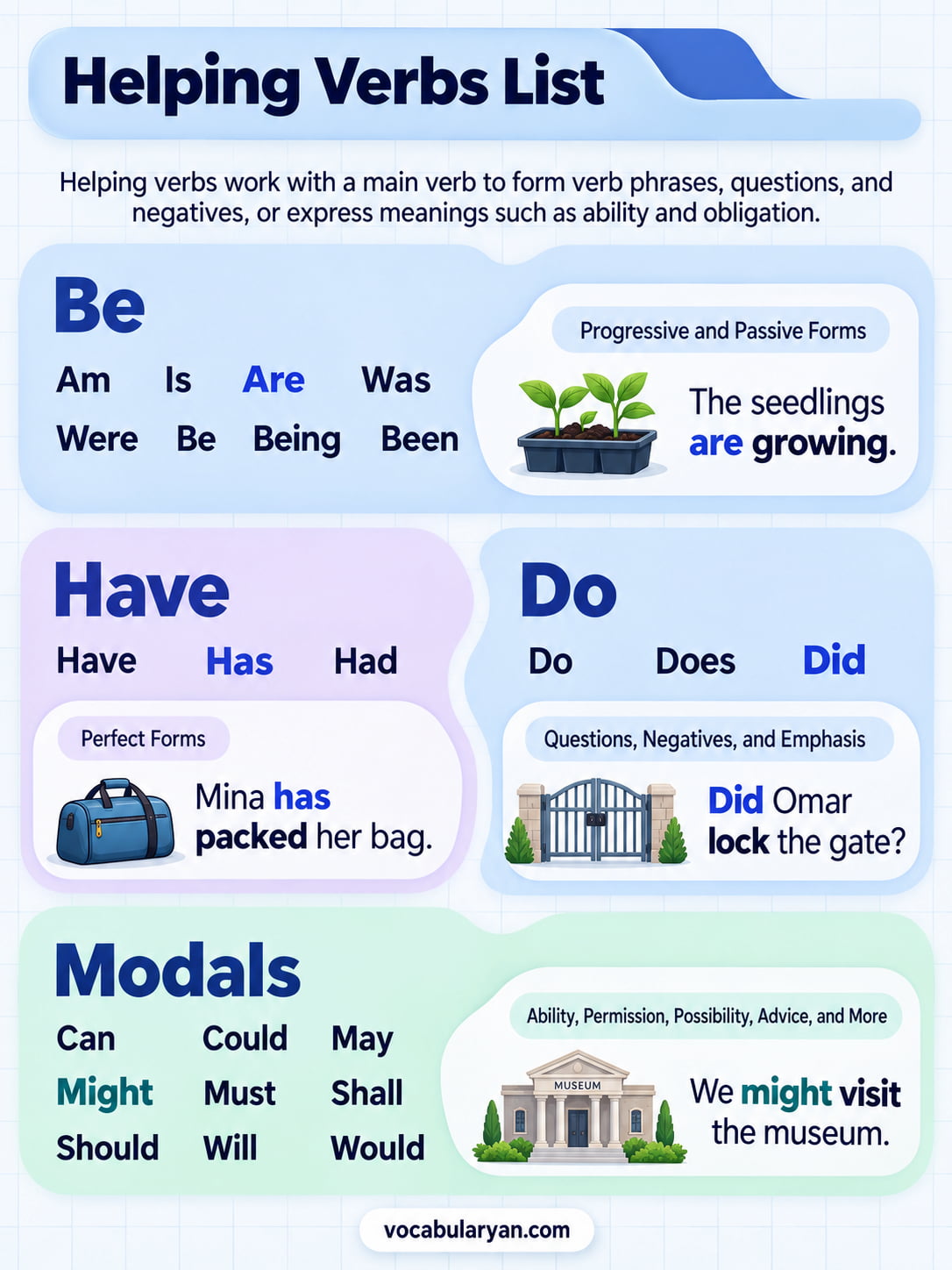
English has 23 helping verbs: eight forms of be, three forms of have, three forms of do and nine modals. A helping verb, also called an auxiliary verb, combines with a main verb to form a tense, a question, a negative or a passive, as in she has finished and the letter was sent. Modals express ability, permission, possibility, advice and obligation, so they change the meaning of the main verb instead of its tense. Other sources count 24 or 25 because they add having or marginal verbs such as ought to, so every helping verbs list depends on how the verbs are counted.
Helping Verbs List: All 23 Helping Verbs
The complete list of helping verbs has 23 verbs in four groups: be, have, do and the modals. Each verb is given with its group, what it forms and a sample sentence.
| Helping verb | Group | What it forms | Sample sentence |
|---|---|---|---|
| Am | Be | Present progressive | I am studying. |
| Are | Be | Present progressive | They are waiting. |
| Be | Be | Future progressive and passive after a modal | The door must be locked. |
| Been | Be | Perfect progressive and perfect passive | She has been working. |
| Being | Be | Progressive passive | The room is being cleaned. |
| Can | Modal | Ability or permission | She can swim. |
| Could | Modal | Past ability or polite request | He could read at four. |
| Did | Do | Past questions and negatives | She did not call. |
| Do | Do | Present questions, negatives and emphasis | Do you know her? |
| Does | Do | Present questions and negatives with he, she, it | Does he live here? |
| Had | Have | Past perfect | They had left before noon. |
| Has | Have | Present perfect with he, she, it | He has arrived. |
| Have | Have | Present perfect with I, you, we, they | We have finished. |
| Is | Be | Present progressive and present passive | She is cooking. |
| May | Modal | Permission or possibility | You may enter. |
| Might | Modal | Uncertain possibility | It might rain tonight. |
| Must | Modal | Obligation or strong conclusion | You must wear a helmet. |
| Shall | Modal | Offer or suggestion with I or we | Shall we begin? |
| Should | Modal | Advice | You should rest. |
| Was | Be | Past progressive and past passive | He was sleeping. |
| Were | Be | Past progressive and past passive | We were leaving. |
| Will | Modal | Future or decision | I will call you tonight. |
| Would | Modal | Polite request or past habit | He would visit every summer. |
List of Primary Helping Verbs: Be, Do and Have
The primary helping verbs are be, do and have, and each also works as a main verb. Between them they cover 14 of the 23 helping verbs.
Forms of Be
Be has eight forms, and the form changes with the subject and the tense.
| Form | Used with | Sample sentence |
|---|---|---|
| Am | I, present | I am ready. |
| Is | He, she, it, present | She is working. |
| Are | You, we, they, present | They are leaving. |
| Was | I, he, she, it, past | He was waiting. |
| Were | You, we, they, past | We were tired. |
| Be | Base form, after a modal or to | They will be late. |
| Being | Present participle | The bridge is being repaired. |
| Been | Past participle | It has been a long day. |
Forms of Do
Do has three helping forms. The forms doing and done work only as main verbs.
| Form | Used with | Sample sentence |
|---|---|---|
| Do | I, you, we, they, present | Do they live nearby? |
| Does | He, she, it, present | Does she work here? |
| Did | All subjects, past | Did you see it? |
Forms of Have
Have has three helping forms. A fourth form, having, is counted as a helping verb by some sources and gives the total of 24.
| Form | Used with | Sample sentence |
|---|---|---|
| Have | I, you, we, they, present | I have seen it. |
| Has | He, she, it, present | She has left. |
| Had | All subjects, past | They had finished. |
| Having | Present participle | Having finished, she went home. |
Modal Verbs List
English has nine central modal verbs, and each takes the base form of the next verb with no to and no -s ending.
| Modal | Meaning expressed | Sample sentence |
|---|---|---|
| Can | Ability or permission | She can swim. |
| Could | Past ability or polite request | Could you open the window? |
| May | Permission or possibility | You may leave early. |
| Might | Uncertain possibility | It might rain tonight. |
| Shall | Offer or suggestion with I or we | Shall we begin? |
| Should | Advice | You should rest. |
| Will | Future or decision | I will call you tomorrow. |
| Would | Polite request or past habit | He would walk to school every day. |
| Must | Obligation or strong conclusion | You must wear a seatbelt. |
Semi-modals express similar meanings and take the forms of ordinary verbs. Some sources count ought to among the modals, which is one reason the totals differ.
| Semi-modal | Meaning expressed | Sample sentence |
|---|---|---|
| Have to | Obligation | She has to leave early. |
| Ought to | Advice | You ought to call him. |
| Need to | Necessity | We need to hurry. |
| Be able to | Ability | He is able to lift it. |
| Used to | Past habit or past state | They used to live here. |
| Had better | Strong advice | You had better hurry. |
Auxiliary Verbs List: Are They the Same as Helping Verbs?
Yes, auxiliary verb and helping verb are two names for the same set of verbs, so the auxiliary verbs list matches the helping verbs list verb for verb. Auxiliary is the term used in linguistics, and helping is the term used in school grammar.
| Term | What it covers |
|---|---|
| Helping verb | The 23 verbs: forms of be, have and do plus nine modals |
| Auxiliary verb | The same 23 verbs |
| Primary auxiliary | Be, do and have |
| Modal auxiliary | The nine central modals |
| Marginal auxiliary | Ought to, need, dare and used to |
How Many Helping Verbs Are There?
A helping verbs list reaches 23 verbs when every form of be, have and do counts once and the modals are limited to the nine central ones. Other totals come from counting the same verbs in different ways.
| Total | What the count includes |
|---|---|
| 12 | Be, have and do counted once each, plus the nine modals |
| 23 | Eight forms of be, three of have, three of do and nine modals |
| 24 | The 23 verbs plus having |
| 28 | The 24 verbs plus marginal forms such as ought to, going to, will be and will have |
Main Verbs, Helping Verbs and Linking Verbs
A verb is a helping verb when another verb follows it in the same verb phrase. It is a main verb when an object follows it, and a linking verb when a describing word or a noun that renames the subject follows it.
| Verb | As a helping verb | As a main verb | As a linking verb |
|---|---|---|---|
| Is | She is working. | Not used | She is tired. |
| Was | He was sleeping. | Not used | He was late. |
| Have | She has finished. | She has a car. | Not used |
| Do | She does not smoke. | She does her homework. | Not used |
| Did | Did you call? | She did the dishes. | Not used |
Helping Verbs List by First Letter
The 23 helping verbs start with nine letters, and W holds the most with four.
| Letter | Helping verbs |
|---|---|
| A | Am, are |
| B | Be, been, being |
| C | Can, could |
| D | Did, do, does |
| H | Had, has, have |
| I | Is |
| M | May, might, must |
| S | Shall, should |
| W | Was, were, will, would |
Helping Verbs List by Tense
Each tense takes its own helping verbs, and the same helping verbs repeat across the progressive, perfect and passive forms.
| Tense | Helping verbs | Sample sentence |
|---|---|---|
| Present simple (questions and negatives) | Do, does | Does she work here? |
| Past simple (questions and negatives) | Did | Did she work here? |
| Present progressive | Am, is, are | They are waiting outside. |
| Past progressive | Was, were | We were leaving at noon. |
| Future simple | Will | I will call you tonight. |
| Present perfect | Have, has | She has finished the report. |
| Past perfect | Had | They had left before the storm. |
| Future perfect | Will have | He will have arrived by noon. |
| Present perfect progressive | Have been, has been | It has been raining all day. |
| Past perfect progressive | Had been | She had been waiting for an hour. |
| Passive | Am, is, are, was, were, been, being | The letter was sent yesterday. |
FAQs
Q1. How many helping verbs are there?
There are 23 helping verbs: eight forms of be, three forms of have, three forms of do and nine modals. Some lists count 24 by adding having, and longer lists add marginal forms such as ought to.
Q2. Are auxiliary verbs the same as helping verbs?
Yes, auxiliary verb and helping verb name the same set of verbs. Auxiliary is the term used in linguistics, and helping is the term used in school grammar.
Q3. Are helping verbs and linking verbs the same?
No, a helping verb is followed by another verb, while a linking verb joins the subject to a word that describes or renames it. The forms of be work as both, as is does in she is working (helping) and she is tired (linking).
Q4. Can helping verbs be main verbs?
Yes, be, have and do work as main verbs when no other verb follows them. She has a car and she did the dishes use has and did as main verbs, while the modals work as helping verbs in standard use.
Q5. Where do helping verbs go in a sentence?
A helping verb comes before the main verb, as in she has finished. In a question it moves before the subject (has she finished?), and in a negative not follows it (she has not finished).
Q6. Is was a helping verb or a linking verb?
Was is a helping verb when a verb follows it, as in he was sleeping. It is a linking verb when it joins the subject to a describing word, as in he was late.
You May Also Like

Leave a Comment