
Linking verbs join the subject of a sentence to a word that describes or renames it. In the soup tastes salty, the verb tastes connects soup to salty, and no one is tasting anything. This linking verbs list has 20 verbs: be in all its forms, plus become, seem, appear, remain, stay, keep, get, grow, turn, go, come, fall, run, look, feel, smell, sound, taste and prove. Each verb is grouped by meaning and shown in a sentence, so any verb is checked against the list in seconds.
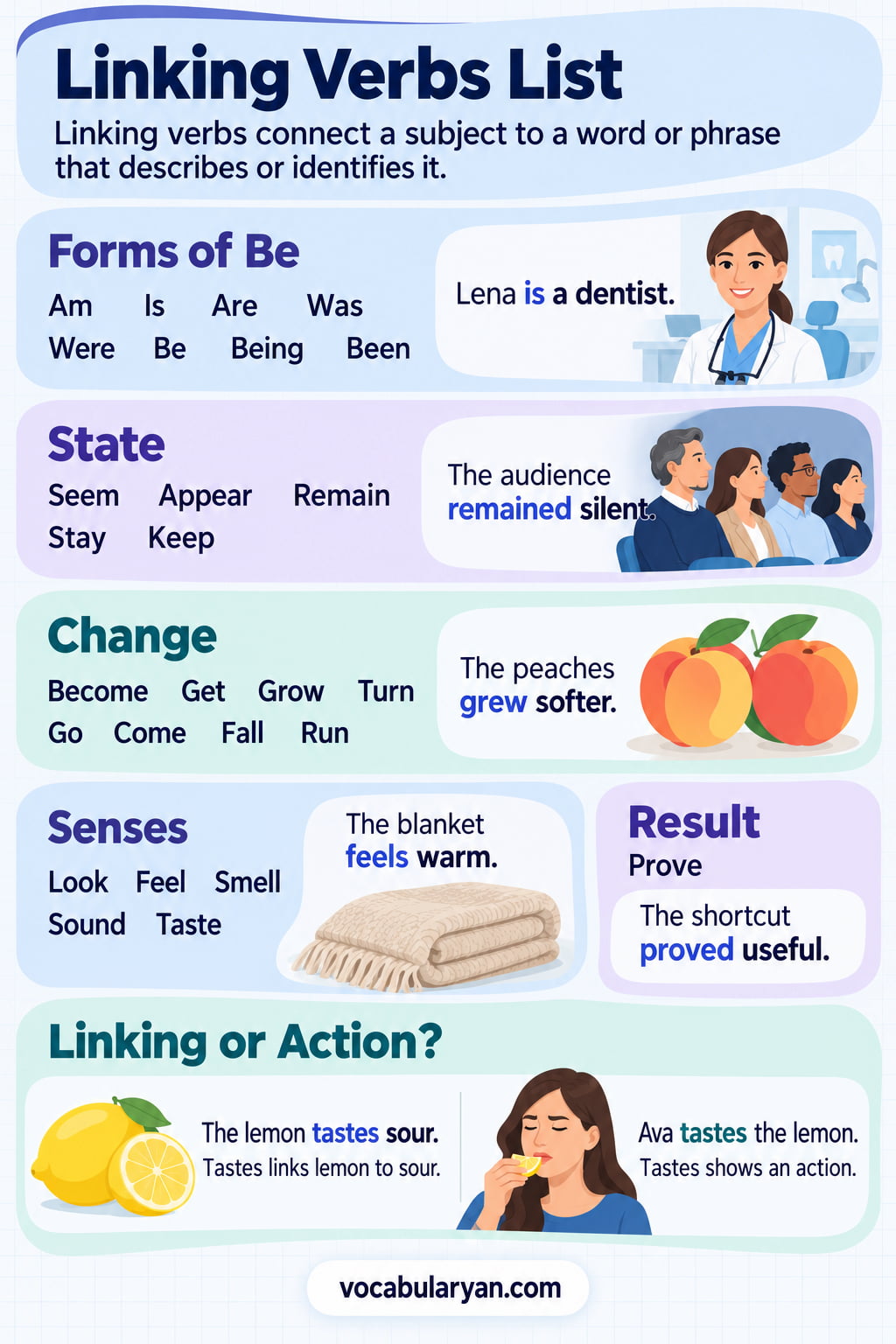
Linking Verbs List: 20 Verbs Grouped by Meaning
The list of linking verbs has five groups: the forms of be, verbs of state, verbs of change, verbs of sense and prove. Every group has its own table.
Forms of Be
Be is the most frequent linking verb and has eight forms. The form changes with the subject and the tense.
| Form | Used with | Sample sentence |
|---|---|---|
| Am | I, present | I am a nurse. |
| Is | He, she, it, present | The test is ready. |
| Are | You, we, they, present | They are neighbors. |
| Was | I, he, she, it, past | She was upset. |
| Were | You, we, they, past | We were late. |
| Be | Base form, after a modal or to | He will be a father in May. |
| Being | Present participle | Being a teacher, she knows the syllabus. |
| Been | Past participle | It has been cold all week. |
Linking Verbs of State
Five verbs describe the condition of the subject, either as it appears or as it stays unchanged.
| Verb | Meaning | Sample sentence |
|---|---|---|
| Seem | Gives an impression | He seems nervous. |
| Appear | Gives an impression | The road appears empty. |
| Remain | Stays in the same state | She remained silent. |
| Stay | Stays in the same state | The children stayed quiet. |
| Keep | Holds a state in place | Keep calm during the drill. |
Linking Verbs of Change
Eight verbs describe a subject that moves from one state to another. Become is the most frequent, and get is the most informal.
| Verb | Meaning | Sample sentence |
|---|---|---|
| Become | Changes into a new state or role | She became a teacher. |
| Get | Changes state in everyday speech | He got angry. |
| Grow | Changes gradually | The days grew shorter. |
| Turn | Changes color or condition | The leaves turned red. |
| Go | Changes to a worse state | The milk went sour. |
| Come | Changes state in fixed phrases | The dream came true. |
| Fall | Changes state suddenly | He fell ill. |
| Run | Changes state in fixed phrases | The well ran dry. |
Linking Verbs of Sense
Five verbs describe what the subject looks, feels, smells, sounds or tastes like.
| Verb | Sense | Sample sentence |
|---|---|---|
| Look | Sight | She looks tired. |
| Feel | Touch or emotion | The fabric feels soft. |
| Smell | Smell | The soup smells rich. |
| Sound | Hearing or impression | That plan sounds reasonable. |
| Taste | Taste | The tea tastes bitter. |
Prove and Related Phrasal Verbs
Prove is the one linking verb that reports an outcome. Two phrasal verbs, turn out and end up, work the same way.
| Verb | Meaning | Sample sentence |
|---|---|---|
| Prove | Shows a result over time | The plan proved effective. |
| Turn out | Ends with a result | The trip turned out well. |
| End up | Ends in a final state | He ended up angry. |
Linking Verb or Action Verb in the Linking Verbs List?
A verb is a linking verb when a form of be replaces it without changing the meaning. She looks tired becomes she is tired, so looks is linking. She looks at the map becomes she is at the map, which changes the meaning, so looks is an action verb there.
| Verb | As a linking verb | As an action verb |
|---|---|---|
| Look | She looks tired. | She looks at the map. |
| Feel | The fabric feels soft. | He felt the wall for a switch. |
| Smell | The soup smells rich. | She smelled the milk. |
| Taste | The sauce tastes sweet. | He tasted the sauce. |
| Sound | The idea sounds good. | The guard sounded the alarm. |
| Grow | The days grow short. | She grows tomatoes. |
| Turn | The leaves turned red. | He turned the key. |
| Get | He got nervous. | He got a letter. |
| Stay | The children stayed quiet. | She stayed at a hotel. |
| Appear | He appears tired. | A face appeared at the window. |
| Prove | The claim proved false. | The lawyer proved the claim. |
| Keep | Keep calm. | She keeps a diary. |
What Follows a Linking Verb?
A linking verb is followed by a subject complement, which is a word or phrase that describes or renames the subject. Three kinds of complement follow the verbs in this linking verbs list.
| Complement | What it does | Sample sentence |
|---|---|---|
| Adjective | Describes the subject | The tea tastes bitter. |
| Noun or noun phrase | Renames the subject | My brother became an engineer. |
| Adverb of place | Locates the subject | The keys are here. |
How Many Linking Verbs Are There?
The linking verbs list here totals 20 verbs, and published lists range from 16 to about 40 because each one draws the line differently.
| Count | What the count covers |
|---|---|
| 1 | Be, counted as a single verb |
| 8 | Every form of be: am, is, are, was, were, be, being, been |
| 16 to 19 | Short school lists built on be, become, seem, appear, remain, stay, grow, turn, get, prove and the five sense verbs, extended by one to four of keep, go, come, fall and run |
| 20 | This list: be plus 19 other verbs |
| 27 | Every form: the eight forms of be plus the 19 other verbs |
| About 40 | Extended lists that add less frequent verbs of change and state |
Linking Verbs and Helping Verbs
The forms of be work as linking verbs and as helping verbs. The word after the verb decides the role: a describing word or a noun makes it linking, and another verb makes it helping.
| Sentence | Word after the verb | Role of the verb |
|---|---|---|
| She is tired. | Adjective | Linking |
| She is sleeping. | Verb | Helping |
| He was a pilot. | Noun | Linking |
| He was promoted. | Verb | Helping |
Linking Verbs List by First Letter
The 27 forms start with 13 letters, and B and S hold the most with four each.
| Letter | Linking verbs |
|---|---|
| A | Am, appear, are |
| B | Be, been, being, become |
| C | Come |
| F | Fall, feel |
| G | Get, go, grow |
| I | Is |
| K | Keep |
| L | Look |
| P | Prove |
| R | Remain, run |
| S | Seem, smell, sound, stay |
| T | Taste, turn |
| W | Was, were |
FAQs
Q1. How many linking verbs are there?
This list has 20 linking verbs: be plus 19 other verbs. Short school lists count 16 to 19, and every form of be raises the total to 27.
Q2. Are linking verbs action verbs?
No, a linking verb describes a state and an action verb describes an activity. Verbs such as look, taste, grow and turn belong to both groups, and the sentence decides which role applies.
Q3. Why are they called linking verbs?
They are called linking verbs because they link the subject to a word that describes or renames it. In the sky turned grey, turned links sky to grey.
Q4. Is was a linking verb or an action verb?
Was is never an action verb. It is a linking verb when it joins the subject to a describing word or a noun, as in he was late, and a helping verb when a verb follows, as in he was sleeping.
Q5. Does a linking verb work as a helping verb?
Yes, but only the forms of be do both. Verbs such as seem, become and taste are linking verbs or action verbs and never helping verbs.
Q6. What follows a linking verb?
A subject complement follows a linking verb. It is an adjective, a noun or an adverb of place, as in she seems happy, he became a doctor and the keys are here.
You May Also Like

Leave a Comment