
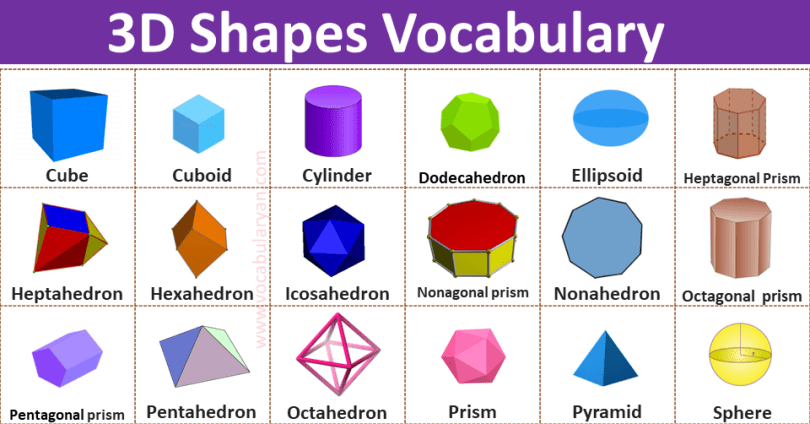
3D shapes are solid objects with three dimensions: length, width, and height. Unlike flat 2D shapes drawn on paper, 3D shapes take up space in the real world, from the round form of a beach ball to the boxy form of a shipping container. Every 3D shape name in English falls under one of six main families based on how the shape is built and what its faces look like.
The 6 main categories of 3D shape names in English are the main 3D shapes (cube, cuboid, sphere, cylinder, cone, pyramid), prisms, pyramid types, Platonic solids, curved shapes, and advanced shapes. Each category has its own defining structure: prisms have two identical end faces, pyramids narrow to a single point, Platonic solids have equal regular polygon faces, and curved shapes have no straight edges at all.
Common 3D Shape Names With Pictures
Each category is defined by how the shape is built. Main 3D shapes, prisms, and pyramids are three of the most-taught families in school geometry. The other three are Platonic solids, curved 3D shapes, and advanced 3D shapes.
Main 3D Shape Names in English
Main 3D shape names are the foundation of every geometry lesson, describing the 6 solid forms most-used in everyday objects and math.
Cube
solid 3D shape with 6 equal square faces, 12 edges of equal length, and 8 vertices at right angles. Cubes are found in dice, ice cubes, gift boxes, and Rubik’s Cubes, and are one of the 5 Platonic solids (also called a regular hexahedron in mathematics).
Cuboid
solid 3D shape with 6 rectangular faces (opposite faces equal, adjacent faces different in size), 12 edges, and 8 vertices. Cuboids are found in bricks, books, cereal boxes, and shipping containers, and every cuboid has three pairs of matching opposite faces.
Sphere
perfectly round 3D shape with a single curved surface, no edges, and no vertices. Spheres are found in balls, planets, oranges, marbles, and soap bubbles, and every point on a sphere’s surface is exactly the same distance from the center point.
Cylinder
3D shape with 2 flat circular faces on top and bottom, joined by a single curved surface. Cylinders have 2 edges and no vertices, are found in tins, batteries, water bottles, and rolling pins, and roll only sideways, never lengthwise.
Cone
3D shape with 1 flat circular base that narrows smoothly to a single point at the top. Cones have 1 curved surface, 1 edge, and 1 vertex (the pointed tip), and are found in ice cream cones, traffic cones, party hats, and megaphones.
Pyramid
3D shape with a polygon base and triangular faces meeting at a single point (the apex) at the top. Pyramids are named after the shape of their base (square pyramid, triangular pyramid), and the ancient Egyptian pyramids of Giza are the most famous square pyramids in history.
Prism Names in English
Prism names describe 3D shapes with two identical parallel end faces joined by rectangular sides, named after the shape of the end face.
Triangular Prism
3D shape with 2 identical triangular faces at each end, joined by 3 rectangular faces. Triangular prisms have 5 faces total, 9 edges, and 6 vertices, and are found in Toblerone chocolate bars, roof frames, and glass prisms that separate white light into a rainbow.
Rectangular Prism
3D shape with 6 rectangular faces (the same as a cuboid), 12 edges, and 8 vertices. Rectangular prisms are found in bricks, books, drawers, and every rectangular box, and are technically the same shape as a cuboid.
Pentagonal Prism
3D shape with 2 identical pentagon (5-sided) faces at each end, joined by 5 rectangular faces. Pentagonal prisms have 7 faces total, 15 edges, and 10 vertices, and are found in some pencil shafts and architectural details.
Hexagonal Prism
3D shape with 2 identical hexagon (6-sided) faces at each end, joined by 6 rectangular faces. Hexagonal prisms have 8 faces total, 18 edges, and 12 vertices, and are found in unsharpened pencils, honeycomb cells, and nut-and-bolt heads.
Octagonal Prism
3D shape with 2 identical octagon (8-sided) faces at each end, joined by 8 rectangular faces. Octagonal prisms have 10 faces total, 24 edges, and 16 vertices, and are found in some pencils, drum sticks, and octagonal Japanese gazebos.
Pyramid Type Names in English
Pyramid type names describe pyramids based on the shape of their polygon base, with names like triangular, square, pentagonal, and hexagonal pyramid.
Triangular Pyramid
pyramid with a triangular base and 3 triangular sides meeting at the apex, for a total of 4 triangular faces. Triangular pyramids have 4 faces, 6 edges, and 4 vertices, and are also called tetrahedra (the Platonic solid version has all equal-sided triangles).
Square Pyramid
pyramid with a square base and 4 triangular sides meeting at the apex. Square pyramids have 5 faces (1 square and 4 triangles), 8 edges, and 5 vertices, and are the shape of the ancient Egyptian pyramids of Giza and the Louvre Pyramid in Paris.
Pentagonal Pyramid
pyramid with a pentagon (5-sided) base and 5 triangular sides meeting at the apex. Pentagonal pyramids have 6 faces (1 pentagon and 5 triangles), 10 edges, and 6 vertices, and appear in some crystal geometry and gaming dice designs.
Hexagonal Pyramid
pyramid with a hexagon (6-sided) base and 6 triangular sides meeting at the apex. Hexagonal pyramids have 7 faces (1 hexagon and 6 triangles), 12 edges, and 7 vertices, and are found in some gemstone cuts and crystal formations.
Platonic Solid Names in English
Platonic solid names describe the 5 special polyhedra where every face is an identical regular polygon, named after the ancient Greek philosopher Plato.
Tetrahedron
Platonic solid with 4 equal equilateral-triangle faces, 6 equal edges, and 4 vertices. Tetrahedra are the simplest of the 5 Platonic solids, appear in molecular chemistry (methane), and are used as 4-sided dice in role-playing games.
Octahedron
Platonic solid with 8 equal equilateral-triangle faces, 12 edges, and 6 vertices. Octahedra look like two square pyramids joined at their bases, are found in diamond crystals and fluorite gemstones, and are used as 8-sided dice.
Dodecahedron
Platonic solid with 12 pentagon faces, 30 edges, and 20 vertices. Dodecahedra were considered by Plato to represent the shape of the universe, appear in some viruses and cage-fullerene molecules, and are used as 12-sided dice.
Icosahedron
Platonic solid with 20 equal equilateral-triangle faces, 30 edges, and 12 vertices. Icosahedra are the shape of many viruses (the common cold virus), are used as 20-sided dice (the classic Dungeons & Dragons “d20”), and are the most-sided of the 5 Platonic solids.
Curved 3D Shape Names in English
Curved 3D shape names describe solid shapes made from curved surfaces without straight edges, like the sphere, torus, and hemisphere.
Hemisphere
3D shape that is exactly half of a sphere, cut through the center along a flat plane. Hemispheres have 1 curved surface, 1 flat circular face, and 1 edge (the circle where they meet), and are found in bowls, domes (the US Capitol), and cut oranges.
Torus
ring-shaped or doughnut-shaped 3D solid with a hole through the center, formed by rotating a circle around an axis. Tori are found in doughnuts, tires, inner tubes, and the rings of Saturn, and have no vertices or straight edges.
Ellipsoid
egg-shaped 3D solid with a smoothly curved surface, similar to a sphere but stretched or squashed. Ellipsoids are found in rugby balls, American footballs, chicken eggs, and the planet Earth itself (slightly flattened at the poles).
Oblate Sphere
3D shape flattened at the poles and bulging at the equator, like a sphere squashed from top and bottom. The Earth is an oblate sphere (not a perfect sphere), and other examples are the planet Saturn and everyday water balloons.
Capsule
3D shape made of a cylinder with a hemisphere at each end, giving it a smooth rounded pill-like form. Capsules are found in medicine capsules, some submarines, and pool floats, and combine the volume of a cylinder with the rounded ends of hemispheres.
Advanced 3D Shape Names in English
Advanced 3D shape names describe less-common shapes appearing in monuments, architecture, and modern design.
Frustum
3D shape formed by slicing off the top of a cone or pyramid parallel to the base, leaving a shape with two flat parallel faces of different sizes joined by a slanted surface. Frustums are found in lampshades, plant pots, buckets, and drinking cups.
Obelisk
tall four-sided 3D shape with a square or rectangular base that tapers upward to a pyramid-shaped point at the top. Obelisks are found as ancient Egyptian monuments (Luxor and Karnak) and modern memorials (Washington Monument at 169 meters tall).
Bicone
3D shape formed by joining two cones at their circular bases, creating a shape pointed at both ends. Bicones are found in bicone jewelry beads, some kite designs, and the elongated silhouettes of certain fish, and have 2 vertices at opposite ends.
Paraboloid
3D shape formed by rotating a parabola (a U-shaped curve) around its axis, creating a smoothly curved bowl-like or dish-like surface. Paraboloids are found in satellite dishes, car headlights, and radio telescopes because they focus incoming waves to a single point.
Polyhedron Names in English
A polyhedron is a 3D shape with flat polygon faces and straight edges only. Polyhedron names in English are:
| Polyhedron | Family |
|---|---|
| Cube | Regular hexahedron (Platonic solid) |
| Cuboid | Rectangular hexahedron |
| Triangular Prism | Prism family |
| Rectangular Prism | Prism family |
| Pentagonal Prism | Prism family |
| Hexagonal Prism | Prism family |
| Octagonal Prism | Prism family |
| Pyramid (all types) | Pyramid family |
| Tetrahedron | Platonic solid |
| Octahedron | Platonic solid |
| Dodecahedron | Platonic solid |
| Icosahedron | Platonic solid |
| Frustum | Cut pyramid or cone |
| Obelisk | Tapered polyhedron |
The 3D shapes NOT in the polyhedron family are the Sphere, Hemisphere, Cylinder, Cone, Torus, Ellipsoid, Oblate Sphere, Capsule, and Paraboloid: these have curved surfaces.
3D Shape Faces Edges and Vertices
Every 3D shape is defined by three parts:
- Face: any flat or curved surface of a shape
- Edge: line where two faces meet
- Vertex (plural: vertices): point where two or more edges meet (a corner)
Here is the count for the most common 3D shapes:
| Shape | Faces | Edges | Vertices |
|---|---|---|---|
| Cube | 6 | 12 | 8 |
| Cuboid | 6 | 12 | 8 |
| Sphere | 1 curved | 0 | 0 |
| Cylinder | 3 (2 flat + 1 curved) | 2 | 0 |
| Cone | 2 (1 flat + 1 curved) | 1 | 1 |
| Triangular Prism | 5 | 9 | 6 |
| Hexagonal Prism | 8 | 18 | 12 |
| Square Pyramid | 5 | 8 | 5 |
| Tetrahedron | 4 | 6 | 4 |
| Octahedron | 8 | 12 | 6 |
| Dodecahedron | 12 | 30 | 20 |
| Icosahedron | 20 | 30 | 12 |
| Hemisphere | 2 (1 flat + 1 curved) | 1 | 0 |
| Torus | 1 curved | 0 | 0 |
Euler’s formula: For any convex polyhedron (a 3D shape with flat faces), Faces + Vertices − Edges = 2. Try it with a cube: 6 + 8 − 12 = 2. ✓
3D Shape Volume Formulas in English
Volume measures the space enclosed inside a 3D shape, in cubic units (cm³, m³, in³).
| Shape | Volume Formula |
|---|---|
| Cube | V = a³ (a = side length) |
| Cuboid | V = l × w × h |
| Sphere | V = (4/3) × π × r³ |
| Cylinder | V = π × r² × h |
| Cone | V = (1/3) × π × r² × h |
| Square Pyramid | V = (1/3) × base area × height |
| Hemisphere | V = (2/3) × π × r³ |
| Torus | V = 2 × π² × R × r² |
| Triangular Prism | V = (1/2) × base × height × length |
| Ellipsoid | V = (4/3) × π × a × b × c |
Symbols: r = radius, h = height, l = length, w = width, R = torus outer radius, a/b/c = ellipsoid axes.
3D Shape Surface Area Formulas in English
Surface area measures the total area of all outer faces of a 3D shape, in square units (cm², m², in²).
| Shape | Surface Area Formula |
|---|---|
| Cube | SA = 6a² |
| Cuboid | SA = 2(lw + lh + wh) |
| Sphere | SA = 4πr² |
| Cylinder | SA = 2πr² + 2πrh |
| Cone | SA = πr² + πrl (l = slant height) |
| Hemisphere | SA = 3πr² |
| Square Pyramid | SA = base area + (1/2) × perimeter × slant height |
| Torus | SA = 4π² × R × r |
Surface area is needed for painting, wrapping, and any real-world coverage calculation.
3D Shapes in Everyday Objects
Here is where you see each common 3D shape in daily life:
| Shape | Everyday Objects |
|---|---|
| Cube | Dice, ice cubes, gift boxes, Rubik’s cubes, sugar cubes |
| Cuboid | Bricks, books, cereal boxes, shipping containers, drawers |
| Sphere | Balls, oranges, marbles, planets, soap bubbles |
| Cylinder | Tins, water bottles, batteries, candles, rolling pins |
| Cone | Ice cream cones, traffic cones, party hats, megaphones |
| Pyramid | Egyptian pyramids of Giza, Louvre Pyramid, tent designs |
| Triangular Prism | Toblerone bars, roof frames, glass prisms |
| Hexagonal Prism | Pencils, honeycomb cells, nut-and-bolt heads |
| Torus | Doughnuts, tires, inner tubes, life rings |
| Hemisphere | Bowls, domes, half oranges, contact lenses |
| Ellipsoid | Rugby balls, chicken eggs, planet Earth |
| Frustum | Lampshades, plant pots, buckets, drinking cups |
| Obelisk | Washington Monument, ancient Egyptian obelisks |
3D Shapes in Famous Architecture
Famous buildings and monuments show off 3D shape names in the real world:
| Building or Monument | 3D Shape Used |
|---|---|
| Egyptian Pyramids of Giza | Square pyramid |
| Louvre Pyramid, Paris | Square pyramid (glass) |
| Washington Monument, USA | Obelisk (169 meters tall) |
| US Capitol Dome | Hemisphere |
| Taj Mahal, India | Cuboidal base with hemispheric dome |
| Sydney Opera House | Shell-shaped hyperbolic paraboloids |
| Empire State Building | Rectangular prism with pyramid top |
| CN Tower, Toronto | Cylinder with a hemispheric observation deck |
| Chrysler Building, New York | Rectangular prism with pentagonal-prism spire |
| Roman Pantheon | Cylinder with a hemispheric dome |
| Great Sphinx of Giza | Rectangular prism body with a rounded head |
| Kaaba, Mecca | Cuboid |
Architects choose specific 3D shapes for structural strength, symbolic meaning, and visual impact.
3D Shapes That Look Similar
Some 3D shape names cause confusion for English learners.
2D vs 3D Shapes
| Type | Meaning |
|---|---|
| 2D Shape | Flat shape with only length and width (circle, square, triangle) |
| 3D Shape | Solid shape with length, width, AND height (sphere, cube, pyramid) |
Every 2D shape has a 3D counterpart: circle → sphere, square → cube, triangle → tetrahedron. 2D shapes are only drawn; 3D shapes are built.
Cube vs Cuboid
| Shape | Faces |
|---|---|
| Cube | 6 equal square faces (all sides equal) |
| Cuboid | 6 rectangular faces (opposite sides equal, adjacent sides different in length) |
A cube is a special kind of cuboid where all sides happen to be equal. Every cube is a cuboid, but not every cuboid is a cube.
Prism vs Pyramid
| Shape | Base | Top |
|---|---|---|
| Prism | Two identical parallel bases | Bases joined by rectangular sides |
| Pyramid | One polygon base | Faces meet at a single apex point |
A prism has the same shape at both ends; a pyramid narrows to a single point at the top. A triangular prism has 2 triangles as bases; a triangular pyramid has 1 triangle base with a pointed apex.
Sphere vs Hemisphere vs Ellipsoid
| Shape | Description |
|---|---|
| Sphere | Perfectly round in all directions (ball, planet) |
| Hemisphere | Half of a sphere with a flat circular face (bowl, dome) |
| Ellipsoid | Stretched or squashed sphere (rugby ball, egg) |
All three have curved surfaces. A sphere is symmetrical from every angle; a hemisphere is half a sphere; an ellipsoid is an oval-shaped sphere.
Tetrahedron vs Triangular Pyramid
| Shape | Description |
|---|---|
| Tetrahedron | A Platonic solid with 4 equal equilateral-triangle faces |
| Triangular Pyramid | Any pyramid with a triangular base (all faces are triangles) |
Every tetrahedron is a triangular pyramid, but a triangular pyramid is only a “true” tetrahedron if all its faces are equal equilateral triangles.
FAQs
Q1. What is the difference between 2D and 3D shapes?
2D shapes (two-dimensional) are flat and have only length and width, like a circle, square, or triangle drawn on paper. 3D shapes (three-dimensional) have length, width, AND height, taking up real space in the world, like a sphere, cube, or pyramid. Every 2D shape has a 3D counterpart: a circle becomes a sphere, a square becomes a cube, a triangle becomes a tetrahedron.
Q2. What is the difference between a cube and a cuboid?
A cube has 6 equal square faces of the same size (dice, ice cubes). A cuboid has 6 rectangular faces where opposite sides are equal but adjacent sides are different lengths (bricks, cereal boxes). Every cube is technically a cuboid, but not every cuboid is a cube: only when all sides are equal.
Q3. What is the difference between a prism and a pyramid?
A prism has two identical parallel bases at each end, joined by rectangular faces (a Toblerone chocolate bar). A pyramid has one polygon base with triangular faces meeting at a single point (apex) at the top (the Egyptian pyramids of Giza). A prism has the same cross-section throughout; a pyramid narrows to a point.
Q4. What are the 5 Platonic solids?
The 5 Platonic solids are the tetrahedron (4 triangular faces), cube or hexahedron (6 square faces), octahedron (8 triangular faces), dodecahedron (12 pentagonal faces), and icosahedron (20 triangular faces). They are the only 3D shapes where every face is an identical regular polygon and every vertex has the same shape meeting.
Q5. How many faces, edges, and vertices does a cube have?
A cube has 6 faces (all equal squares), 12 edges (all equal in length), and 8 vertices (corners). All angles at every vertex are right angles (90 degrees). Euler’s formula (Faces + Vertices − Edges = 2) works out: 6 + 8 − 12 = 2.
Q6. What are common 3D shapes in everyday objects?
Common 3D shapes in everyday objects are the cube (dice, gift box), cuboid (brick, book), sphere (ball, orange), cylinder (tin, battery), cone (ice cream cone, traffic cone), pyramid (Egyptian pyramids), triangular prism (Toblerone bar), hexagonal prism (pencil), torus (doughnut), and hemisphere (bowl).