
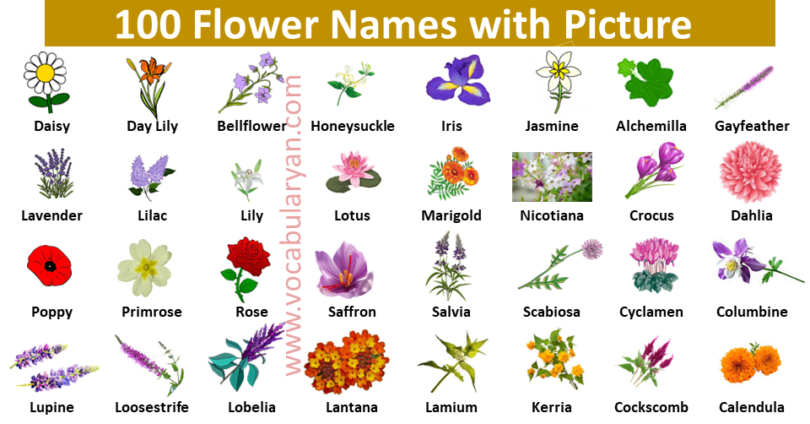
Flowers are the reproductive blooming parts of flowering plants, from garden roses to wild dandelions. English flower names have 16 main type-family categories by shape, use, and where they grow.
English flower names have 16 main type-family categories: rose and carnation, lily, sunflower and daisy family, spring bulb, tropical, common garden, wildflower, cottage garden, peony and iris family, aquatic, flowering shrub, flowering vine, flowering tree, medicinal, wedding, and rare and exotic flowers.
Common Flower Names With Pictures
Each category is defined by flower family, growth habit, or how the flower is used. Roses, lilies, and sunflower-family flowers are three of the most-recognized types worldwide. The other 13 are spring bulb, tropical, common garden, wildflower, cottage garden, peony and iris family, aquatic, flowering shrub, flowering vine, flowering tree, medicinal, wedding, and rare and exotic flowers.
Rose and Carnation Names in English
Roses and carnations are the classic layered cut flowers, prized for their fragrance and long history in gardens across the world.
Rose
classic woody flowering shrub with fragrant layered petals in every color from white to deep red, and sharp thorns on the stem. Roses are the world’s most-sold cut flower, symbolic of love, cultivated for over 5,000 years across Persia, China, and Europe, and called “the queen of flowers.”
Wild Rose
single-petaled pink or white rose with an open 5-petal bloom and a golden center. Wild roses are native to hedgerows and meadows across Europe, Asia, and North America, produce edible red rose hips rich in vitamin C, and are the state flower of Iowa.
Climbing Rose
vigorous long-caned rose variety trained to grow up walls, trellises, and arches. Climbing roses bloom in massive sprays from late spring through autumn, are the classic cottage garden feature across England and France, and famous varieties are Zephirine Drouhin and New Dawn.
Carnation
ruffled multi-petaled flower with a spicy clove-like fragrance and colors from pure white to striped candy pinks. Carnations are the birth flower of January, the traditional Mother’s Day flower, and have been cultivated for over 2,000 years since ancient Greek and Roman times.
Lily Names in English
Lilies are elegant tall bulb flowers with 6 large trumpet-shaped petals, among the world’s most sacred wedding and funeral flowers.
Tiger Lily
tall orange lily with dark spots on the petals and prominent recurved backward-curving petal tips. Tiger lilies are native to eastern Asia (China, Japan, Korea), bloom in late summer, and produce dozens of hanging flowers per tall stem.
Calla Lily
elegant trumpet-shaped flower with a smooth curled white or colored petal (called a spathe) and a yellow finger-like center. Calla lilies are native to South Africa, symbolic of purity and rebirth, popular at weddings and funerals, and famously painted by Georgia O’Keeffe.
Day Lily
hardy perennial with strap-like leaves and trumpet-shaped flowers in orange, yellow, red, or pink. Day lilies are native to Asia, get their name from the fact that each flower blooms for just one day, and come in over 60,000 named cultivars.
Lily of the Valley
small woodland perennial with tiny bell-shaped pure white flowers hanging from a slim stem and broad green leaves. Lily of the valley is native to Europe and Asia, symbolic of humility and returning happiness, and traditionally worn by brides at royal weddings including Kate Middleton.
Sunflower and Daisy Family Flower Names
Sunflowers and daisies are the disc-shaped flowers of the Asteraceae family, the largest flowering plant family with over 32,000 species.
Sunflower
tall annual plant with a large yellow disc-shaped flower head that turns to follow the sun through the day. Sunflowers are grown as ornamental garden flowers, pressed for sunflower oil, and cultivated across Ukraine, Russia, and the American Midwest as major crops.
Daisy
cheerful small flower with a bright yellow center disc surrounded by white petals. Daisies are found across meadows worldwide, symbolic of innocence and new beginnings, the birth flower of April, and inspire the “he loves me, he loves me not” petal-picking game.
Chrysanthemum
autumn-blooming ornamental with large ball-shaped or spider-shaped flower heads in every color. Chrysanthemums are the imperial flower of Japan (Japan’s national seal), the birth flower of November, and brewed into a floral tea across East Asia.
Gerbera Daisy
large bright-colored daisy from South Africa with a bold central disc and long slim petals in vivid pink, orange, red, or yellow. Gerbera daisies are the fifth most-sold cut flower in the world, popular in modern bouquets, and one of the top ten cut flower crops worldwide.
Black-Eyed Susan
cheerful golden-yellow wildflower with a dark brown-black raised central cone and broad drooping petals. Black-eyed Susans are native to North American prairies and roadsides, the state flower of Maryland, and bloom from summer through the first frost.
Spring Bulb Flower Names in English
Spring bulb flowers grow from underground bulbs and bloom in early spring, from February snowdrops to late-spring tulips.
Tulip
spring-blooming bulb plant with cup-shaped flowers in every color, growing on smooth stems. Tulips are the national flower of the Netherlands and Turkey, and the 17th-century Dutch “tulip mania” was one of the first speculative-bubble crashes in history.
Daffodil
spring bulb plant with bright yellow or white trumpet-shaped flowers, symbolizing renewal and new beginnings. Daffodils are the national flower of Wales, worn on Saint David’s Day, and one of the first flowers to bloom after winter.
Crocus
small early-spring bulb with cup-shaped purple, white, yellow, or striped flowers that push up through the last snow. Crocuses are native to Europe, North Africa, and Asia, and the dried orange stigmas of the saffron crocus are the world’s most expensive spice by weight.
Hyacinth
spring bulb with dense clusters of small waxy bell-shaped flowers packed onto a single upright spike, in blue, pink, purple, or white. Hyacinths are native to the eastern Mediterranean, prized for their heavy sweet fragrance, and forced indoors to bloom during winter months.
Snowdrop
tiny early-spring bulb with a single hanging bell-shaped pure white flower on a slim stem. Snowdrops are among the very first flowers to bloom (pushing through snow in January or February), native to Europe and the Middle East, and symbolic of hope and rebirth.
Tropical Flower Names in English
Tropical flowers are the exotic waxy showstoppers of the rainforest and warm regions, prized for their bold colors and long vase life.
Orchid
exotic tropical flower with unique symmetrical petals in every color and pattern, growing on a slender stem. Orchids are one of the largest flowering plant families (30,000 species), the national flower of Singapore and Colombia, and a status houseplant worldwide.
Bird of Paradise
striking tropical flower with a sharp orange-and-blue crown shaped like the head of a tropical bird, and long stiff stems. Bird of paradise is native to South Africa, popular in exotic floral arrangements, and the official flower of the city of Los Angeles.
Anthurium
glossy heart-shaped tropical flower with a bright red, pink, or white waxy petal (the spathe) and a yellow finger-like center (the spadix). Anthuriums are native to Colombia and Ecuador rainforests, and their flowers last 4-6 weeks after being cut for arrangements.
Hibiscus
tropical flowering shrub with large trumpet-shaped flowers in red, pink, yellow, or white, and glossy dark-green leaves. Hibiscus is the national flower of Malaysia, worn as hair decoration in Hawaii, and brewed into a tart red tea across the Caribbean.
Plumeria (Frangipani)
tropical tree flower with waxy 5-petaled star-shaped blooms in white, yellow, pink, or red, and a sweet fragrance strongest at night. Plumeria is native to Central America and the Caribbean, called champa in Sanskrit, and worn in Hawaiian leis and Polynesian hair decorations.
Common Garden Flower Names in English
Common garden flowers are the everyday bedding annuals planted in flower beds, hanging baskets, and window boxes across every temperate country.
Marigold
bright yellow and orange annual flower with a strong distinctive scent. Marigolds are strung into flower garlands at Hindu weddings and festivals (especially Diwali), used in Mexican Day of the Dead altars, and planted to repel garden pests naturally.
Petunia
trumpet-shaped annual flower in pink, purple, white, red, or striped varieties, blooming from spring through frost. Petunias are the most-planted annual bedding flower in the world, native to South America, and popular in hanging baskets and window boxes.
Pansy
cool-season annual with cheerful “face-like” flowers in purple, yellow, orange, white, or blue, marked with dark centers. Pansies are hybrids of European wild violets, bloom happily in autumn, winter, and early spring, and famously appear in Shakespeare’s A Midsummer Night’s Dream.
Snapdragon
tall spike flower with clusters of dragon-jaw-shaped blooms in every color, that “snap” open when pinched at the sides. Snapdragons are native to the Mediterranean, bloom in cool weather, and are a favorite of children who love to make the flowers “talk.”
Zinnia
hot-weather annual with vibrant daisy-like flowers in every color from red to orange to pink to lime green. Zinnias are native to Mexico, one of the easiest cut flowers to grow from seed, and beloved for their long vase life and butterfly-attracting power.
Geranium
hardy garden favorite with round clusters of small flowers in red, pink, white, or purple, and distinctive lobed scented leaves. Geraniums are native to South Africa, the classic window-box flower of European cottages, and produce essential oil used in perfumes.
Wildflower Names in English
Wildflowers are the flowers of meadows, roadsides, and woodland edges, thriving without human care.
Buttercup
small shiny yellow wildflower with 5 waxy petals that reflect light like a mirror. Buttercups are found in meadows and lawns worldwide, and the childhood game of placing one under the chin to see if it “glows yellow” (meaning you like butter) is a British tradition.
Dandelion
bright yellow wildflower with a single flower head made of hundreds of tiny florets, and a fluffy white seed puff after blooming. Dandelions are found on every continent except Antarctica, entirely edible (leaves, flowers, and roots), and children famously blow away the seeds to make wishes.
Bluebell
woodland wildflower with hanging bell-shaped violet-blue flowers on slim stems. English bluebells carpet ancient British woodlands in spring in vast blue seas, are protected by law in the UK, and Spanish bluebells are the paler broader-flowered cousin.
Cornflower
slim wildflower with intense electric-blue starburst flowers and thin grey-green stems. Cornflowers are native to European grain fields (from which they get their name), the national flower of Estonia and Germany, and worn by President John F. Kennedy on his wedding day.
Clover
low-growing meadow plant with round pink or white pom-pom flower heads and trefoil three-leaflet leaves. Clover is found in meadows and lawns worldwide, symbolic of the Irish shamrock (Saint Patrick’s Day), and the very rare four-leaf clover is a symbol of luck.
Poppy
wildflower with bright red, orange, or white paper-thin petals around a dark seed-filled center. Red poppies are the memorial flower of World War I (worn on Remembrance Day in the UK and Veterans Day in the USA), thanks to the poem “In Flanders Fields.”
Cottage Garden Flower Names in English
Cottage garden flowers are the tall old-fashioned favorites of English country gardens, packed together in colorful herbaceous borders.
Delphinium
tall dramatic spike flower with dozens of star-shaped blue, purple, pink, or white blooms packed along a 1-2 meter stem. Delphiniums are the birth flower of July, the classic backdrop flower of British herbaceous borders, and got their name from the Greek word for “dolphin.”
Foxglove
tall spike flower with hanging tubular purple, pink, or white bell-shaped blooms marked with dark spots inside. Foxgloves are the source of the heart medication digitalis, native to European woodlands and cottage gardens, and the birth flower of Iowa.
Hollyhock
giant cottage flower with tall spikes of large single or double flowers in every color, reaching 2 meters tall. Hollyhocks are the traditional flower of English cottage gardens, native to China, and beloved for their old-fashioned charm along garden walls and fences.
Lupine
tall spike flower with dense clusters of pea-shaped blue, purple, pink, white, or yellow blooms above finger-like leaves. Lupines are native to North America and the Mediterranean, the state flower of Texas (as bluebonnet), and produce edible protein-rich seeds used in Mediterranean cooking.
Cosmos
airy annual with daisy-like flowers in pink, white, orange, or red on tall slim stems above feathery fern-like foliage. Cosmos are native to Mexico, one of the easiest cut flowers to grow from seed, and beloved for their old-fashioned country garden feel.
Peony and Iris Family Flower Names
Peonies and irises are the elegant large-headed spring perennials with dramatic layered petals in every color.
Peony
perennial with huge ruffled flower heads in soft pink, white, or deep red, blooming in late spring. Peonies are the national flower of China (called “the king of flowers”), a popular wedding flower, prized for their heavy fragrance, and last for over 100 years in the garden.
Iris
tall elegant flower with 6 velvet petals in every color (three upright “standards” and three drooping “falls”), on a sword-like leaf stem. Irises are the state flower of Tennessee, the national flower of France (as the fleur-de-lis), and named after the Greek goddess of the rainbow.
Anemone
delicate cup-shaped flower with 5-8 papery petals in red, purple, blue, pink, or white and a dark central boss of stamens. Anemones bloom in spring and autumn, are symbolic of anticipation, and get their name from the Greek word for “wind.”
Freesia
fragrant funnel-shaped flower with 6-8 clustered blooms on a curved wiry stem, in yellow, white, pink, red, or purple. Freesias are native to South Africa, prized for their strong sweet citrus perfume, and one of the top-selling wedding and Mother’s Day flowers.
Sweet Pea
fragrant climbing annual with delicate ruffled pea-shaped flowers in pastel pinks, purples, whites, and reds. Sweet peas are the birth flower of April, native to Sicily, and famously bred by British Victorian gardeners into hundreds of scented varieties.
Aquatic Flower Names in English
Aquatic flowers grow in or on the water surface, from the sacred lotus to the invasive water hyacinth.
Lotus
aquatic flowering plant with large round leaves floating on the water and huge pink, white, or yellow flowers on tall stems above. Lotus is the national flower of India and Vietnam, sacred in Hindu and Buddhist traditions, and every part of the plant is edible.
Water Lily
aquatic plant with round flat leaves (lily pads) floating on the water surface and cup-shaped white, pink, or yellow flowers. Water lilies are the national flower of Bangladesh, spread across ponds worldwide, and the subject of Claude Monet’s most famous paintings.
Water Hyacinth
fast-spreading floating aquatic plant with rounded shiny green leaves and clusters of pale purple flowers on a tall spike. Water hyacinth is native to South America but has become an invasive weed across tropical waterways, doubling its population in less than a week.
Flowering Shrub Names in English
Flowering shrubs are woody garden plants with dense blooms for weeks or months, popular as garden borders and hedges.
Azalea
compact evergreen or deciduous shrub with clouds of small trumpet-shaped flowers in spring, in pink, red, white, or purple. Azaleas are widely planted across the American South, celebrated in Georgia’s Masters Golf Tournament week, and a symbol of femininity in Japan.
Hydrangea
deciduous flowering shrub with large ball-shaped or lace-cap flower heads in blue, pink, purple, or white. Hydrangea flower color depends on soil pH (acidic soil turns them blue, alkaline turns them pink), making them a popular garden showpiece.
Camellia
glossy evergreen shrub with symmetrical rose-like flowers in white, pink, or red, blooming through winter and early spring. Camellia sinensis is the plant that gives us tea, and the ornamental Camellia japonica is Japan’s classic winter garden shrub.
Rhododendron
large evergreen shrub with leathery dark-green leaves and clusters of showy funnel-shaped spring flowers. Rhododendrons grow in cool moist mountain regions, are the state flower of Washington, and dominate the alpine slopes of Nepal and Bhutan.
Lilac
deciduous shrub with clusters of small purple, pink, or white 4-petaled flowers with a heavy sweet fragrance. Lilacs are native to the Balkans and Eastern Europe, bloom for two weeks in late spring, and are the state flower of New Hampshire and the national flower of Kosovo.
Flowering Vine Names in English
Flowering vines are long-stemmed climbing plants that need trellises, walls, or arbors for support.
Bougainvillea
thorny tropical climbing shrub with clusters of paper-thin bright pink, purple, orange, or white bracts around tiny white flowers. Bougainvillea drapes over walls and pergolas in Mediterranean, Indian, and South American gardens, blooming year-round in warm climates.
Morning Glory
fast-growing annual climbing vine with trumpet-shaped flowers in blue, purple, pink, or white that open at sunrise and close by afternoon. Morning glories grow on trellises and fences worldwide, and Japanese asagao are a traditional summer garden favorite.
Jasmine
evergreen climbing shrub with small white star-shaped flowers and a heady sweet fragrance released after sunset. Jasmine (Jasminum officinale) is the national flower of Pakistan and the Philippines, worn in Indian bridal hair, and brewed into classic Chinese jasmine green tea.
Clematis
deciduous climbing perennial with large star-shaped flowers in purple, pink, white, blue, or red. Clematis is called the “queen of climbers” among garden vines, grown up trellises and arbors across temperate gardens worldwide.
Wisteria
deciduous woody climbing vine with hanging clusters of fragrant purple, pink, or white pea-shaped flowers in spring. Wisteria is trained over pergolas and arbors, and Japan’s Ashikaga Flower Park is famous for its blooming wisteria tunnels.
Flowering Tree Names in English
Flowering trees produce showy blooms in spring and summer, on bare branches before the leaves appear.
Cherry Blossom
small pink or white 5-petaled flowers that cover the branches of the cherry tree for two weeks in spring. Cherry blossoms are the national flower of Japan (called sakura), celebrated at hanami viewing parties, and famous around the Tidal Basin in Washington DC.
Magnolia
ancient flowering tree with huge waxy fragrant flowers in white, pink, purple, or yellow, blooming before the leaves in spring. Magnolias are one of the oldest flowering plants on Earth (95 million years), the state flower of Mississippi and Louisiana, and beloved across the American South.
Dogwood
small ornamental tree with distinctive four-petaled spring flowers (technically bracts) in white or pink, and red berries in autumn. Dogwoods are the state flower of Virginia and North Carolina, and one of the classic understory trees of Eastern American forests.
Jacaranda
subtropical tree covered in a mass of trumpet-shaped bright violet-blue flowers for weeks in spring, dropping a purple carpet of petals below. Jacarandas are native to South America, planted as street trees across Australian, Californian, and South African cities, and famous in Pretoria’s spring festival.
Silk Floss Tree
striking spiny-trunked tropical tree with huge pink 5-petaled flowers that resemble hibiscus. Silk floss trees are native to South American forests, planted as ornamental street trees worldwide, and produce cotton-like silk fibers from their seed pods used to fill pillows.
Medicinal Flower Names in English
Medicinal flowers are the flowers used for centuries in traditional medicine and modern herbal preparations.
Chamomile
small daisy-like flower with a yellow center and white petals, brewed dried into a golden tea. Chamomile is native to Europe and Western Asia, one of the world’s most-drunk medicinal teas for relaxation and sleep, and used for over 2,000 years since ancient Egypt.
Calendula (Pot Marigold)
bright orange or yellow annual daisy-like flower with soft petals. Calendula petals are used in traditional skin-healing balms, cooking as a saffron substitute, and coloring soaps and lotions, and one of the most-used medicinal flowers in European herbal tradition.
Lavender
silvery-grey Mediterranean shrub with narrow leaves and tall spikes of small purple flowers. Lavender is grown in Provence, France for its calming aroma, harvested for essential oil, and dried into sachets that scent linen closets and clothing.
Echinacea (Coneflower)
tall daisy-like flower with drooping pink or purple petals and a raised dark orange central cone. Echinacea is native to North American prairies, brewed into a herbal tea to boost the immune system, and one of the best-selling medicinal herbs in North America and Europe.
Elderflower
creamy-white flowers of the elder tree, growing in flat lace-cap clusters up to 20 cm wide. Elderflowers are brewed into elderflower cordial (a classic British summer drink), fermented into elderflower champagne, and pressed into a syrup used by Queen Elizabeth II at royal celebrations.
Wedding Flower Names in English
Wedding flowers are the classic bridal-bouquet blooms, chosen for symbolism, fragrance, and long vase life after cutting.
Baby’s Breath
delicate airy flower with tiny white five-petaled blooms in cloudy sprays on wispy stems. Baby’s breath is native to Eastern Europe, the classic filler flower in bridal bouquets, symbolic of everlasting love, and has become popular as a stand-alone wedding flower in recent years.
Gardenia
glossy evergreen shrub with pure white waxy fragrant flowers and dark green leaves. Gardenias are native to China and Japan, prized for their heavy sweet perfume, one of the most-used wedding boutonniere flowers, and the state flower of Georgia.
Stephanotis
climbing vine with waxy white star-shaped fragrant flowers, called “Madagascar jasmine.” Stephanotis is native to Madagascar, one of the classic wedding flowers used in bouquets and boutonnieres, and its name comes from the Greek for “fit for a crown.”
Lisianthus
elegant rose-like flower with layered ruffled petals in white, pink, purple, or bicolor, on tall wiry stems. Lisianthus is native to the American Great Plains, one of the top wedding and event flowers worldwide, and lasts up to 3 weeks in a vase after cutting.
Ranunculus
layered rose-like flower with dozens of tissue-paper thin petals in white, pink, orange, red, or yellow. Ranunculus are native to the Mediterranean, one of the most-requested modern wedding flowers, and their name means “little frog” in Latin (they grow near water).
Rare and Exotic Flower Names
Rare and exotic flowers are the unusual blooms from remote islands, ancient plant families, and specialized habitats worldwide.
Bleeding Heart
woodland perennial with arching stems of hanging pink heart-shaped flowers with a white “teardrop” at the base. Bleeding hearts are native to Asia and North America, bloom in shady gardens in late spring, and symbolic of romantic love and sorrow across cultures.
Passionflower
exotic climbing vine with intricate symmetrical flowers in purple, white, or red, with a delicate structure that Christian missionaries connected to the Passion of Christ. Passionflowers are native to the Americas, produce edible passion fruit in tropical varieties, and one of the most complex flowers in structure worldwide.
Fuchsia
hanging tubular flower with a red or pink outer skirt and a deep purple, red, or white inner “petticoat,” dangling from a slender stem. Fuchsias are native to South America and New Zealand, named after German botanist Leonhart Fuchs, and famous for their vivid color that gave the world the color name “fuchsia.”
Protea
huge exotic South African flower with a spiky bowl-shaped bloom in pink, cream, or red surrounded by hard bracts. Proteas are the national flower of South Africa, named after the Greek god Proteus (the shape-shifting sea god), and one of the oldest flowering plant families on Earth (300 million years).
Flowers That Look Similar
Some flower categories cause confusion for English learners.
Flower vs Plant
| Term | Meaning |
|---|---|
| Plant | Whole organism (roots, stem, leaves, flower) |
| Flower | Only the blooming reproductive part of a plant |
Every flower comes from a plant, but a plant has many other parts. Roses grow on rose plants; tulip flowers grow from tulip bulbs.
Annual vs Perennial vs Biennial
| Term | Life Cycle |
|---|---|
| Annual | Grows, blooms, sets seed, dies in one year (petunia, zinnia, marigold) |
| Perennial | Blooms year after year for many years (peony, iris, day lily) |
| Biennial | Grows leaves in year 1, blooms and dies in year 2 (foxglove, hollyhock) |
Annuals give one big season of color. Perennials return each year. Biennials skip a year before flowering.
Wildflower vs Garden Flower
| Term | Meaning |
|---|---|
| Wildflower | Flower that grows naturally without human planting (buttercup, dandelion, poppy) |
| Garden Flower | Flower planted and tended by people in gardens (rose, tulip, marigold) |
Some flowers are both (poppy is a wildflower in fields and a garden flower in beds). Wildflowers thrive without care; garden flowers are bred for showier blooms.
Flowering Shrub vs Vine vs Tree
| Type | Structure |
|---|---|
| Flowering Shrub | Woody, many stems from base, 1-4 meters tall (azalea, lilac, hydrangea) |
| Flowering Vine | Long-stemmed, needs support to climb (wisteria, jasmine, clematis) |
| Flowering Tree | Woody, single trunk, 5+ meters tall (cherry blossom, magnolia, dogwood) |
Shrubs are woody and bushy. Vines climb with support. Trees have a trunk and grow tall.
Petal vs Sepal vs Stamen vs Pistil
| Part | Meaning |
|---|---|
| Petal | Colored outer leaf-like structure that attracts pollinators |
| Sepal | Green outer covering that protects the flower bud |
| Stamen | Male part with pollen (anther on filament) |
| Pistil | Female part receiving pollen (stigma, style, ovary) |
Petals attract bees. Sepals protect the bud. Stamens produce pollen. Pistils receive pollen.
FAQs
Q1. What is the difference between a flower and a plant?
A plant is the whole organism, with roots, stem, leaves, and flowers. A flower is just the blooming reproductive part of a plant. Every flower comes from a plant, but a plant has many parts beyond the flower. When we say “rose,” we mean either the whole rose plant or just the rose flower bloom.
Q2. Which flower is called the queen of flowers?
The rose is called “the queen of flowers” for its unmatched beauty, fragrance, and worldwide popularity. Roses have been cultivated for over 5,000 years across Persia, China, Europe, and India. They are the most-sold cut flower in the world and the birth flower of June.
Q3. Which flower is called the king of flowers?
The peony is called “the king of flowers” in Chinese tradition, prized for over 2,000 years for its heavy fragrance and huge ruffled blooms. Peonies are the national flower of China, symbolic of wealth, honor, and romance, and were declared the official floral emblem by the Empress Wu Zetian in the 7th century.
Q4. What are the national flowers of major countries?
The rose is the national flower of England, the United States, and Iran. The tulip is the national flower of the Netherlands and Turkey. The lotus is the national flower of India and Vietnam. The peony is the national flower of China. The cherry blossom is the national flower of Japan. The daffodil is the national flower of Wales. The jasmine (Jasminum officinale) is the national flower of Pakistan.
Q5. What is the difference between annual, perennial, and biennial flowers?
Annual flowers grow, bloom, produce seed, and die within one growing year (petunia, zinnia, marigold, sunflower). Perennial flowers come back year after year for many years without replanting (peony, iris, day lily, hosta). Biennial flowers grow leaves in year 1, then bloom, set seed, and die in year 2 (foxglove, hollyhock, sweet William).
Q6. What are the most popular wedding flowers?
The most popular wedding flowers are white roses (love and purity), peonies (romance and prosperity), hydrangeas (heartfelt emotion), baby’s breath (everlasting love), gardenias (secret love), and lisianthus (rose-like elegance). Ranunculus, freesia, and stephanotis are also classic wedding choices for bouquets, boutonnieres, and centerpieces.