
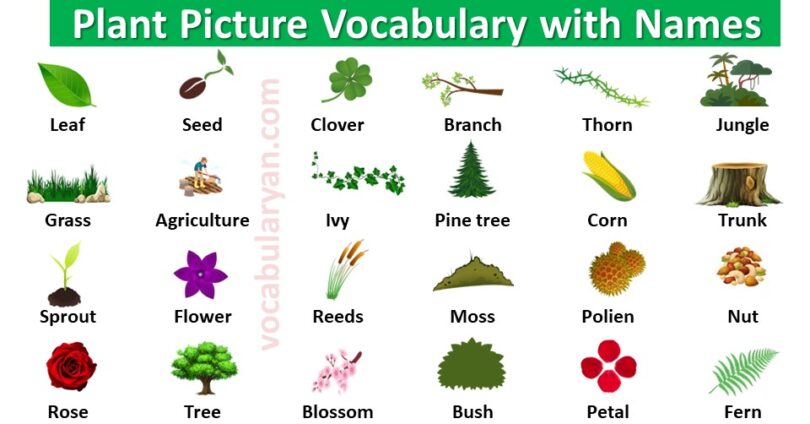
Plants are living organisms with roots, stems, leaves, and flowers, from tiny mosses to tall trees. The 8 main categories in English are herbs, flowering plants, shrubs, vines and climbers, succulents and cacti, grasses and bamboos, aquatic plants, and indoor plants.
English has 8 main plant categories: herbs (tulsi, mint, basil, coriander, rosemary), flowering plants (rose, sunflower, tulip, marigold, orchid), shrubs (lavender, hydrangea, azalea, camellia), vines and climbers (ivy, jasmine, bougainvillea, wisteria), succulents and cacti (aloe vera, jade plant, prickly pear), grasses and bamboos (bamboo, pampas grass, papyrus), aquatic plants (lotus, water lily, water hyacinth), and indoor plants (money plant, snake plant, peace lily, monstera).
Common Plant Names With Pictures
Each family is defined by shape, structure, or where the plant grows. Herbs, flowering plants, and shrubs are the three most-common in gardens and homes. The other five are vines and climbers, succulents and cacti, grasses and bamboos, aquatic plants, and common indoor plants.
Common Herb Names in English
Herbs are small non-woody plants with soft green stems, grown for their leaves used in cooking, tea, or traditional medicine.
Tulsi (Holy Basil): sacred herb of the mint family, native to India, with fragrant green or purple oval leaves. Tulsi is grown at Hindu homes for daily prayer, brewed into medicinal tea for cough and stress relief, and considered “the queen of herbs” in Ayurveda.
Basil (Sweet Basil): aromatic culinary herb with broad glossy green leaves, native to South Asia. Basil is the base of Italian pesto, tossed fresh onto Neapolitan pizza and caprese salad, and used in Thai stir-fries under the name Thai basil.
Mint: fast-growing herb with a fresh cool aroma and bright green serrated leaves. Mint is added to Middle Eastern tabbouleh, brewed into Moroccan mint tea, mixed into Indian raita and chutneys, and used in mojitos and mint juleps worldwide.
Coriander (Cilantro): annual herb with two culinary forms in one plant: leaves (called cilantro in America) and dried seeds (called coriander). Fresh leaves are added to Indian, Mexican, and Thai cuisines, and the seeds go into garam masala and pickling spices.
Rosemary: woody Mediterranean herb with needle-like grey-green leaves and a pine-like aroma. Rosemary is roasted with lamb and potatoes, sprinkled on focaccia bread, and grown as a small evergreen shrub in warm-climate gardens.
Thyme: small woody Mediterranean herb with tiny grey-green leaves and a warm earthy flavor. Thyme is a base herb of the French bouquet garni, added to stews, roasts, and marinades, and one of the most-used herbs in European cooking.
Sage: silvery-green Mediterranean herb with velvety oval leaves and a strong pine-and-eucalyptus aroma. Sage is stuffed with pork and poultry (especially at Thanksgiving), fried in butter for Italian pasta, and burned as smudge sticks in Native American traditions.
Oregano: aromatic Mediterranean herb with small oval leaves and a warm peppery flavor. Oregano is the signature herb of Italian pizza and pasta sauce, sprinkled on Greek salad with feta, and dried into the everyday spice-rack staple worldwide.
Turmeric: golden-orange rhizome from the ginger family, native to South Asia. Turmeric is ground into the yellow powder that colors Indian curries, brewed as “golden milk” for its anti-inflammatory compound curcumin, and used to dye Buddhist monks’ robes.
Lemongrass: tall grass with a fresh lemony aroma and long thin blades, native to South and Southeast Asia. Lemongrass is bruised and added to Thai tom yum soup, brewed into calming tea, and pressed for citronella oil used in mosquito repellents.
Flowering Plant Names With Pictures
Flowering plants are grown for their showy blooms, from garden roses to tropical orchids.
Rose: classic woody flowering shrub with fragrant layered petals in every color from white to deep red, and sharp thorns on the stem. Roses are the world’s most-sold cut flower, symbolic of love, and cultivated for over 5,000 years across Persia, China, and Europe.
Sunflower: tall annual plant with a large yellow disc-shaped flower that turns to follow the sun through the day. Sunflowers are grown as ornamental garden flowers, pressed for sunflower oil, and cultivated across Ukraine, Russia, and the American Midwest.
Marigold: bright yellow and orange annual flower with a strong distinctive scent. Marigolds are strung into flower garlands at Hindu weddings and festivals (especially Diwali), used in Mexican Day of the Dead altars, and planted to repel garden pests naturally.
Tulip: spring-blooming bulb plant with cup-shaped flowers in every color, growing on smooth stems. Tulips are the national flower of the Netherlands and Turkey, and the 17th-century Dutch “tulip mania” was one of the first speculative-bubble crashes in history.
Daffodil: spring bulb plant with bright yellow or white trumpet-shaped flowers, symbolizing renewal and new beginnings. Daffodils are the national flower of Wales, worn on Saint David’s Day, and one of the first flowers to bloom after winter.
Chrysanthemum: autumn-blooming ornamental with large ball-shaped flower heads in every color. Chrysanthemums are the imperial flower of Japan (Japan’s national seal), the birth flower of November, and brewed into a floral tea across East Asia.
Orchid: exotic tropical flower with unique symmetrical petals in every color and pattern, growing on a slender stem. Orchids are one of the largest flowering plant families (30,000 species), the national flower of Singapore and Colombia, and a status houseplant worldwide.
Lily: tall elegant plant with large trumpet-shaped flowers on a straight stem, in white, pink, orange, or yellow. Lilies are a classic funeral and wedding flower, symbolic of purity and rebirth across Christian, Hindu, and Chinese traditions.
Hibiscus: tropical flowering shrub with large trumpet-shaped flowers in red, pink, yellow, or white, and glossy dark-green leaves. Hibiscus is the national flower of Malaysia, worn as hair decoration in Hawaii, and brewed into a tart red tea across the Caribbean.
Peony: perennial with huge ruffled flower heads in soft pink, white, or deep red, blooming in late spring. Peonies are the national flower of China (called the “king of flowers”), a popular wedding flower, and prized for their heavy fragrance.
Shrub and Bush Names in English
Shrubs are woody plants smaller than trees, with many stems from the base and a rounded bushy shape.
Lavender: silvery-grey Mediterranean shrub with narrow leaves and tall spikes of small purple flowers. Lavender is grown in Provence, France for its calming aroma, harvested for essential oil, and dried into sachets that scent linen closets and clothing.
Hydrangea: deciduous flowering shrub with large ball-shaped or lace-cap flower heads in blue, pink, purple, or white. Hydrangea flower color depends on soil pH (acidic soil turns them blue, alkaline turns them pink), making them a popular garden showpiece.
Azalea: compact evergreen or deciduous shrub with clouds of small trumpet-shaped flowers in spring, in pink, red, white, or purple. Azaleas are widely planted across the American South, celebrated in Georgia’s Masters Golf Tournament week, and a symbol of femininity in Japan.
Rhododendron: large evergreen shrub with leathery dark-green leaves and clusters of showy funnel-shaped spring flowers. Rhododendrons grow in cool moist mountain regions, are the state flower of Washington, and dominate the alpine slopes of Nepal and Bhutan.
Camellia: glossy evergreen shrub with symmetrical rose-like flowers in white, pink, or red, blooming through winter and early spring. Camellia sinensis is the plant that gives us tea, and the ornamental Camellia japonica is Japan’s classic winter garden shrub.
Boxwood: dense evergreen shrub with small round leathery leaves, prized for its ability to be clipped into precise shapes. Boxwood is the classic hedge and topiary plant of European formal gardens, from Versailles to English country manors.
Vine and Climbing Plant Names
Vines and climbers are long-stemmed plants that need support to grow upward on walls, fences, or trellises.
Ivy: evergreen climbing vine with dark-green lobed leaves that cling to walls, tree trunks, and fences with tiny aerial rootlets. English Ivy climbs the walls of Oxford and Cambridge colleges (hence “Ivy League”), and Boston Ivy turns brilliant red in autumn.
Bougainvillea: thorny tropical climbing shrub with clusters of paper-thin bright pink, purple, orange, or white bracts around tiny white flowers. Bougainvillea drapes over walls and pergolas in Mediterranean, Indian, and South American gardens, blooming year-round in warm climates.
Jasmine: evergreen climbing shrub with small white star-shaped flowers and a heady sweet fragrance released after sunset. Jasmine is worn in Indian bridal hair, brewed into the classic Chinese jasmine green tea, and the national flower of Pakistan and the Philippines.
Morning Glory: fast-growing annual climbing vine with trumpet-shaped flowers in blue, purple, pink, or white that open at sunrise and close by afternoon. Morning glories grow on trellises and fences worldwide, and Japanese asagao are a traditional summer garden favorite.
Honeysuckle: climbing woody vine with tubular yellow, white, or pink flowers that release a heady sweet scent at dusk. Honeysuckle attracts hummingbirds and bees, and children have traditionally pulled the flowers apart to taste the drop of sweet nectar inside.
Passionflower: exotic climbing vine with intricate symmetrical flowers in purple, white, or red, and edible passion fruit in tropical varieties. Christian missionaries named the flower after the Passion of Christ, seeing symbols of the crown of thorns in its structure.
Clematis: deciduous climbing perennial with large star-shaped flowers in purple, pink, white, blue, or red. Clematis is called the “queen of climbers” among garden vines, grown up trellises and arbors across temperate gardens worldwide.
Wisteria: deciduous woody climbing vine with hanging clusters of fragrant purple, pink, or white pea-shaped flowers in spring. Wisteria is trained over pergolas and arbors, and Japan’s Ashikaga Flower Park is famous for its blooming wisteria tunnels.
Succulent and Cactus Names
Succulents and cacti are plants with thick fleshy leaves or stems that store water, adapted to hot dry climates.
Aloe Vera: short succulent with thick fleshy green leaves lined with small spines, and a healing gel inside. Aloe vera has been used in medicine and cosmetics for over 6,000 years, treats sunburns and cuts, and is a popular low-maintenance indoor plant.
Prickly Pear Cactus: flat paddle-shaped cactus with clusters of sharp spines and edible red or yellow “tuna” fruits on the top. Prickly pear is the national plant of Mexico (on the flag), eaten as a vegetable in Mexican cuisine, and drought-tolerant across arid regions.
Jade Plant: small tree-like succulent with thick oval fleshy leaves in glossy green, and a stout woody trunk. Jade plants are the classic “money plant” of Chinese Feng Shui, given as housewarming and business-opening gifts, and one of the longest-lived houseplants.
Agave: large succulent forming a rosette of thick spiky pointed leaves in blue-green or grey. Blue Agave is the plant that gives us tequila and mezcal, grown across the highlands of Jalisco, Mexico, and traditionally used for fiber and sweetener as well.
Echeveria: small succulent forming a symmetrical rosette of thick fleshy leaves in pastel green, blue, purple, or pink. Echeverias are one of the most photographed plants on Instagram, a favorite for wedding centerpieces, and native to the semi-desert of Mexico.
Barrel Cactus: round barrel-shaped desert cactus covered in vertical ribs and rows of curved yellow-orange spines. Barrel cacti grow slowly for over 100 years across the American Southwest and Mexican deserts, and their tops tilt slightly south toward the sun.
Grass and Bamboo Names in English
Grasses and bamboos are narrow-leaved plants of the grass family, from ornamental tufts to the giant hollow bamboo stems.
Bamboo: fast-growing woody grass with hollow segmented stems (culms) that can reach 100 feet in some tropical species. Bamboo is the panda’s only food, the base material of Asian construction and scaffolding, and one of the fastest-growing plants on Earth.
Pampas Grass: large ornamental grass forming a fountain of long narrow arching leaves and tall silver-white feathery flower plumes. Pampas grass is native to South America’s grassland region (the Pampas), and popular in Boho wedding decor and modern minimalist gardens.
Fountain Grass: medium ornamental grass forming a graceful mound of narrow arching leaves and fluffy foxtail-like flower spikes. Fountain grass adds movement and texture to garden borders, and turns a soft golden bronze in autumn light.
Papyrus: tall aquatic grass-like plant from Egypt’s Nile Delta, with a triangular stem topped by a rounded burst of thin leaves. Papyrus is the plant the ancient Egyptians used to make paper (the word “paper” comes from papyrus), boats, sandals, and mats.
Zebra Grass: ornamental grass with tall arching leaves marked with horizontal cream-yellow stripes, giving it the “zebra” name. Zebra grass forms a fountain-like clump in gardens, silver flower plumes appear in autumn, and it stays attractive through winter.
Aquatic Plant Names
Aquatic plants are the plants that grow in or near water, including floating, submerged, and marsh-loving species.
Lotus: aquatic flowering plant with large round leaves floating on the water and huge pink, white, or yellow flowers on tall stems above. Lotus is the national flower of India and Vietnam, sacred in Hindu and Buddhist traditions, and every part of the plant is edible.
Water Lily: aquatic plant with round flat leaves (lily pads) floating on the water surface and cup-shaped white, pink, or yellow flowers. Water lilies are the national flower of Bangladesh, spread across ponds worldwide, and the subject of Claude Monet’s most famous paintings.
Water Hyacinth: fast-spreading floating aquatic plant with rounded shiny green leaves and clusters of pale purple flowers on a tall spike. Water hyacinth is native to South America but has become an invasive weed across tropical waterways, doubling its population in less than a week.
Duckweed: tiny floating aquatic plant with individual leaves about the size of a fingernail, forming green mats on ponds. Duckweed is the smallest flowering plant on Earth, eaten by ducks and fish, and being researched as a fast-growing biofuel and protein crop.
Cattail: tall wetland plant with long strap-shaped leaves and a distinctive brown cigar-shaped seed head on a straight stem. Cattails grow at the edges of ponds, lakes, and marshes worldwide, and every part (roots, shoots, pollen, seed heads) is edible for wildlife and people.
Common Indoor Plant Names
Indoor plants are the plants grown inside homes and offices for décor, air quality, and low-maintenance greenery.
Money Plant (Pothos): trailing indoor vine with heart-shaped green leaves marbled in gold, cream, or white. Money plant is a low-light houseplant tolerant of neglect, called Devil’s Ivy in the West, and considered lucky in Feng Shui and Vastu traditions.
Snake Plant: hardy indoor plant with long stiff sword-shaped leaves in dark green with pale yellow edges. Snake plants tolerate low light, need watering only every two to three weeks, and are one of the top air-cleaning plants tested by NASA.
Peace Lily: elegant indoor plant with glossy dark-green leaves and white curved single-petal flowers. Peace lilies droop dramatically when thirsty but recover within hours after watering, and they are effective at removing indoor mold spores and airborne toxins.
Spider Plant: hardy indoor plant with arching narrow striped leaves in green and cream, producing baby “spiderettes” on long stems. Spider plants are one of the classic starter houseplants for children and beginners, and effective at removing formaldehyde from indoor air.
ZZ Plant: compact indoor plant with glossy dark-green oval leaves on upright stems, tolerating extreme neglect. ZZ plants store water in their thick rhizomes, survive weeks without watering, and thrive in low-light offices with no natural sunlight.
Rubber Plant: medium tree-like indoor plant with large glossy dark-green leathery leaves. Rubber plants grow quickly from a small pot into a floor-standing statement plant, and were historically tapped for natural latex before Amazon rubber-tree plantations took over the market.
Fiddle Leaf Fig: popular indoor tree with large violin-shaped glossy dark-green leaves. Fiddle leaf figs are the star houseplant of modern interior design, seen in Instagram photos and design magazines, and one of the trickiest houseplants to keep happy for beginners.
Areca Palm: elegant clumping indoor palm with feathery arching yellow-green fronds. Areca palms are a top air-cleaning houseplant per NASA studies, add tropical-resort atmosphere to a room, and are the most-sold indoor palm species worldwide.
Boston Fern: classic indoor fern with cascading feathery fronds of small bright-green leaflets. Boston ferns love humid bathrooms and shaded porches, were the ubiquitous houseplant of Victorian parlors, and add a soft green waterfall effect to hanging baskets.
Monstera: trailing tropical indoor plant with huge glossy dark-green leaves marked by natural holes and splits. Monstera deliciosa is called the “Swiss Cheese Plant” for its perforated leaves, the poster plant of modern jungle interiors, and native to the rainforests of Central America.
Plants That Look Similar
Some plant categories are close in meaning and hard to tell apart.
Plant vs Tree
| Term | Meaning |
|---|---|
| Plant | Any living organism from the plant kingdom (trees, herbs, shrubs, grasses, vines) |
| Tree | A plant with a hard woody trunk, growing taller than 10 feet at maturity |
Every tree is a plant, but not every plant is a tree. Herbs, shrubs, vines, grasses, and flowers are plants but not trees.
Herb vs Shrub vs Vine
| Term | Structure | Height |
|---|---|---|
| Herb | Soft green non-woody stem | Under 3 feet |
| Shrub | Woody with many stems from the base | 3–15 feet |
| Vine | Woody or soft; needs support to climb | Depends on support |
Herbs are small and soft (basil, mint). Shrubs are woody and bushy (lavender, hydrangea). Vines need something to climb (ivy, jasmine).
Succulent vs Cactus
| Term | Meaning |
|---|---|
| Succulent | Any plant with thick fleshy water-storing leaves or stems |
| Cactus | A type of succulent from the Cactaceae family, with spines growing from small pads called areoles |
Every cactus is a succulent, but not every succulent is a cactus. Aloe vera and jade plant are succulents but not cacti. A prickly pear is both.
Vine vs Climber vs Creeper
| Term | Direction |
|---|---|
| Vine | Long stem plant that either climbs or trails |
| Climber | Plant that grows upward using support (walls, trellises, other plants) |
| Creeper | Plant that spreads horizontally along the ground |
All three are similar but tell you the direction. Climbers go up. Creepers go along. Vine is the general term for either.
FAQs
Q1. What are the main types of plants in English?
The main types of plants in English are herbs (small non-woody like basil, mint), flowering plants (rose, tulip, marigold), shrubs (lavender, hydrangea), vines and climbers (ivy, jasmine), succulents and cacti (aloe vera, jade plant), grasses and bamboos (bamboo, pampas grass), aquatic plants (lotus, water lily), and indoor plants (money plant, snake plant). Trees are also plants but are treated as their own separate category.
Q2. What is the difference between a plant and a tree?
Every tree is a plant, but not every plant is a tree. A plant is any living organism from the plant kingdom, including herbs, shrubs, vines, grasses, and flowers. A tree is a specific type of plant with a hard woody trunk that grows taller than 10 feet at maturity, and survives for many years.
Q3. What is the difference between a herb, shrub, and vine?
A herb is a small non-woody plant with soft green stems, under 3 feet tall (basil, mint, rosemary). A shrub is a woody plant with many stems from the base, 3–15 feet tall (lavender, hydrangea). A vine is a plant with long stems that needs support to climb up (ivy, jasmine, bougainvillea).
Q4. What are the best indoor plants for air quality?
The top indoor plants for air quality, per NASA’s landmark research on indoor air quality, are snake plant, peace lily, spider plant, areca palm, and Boston fern. These plants remove airborne toxins like formaldehyde and benzene, and produce oxygen at night when most other plants do not. Snake plants are the most tolerant of neglect for beginners.
Q5. What is the difference between a succulent and a cactus?
Every cactus is a succulent, but not every succulent is a cactus. A succulent is any plant with thick fleshy leaves or stems that store water (aloe vera, jade plant, echeveria). A cactus is a specific type of succulent from the Cactaceae family, with spines that grow from small pads called areoles (barrel cactus, prickly pear).
Q6. Which plants are best for beginner gardeners?
The most beginner-friendly plants are mint, basil, marigold, sunflower, and tomato for outdoor gardens, and snake plant, pothos, spider plant, and ZZ plant for indoors. These plants are hardy, forgiving of watering mistakes, and give quick visible growth to keep new gardeners motivated through their first season.

Leave a Comment