
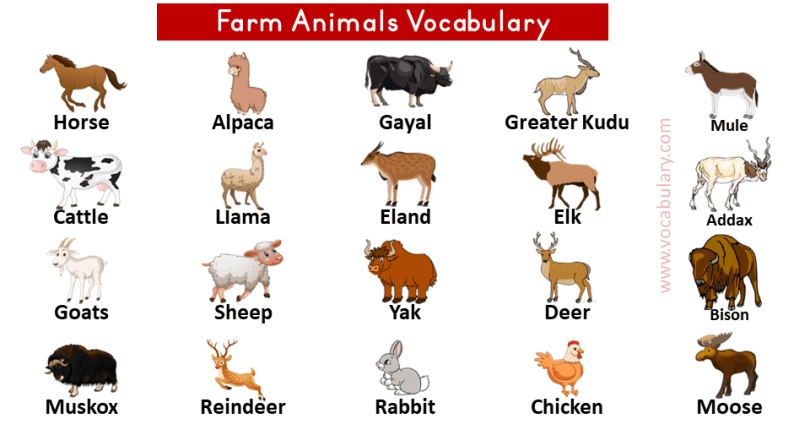
Farm animals are the domesticated species raised by humans for food, work, wool, milk, eggs, and companionship. English farm animal names have 15 main categories by species, life stage, gender, and role.
English farm animal names have 15 main categories: cattle, sheep, goats, pigs, horses, working animals, poultry birds, water fowl, small animals, camelids, exotic birds, baby animals, male and female names, sounds, and homes.
Common Farm Animal Names With Pictures
Each category is defined by species, life stage, gender, or animal role. Cattle, sheep and goats, and pigs are the three most-common farm animal families. The other 12 are horses, working animals, poultry, water fowl, small animals, camelids, exotic birds, baby names, male and female names, sounds, and homes.
Cattle Farm Animal Names in English (Bovine Family)
Cattle (family Bovidae) are the large horned grazing animals kept for milk, meat, and work across every continent except Antarctica.
Cow
adult female bovine kept for milk production and meat, one of the world’s most-farmed animals. Cows come in dairy breeds (Holstein, Jersey, Guernsey) and beef breeds (Angus, Hereford, Charolais).
Bull
adult uncastrated male bovine kept for breeding, with large muscular build and horns. Bulls are known for aggression and are used mainly for producing calves through natural breeding or artificial insemination.
Ox
castrated adult male bovine trained for pulling plows, carts, and heavy loads. Oxen were the primary draft animals of world agriculture for 6,000 years before tractors and are still used across Africa and Asia.
Heifer
young female cow that has not yet given birth to a calf. Heifers are the future dairy herd and first calve at 18-24 months of age.
Buffalo
large horned bovine with heavy body, kept for milk and meat across Asia and Africa. Water buffalo produce richer higher-fat milk than cows and are essential for Indian ghee, Italian mozzarella di bufala, and Southeast Asian farming.
Yak
long-haired cold-adapted bovine of the Tibetan and Mongolian highlands. Yaks provide milk (used for butter tea), meat, wool, and transport at altitudes over 4,000 meters where other cattle cannot survive.
Sheep Farm Animal Names in English
Sheep are the gentle wooly grazing animals kept for wool, meat (lamb and mutton), and milk in flocks of 30 to 3,000 animals.
Sheep
gentle wooly grazing animal kept for wool, meat, and milk. Sheep are the most-farmed animal after chicken, with over 1 billion worldwide and popular breeds like Merino, Suffolk, and Dorper.
Ram
adult male sheep with large curved horns, kept for breeding the flock. Rams have thicker wool, more aggressive behavior, and demonstrate dominance through head-butting contests during mating season.
Ewe
adult female sheep that produces lambs, milk, and wool. Ewes are the majority of any sheep flock and give birth to 1-3 lambs per year (twins are most common).
Goat Farm Animal Names in English
Goats are the small horned climbing farm animals kept for milk, meat, cheese, and mohair fiber.
Goat
small horned climbing farm animal kept for milk, meat, cheese, and mohair fiber. Goats are among the most adaptable farm animals, surviving in mountains, deserts, and small backyard homesteads worldwide.
Billy Goat
adult male goat kept for breeding, with strong-smelling coat and large curved horns. Billy goats have distinctive beards and are essential for producing kids in dairy and meat herds.
Nanny Goat
adult female goat that produces kids and milk. Nanny goats give 1-3 quarts of milk per day and are the source of goat cheese, kefir, and yogurt worldwide.
Pig Farm Animal Names in English (Porcine Family)
Pigs (family Suidae) are the intelligent pink or black omnivorous farm animals kept mainly for pork meat.
Pig
intelligent pink or black farm animal kept mainly for pork meat. Pigs are the fourth most-populous farm animal (1 billion worldwide) and are farmed in breeds like Yorkshire, Duroc, Hampshire, and Berkshire.
Boar
adult male uncastrated pig kept for breeding, larger and more aggressive than domestic pigs. Boars have thick coats, prominent tusks, and are the ancestor of all modern pig breeds.
Sow
adult female pig that gives birth to piglets, producing 8-12 piglets per litter twice yearly. Sows are the mothers of the pig farm and nurse their young for 3-5 weeks after birth.
Hog
large fully-grown pig raised to slaughter weight (250+ pounds), the American English term for a market-ready pig. Hogs are the primary source of pork, bacon, and ham in Western agriculture.
Horse Farm Animal Names in English (Equine Family)
Horses (family Equidae) are the tall hoofed grazing farm animals kept for riding, work, racing, and companionship.
Horse
large hoofed grazing farm animal kept for riding, racing, work, and companionship. Horses come in over 400 breeds worldwide, from tiny miniature horses to massive draft breeds like the Clydesdale and Shire.
Stallion
adult uncastrated male horse kept for breeding, prized for stud value based on lineage and performance. Stallions are aggressive during breeding season and separated from mares outside mating cycles.
Mare
adult female horse that produces foals and, in some cultures, milk (kumis in Central Asia). Mares carry a foal for 11 months and produce one foal per year in normal breeding cycles.
Pony
small horse breed under 14.2 hands (147 cm) at the shoulder, with sturdy build and calm temperament. Ponies are popular children’s mounts, with breeds like the Shetland, Welsh, and Connemara.
Working Farm Animal Names in English
Working farm animals are the long-eared hoofed mammals kept for carrying loads, pulling carts, and sure-footed mountain transport.
Donkey
long-eared sturdy hoofed animal kept for carrying loads and pulling small carts. Donkeys are more sure-footed than horses, live 30-50 years, and are essential across African, Asian, and South American small farms.
Mule
cross-breed offspring of a male donkey and a female horse, sterile but stronger than either parent. Mules combine donkey endurance with horse strength as the world’s classic pack animal for mountain trails.
Hinny
cross-breed offspring of a male horse and a female donkey, smaller than a mule and sterile. Hinnies are rarer than mules and less commercially valuable due to smaller size and lower work capacity.
Poultry Farm Bird Names in English
Poultry farm birds are the domesticated land birds kept mainly for eggs and meat production.
Chicken
small domesticated bird kept for eggs and meat, the world’s most-farmed animal with over 25 billion. Chickens come in breeds like Rhode Island Red (eggs), Cornish Cross (meat), and Bantam (small ornamental).
Hen
adult female chicken that lays 250-300 eggs per year. Hens are the source of every commercial egg and produce eggs without a rooster present (rooster is needed only for fertilized eggs).
Rooster
adult male chicken with large red comb and colorful tail feathers, known for dawn crowing. Roosters are needed only for breeding fertilized eggs and are aggressively territorial toward other roosters.
Turkey
large game bird kept for meat with fan-shaped tail and distinctive wattles. Turkeys are the classic North American Thanksgiving bird and are also farmed for lunch-meat production year-round.
Guinea Fowl
small speckled grey game bird kept for eggs, meat, and pest control (they eat ticks and insects). Guinea fowl are noisy watchdogs of the farm, alerting to intruders with distinctive alarm calls.
Water Fowl Farm Bird Names in English
Water fowl farm birds are the web-footed swimming birds kept for meat, eggs, and down feathers.
Duck
web-footed swimming bird kept for meat, eggs, and down feathers. Domestic ducks come from the wild mallard and Muscovy species, with popular breeds like Pekin (white meat) and Khaki Campbell (eggs).
Drake
adult male duck with distinctive colorful feathers (breeding plumage) and curly tail feather. Drakes are quieter than female ducks and lead the flock during migration and daily movements.
Goose
large web-footed swimming bird kept for meat, eggs, and down feathers. Geese make excellent farm watchdogs (they honk loudly at intruders) and mate for life, unlike most other farm birds.
Gander
adult male goose, larger and more aggressive than female geese. Ganders defend nesting females and goslings by hissing, chasing, and biting intruders (including humans).
Small Farm Animal Names in English
Small farm animals are the tiny mammals, insects, and specialty species kept for meat, fiber, honey, and silk.
Rabbit
small furry long-eared mammal kept for meat, fur, and pets. Domestic rabbits reproduce fast (30-day gestation, 5-8 kits per litter) and are farmed in breeds like New Zealand White, Californian, and Angora.
Bunny
informal name for a young or small rabbit, especially the pet or Easter variety. Bunnies are the popular pet name for rabbits and are the classic children’s Easter symbol.
Honey Bee
small social flying insect kept in hives for honey, beeswax, and crop pollination. Honey bees are essential for agricultural pollination (worth $15 billion annually to US crops) and produce 70 pounds of honey per hive annually.
Silkworm
white caterpillar of the silk moth farmed for silk production. Silkworms have been farmed in China for 5,000 years, producing a single continuous silk thread 1,600 meters long from each cocoon.
Camelid Farm Animal Names in English
Camelids are the South American and Middle Eastern humped or long-necked mammals kept for wool, milk, meat, and transport.
Camel
large humped desert-adapted mammal kept for milk, meat, transport, and wool. Camels come in one-humped Dromedary (Arabian, Middle Eastern) and two-humped Bactrian (Central Asian) varieties.
Llama
tall long-necked South American camelid kept as a pack animal and for wool. Llamas guard sheep herds against predators and are essential to Andean mountain farms above 4,000 meters altitude.
Alpaca
smaller short-eared South American camelid kept mainly for luxurious wool. Alpacas produce softer finer wool than sheep or llamas, with Suri and Huacaya as the two main breeds.
Vicuña
smallest wildest South American camelid, semi-domesticated for extremely rare fine wool. Vicuña wool is the world’s most expensive natural fiber ($400-500 per pound), harvested only every 2-3 years by Peruvian shearing.
Exotic Farm Bird Names in English
Exotic farm birds are the large flightless and specialty game birds farmed for meat, eggs, feathers, and leather.
Ostrich
world’s largest flightless bird kept for meat, eggs, feathers, and leather. Ostriches lay eggs weighing 3 pounds (equal to 24 chicken eggs) and are farmed commercially in South Africa, USA, and Australia.
Emu
Australia’s large flightless bird kept for meat, eggs, oil, and leather. Emus are the second-largest bird species (after ostrich) and produce dark red meat and blue-green eggs weighing 1.5 pounds each.
Quail
small game bird kept for eggs and meat, popular in Asian and European cuisine. Quails produce 200+ small speckled eggs per year and are considered a delicacy at fine dining restaurants worldwide.
Baby Farm Animal Names in English
Every farm animal species has a specific English name for its baby. Below is the complete baby name chart for common farm animals worldwide.
| Adult Animal | Baby Name |
|---|---|
| Cow, Bull, Buffalo, Yak | Calf (plural: calves) |
| Sheep | Lamb |
| Goat | Kid |
| Pig | Piglet |
| Horse | Foal (male: Colt, female: Filly) |
| Donkey | Foal |
| Chicken | Chick |
| Duck | Duckling |
| Goose | Gosling |
| Turkey | Poult |
| Rabbit | Kit (or Bunny) |
| Guinea Fowl | Keet |
| Llama, Alpaca, Vicuña | Cria |
| Camel | Calf |
| Ostrich, Emu | Chick |
| Honey Bee | Larva |
Baby cows and camels share the name “calf.” Baby horses and donkeys share the name “foal,” with colt (male) and filly (female) as gender-specific names for baby horses.
Male and Female Farm Animal Names in English
Every farm animal species has separate English names for the adult male and adult female. Below is the complete gender name chart for common farm animals.
| Species | Adult Male | Adult Female |
|---|---|---|
| Cattle | Bull | Cow |
| Sheep | Ram | Ewe |
| Goat | Billy Goat (Buck) | Nanny Goat (Doe) |
| Pig | Boar | Sow |
| Horse | Stallion | Mare |
| Donkey | Jack | Jenny |
| Chicken | Rooster (Cock) | Hen |
| Duck | Drake | Duck (or Hen) |
| Goose | Gander | Goose |
| Turkey | Tom (Gobbler) | Hen |
| Rabbit | Buck | Doe |
| Camel | Bull | Cow |
| Llama, Alpaca | Macho | Hembra |
An ox is a castrated adult male bovine trained for work. A gelding is a castrated adult male horse. A wether is a castrated adult male sheep or goat.
Farm Animal Sound Names in English
Every farm animal makes a distinctive sound with its own English verb and onomatopoeia. Below is the complete sound chart for common farm animals.
| Animal | Sound Verb | Onomatopoeia |
|---|---|---|
| Cow | Moo | “Mooooo” |
| Sheep | Bleat, Baa | “Baaaa” |
| Goat | Bleat, Baa | “Maaaa” |
| Pig | Oink, Grunt, Squeal | “Oink oink” |
| Horse | Neigh, Whinny | “Neeeigh” |
| Donkey | Bray | “Hee-haw” |
| Chicken | Cluck | “Cluck cluck” |
| Rooster | Crow | “Cock-a-doodle-doo” |
| Chick | Peep, Cheep | “Peep peep” |
| Duck | Quack | “Quack quack” |
| Goose | Honk, Hiss | “Honk honk” |
| Turkey | Gobble | “Gobble gobble” |
| Camel | Grunt, Bellow | (Deep rumbling) |
| Llama, Alpaca | Hum | (Soft humming) |
| Rabbit | Squeak | (Mostly silent) |
| Honey Bee | Buzz | “Bzzzzz” |
Cats meow, dogs bark, but these two are traditionally pets rather than farm animals in ESL vocabulary.
Farm Animal Home Names in English
Every farm animal species has a specific name for its shelter or home. Below is the complete home name chart for common farm animals.
| Animal | Home Name |
|---|---|
| Cow, Cattle | Barn, Cowshed, Byre, Cattle Stall |
| Sheep | Sheepfold, Sheep Pen |
| Goat | Goat Pen, Goat Shed |
| Pig | Pigsty, Pigpen, Sow Barn |
| Horse | Stable, Stall, Loose Box |
| Donkey, Mule | Stable, Barn |
| Chicken | Chicken Coop, Henhouse, Roost |
| Duck, Goose | Duck House, Duck Pond, Pond |
| Turkey | Turkey Coop, Turkey Shed |
| Rabbit | Rabbit Hutch, Warren (wild rabbits) |
| Honey Bee | Beehive, Apiary (bee-keeping location) |
| Camel | Camel Barn, Camel Yard |
| Llama, Alpaca | Barn, Corral |
| Ostrich, Emu | Ostrich Pen, Ratite Enclosure |
Grazing farm animals (cattle, sheep, goats, horses) also spend time in pastures, paddocks, and grazing fields when not in their sheltered home.
Farm Animals That Look Similar
Some farm animal names cause confusion for English learners and city visitors.
Cow vs Bull vs Ox vs Buffalo vs Yak
| Animal | Meaning |
|---|---|
| Cow | Adult female bovine (Bos taurus) |
| Bull | Adult uncastrated male bovine (Bos taurus) |
| Ox | Castrated adult male bovine trained for work |
| Buffalo | Different species (water buffalo Bubalus bubalis) with larger horns and richer milk |
| Yak | High-altitude bovine species (Bos grunniens) with long hair for cold |
Cow, bull, and ox are the same species (Bos taurus) at different sexes and roles. Buffalo and yak are separate bovine species from Asia.
Sheep vs Ram vs Ewe vs Lamb
| Term | Meaning |
|---|---|
| Sheep | General term for the species |
| Ram | Adult male sheep with curved horns |
| Ewe | Adult female sheep |
| Lamb | Baby sheep under 1 year old |
Goat vs Kid vs Billy vs Nanny
| Term | Meaning |
|---|---|
| Goat | General term for the species |
| Billy Goat (Buck) | Adult male goat |
| Nanny Goat (Doe) | Adult female goat |
| Kid | Baby goat under 1 year old |
Pig vs Hog vs Boar vs Sow vs Piglet
| Term | Meaning |
|---|---|
| Pig | General term for the species (any age) |
| Hog | Large fully-grown pig (American English) |
| Boar | Adult uncastrated male pig |
| Sow | Adult female pig |
| Piglet | Baby pig |
Horse vs Pony vs Donkey vs Mule vs Hinny
| Term | Meaning |
|---|---|
| Horse | Full-sized horse (Equus ferus caballus) |
| Pony | Small horse breed under 14.2 hands (147 cm) tall |
| Donkey | Different species (Equus africanus asinus) with long ears |
| Mule | Male donkey plus female horse (sterile) |
| Hinny | Male horse plus female donkey (sterile, smaller than mule) |
Llama vs Alpaca
| Trait | Llama | Alpaca |
|---|---|---|
| Size | 350-400 lb, 6 ft tall | 100-175 lb, 4-5 ft tall |
| Ears | Long banana-shaped | Short straight |
| Face | Long horse-like | Short blunt |
| Purpose | Pack animal, guard | Wool production |
| Wool | Coarser | Softer, more valuable |
Llamas are the larger pack animals; alpacas are the smaller wool-producing cousins. Both are South American camelids from the Andes mountains.
FAQs
Q1. What are the most common farm animals?
The 10 most-common farm animals worldwide are: chicken (25 billion), sheep (1.2 billion), cow/cattle (1 billion), pig (1 billion), goat (1 billion), duck (600 million), buffalo (200 million), horse (60 million), turkey (500 million), and rabbit (700 million). Chicken is the most-farmed animal on Earth by a wide margin.
Q2. What are the babies of farm animals called?
The babies of common farm animals are: calf (cow, buffalo, yak, camel), lamb (sheep), kid (goat), piglet (pig), foal (horse, donkey), colt (male foal), filly (female foal), chick (chicken), duckling (duck), gosling (goose), poult (turkey), kit (rabbit), keet (guinea fowl), and cria (llama, alpaca, vicuña).
Q3. What are the male and female names of farm animals?
Common male/female farm animal names are: bull/cow (cattle), ram/ewe (sheep), billy/nanny (goat), boar/sow (pig), stallion/mare (horse), jack/jenny (donkey), rooster/hen (chicken), drake/hen (duck), gander/goose (goose), tom/hen (turkey), and buck/doe (rabbit). An ox is a castrated male bovine trained for work.
Q4. What sounds do farm animals make?
Farm animal sounds are: cow “moos,” sheep and goat “bleat” or “baa,” pig “oinks” and “grunts,” horse “neighs” or “whinnies,” donkey “brays” (hee-haw), chicken “clucks” (rooster “crows” cock-a-doodle-doo), duck “quacks,” goose “honks,” turkey “gobbles,” camel “grunts,” llama and alpaca “hum,” and bee “buzzes.”
Q5. What is the difference between a llama and an alpaca?
Llamas are larger (350-400 lb) with longer heads and pointed banana-shaped ears, kept mainly as pack animals and guard animals for sheep herds. Alpacas are smaller (100-175 lb) with shorter heads and straight ears, kept mainly for their soft luxurious wool. Both are South American camelids from the Andes mountains and share the same baby name (cria).
Q6. What is the difference between a horse, donkey, and mule?
A horse is Equus ferus caballus, tall with a full mane and short ears. A donkey is Equus africanus asinus, smaller with a bristly upright mane and long ears. A mule is the cross-breed offspring of a male donkey and a female horse: sterile, combining donkey endurance with horse strength. A hinny is the reverse cross (male horse and female donkey), smaller and rarer.

Leave a Comment