
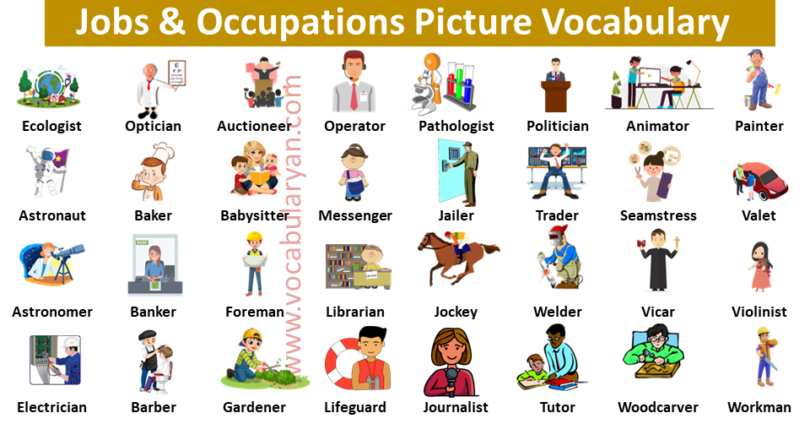
Occupation names describe the different jobs people do to earn a living. The 9 main industry categories are healthcare and medical, education, business and finance, legal and government, creative and arts, technology and engineering, skilled trade, food and hospitality, and everyday service jobs.
English occupation names sort into 9 industry categories: healthcare and medical, education, business and finance, legal and government, creative and arts, technology and engineering, trade and skilled manual, food and hospitality, and service and everyday jobs.
Common Occupation Names With Pictures
Each category is defined by the industry the worker is in. Healthcare, education, and business jobs are three of the most-common worldwide. The other six are legal and government, creative and arts, technology and engineering, skilled trade, food and hospitality, and service and everyday jobs.
Healthcare and Medical Jobs
Healthcare and medical jobs are the trained professionals who look after our physical and dental health from birth to old age.
Doctor: medical professional who examines patients, diagnoses illnesses, and prescribes treatment, working in hospitals, clinics, or private practices. “The doctor gave me a prescription for antibiotics and told me to rest for a full week to recover from the flu.”
Nurse: healthcare worker who cares for patients, gives medication, assists doctors, and handles emergencies in hospitals, clinics, and nursing homes. “The night-shift nurse checked on my grandmother every hour and adjusted her IV drip during the entire hospital stay.”
Surgeon: medical doctor with advanced training who performs operations, works in hospital operating rooms, and specialises by body area (heart, brain, orthopedic). “The heart surgeon at St. Mary’s Hospital has performed over 3,000 bypass operations across her 20-year career.”
Dentist: healthcare professional who checks, cleans, and treats teeth and gums, and fits fillings, crowns, and braces in a dental clinic. “My dentist told me I need to floss more carefully and booked me in for a cleaning next month.”
Pharmacist: healthcare professional who prepares and dispenses prescription medicines, and gives advice on over-the-counter treatments, working in a pharmacy. “The pharmacist explained how to take the new medication and warned me not to drink alcohol while on the course.”
Veterinarian (Vet): medical professional who treats sick and injured animals, gives vaccinations, and performs surgery on pets and livestock. “We took our cat to the veterinarian for her annual check-up and rabies vaccination on Saturday morning.”
Paramedic: emergency medical worker who responds to 999 and 911 calls in an ambulance, giving on-the-spot treatment to accident victims and patients in crisis. “The paramedics arrived within four minutes of the car crash and stabilised the driver’s injuries before rushing him to hospital.”
Education Jobs in English
Education jobs are the teachers, professors, and support staff who help children, teenagers, and adults learn.
Teacher: educational professional who plans lessons, instructs students, grades assignments, and manages a classroom in a primary or secondary school. “My English teacher assigns two novels per term and always writes detailed feedback on our essays in red pen.”
Professor: senior academic who teaches university students, leads lectures and seminars, and conducts original research in a specialist field. “Professor Anderson lectures on medieval history at Oxford and has published five books on the Norman Conquest.”
Librarian: trained information specialist who manages book collections, helps readers find sources, and organises programs at a public or academic library. “The librarian helped me find three biographies of Winston Churchill for my history dissertation research project.”
Principal: senior administrator in charge of a school, managing teachers, budget, discipline, and the day-to-day running of the whole institution. “The principal called an assembly to announce the new anti-bullying policy and introduce the new head of the maths department.”
School Counselor: trained specialist who supports students with academic, career, and personal-life guidance, working in schools and colleges. “The school counselor met with my daughter every Tuesday to help her manage exam stress during her final year of high school.”
Business and Finance Jobs
Business and finance jobs are the roles in offices, banks, and shops that handle money, sales, and management.
Accountant: trained financial professional who prepares tax returns, audits financial records, and advises businesses on money management. “Our family accountant does my tax return every March and saves us thousands of pounds in legitimate deductions each year.”
Banker: finance professional who works at a bank, handling loans, investments, mortgages, and customer accounts. “The banker approved our home mortgage application in three days after we submitted all the income and employment documents.”
Manager: business professional who leads a team, sets goals, organises workflow, and reports to senior executives in a company or shop. “Our office manager organised the whole team-building weekend at a country hotel to boost morale after the difficult quarter.”
Entrepreneur: business founder who identifies opportunities, starts new companies, takes financial risks, and builds products or services from scratch. “The tech entrepreneur behind the food-delivery app started with a laptop in her garage and now employs 400 people worldwide.”
Cashier: retail worker who scans items, handles payment, and gives receipts at the checkout counter in shops and supermarkets. “The cashier at the supermarket rang up our groceries, packed them into bags, and gave us the loyalty-card discount.”
Economist: trained analyst who studies markets, inflation, and government spending, and advises policymakers, businesses, and news outlets. “The chief economist at the Bank of England explained why interest rates went up at the press conference this morning.”
Legal and Government Jobs
Legal and government jobs are the workers who make and enforce the laws, and keep public order.
Lawyer: legal professional who represents clients in court, drafts contracts, and gives legal advice on wills, property, divorce, and business deals. “The lawyer reviewed the rental contract, spotted three unfair clauses, and negotiated better terms with the landlord for us.”
Judge: senior legal official who presides over court cases, hears evidence from both sides, and issues sentences in criminal and civil trials. “The judge sentenced the fraudster to five years in prison after hearing evidence from ten victims and reviewing the bank records.”
Police Officer: law enforcement professional who patrols streets, investigates crimes, arrests suspects, and keeps public order. “The police officer stopped the drunk driver on the highway and administered a breathalyzer test on the spot.”
Firefighter: emergency worker who responds to fires, road accidents, and rescue calls, working from a fire station with fire trucks and specialist equipment. “The firefighters put out the kitchen fire in ten minutes and gave us safety advice about smoke alarms before leaving.”
Politician: elected government representative who makes laws, votes on policy, and represents voters at local, national, or international level. “The politician gave a campaign speech about affordable housing and answered questions from voters at the town hall meeting.”
Creative and Arts Jobs
Creative and arts jobs are the performers, artists, and designers who entertain us and shape the visual world around us.
Actor: performing artist who plays characters on stage, in films, on television, or in radio dramas, working with directors and other cast members. “The actor won an Oscar for her role as a lonely nurse in the World War II drama last year.”
Musician: performing artist who plays an instrument, composes, or performs live music in bands, orchestras, studios, or as a solo artist. “The musician plays the violin with the London Philharmonic Orchestra and gives private lessons on Saturday mornings.”
Singer: vocal performing artist who performs songs in bands, choirs, opera, or as a solo recording artist. “The singer released her first pop album at age 19 and has just finished a sold-out world tour of 40 cities.”
Dancer: professional performer who trains in ballet, contemporary, hip-hop, or traditional styles, performing in shows, music videos, and dance companies. “The dancer trained at the Royal Ballet School for eight years before joining the main company at Covent Garden.”
Painter: visual artist who creates original paintings using oil, watercolor, acrylic, or mixed media, and exhibits in galleries and art fairs. “The painter’s landscapes of the Scottish Highlands sold for £15,000 each at the London gallery show last month.”
Photographer: visual artist who takes pictures for a living, working in weddings, fashion, journalism, wildlife, or commercial advertising. “The wedding photographer captured 800 beautiful photos across the ceremony, reception, and evening dance.”
Writer: creative professional who writes novels, articles, scripts, or poetry for books, magazines, websites, film, or television. “The novelist finished her fifth crime thriller last month, and it has already been sold to a Netflix film production company.”
Graphic Designer: visual creative who designs logos, posters, packaging, websites, and marketing materials using digital software. “The graphic designer created a new logo for our bakery, along with matching business cards, menus, and shop-front signage.”
Fashion Designer: creative professional who sketches, designs, and produces clothing collections for fashion houses, brands, or their own label. “The fashion designer showed her spring collection at Paris Fashion Week and was written up in every major fashion magazine.”
Technology and Engineering Jobs
Technology and engineering jobs are the technical experts who design, build, and maintain the digital and physical systems of modern life.
Engineer: technical professional who designs, builds, or maintains machines, structures, or systems (civil, mechanical, electrical, chemical, aerospace). “The civil engineer designed the new bridge across the river, and construction was completed on budget in two years.”
Software Developer: technology professional who writes computer code to build apps, websites, games, and software products. “The software developer joined the startup last year and helped build the mobile app that now has two million active users.”
Architect: design professional who plans buildings, homes, and public structures, drawing detailed blueprints and working with construction teams. “The architect designed the new city library with huge windows, a rooftop garden, and space for 500,000 books across five floors.”
Scientist: research professional who conducts experiments, gathers data, and publishes findings in a specialist field like biology, chemistry, or physics. “The scientist spent five years researching climate change and published her results in the journal Nature last month.”
IT Technician: technology support professional who sets up computers, fixes hardware and software problems, and manages office networks. “The IT technician arrived within an hour and fixed the office server outage that had stopped every employee’s work all morning.”
Data Analyst: technology professional who studies large data sets to spot trends, build reports, and inform business decisions. “The data analyst identified a 30% drop in weekend sales and recommended a Saturday promotion campaign that boosted revenue back up.”
Trade and Skilled Manual Jobs
Trade and skilled manual jobs are the craftspeople and tradespeople who build, fix, and shape the physical world with their hands and tools.
Carpenter: skilled tradesperson who works with wood, building and repairing furniture, doors, floors, roofs, and cabinets. “The carpenter built us a custom kitchen island out of solid oak, along with matching shelves and a dining table.”
Electrician: skilled tradesperson who installs, repairs, and maintains electrical wiring, lighting, and appliances in homes and businesses. “We called an electrician to fix the fuse box after the power kept tripping every time we turned on the microwave.”
Plumber: skilled tradesperson who installs and repairs water pipes, boilers, sinks, showers, and heating systems in homes and businesses. “The plumber fixed the leaking pipe under the kitchen sink and replaced the old washing machine hose within an hour.”
Mechanic: skilled tradesperson who diagnoses and repairs cars, motorcycles, and other vehicles, working in garages and auto shops. “The mechanic replaced my brake pads and changed the oil for £180, and now the car drives like new.”
Welder: skilled tradesperson who joins metal parts using high heat, working in construction, shipbuilding, car manufacturing, and repair shops. “The welder fixed the crack in the metal gate and made it stronger than the original weld from twenty years ago.”
Mason: skilled tradesperson who builds with brick, stone, or concrete, constructing walls, chimneys, and fireplaces. “The stone mason built our garden wall from limestone blocks, and it will still be standing 200 years from now.”
Tailor: skilled tradesperson who measures, cuts, and sews clothing, especially for made-to-measure suits, dresses, and alterations. “The tailor took my measurements and made a beautifully fitted three-piece wool suit for my brother’s wedding.”
Barber: skilled tradesperson who cuts and styles men’s hair and shaves beards, working in a barbershop with old-fashioned chairs and mirrors. “The barber gave me a sharp fade haircut and a hot-towel shave, and the whole appointment took just 30 minutes.”
Farmer: agricultural worker who grows crops, raises livestock, and manages farmland, working long hours from sunrise to sunset. “The farmer wakes at 4 AM every morning to milk the 200 cows and drive the milk truck to the local dairy factory.”
Food and Hospitality Jobs
Food and hospitality jobs are the workers in restaurants, hotels, cafés, and bars who feed and host customers.
Chef: professional cook who plans menus, prepares meals, and runs the kitchen in a restaurant, hotel, or catering company. “The head chef at the French restaurant trained in Paris for eight years and has one Michelin star to his name.”
Baker: food professional who bakes bread, cakes, pastries, and cookies, starting work at 3 or 4 in the morning to have fresh goods ready by 7. “The village baker makes 200 sourdough loaves every morning, and they sell out by 10 AM every day.”
Waiter: hospitality worker who takes orders, serves food and drinks, and looks after customers at tables in restaurants and cafés. “The waiter recommended the seafood pasta special and brought us fresh bread and olive oil while we waited for our starters.”
Bartender: hospitality worker who mixes and serves drinks (cocktails, beer, wine) behind the bar in pubs, bars, and hotel lounges. “The bartender at the Ritz makes the best classic martini in London and has won three international cocktail competitions.”
Barista: hospitality worker who makes espresso-based drinks and light snacks at a coffee shop or café. “The barista at the corner café makes an amazing flat white with a little heart shape drawn in the milk foam.”
Hotel Manager: hospitality professional who runs a hotel, managing staff, guests, bookings, and maintenance, working long hours across day and night shifts. “The hotel manager greeted us warmly at reception and personally upgraded our room to a suite with an ocean view.”
Service and Everyday Jobs
Service and everyday jobs are the workers who keep homes, streets, transport, and buildings running smoothly for the rest of us.
Cleaner: service worker who cleans homes, offices, or public buildings, dusting, mopping floors, vacuuming, and washing windows. “The office cleaner comes in every evening at 6 PM and has the whole building sparkling by the time we arrive next morning.”
Gardener: service worker who plants, weeds, prunes, mows, and maintains gardens and outdoor spaces for private homes, parks, or estates. “The gardener at the country estate looks after 20 acres of lawn, flower beds, and vegetable gardens throughout the year.”
Delivery Driver: logistics worker who picks up and delivers parcels, food, or goods, working for Amazon, delivery apps, or courier companies. “The delivery driver dropped my Amazon parcel at the front porch by 10 AM and asked me to sign for the package.”
Bus Driver: transport worker who drives passenger buses along fixed routes, checking tickets and following the timetable. “The bus driver on the number 43 route knows all the regular passengers by name and stops for a chat at the coffee shop terminus.”
Taxi Driver: transport worker who drives passengers around the city for a fare, working for taxi companies, Uber, or as an independent driver. “The taxi driver took the back roads to avoid rush-hour traffic and got me to the airport in just 25 minutes.”
Security Guard: service worker who patrols and monitors a building, business, or event, keeping intruders out and reporting suspicious activity. “The security guard at the shopping mall watches the CCTV monitors all night and does hourly patrols of the whole building.”
Postman (Mail Carrier): postal worker who sorts and delivers letters and parcels along a fixed daily route, on foot, by bike, or in a small van. “Our postman knows every family on the street by name and always has a friendly wave for the schoolchildren on his morning round.”
Occupation Names That Look Similar
Some job titles are close in meaning and hard to tell apart.
Job vs Occupation vs Profession vs Trade
| Term | Meaning |
|---|---|
| Job | A specific position at a specific employer (cashier at Tesco) |
| Occupation | A general type of work (cashier) |
| Profession | Skilled work requiring formal education (doctor, lawyer, engineer) |
| Trade | Skilled manual work learned through apprenticeship (carpenter, electrician) |
Job is the most-specific; occupation is broader; profession implies formal education; trade implies hands-on training.
Doctor vs Physician vs Surgeon
| Term | Meaning |
|---|---|
| Doctor | Common English word for any medical professional with an MD degree |
| Physician | American English formal term for a doctor (especially non-surgical) |
| Surgeon | Doctor with advanced training who performs operations |
Every surgeon is a doctor, but not every doctor is a surgeon. Physicians treat with medicines; surgeons treat with operations.
Chef vs Cook
| Term | Meaning |
|---|---|
| Chef | Professionally trained in culinary arts, running a restaurant kitchen |
| Cook | General term for anyone who prepares food, at home or professionally |
Every chef is a cook, but not every cook is a chef. Chef implies formal training and a professional kitchen; cook is the everyday term.
White-Collar vs Blue-Collar
| Term | Meaning |
|---|---|
| White-collar | Office-based professional or administrative work (accountant, manager, lawyer) |
| Blue-collar | Manual or trade work in factories, workshops, or construction (electrician, mechanic, welder) |
The names come from the traditional clothing: white shirts for office workers, blue overalls for manual workers. Pink-collar (nurses, teachers) and green-collar (environmental jobs) have joined the vocabulary too.
FAQs
Q1. What is the difference between a job, occupation, and profession?
A job is a specific position at a specific employer, like “cashier at Tesco.” An occupation is a general type of work, like “cashier.” A profession is a specific type of occupation that requires formal education and training, like “doctor” or “lawyer.” All doctors work in the medical profession, but a doctor working at St. Mary’s Hospital has a specific job there.
Q2. What is the difference between white-collar and blue-collar jobs?
White-collar jobs are office-based professional or administrative roles like accountant, manager, lawyer, or software developer, named after the white dress shirts traditionally worn to the office. Blue-collar jobs are manual or trade work in factories, workshops, or construction like electrician, mechanic, welder, or carpenter, named after the blue overalls traditionally worn on the job.
Q3. What is the difference between a profession and a trade?
A profession requires formal higher education and training, like a doctor (medical school), lawyer (law school), or engineer (university degree). A trade requires hands-on training through an apprenticeship or vocational course, like a carpenter, electrician, plumber, or welder. Both are highly skilled, but professions rely on academic learning while trades rely on practical skill.
Q4. What is the difference between a doctor, physician, and surgeon?
A doctor is the everyday English word for any medical professional with an MD degree. A physician is the formal American English term for a doctor, especially one who treats patients with medicine rather than surgery. A surgeon is a doctor with advanced training who performs operations. Every surgeon is a doctor, but not every doctor is a surgeon.
Q5. What is the difference between a chef and a cook?
A cook is the general English term for anyone who prepares food, whether at home or professionally. A chef is a professionally trained culinary artist, running or supervising a restaurant kitchen. Every chef is a cook, but not every cook is a chef. The title “chef” implies formal culinary training, and the head chef is called the chef de cuisine in French.
Q6. What are the highest-paying jobs in English-speaking countries?
The highest-paying jobs in English-speaking countries are surgeons, anesthesiologists, and other medical specialists, then chief executives (CEOs), corporate lawyers, orthodontists, and airline pilots. Software engineers at top tech companies (Google, Meta, Amazon) and investment bankers on Wall Street also earn very high salaries, reaching several hundred thousand dollars per year.

Leave a Comment