
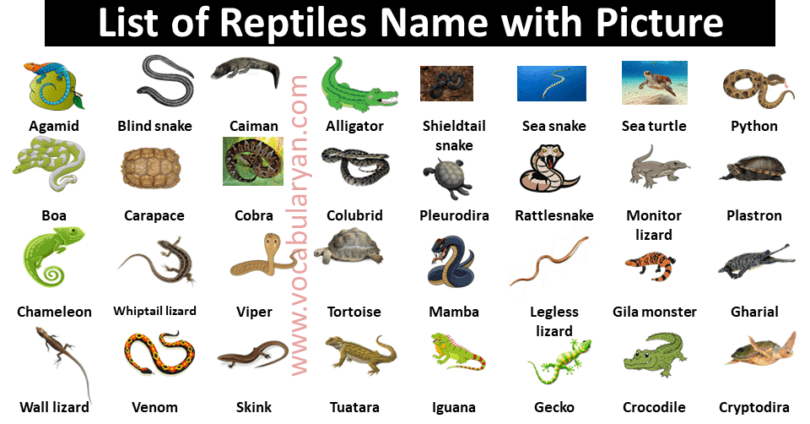
Reptiles are cold-blooded, scaly-skinned animals that breathe air and lay eggs on land, from tiny geckos to giant crocodiles. The 5 main categories of English reptile names are snakes, lizards, turtles and tortoises, crocodilians, and iconic and unique reptiles.
English reptile names have 5 main categories: snakes, lizards, turtles and tortoises, crocodilians, and iconic and unique reptiles. The largest is the saltwater crocodile at 7 meters; the smallest is Brookesia nana, a Madagascar chameleon that fits on a fingernail.
Common Reptile Names With Pictures
Each category is defined by body shape, movement, and habitat. Snakes are legless, lizards have four legs, and turtles have shells. Crocodilians are the largest reptiles. Iconic reptiles are rare or unique species that don’t fit neatly into the main categories.
Snake Names in English
Snakes are legless reptiles that slither and swallow prey whole, from tiny worm snakes to 9-meter anacondas.
Cobra: venomous snake famous for the wide hood it flares when threatened, found across Africa and Asia. Cobras have hypnotized generations of snake charmers from India to Egypt, and their venom is potent enough to kill an elephant with a single bite.
King Cobra: world’s longest venomous snake, reaching up to 5.5 meters, with a hood and a growling hiss like a small dog. King cobras hunt in the forests of India and Southeast Asia, eat other snakes as their main diet, and are the national reptile of India.
Rattlesnake: venomous pit viper native to the Americas, with a distinctive rattle at the end of its tail. Rattlesnakes shake their rattle as a warning to predators before striking, and their venom breaks down blood tissue in seconds.
Viper: venomous snake family with long hinged fangs and a triangular head, found on every continent except Antarctica. Vipers strike quickly, inject deep venom doses, and are one of the most-feared snake families for hikers across Africa, Europe, and Asia.
Black Mamba: fastest venomous snake in the world, reaching speeds of 20 km/h, native to sub-Saharan Africa. Black mambas got their name from the inky black inside of their mouths (their body is grey-brown), and their bite was 100% fatal before anti-venom was developed.
Ball Python: small non-venomous python from West Africa, curling into a tight ball when scared. Ball pythons are the most popular pet snake in the world thanks to their calm temperament and manageable 1.5-meter length.
Burmese Python: giant non-venomous python from Southeast Asia, reaching lengths of 6 meters and weights of 90 kilograms. Burmese pythons kill prey by constriction, have become an invasive species in Florida’s Everglades, and are one of the largest snake species on Earth.
Anaconda: massive non-venomous snake native to South American rivers and swamps, and the heaviest snake in the world. Green anacondas reach 9 meters and 250 kilograms, hunt underwater in the Amazon and Orinoco basins, and can swallow a deer whole.
Boa Constrictor: thick-bodied non-venomous snake from Central and South America, killing prey by squeezing rather than biting with venom. Boa constrictors reach up to 4 meters, are popular exotic pets, and have been kept by humans for over 2,000 years.
Corn Snake: small non-venomous American snake with orange, red, and yellow markings, and one of the most popular beginner pet snakes. Corn snakes reach 1.5 meters, control rodent populations on farms, and got their name from the maize-kernel pattern on their belly.
Garter Snake: small non-venomous snake found across North America, with three yellow or green stripes running the length of a dark green body. Garter snakes are harmless to humans, eat frogs and slugs, and form “mating balls” of hundreds of males around one female in spring.
Milk Snake: non-venomous American snake with red, black, and yellow banded coloring that mimics the deadly coral snake. Milk snakes got their name from an old farmer myth that they drink cow’s milk (they actually eat rodents in the dairy barns).
Lizard Names in English
Lizards are four-legged scaly reptiles with movable eyelids and long tails, and the largest reptile group in number of species.
Green Iguana: large plant-eating lizard from Central and South America, growing up to 1.8 meters long with a bright green body. Green iguanas are one of the world’s most popular pet lizards, but their strong tail whip and sharp claws make them a handful for beginners.
Chameleon: slow-moving arboreal lizard famous for changing skin color and moving each eye independently. Chameleons are native to Madagascar and Africa, catch insects with a lightning-fast sticky tongue twice their body length, and change color based on mood and temperature more than camouflage.
Leopard Gecko: small ground-dwelling desert gecko from Pakistan and Afghanistan, with yellow skin and dark leopard-like spots. Leopard geckos are the most popular pet gecko in the world, thanks to their calm temperament, hands-off care, and cute smiling expression.
House Gecko: small nocturnal gecko found in warm regions worldwide, seen running across walls and ceilings hunting insects at night. House geckos have sticky toe pads for climbing smooth surfaces upside down, chirp loudly at dusk, and are welcomed as free pest control.
Komodo Dragon: world’s largest lizard, reaching 3 meters long and 70 kilograms, found only on Indonesia’s Komodo Islands. Komodo dragons hunt deer and wild pigs, have venom in their bite, and can smell rotting meat from 4 kilometers away.
Bearded Dragon: medium desert lizard from Australia with a spiky “beard” of throat scales it puffs up when threatened. Bearded dragons are one of the world’s top pet lizards, friendly enough to be handled on their owner’s shoulder, and turn their beard black to show anger.
Monitor Lizard: large predatory lizard family from Africa, Asia, and Australia, with long forked tongues and sharp claws. Species come in every size, from small tree monitors to the massive Komodo Dragon, and the Nile Monitor grows up to 2.5 meters along Africa’s Nile River.
Gila Monster: slow, heavy-bodied venomous lizard native to the American Southwest and northern Mexico. Gila monsters have orange and black bead-like scales, are one of only two venomous lizards in the world, and their venom is now studied for use in diabetes medication.
Anole: small tropical American lizard, called the “American chameleon” for its ability to change from green to brown. Anoles are common backyard lizards across the southern United States and Caribbean islands, and males flash a pink throat fan to attract mates.
Frilled Lizard: medium Australian lizard famous for the huge frilled collar it opens when threatened, making itself look twice its size. Frilled lizards also run on their hind legs to escape predators, and are the mascot of Australia’s 2-cent coin.
Horned Lizard: short, spiky desert lizard from the American Southwest and Mexico, disguised to blend with sand and rocks. Horned lizards are famous for squirting a jet of blood from their eyes when attacked, and their popular nickname is “horny toad.”
Turtle and Tortoise Names
Turtles and tortoises are reptiles with a hard bony shell, evolved into a portable armor over 200 million years ago.
Sea Turtle: large marine turtle family with flipper-like legs, found in all warm oceans worldwide. Sea turtles migrate thousands of kilometers between feeding grounds and nesting beaches, return to the same beach where they were born to lay eggs, and can stay underwater without breathing for hours.
Red-Eared Slider: small freshwater turtle with a distinctive red stripe behind each eye, native to the southern United States. Red-eared sliders are the most popular pet turtle in the world, but released pets have become an invasive species in ponds across Europe and Asia.
Box Turtle: small American land turtle with a domed shell that closes tight like a box, sealing it inside for protection. Box turtles reach 15 centimeters, are found across the eastern United States and survive for over 100 years, and are the state reptile of North Carolina.
Snapping Turtle: large aggressive freshwater turtle from North and Central America, with a powerful jaw that snaps hard enough to break a broom handle. Snapping turtles reach 35 kilograms, hunt fish and frogs in ponds and rivers, and have been on Earth since the dinosaur era.
Painted Turtle: small colorful freshwater turtle from North America, with red, yellow, and orange markings on its shell and skin. Painted turtles bask in the sun on logs in rows of five or ten, are the most-widespread native turtle in the United States, and hibernate underwater in winter.
Softshell Turtle: flat freshwater turtle with a leathery cartilage-covered shell instead of the usual hard shell. Softshell turtles bury themselves in mud at the bottom of rivers, snorkel through their long snout, and are eaten as a delicacy in Chinese and Japanese cuisine.
Leatherback Turtle: largest sea turtle in the world, reaching 900 kilograms and 2.5 meters, with a leathery rubbery shell instead of the usual hard shell. Leatherback turtles dive over 1,200 meters deep hunting jellyfish, migrate 15,000 kilometers across oceans yearly, and have been on Earth for 100 million years.
Galápagos Tortoise: giant land tortoise with a huge domed shell, found only on the Galápagos Islands off Ecuador. Galápagos tortoises reach 400 kilograms, survive for over 150 years, and inspired Charles Darwin’s theory of evolution during his 1835 visit on HMS Beagle.
Russian Tortoise: small hardy tortoise from Central Asia’s dry steppes, reaching 25 centimeters and 2 kilograms. Russian tortoises are the most popular pet tortoise in the world thanks to their manageable size, calm nature, and tolerance of cold winters.
Indian Star Tortoise: medium tortoise from India and Sri Lanka, with a highly domed shell marked in beautiful yellow star patterns on black. Indian star tortoises grow up to 30 centimeters, are the second-most-traded tortoise on the illegal wildlife market, and are now legally protected.
Crocodilian Names in English
Crocodilians are the largest living reptiles, with armored skin, powerful jaws, and a hunting style unchanged since the dinosaur era.
Nile Crocodile: massive African crocodile reaching 6 meters and 900 kilograms, found in rivers, lakes, and marshes across sub-Saharan Africa. Nile crocodiles kill more people annually than any other crocodilian, ambushing wildebeest during the Serengeti river migration.
Saltwater Crocodile: largest living reptile on Earth, reaching 7 meters and over 1,000 kilograms, found across northern Australia, Southeast Asia, and India. Saltwater crocodiles swim across open ocean between islands, ambush prey with the strongest bite force ever measured, and have existed in the same swamps since the dinosaur era.
American Alligator: large freshwater alligator native to the southeastern United States, especially Florida and Louisiana swamps. American alligators reach 4 meters and 450 kilograms, have made a full recovery from near-extinction in the 1960s, and are now the state reptile of Florida.
Caiman: small to medium South American crocodilian, resembling an alligator but with a bonier body and shorter snout. Caimans are found across the Amazon, Orinoco, and Pantanal wetlands, and the black caiman is the largest at 5 meters and 400 kilograms.
Gharial: critically endangered Indian crocodilian with an extremely long thin snout lined with over 100 razor-sharp teeth. Gharials are found in the rivers of India and Nepal, eat only fish (their thin snout is too fragile for larger prey), and fewer than 250 breeding adults remain in the wild.
Iconic and Unique Reptiles
Iconic and unique reptiles are rare species from remote islands, ancient lineages, or extreme habitats worldwide.
Tuatara: rare New Zealand reptile that resembles a lizard but is the sole member of its own ancient order, unchanged for 200 million years. Tuataras have a “third eye” (a light-sensitive spot) on top of their head, reach 60 centimeters, survive for over 100 years, and are called “living fossils.”
Marine Iguana: only sea-going lizard in the world, found on the volcanic Galápagos Islands off Ecuador. Marine iguanas dive up to 20 meters to graze on underwater algae, sneeze out excess salt through nostril glands, and were called “imps of darkness” by Charles Darwin.
Thorny Devil: small spiky desert lizard from the Australian outback, covered head to tail in sharp defensive thorns. Thorny devils drink through their skin (not their mouth) by capillary action from morning dew, and eat up to 2,500 ants a day one by one.
Reptiles That Look Similar
Some reptile categories are close in meaning and hard to tell apart.
Reptile vs Amphibian
| Term | Skin | Eggs |
|---|---|---|
| Reptile | Dry scaly skin | Hard-shelled, on land |
| Amphibian | Moist smooth skin | Soft, in water |
Reptiles (snakes, lizards, turtles, crocodiles) breathe air from birth. Amphibians (frogs, salamanders, newts) start life as water-breathing larvae before turning into air-breathing adults.
Turtle vs Tortoise vs Terrapin
| Term | Habitat | Body |
|---|---|---|
| Turtle | Water-dwelling | Flat streamlined shell, webbed feet or flippers |
| Tortoise | Land-dwelling | High domed shell, thick stumpy legs |
| Terrapin | Brackish coastal water | Halfway between turtle and tortoise |
Turtles swim; tortoises walk on land; terrapins do both, in mixed salt-and-fresh coastal water.
Crocodile vs Alligator vs Caiman vs Gharial
| Term | Snout | Native Range |
|---|---|---|
| Crocodile | V-shaped narrow snout | Salt and fresh water worldwide |
| Alligator | U-shaped wide snout | Fresh water, USA and China |
| Caiman | Bony ridged snout | Fresh water, South America |
| Gharial | Extremely thin long snout | Fresh water, India and Nepal |
All four are crocodilians, but each has a distinct snout shape and native range.
Boa vs Python vs Anaconda
| Term | Native Range | Reproduction |
|---|---|---|
| Boa | Americas | Live birth |
| Python | Africa, Asia, Australia | Eggs |
| Anaconda | South America (Amazon) | Live birth |
Anacondas are a type of boa. Both boas and anacondas give live birth; pythons lay eggs. All three are non-venomous constrictors.
Venomous vs Poisonous
| Term | Meaning |
|---|---|
| Venomous | Injects toxin through a bite or sting (cobra, viper, rattlesnake) |
| Poisonous | Toxin affects you if you eat or touch it (some frogs, some plants) |
Snakes are venomous, not poisonous. If you get bitten by it and get sick, it is venomous. If you eat it and get sick, it is poisonous.
FAQs
Q1. What is the difference between a reptile and an amphibian?
Reptiles have dry scaly skin, breathe air from birth, and lay eggs with hard shells on land. Amphibians have moist smooth skin, start life as water-breathing larvae (tadpoles), and lay soft eggs in water. Reptiles are snakes, lizards, turtles, and crocodiles. Amphibians are frogs, toads, salamanders, and newts.
Q2. What is the largest reptile in the world?
The largest reptile in the world is the saltwater crocodile, reaching 7 meters (23 feet) long and over 1,000 kilograms (2,200 pounds). Saltwater crocodiles are found across northern Australia, Southeast Asia, and India, and can swim across open ocean between islands. Adult males have the strongest bite force ever measured in the animal kingdom.
Q3. What is the smallest reptile in the world?
The smallest reptile in the world is Brookesia nana, a tiny chameleon species discovered in 2021 in northern Madagascar. Adult males measure just 13.5 mm (about half an inch) from nose to tail, and can perch on the tip of a human fingernail. Females are slightly larger at around 19 mm.
Q4. What is the difference between a crocodile and an alligator?
Crocodiles have a V-shaped narrow snout with visible teeth showing when the mouth is closed, and are found in salt and fresh water across Africa, Asia, and Australia. Alligators have a U-shaped wide snout with teeth hidden inside the closed mouth, and are found in fresh water in the southeastern United States and eastern China.
Q5. What is the difference between a turtle, tortoise, and terrapin?
A turtle spends most of its life in water and has a flat streamlined shell with webbed feet or flippers (sea turtle, red-eared slider). A tortoise spends its life on dry land and has a high domed shell with thick stumpy legs (Galápagos tortoise, Russian tortoise). A terrapin is a small brackish-water turtle from coastal marshes, halfway between the two (diamondback terrapin).
Q6. What are the 4 main biological orders of reptiles?
The 4 main biological orders of reptiles are: Squamata (snakes and lizards, the largest group with over 10,000 species), Testudines (turtles, tortoises, and terrapins with about 350 species), Crocodilia (crocodiles, alligators, caimans, and gharials with 25 species), and Rhynchocephalia (just the tuatara, native only to New Zealand).

Leave a Comment