
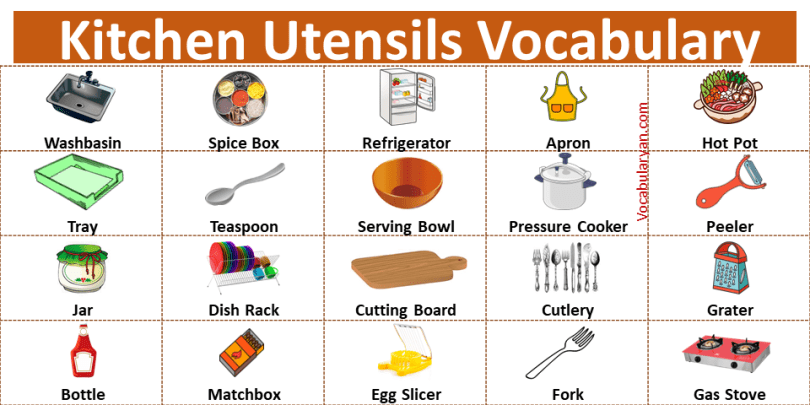
Kitchen utensils are the small handheld tools, pots, pans, and appliances used for preparing, cooking, serving, and eating food. English has 16 main categories of kitchen utensil names by function and use.
English kitchen utensils have 16 main categories: knives, spoons, forks and tongs, pots and pans, baking pans, mixing and whisking tools, food-preparation tools, measuring tools, straining tools, grinding tools, large appliances, small appliances, serving items, drinkware, storage items, and kitchen textiles.
Common Kitchen Utensil Names With Pictures
Each category is defined by function and use. Knives, spoons, and pots and pans are the three most-used kitchen tool families. The other 13 are forks and tongs, baking pans, mixing tools, food-preparation tools, measuring tools, straining tools, grinding tools, appliances, small appliances, serving items, drinkware, storage items, and textiles.
Kitchen Knife Names in English
Kitchen knives are the sharp-bladed cutting tools of every kitchen, each shaped for a specific cutting task.
Chef’s Knife
large all-purpose kitchen knife with an 8-10 inch curved blade, the primary knife of every professional and home chef. Chef’s knives chop, slice, dice, and mince vegetables, meats, and herbs.
Paring Knife
small 3-4 inch pointed kitchen knife for peeling fruits, mincing garlic, and delicate cuts. Paring knives are the second most-used knife in the kitchen after the chef’s knife.
Bread Knife
long 8-10 inch serrated kitchen knife with saw-like teeth for slicing bread without crushing. Bread knives cut through crusty loaves, tomatoes, and layer cakes with a gentle sawing motion.
Cleaver
heavy broad-bladed rectangular knife for chopping bones, meat, and hard vegetables. Cleavers are essential in Chinese cuisine, used for everything from mincing garlic to cracking coconuts.
Butter Knife
small dull-edged blade for spreading butter, cream cheese, and jam. Butter knives are placed at each table setting in formal dining as one of the classic Western table utensils.
Utility Knife
medium 5-7 inch knife bridging the size gap between chef’s knife and paring knife. Utility knives handle sandwiches, small fruits, tomatoes, and general slicing tasks around the kitchen.
Kitchen Spoon Names in English
Kitchen spoons are the shaped-bowl utensils for stirring, mixing, serving, and eating food.
Wooden Spoon
sturdy long-handled spoon made of hardwood for stirring hot foods without scratching cookware. Wooden spoons resist heat and are the traditional stirring tool across every cuisine worldwide.
Ladle
deep-bowled long-handled spoon for serving soups, stews, sauces, and punches. Ladles come in 4-8 ounce sizes as the classic party-serving utensil across every cuisine.
Slotted Spoon
serving spoon with drainage holes for lifting food from cooking liquid. Slotted spoons remove poached eggs from water, dumplings from broth, and pasta from sauce.
Serving Spoon
large-bowled spoon for scooping and serving food onto plates at the dinner table. Serving spoons are the classic side-dish serving utensil for rice, mashed potatoes, and vegetables.
Ice Cream Scoop
half-sphere metal scoop with a spring-loaded release lever for portioning ice cream. Ice cream scoops give even round balls of ice cream, sorbet, or meatball mixture for cooking.
Kitchen Fork and Tong Names
Kitchen forks and tongs are the pointed and clamping utensils for gripping, lifting, and eating food.
Fork
pointed 4-tine metal utensil for eating and cooking. Kitchen forks come in dinner, salad, dessert, and cooking sizes as one of the three classic Western cutlery pieces.
Tongs
scissor-like grabbing utensil with two arms for gripping and turning hot food. Tongs handle grilling, salad tossing, pasta serving, and any hot-food task the hand cannot manage.
Salad Tongs
lightweight two-armed serving utensil for tossing and lifting salad greens onto plates. Salad tongs come in wood, plastic, and stainless steel as the essential salad-bar serving tool.
Cooking Pot and Pan Names in English
Kitchen pots and pans are the primary cooking vessels used on the stovetop for boiling, frying, and sautéing.
Frying Pan (Skillet)
shallow flat-bottomed pan with sloped sides for frying, sautéing, and searing. Called a “frying pan” in British English and a “skillet” in American English, in every kitchen worldwide.
Saucepan
medium round pot with straight sides and a long handle for making sauces, gravies, and small-batch cooking. Saucepans come in 1-4 quart sizes as the daily-use kitchen pot.
Stock Pot
large deep round pot with two side handles for making stocks, broths, soups, and pasta. Stock pots come in 8-20 quart sizes for feeding crowds and batch cooking.
Wok
deep round-bottomed Chinese pan with sloped sides for high-heat stir-frying. Woks come in carbon steel and cast iron as the essential pan of Chinese, Thai, and Vietnamese kitchens.
Pressure Cooker
sealed pot that cooks food quickly under pressurized steam. Pressure cookers reduce cooking time by 70% and are the standard pot across Indian, South American, and modern Instant Pot kitchens.
Dutch Oven
heavy cast-iron pot with tight-fitting lid for slow-cooking, braising, and bread baking. Dutch ovens transfer from stovetop to oven as the classic French country cooking pot.
Baking Pan and Sheet Names
Baking pans and sheets are the oven-safe pans and dishes for baking cookies, cakes, breads, and roasted dishes.
Baking Sheet
flat rectangular metal tray with a rimmed edge for baking cookies, roasting vegetables, and sheet-pan dinners. Baking sheets come in aluminum and non-stick versions in half, quarter, and full-sheet sizes.
Cake Pan
round or square metal pan for baking layer cakes and celebration cakes. Cake pans come in 8-inch, 9-inch, and 10-inch rounds, along with springform, bundt, and angel-food specialty designs.
Muffin Tin
metal pan with 6 or 12 cup-shaped depressions for baking muffins and cupcakes. Muffin tins come in mini, standard, and jumbo sizes as the essential breakfast-baking pan.
Loaf Pan
rectangular deep-sided pan for baking bread, meatloaf, and pound cakes. Loaf pans come in standard 9×5-inch and 8×4-inch sizes in aluminum, glass, and ceramic materials.
Casserole Dish
deep oven-safe ceramic or glass dish for baking casseroles, gratins, and layered dishes. Casserole dishes go from oven to table for family-style serving across French, American, and Mediterranean cuisines.
Mixing and Whisking Utensil Names
Mixing and whisking tools are the utensils for combining, aerating, and blending ingredients during recipe preparation.
Whisk
wire-loop hand tool for beating, blending, and aerating liquid ingredients. Whisks come in balloon, French, and flat versions for whipping cream, mixing batter, and emulsifying sauces.
Mixing Bowl
round deep-sided bowl for combining ingredients during recipe preparation. Mixing bowls come in nesting sets of small, medium, and large in stainless steel, glass, and ceramic materials.
Spatula
flat wide-headed utensil with a handle for flipping food during cooking. Spatulas come in fish-flipping, pancake-flipping, and cake-icing styles in metal, silicone, or plastic materials.
Rubber Spatula
flexible silicone or rubber-headed spatula for scraping batter out of bowls and mixing wet ingredients. Rubber spatulas are the essential baking tool for reaching every last drop.
Silicone Turner
heat-resistant flexible silicone spatula-like tool for flipping delicate foods like fish and eggs. Silicone turners will not scratch non-stick cookware and withstand temperatures up to 500°F.
Food Preparation Tool Names
Food-preparation tools are the cutting, rolling, grating, and peeling tools used to ready ingredients before cooking.
Cutting Board
flat rigid surface for chopping and preparing food. Called a “cutting board” in American English and a “chopping board” in British English, in wood, bamboo, plastic, and glass materials.
Rolling Pin
long cylindrical wooden or marble tool for rolling out dough. Rolling pins come in straight French and tapered handled versions, essential for pastry, pie crust, and pasta making.
Grater
sharp-toothed metal tool for shredding cheese, vegetables, and zest. Graters come in box, flat, rotary, and microplane versions, each optimized for different foods and coarseness levels.
Peeler
small handheld tool with a swivel blade for removing skin from fruits and vegetables. Peelers come in Y-shaped, straight, and swivel styles as one of the most-used kitchen prep tools worldwide.
Mandoline
flat slicer with an adjustable blade for cutting uniform thin slices of vegetables. Mandolines produce perfectly even slices for gratins, chips, and salads, and require a hand guard for safety.
Kitchen Shears
heavy-duty scissors designed for cutting herbs, meat, and packaging. Kitchen shears come apart for cleaning and handle bones, seafood, and fibrous produce as an underrated kitchen tool.
Measuring Utensil Names in English
Measuring tools are the graduated cups, spoons, scales, and timers for precise recipe measurement and cooking control.
Measuring Cup
graduated cup with volume markings for measuring liquid or dry ingredients. Measuring cups come in liquid (spouted glass) and dry (nested metal) versions, essential for accurate baking.
Measuring Spoon
small graduated spoons in sets of 1/4 teaspoon to 1 tablespoon for measuring small amounts of ingredients. Measuring spoons are the essential recipe-following tool for precise baking.
Kitchen Scale
digital or mechanical device for weighing ingredients in grams, ounces, or pounds. Kitchen scales are the professional baker’s tool of choice for precision, gaining popularity in home baking.
Kitchen Timer
clock-face or digital device for counting down cooking time. Kitchen timers ensure precise cooking, and modern digital versions with multiple channels track several dishes cooking at once.
Straining Utensil Names in English
Straining tools are the perforated and mesh utensils for separating solids from liquids and sifting dry ingredients.
Colander
bowl with drainage holes for straining pasta, washing vegetables, and rinsing rice. Colanders come in stainless steel, plastic, and silicone materials with straight handles or side grips.
Sieve (Strainer)
fine wire-mesh basket for straining liquids and sifting dry ingredients. Sieves catch tea leaves, coffee grounds, and drain pasta water more finely than a colander.
Sifter
mesh device with a spring handle for aerating flour, powdered sugar, and cocoa. Sifters remove lumps from dry ingredients as the essential tool of every baker for even cake textures.
Skimmer
long-handled shallow slotted spoon for removing foam, oil, and impurities from soups and boiled foods. Skimmers are the professional cook’s tool for refined broths and pristine stocks.
Grinding and Crushing Tool Names
Grinding tools are the hand-powered utensils for crushing herbs, spices, garlic, and nuts.
Mortar and Pestle
heavy stone or ceramic bowl and blunt grinding stick for crushing herbs, spices, and pastes by hand. Mortars and pestles are the traditional grinding tool of Thai, Indian, and Mediterranean kitchens.
Garlic Press
hinged tool with tiny holes for crushing garlic cloves without peeling. Garlic presses produce a fine paste-like mince and speed up cooking prep for garlic-heavy recipes.
Pepper Mill
tall cylindrical grinder with an internal blade for freshly cracking peppercorns onto food. Pepper mills come in wood, ceramic, and acrylic in table and cooking sizes.
Nutcracker
metal hinged tool with a leverage arm for cracking open shells of walnuts, pecans, and hazelnuts. Nutcrackers come in classic pliers style, tabletop screw-press, and decorative wooden Christmas versions.
Kitchen Appliance Names in English
Large kitchen appliances are the built-in and freestanding machines that form the backbone of every modern kitchen.
Refrigerator
large upright appliance with cold and freezer compartments for storing food. Refrigerators come in top-freezer, bottom-freezer, side-by-side, and French-door designs in 15-30 cubic foot capacities.
Oven
electric or gas appliance for baking, roasting, and broiling food at temperatures up to 500°F. Ovens come as part of the stove or as separate wall-mounted units.
Microwave
countertop or built-in appliance that heats food using microwave radiation. Microwaves warm leftovers, defrost frozen food, and cook quick dishes in minutes, in every modern kitchen.
Stove (Cooker)
main cooking appliance with burners on top and an oven below. Called a “stove” in American English and a “cooker” or “hob” in British English, powered by gas, electric, or induction.
Dishwasher
built-in appliance that washes dishes automatically using hot water and detergent. Dishwashers save 4-5 hours a week over hand-washing and use less water than washing by hand.
Small Kitchen Appliance Names
Small kitchen appliances are the countertop electric devices for coffee, blending, mixing, and specialty cooking.
Toaster
countertop appliance with slots for browning slices of bread with heating elements. Toasters come in 2-slice, 4-slice, and long-slot bread versions with browning-level controls.
Coffee Maker
electric appliance that brews coffee by dripping hot water through ground beans. Coffee makers come in drip, single-serve pod, espresso, and French press pour-over varieties.
Electric Kettle
plug-in appliance that heats water to boiling in 2-4 minutes. Electric kettles are the standard morning appliance across UK, Australia, and India kitchens for tea and instant coffee.
Blender
tall pitcher on a motorized base with rotating blades for pureeing liquids and soft foods. Blenders make smoothies, soups, sauces, and cocktails at high speeds up to 30,000 rpm.
Stand Mixer
heavy motorized appliance with a bowl and attachments for mixing dough, batter, and creamed ingredients. Stand mixers mix hands-free with paddle, whisk, and dough hook attachments.
Food Processor
motorized appliance with rotating blades in a large bowl for chopping, slicing, shredding, and pureeing food. Food processors handle bulk vegetable prep and speed up cooking for large recipes.
Kitchen Serving Item Names
Kitchen serving items are the bowls, platters, and trays for presenting food at the table.
Serving Bowl
large deep bowl for presenting salads, pastas, and side dishes at the table. Serving bowls come in ceramic, wood, glass, and stainless steel, sized to feed 4-8 people at once.
Serving Platter
large flat oval or rectangular dish for presenting roasted meats, seafood, and appetizer spreads. Serving platters come in porcelain, wood, slate, and glass for family-style meal service.
Tray
flat surface with raised edges for carrying multiple dishes at once. Trays come in serving, breakfast, bar, and TV-tray styles in wood, metal, and lacquered materials.
Salad Bowl
large wide shallow bowl for serving salads with dressing. Salad bowls come in wood, glass, and ceramic, paired with matching salad servers for family and party service.
Bread Basket
shallow woven basket lined with a cloth napkin for serving bread rolls warm at the table. Bread baskets are the classic Mediterranean and European dining accessory, keeping bread soft during meals.
Kitchen Drinkware Names in English
Kitchen drinkware are the cups, mugs, and glasses for hot and cold beverages.
Cup
small handled drinking vessel for hot beverages like tea and coffee. Cups come in porcelain, ceramic, glass, and paper, standard sized at 6-8 ounces in Western kitchens.
Mug
larger straight-sided handled drinking vessel for coffee, tea, and hot chocolate. Mugs come in ceramic, stoneware, and glass, in 10-16 ounce capacities for casual daily drinking.
Glass
tall or short transparent vessel for cold beverages like water, juice, and soft drinks. Drinking glasses come in tumbler, highball, rocks, and pint sizes for every drink style.
Water Bottle
portable insulated or non-insulated bottle for carrying water throughout the day. Water bottles come in stainless steel, glass, plastic, and aluminum with screw or flip-top lids.
Wine Glass
stemmed glass vessel for serving wine at the correct temperature. Wine glasses come in red-wine (wider bowl), white-wine (narrower), champagne (flute), and dessert wine specialty shapes.
Kitchen Storage and Prep Item Names
Kitchen storage items are the jars, bottles, and containers for keeping food fresh and organized.
Jar
glass or ceramic container with a screw-top or clip lid for storing dry goods, preserves, and pickles. Jars come in Mason, Weck, and Kilner styles in kitchens worldwide.
Bottle
narrow-necked container for storing and pouring liquids like oil, vinegar, syrup, and juice. Kitchen bottles come in glass, plastic, and ceramic with pour spouts and airtight seals.
Storage Container
plastic, glass, or silicone container with a snap or screw lid for storing leftovers, meal-prep, and pantry ingredients. Storage containers stack in the fridge and freezer safely.
Bread Bin (Bread Box)
countertop container with a lid or roll-top door for storing bread at room temperature. Called a “bread bin” in British English and a “bread box” in American English, keeping bread fresh.
Spice Rack
tiered shelf or rotating carousel for organizing spice jars near the cooking area. Spice racks come in wall-mounted, countertop, drawer-insert, and rotating carousel designs for quick spice access.
Kitchen Textile and Accessory Names
Kitchen textiles and accessories are the fabric protective items and drying tools for a safe, tidy kitchen.
Apron
protective cloth or leather garment worn over clothes while cooking. Aprons come in bib, waist, and cross-back styles in cotton, canvas, and linen materials, protecting from splashes and stains.
Oven Mitt (Oven Gloves)
padded heat-resistant hand covering for handling hot pans and dishes. Called “oven mitts” in American English and “oven gloves” in British English, essential for safe hot-pan handling.
Kitchen Towel
absorbent cloth or paper towel for drying hands, wiping spills, and drying dishes. Kitchen towels come in cotton (dish towel, tea towel), linen, and paper roll versions.
Dish Rack
metal or plastic rack for air-drying washed dishes and glassware. Dish racks come in over-the-sink, countertop, and roll-up mat designs for kitchens with and without dishwashers.
Kitchen Items That Look Similar
Some kitchen utensil names cause confusion for English learners.
Utensils vs Cookware vs Appliances
| Type | Meaning |
|---|---|
| Utensil | Small handheld tool for cooking or eating (spoon, knife, whisk, tongs) |
| Cookware | Pots, pans, and vessels used for cooking on the stove or in the oven (frying pan, saucepan, wok) |
| Appliance | Electric or gas powered machine for cooking or storing food (oven, microwave, refrigerator, blender) |
All utensils are kitchen tools, but not all kitchen tools are utensils. Utensils are handheld; cookware goes on the heat; appliances are powered.
Frying Pan vs Skillet vs Sauté Pan
| Pan | Meaning |
|---|---|
| Frying Pan | Shallow pan with sloped sides for frying (British English term) |
| Skillet | Same as frying pan (American English term) |
| Sauté Pan | Deeper pan with straight sides for sautéing with liquid |
Frying pan and skillet are the same pan under different names. Sauté pans are deeper for cooking with more liquid.
British vs American Kitchen Vocabulary
| British English | American English |
|---|---|
| Cooker / Hob | Stove / Range |
| Frying Pan | Skillet |
| Chopping Board | Cutting Board |
| Oven Gloves | Oven Mitts |
| Cling Film | Plastic Wrap |
| Tin Foil | Aluminum Foil |
| Washing-Up Liquid | Dish Soap |
| Bread Bin | Bread Box |
| Tea Towel | Kitchen Towel |
| Muslin | Cheesecloth |
British and American English use different names for many kitchen items. British says “cooker” and “frying pan”; Americans say “stove” and “skillet.”
Sieve vs Colander vs Sifter vs Strainer
| Tool | Purpose |
|---|---|
| Colander | Large bowl with big drainage holes for pasta and washing vegetables |
| Sieve | Fine wire mesh for straining liquids and dry sifting |
| Sifter | Mesh with spring-handle specifically for aerating flour |
| Strainer | General term for any straining tool |
Colanders have big holes for pasta water. Sieves have fine mesh for tea and stocks. Sifters aerate flour. “Strainer” is the general umbrella term.
Spatula vs Turner vs Fish Slice
| Tool | Meaning |
|---|---|
| Spatula (US) | Flat flipping tool (American term) |
| Turner | Flat flipping tool (professional cooking term) |
| Fish Slice (UK) | Same tool (British English term) |
| Spatula (UK) | Rubber scraper for bowls (British English differs from US) |
The word “spatula” causes confusion: in America it means the flipping tool; in Britain it means the rubber scraper. British “fish slice” = American “spatula/turner.”
FAQs
Q1. What is the difference between kitchen tools, utensils, and appliances?
Kitchen utensils are small handheld tools used for cooking, serving, and eating (spoons, knives, whisks, tongs, spatulas). Kitchen cookware is pots, pans, and vessels used for cooking food over heat (frying pans, saucepans, woks, baking sheets). Kitchen appliances are electric or gas powered machines for cooking or storing food (ovens, microwaves, blenders, refrigerators). All utensils are kitchen tools, but not all kitchen tools are utensils.
Q2. What is the difference between a frying pan and a skillet?
A frying pan and a skillet are the same cooking pan under two different names. British English speakers say “frying pan”; American English speakers say “skillet.” Both refer to a shallow pan with sloped sides for frying, sautéing, and searing food. A “sauté pan” is a different piece of cookware with deeper straight sides for cooking with more liquid.
Q3. What are the essential kitchen utensils for a new home?
Essential kitchen utensils are: chef’s knife, paring knife, bread knife, cutting board, wooden spoon, ladle, tongs, spatula, whisk, mixing bowls (small, medium, large), measuring cups, measuring spoons, colander, peeler, grater, frying pan (skillet), saucepan, stock pot, and baking sheet. These 20 tools handle 90% of daily cooking needs in a new home kitchen.
Q4. What are British and American kitchen vocabulary differences?
British and American English use different kitchen vocabulary. British says cooker/hob (US: stove/range), frying pan (US: skillet), chopping board (US: cutting board), oven gloves (US: oven mitts), cling film (US: plastic wrap), tin foil (US: aluminum foil), washing-up liquid (US: dish soap), and tea towel (US: kitchen towel). Both are correct in their region.
Q5. What is the difference between a colander, sieve, sifter, and strainer?
A colander is a large bowl with big drainage holes for draining pasta and washing vegetables. A sieve is a fine wire-mesh basket for straining liquids and sifting dry ingredients. A sifter is a spring-handled mesh device specifically for aerating flour and powdered sugar. “Strainer” is the general umbrella term for any straining tool. All four separate solids from liquids or lumps from powders.
Q6. What are the 10 most-used kitchen utensils?
The 10 most-used kitchen utensils are: chef’s knife (for chopping), cutting board (for prep), wooden spoon (for stirring), spatula (for flipping), ladle (for serving soups), whisk (for beating eggs and batter), tongs (for grabbing hot food), measuring cup (for portions), colander (for draining), and mixing bowl (for combining ingredients). These 10 tools handle over 80% of daily cooking tasks.

Leave a Comment