
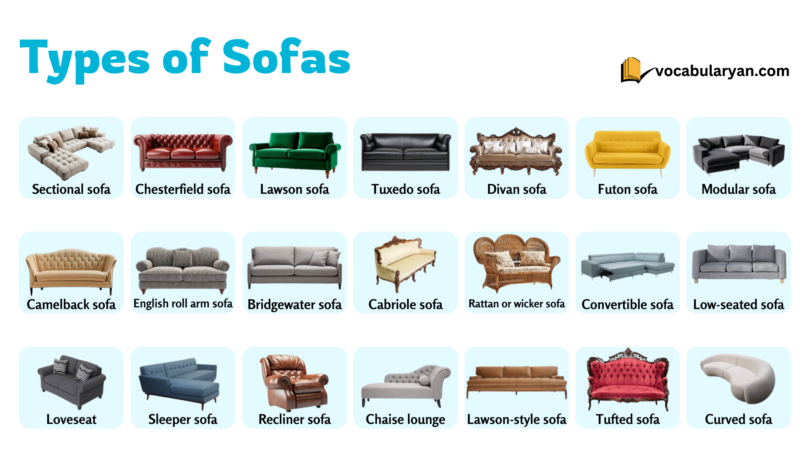
A sofa’s shape, arm style, and frame material change how it fits a room and how it feels to sit on, from a deep-cushioned Chesterfield to a slim modern sectional. Sorting the types of sofas by style and function helps a shopper or learner find the right word for the right piece of furniture.
Types of Sofas by Style and Function
A sofa’s shape decides its main category: classic, modern, sectional, or reclining. Arm shape, frame material, and design era decide the exact type of sofa within that category. Arm curve, back shape, and section count set one sofa type apart from another.
Classic and Traditional Sofas
These types of sofas favor tufted upholstery, curved or rolled arms, and a formal presence built for a traditional living room.
- Chesterfield Sofa: deep button-tufted leather, rolled arms level with the back, and a low-slung, formal profile. It suits a library or a study aiming for an old-money look.
- Camelback Sofa: a back that rises in the center like a camel’s hump, paired with rolled arms and short wooden legs. This shape has stayed a fixture of traditional living rooms for over a century.
- Lawson Sofa: loose or attached back cushions sit above lower rolled or square arms, giving a relaxed, lived-in silhouette. Its soft profile made it one of the most widely copied designs of the 20th century.
- English Roll Arm Sofa: low, softly rolled arms and deep seat cushions define this shape, built for sinking into rather than sitting upright. English country homes popularized the look well before it spread worldwide.
- Bridgewater Sofa: a low back, softly rolled arms, and a slightly reclined seat give this sofa an unusually casual feel for a classic design. It reads as less formal than a Chesterfield despite sharing a similar era.
- Tuxedo Sofa: straight, squared arms rise to the same height as the back, creating a boxy, tailored silhouette. The name nods to its crisp, formal-wear-like lines.
- Cabriole Sofa: curved, exposed wooden legs and a gently curved back give this sofa a delicate, almost sculptural look. It draws directly from 18th-century French furniture design.
- Knole Sofa: tall, adjustable side arms held in place by rope and tassels let the sides fold outward. Originally built for English nobility, the rope mechanism still marks it as unmistakably grand.
- Club Sofa: rounded arms, deep cushions, and a relaxed lounge feel echo the leather club chairs it was designed to match. Hotel lobbies and private studies use it often.
- Victorian Sofa: ornate wood carving, curved backs, and tufted upholstery reflect the heavy decorative style of the era. Rich fabrics like velvet or brocade usually complete the look.
- Settee: a small, formal seat for two or three, often with an exposed wooden frame and a straight or gently curved back. Entryways and small sitting rooms use it more than a full-size sofa would fit.
Modern and Minimalist Sofas
These types of sofas trade ornamentation for straight lines, low profiles, and bare, uncluttered frames.
- Track Arm Sofa: straight, narrow arms run parallel to the seat with no curve or taper, giving a sharp, architectural edge. Contemporary living rooms favor this shape for its uncluttered look.
- Armless Sofa: the seat ends without any raised side support at all, letting the upholstery run flat from end to end. This design saves width in a small room and pairs easily with sectional pieces.
- Mid-Century Modern Sofa: low, tapered wooden legs and a slim, rectangular frame define this style, born in the 1940s through the 1960s. Its spare geometry still drives much of today’s furniture design.
- Low-Profile Sofa: a shorter back and seat height than a standard sofa give this design a grounded, spread-out feel. Studio apartments and open-plan rooms often use it to keep sightlines clear.
- Bench-Seat Sofa: one continuous, unbroken cushion replaces the usual two or three separate seat cushions. The flat surface removes the visible gaps that standard sofas show between cushions.
- Square Arm Sofa: flat-topped, angular arms give this sofa sharp, geometric lines rather than a soft curve. It suits rooms built around a modern, minimal aesthetic.
- Boxy Modular Sofa: rigid, cube-like sections connect to form the overall shape, favoring sharp angles over any rounded edge. Its rigid sections separate and rearrange more easily than a soft-framed sofa.
- Floating Base Sofa: the frame appears to hover above the floor, supported by a recessed base or slim exposed legs. Rooms with hard flooring often gain a lighter, airier feel from this design.
- Metal Leg Sofa: slim metal legs, usually in black, brass, or chrome, replace the wooden legs of a traditional frame. The contrast between soft upholstery and hard metal defines its modern character.
- Contemporary Curved Sofa: a rounded, flowing silhouette replaces the straight lines of most modern furniture, often built in sections that follow a gentle arc. Statement living rooms increasingly favor this shape over a standard rectangular sofa.
- Platform Sofa: a low, wide base extends beyond the seat cushions themselves, creating a solid visual foundation. This design pairs naturally with the same low-profile aesthetic found in platform beds.
Sectional Sofas
These types of sofas connect multiple sections into one larger seating arrangement, built for filling a corner or a large room.
- L-Shaped Sectional: two connected sections meet at a right angle, forming the letter L and filling a corner efficiently. It remains the most common sectional shape sold today.
- U-Shaped Sectional: three connected sections wrap around an open middle space, seating far more people than a standard sofa. Large family rooms or media rooms make the best use of its size.
- Curved Sectional: the connected sections follow a gentle arc instead of a sharp corner, softening the overall shape. It works well in a room without a strong right-angle corner to fill.
- Modular Sectional: individual pieces connect and separate freely, letting an owner rearrange the whole layout as needs change. This flexibility sets it apart from a fixed L- or U-shaped design.
- Reclining Sectional: one or more sections have a reclining mechanism fitted into the seat, combining sectional size with recliner comfort. Home theater rooms rely on this combination often.
- Pit Sectional: deep, low seating surrounds a central open area, creating a sunken, lounge-like feel. The design favors lying back and relaxing over sitting upright.
- Two-Piece Sectional: exactly two connected sections make up the whole sofa, offering sectional seating without the bulk of a full L- or U-shape. Smaller living rooms often choose this scaled-down option.
- Chaise Sectional: one end extends into a chaise longue for stretching the legs out fully, while the rest keeps a standard sofa shape. This hybrid shape suits anyone who wants to lie down without buying a separate chaise.
- Reversible Sectional: the chaise or extended section can be moved to either side, since the frame allows both configurations. This adaptability matters most when a room’s layout might change later.
- Semi-Attached Sectional: the sections connect but keep a slight visual separation rather than reading as one solid piece. It offers a middle ground between a fully joined sectional and separate matching sofas.
- Wraparound Sectional: connected sections extend along two or more walls, following the room’s shape rather than a fixed L or U. Large or irregularly shaped rooms benefit most from this custom-fit layout.
Recliner Sofas
These types of sofas build a reclining mechanism directly into the seat, letting the backrest tilt and the footrest extend for added comfort.
- Manual Recliner Sofa: a side lever or handle physically releases the footrest and tilts the backrest. It needs no power source, making it the simplest and most affordable reclining option.
- Power Recliner Sofa: a button triggers a motor that adjusts the footrest and backrest automatically. The smoother motion comes at a higher price than a manual mechanism.
- Wall-Hugger Recliner: the seat itself slides forward as the footrest extends, so the whole sofa needs only a few inches of clearance from the wall. Small rooms benefit from this space-saving reclining mechanism.
- Rocker Recliner: a gentle rocking motion is built into the base in addition to the standard reclining function. Nurseries and living rooms alike use this motion for soothing, repetitive movement.
- Massage Recliner Sofa: built-in motors vibrate or knead the backrest and seat cushions for a massage effect while reclined. Some models add adjustable intensity settings for different pressure levels.
- Lift-Assist Recliner: a motor tilts the entire seat forward and upward, helping someone stand up without straining their knees or back. Older adults and people with limited mobility rely on this feature most.
- Dual-Seat Recliner: two individual reclining seats sit side by side within what looks like a single loveseat. Each side reclines independently of the other.
- Sleeper Recliner Sofa: the frame folds flat into a bed in addition to its normal reclining positions. This combination suits a guest room that also needs everyday seating.
- Power Headrest Recliner: a separate motor adjusts the headrest angle independently of the backrest and footrest. Reading or watching television benefits from this extra, targeted adjustment.
- Zero-Gravity Recliner: the seat tilts back until the legs sit level with or above the heart, mimicking the posture astronauts use during liftoff. This position is designed to reduce spinal pressure and improve circulation.
Sofa Beds and Sleepers
These types of sofas fold, unfold, or convert into a usable bed, doubling as seating by day and sleeping space by night.
- Sleeper Sofa: a mattress folds out from inside the frame, turning ordinary seating into a usable bed. Guest rooms and studio apartments rely on this dual purpose constantly.
- Divan: a plain, low, backless or low-backed couch, often placed against a wall and used for both sitting and reclining. Its stripped-down frame traces back to Ottoman and Middle Eastern furniture traditions.
- Pull-Out Sofa Bed: a hidden frame and mattress slide out from beneath or within the seat cushions. Unlike a full sleeper sofa, the mechanism is usually simpler and lighter to operate.
- Futon Sofa: a single flat mattress-like cushion folds between a full upright seat and a flat bed position. Its frame usually shows plainly, without the upholstered bulk of a standard sofa.
- Daybed with Backrest: a bed-width frame has a raised back and sometimes armrests, letting it function as both a sofa by day and a bed by night. Small apartments and home offices use this dual role often.
- Bunk Bed Sofa: a sofa converts into the lower level of a bunk bed, with a second sleeping level built in above it. Children’s rooms and shared spaces get extra sleeping capacity without extra floor space.
- Fold-Flat Sleeper Sofa: the entire seat back folds down level with the seat cushions, forming a flat sleeping surface without pulling out a separate mattress. This mechanism trades some sleeping comfort for a simpler, lighter frame.
- Convertible Sectional Sleeper: one or more sections of a sectional have a fold-out sleeping mechanism built in, combining full sectional seating with overnight sleeping capacity. Larger households gain flexible seating and a spare bed in one piece of furniture.
- Click-Clack Sofa: a ratcheting mechanism lets the backrest click into several fixed positions between upright and fully flat. The name comes from the sound the mechanism makes as it locks into place.
Modular Sofas and Loveseats
These types of sofas either rearrange freely as individual pieces or scale down to a compact two-seat frame for smaller rooms.
- Modular L-Shape Sofa: individual modular pieces arrange into an L shape, but unlike a fixed sectional, each piece can later separate into a different layout. This adaptability suits anyone who expects to move or redecorate.
- Modular Corner Sofa: a dedicated corner piece anchors the layout, with straight modular sections extending from it in either direction. The corner piece itself often seats more people than a standard straight section.
- Modular Chaise Sofa: a chaise-style piece attaches to a run of modular sections, offering a stretched-out seat within an otherwise reconfigurable layout. Owners can detach and relocate the chaise piece as their room layout changes.
- Modular Ottoman Unit: a cushioned, legless unit matches the modular seating pieces and can serve as a footrest, extra seat, or small table. Its matching upholstery lets it blend into the sectional rather than standing out as separate furniture.
- Modular Curved Unit: a curved modular piece breaks up the straight lines of a standard rectangular layout. Combining several curved units can build an arc or a circular seating arrangement.
- Modular U-Shape Set: several modular pieces combine into a U shape, matching the seating capacity of a fixed U-shaped sectional while keeping the option to rearrange later. Large households favor this set for both its size and its flexibility.
- Modular Bench Unit: a single backless bench-style piece adds extra seating without arms or a backrest. It works well as overflow seating pulled up to a coffee table.
- Floating Modular Set: slim, raised legs lift each modular piece off the floor, giving the whole arrangement a lighter visual weight than a set with a solid base. Rooms with hard flooring show the gap beneath each piece clearly.
- Traditional Loveseat: a two-seat sofa built at roughly half the width of a standard three-seat sofa. Small living rooms and bedrooms use it where a full sofa would crowd the space.
- Reclining Loveseat: built like a standard loveseat, but each of its two seats has its own reclining mechanism. Couples get individual recline control within a single, space-saving piece.
- Tufted Loveseat: buttons pulled tight into the upholstery create a diamond or square pattern of indentations across the back and seat. This detailing gives even a small loveseat a more formal, finished look.
- Convertible Loveseat: the seat folds out into a small bed, following the same principle as a full sleeper sofa but at loveseat scale. Compact guest rooms benefit from the extra sleeping option without the footprint of a full sleeper sofa.
- Curved Loveseat: a gently arced back and seat replace the straight lines of a standard loveseat. Rounded reading nooks or bay windows fit this shape more naturally than a straight-backed piece.
- Compact Loveseat: built noticeably smaller than a standard loveseat, trimming both width and depth. Tight apartments and narrow hallways or entryways can fit this scaled-down size where even a standard loveseat would not.
Arm and Back Style Variations
These types of sofas differ mainly in one construction detail, whether that is the arm’s curve or the way the back cushion is built.
- Rolled Arm Sofa: the arm curves outward and downward in a soft roll rather than ending in a flat or squared edge. This shape appears across many classic sofa styles, from the Chesterfield to the English roll arm.
- Scroll Arm Sofa: the arm curls inward at the top, forming a shape close to a scroll or a wave. It reads as slightly more delicate than a fuller rolled arm.
- Box Arm Sofa: the arm rises straight up in a flat, squared block with no curve at all. Modern and track-arm sofas rely on this shape for their sharp, geometric look.
- Wingback Sofa: tall side panels extend forward from the back, framing the head and shoulders on each side. Originally built to block drafts near a fireplace, the design has remained common for its distinctive silhouette.
- Tight Back Sofa: the back cushion is sewn permanently into the frame rather than sitting as a separate, removable cushion. This construction keeps a crisp, unwrinkled look that a loose cushion cannot hold over time.
- Pillow Back Sofa: loose, separate cushions form the back rest instead of a fixed, upholstered panel. Owners can fluff, flip, or rearrange these cushions as they wear unevenly.
- Channel-Tufted Sofa: long vertical or diagonal seams run down the back cushion, creating a ribbed, channeled pattern instead of the diamond pattern of standard tufting. Mid-century and contemporary designs both use this detail often.
- Deep-Seated Sofa: the seat cushion extends noticeably farther from the backrest than a standard sofa allows. People who prefer sitting cross-legged or fully reclined favor this extra depth.
Sofas by Material
These types of sofas are named for the material wrapped around or built into the frame, from real leather to engineered wood.
- Genuine Leather Sofa: real animal hide wraps the frame, aging into a softer, more textured surface over years of use. Its natural material commands a higher price than any synthetic alternative.
- Faux Leather Sofa: a synthetic material mimics leather’s look and texture at a fraction of the cost. It resists water better than real leather but tends to crack sooner with heavy use.
- Top Grain Leather Sofa: the outermost, most durable layer of the hide is used, sanded lightly to remove natural blemishes. It balances durability with a smoother finish than full, unsanded leather.
- Aniline Leather Sofa: the hide is dyed with soluble dyes rather than coated with a surface pigment, keeping the leather’s natural texture and markings visible. This process produces a softer feel but leaves the surface more prone to staining.
- Suede Leather Sofa: the underside of the hide is buffed to a soft, napped finish rather than the smooth top surface. This texture feels soft to the touch but shows water marks and wear more easily than smooth leather.
- Bonded Leather Couch: scraps of leftover leather are bonded onto a fabric backing with a polyurethane coating. It costs less than real leather but wears through and peels faster.
- Recycled Leather Sofa: reclaimed leather fibers are processed and reformed into a new usable material rather than sourced from a single fresh hide. This process reduces waste compared to using entirely new leather.
- Cotton Fabric Sofa: woven cotton wraps the frame, offering a breathable, natural feel at a moderate price. It softens with age but stains more easily than synthetic blends.
- Linen Upholstered Sofa: a textured, slightly rougher natural fiber gives this sofa a relaxed, matte finish. Linen wrinkles and creases more visibly than tightly woven cotton or synthetic fabric.
- Velvet Fabric Sofa: short, dense fibers stand upright from the base fabric, creating a soft texture and a subtle sheen that shifts with the light. Its plush feel comes at the cost of easily showing pile marks from pressure.
- Chenille Sofa: a fuzzy, textured yarn is woven into the upholstery, giving a soft, slightly nubby surface. It feels similar to velvet but usually costs less and wears more evenly.
- Polyester Blend Sofa: synthetic polyester fibers are mixed with other materials for added durability and stain resistance. This blend holds up well to households with children or pets.
- Wool Fabric Couch: natural wool fiber wraps the frame, offering warmth, durability, and natural resistance to stains. It costs more than most synthetic fabrics but lasts considerably longer.
- Microfiber Sofa: extremely fine synthetic fibers are woven tightly together, creating a soft surface that resists stains and spills well. Households with children or pets often choose it for quick cleanup.
- Bouclé Fabric Sofa: a looped, textured yarn gives the surface a bumpy, curl-like appearance similar to sheep’s wool. The style has become closely associated with rounded, contemporary sofa shapes.
- Hardwood Frame Sofa: a solid hardwood skeleton, such as oak or maple, supports the cushions and upholstery beneath the surface. This frame typically outlasts cheaper softwood or particleboard construction by decades.
- Plywood Frame Sofa: layered, glued wood sheets form the internal frame instead of solid hardwood. It costs less than solid wood while still offering reasonable strength.
- Metal Frame Sofa: steel or aluminum forms the internal structure instead of any wood. This frame resists warping from humidity better than a wood-based structure.
- Stainless Steel Frame: a corrosion-resistant steel alloy forms the visible or structural frame, often left exposed as part of the design. Outdoor and patio sofas rely on this material for weather resistance.
- Reclaimed Wood Sofa: timber salvaged from old buildings, barns, or furniture forms the visible frame, keeping the wood’s existing marks and history. Each piece shows slightly different grain and wear from the last.
- Engineered Wood Frame: manufactured wood products, such as particleboard or MDF, form a budget-friendly internal frame. It sacrifices some long-term durability for a substantially lower price than solid wood.
Sofa Styles by Era
These types of sofas borrow their shape from a specific design period, updating or preserving details from earlier decades.
- Modern Chesterfield: the traditional deep-tufted, rolled-arm shape is simplified with cleaner lines and a lower profile. Contemporary rooms use it for a more updated take on the original 19th-century design.
- Victorian Carved Wood Sofa: intricate hand-carved wood trim frames the upholstery, often finished with dark stains and ornate detailing. This craftsmanship reflects the elaborate decorative standards of the era.
- Upholstered Victorian Settee: a small Victorian-era seat is fully covered in fabric rather than leaving carved wood exposed, softening the formal look. Rich, patterned fabric usually completes the period style.
- Floral Victorian Couch: a patterned floral fabric wraps the frame, matching the decorative textiles common during the Victorian period. The busy pattern usually pairs with carved wood trim for a complete period look.
- Tapered Leg Sofa: the legs narrow gradually from a wider top to a slim point at the floor. This detail is one of the clearest visual markers of mid-century modern design.
- Button-Tufted Mid-Century Sofa: buttons pull the upholstery into a grid or diamond pattern across a low, angular mid-century frame. The tufting adds texture to what is otherwise a very plain, understated shape.
- Box-Shaped Retro Sofa: a rigid, rectangular frame with minimal curves recalls the boxier furniture shapes of past decades. Straight lines throughout replace the soft curves of earlier traditional designs.
- Teak Wood Frame Sofa: a dense, naturally water-resistant hardwood forms the visible frame, closely associated with mid-century Scandinavian design. Its rich color deepens further with age.
- High-Leg Modern Design: legs raise the entire frame noticeably higher off the floor than most contemporary sofas. This height adds visual lightness and leaves more of the floor visible beneath the frame.
- Mixed Material Sofa: two or more distinct materials, such as wood, metal, and fabric, appear together in one frame rather than a single unified material. Contemporary designers use this combination to create contrast and visual interest.
FAQs
Q1. What is the most comfortable type of sofa?
The Lawson sofa and the English roll arm sofa are both known for their deep cushions and soft, low armrests, making them among the most comfortable classic choices. Among modern options, a deep-seated sofa or a pit sectional offers a similarly relaxed, sink-in feel.
Q2. What separates these two types of sofas: sectional and modular?
A sectional sofa comes in pre-arranged sections designed to fit together in one specific layout, such as an L or U shape. A modular sofa uses individual pieces that can be rearranged freely into different layouts as needs change.
Q3. Which sofa is best for small spaces?
Loveseats, futons, and armless sofas all work well in small spaces since they take up less width and depth than a standard three-seat sofa. A compact loveseat or a two-piece sectional can add seating without overwhelming a tight room.
Q4. What is the difference between a sofa bed and a sleeper sofa?
The terms are largely interchangeable, though “sleeper sofa” often refers specifically to designs with a pull-out mattress stored inside the frame. “Sofa bed” can also describe simpler mechanisms, such as a futon or a click-clack frame that folds flat without a separate mattress.
Q5. Among classic types of sofas, what makes a Chesterfield different?
A Chesterfield is defined by deep button tufting, rolled arms set at the same height as the back, and a low, formal profile, usually in leather. Other classic styles, such as the Lawson or camelback, share a similar era but use looser cushions or a distinctly shaped back instead of all-over tufting.
Q6. Is a loveseat the same as a settee?
Not exactly. A loveseat is a small, upholstered two-seat sofa built like a scaled-down version of a standard sofa, while a settee often has a more formal, sometimes exposed wooden frame and a straighter back. Both seat two to three people, but a settee tends to look more decorative than a loveseat.

Leave a Comment