
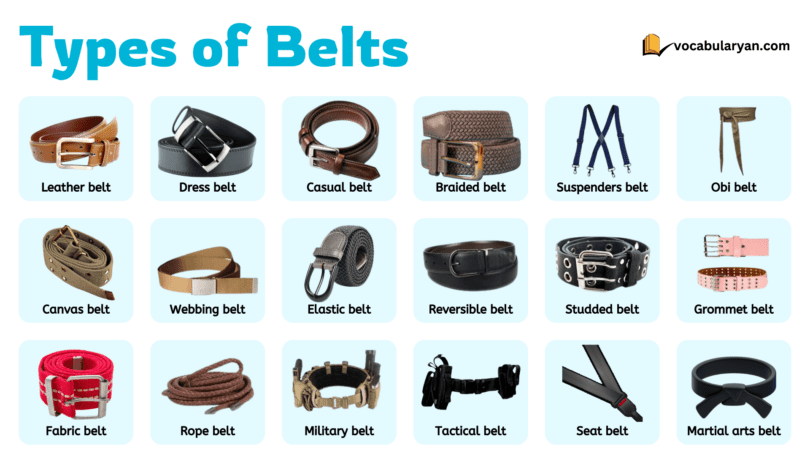
A belt holds up trousers, carries tools, supports a lifter’s back, or finishes an outfit, and the material and buckle change depending on which job it does. Formal leather differs from tactical webbing, and a dress buckle works nothing like a ratchet mechanism built for quick sizing.
Types of Belts by Style and Material
Belt names sort naturally by how formal the setting is, what the belt is made from, and how it fastens, so a business belt and a powerlifting belt never end up filed under the same label.
Formal and Business Belts
These types of belts pair with dress shoes and tailored suits, favoring smooth leather over rougher textures.
- Black Leather Belt: the standard choice for business and formal wear, cut from smooth leather with a slim, understated buckle. Dress shoes and formal trousers pair with it by default.
- Brown Leather Belt: matches brown or tan dress shoes and works well with lighter suits than black leather allows. Its warmer tone reads as slightly less formal than black.
- Reversible Dress Belt: flips inside out to switch between black and brown with one belt, using a rotating buckle to lock either side in place. Business travelers favor it for packing less.
- Polished Finish Belt: buffed to a glossy shine rather than left with a matte surface, giving it a sharper look for formal events. The shine also makes scuffs and scratches more visible over time.
- Slim Formal Belt: narrower than a standard leather belt, cut to sit under a fitted suit without adding bulk at the waist. Tailored, slim-fit trousers call for this narrower width.
- Italian Leather Belt: made from leather tanned and finished using traditional Italian methods, prized for softness and a fine grain. The reputation behind the name often means a higher price tag too.
- Business Classic Belt: a plain, no-frills leather belt built for daily office wear rather than any particular trend. Its buckle stays small and its color stays neutral.
- Patent Leather Belt: coated to a hard, glass-like shine, typically matched with patent leather shoes for black-tie events. The coating makes it far less flexible than untreated leather.
Casual and Everyday Belts
These types of belts favor comfort and flexibility over polish, suited to jeans, shorts, and other relaxed outfits.
- Fabric Belt: woven from cotton or a similar textile rather than leather, giving a softer, more relaxed look. It pairs easily with jeans, shorts, and other informal outfits.
- Woven Belt: made by interlacing strips of material into a flexible band, often shown off through a woven-front buckle. The texture adds visual interest that a plain strap lacks.
- Braided Belt: twisted from several thin leather or fabric strands into a rope-like pattern. Its flexible weave suits khakis and other smart-casual pants well.
- D-Ring Belt: threads through two metal rings instead of a buckle and pin, adjusting to any length by pulling the strap tight. Its stripped-down look suits a casual, outdoorsy outfit.
- Denim Belt: cut from the same sturdy cotton twill as jeans, sometimes stitched to match a specific denim wash. It reinforces a casual, workwear-inspired look.
- Rope Belt: made from twisted or braided cord rather than a flat strap, tied or buckled at the front. Sailing and nautical-themed outfits often use this style.
- Velcro Belt: fastens with a hook-and-loop strip instead of a buckle, adjusting instantly to any waist size. Kids’ clothing and travel outfits use it for the quick, tool-free fit.
- Colored Canvas Belt: made from dyed cotton canvas in bright or pastel shades rather than the usual neutral tones. Summer outfits and casual weekend wear lean on its added color.
Fashion and Statement Belts
These types of belts prioritize a bold look over subtlety, often built to be noticed rather than blend in.
- Chain Belt: made from linked metal chain instead of a strap, worn loosely at the hip or cinched at the waist. It adds a hard, metallic edge to an otherwise soft outfit.
- Corset Belt: wide and structured, often laced or boned like a corset, worn over a dress or top to shape the waist. It functions more as shapewear-meets-accessory than a plain trouser holder.
- Wide Waist Belt: spans a much larger area than a standard belt, often cinching a dress or coat rather than threading through trouser loops. Its width alone makes it the visual centerpiece of an outfit.
- Designer Logo Belt: displays a fashion house’s name or emblem prominently on the buckle, often signaling the brand as much as holding up clothing. Price usually reflects the label more than the materials.
- Studded Belt: covered in metal studs, spikes, or rivets across its surface, associated with rock and punk-inspired fashion. The hardware adds both texture and an edgier visual statement.
- Rhinestone Belt: set with small faceted crystals across the strap or buckle, catching light with movement. Evening wear and going-out outfits use it for extra sparkle.
- Animal Print Belt: stamped or dyed with leopard, zebra, or snake-style patterns rather than a solid color. It works as a bold accent against an otherwise plain outfit.
- Transparent Fashion Belt: made from clear or translucent plastic or vinyl, letting the outfit underneath show through the strap itself. Its see-through material makes it purely decorative rather than load-bearing.
Leather Grades and Finishes
These types of belts vary by which layer of the hide is used and how the surface is treated, and both choices affect durability, price, and appearance.
- Full Grain Belt: cut from the outermost, toughest layer of the hide with its natural surface left intact. It develops a rich patina over years of wear rather than wearing out.
- Top Grain Belt: sanded and refinished just below the full grain layer, giving a more uniform, blemish-free surface. It sacrifices some of full grain’s durability for a cleaner, more consistent look.
- Corrected Grain Belt: buffed to remove natural imperfections, then stamped with an artificial grain pattern. This process makes lower-quality hides usable at a lower cost.
- Split Leather Belt: made from the leftover layer split away beneath the top grain, thinner and less durable on its own. Manufacturers often back it with fabric or coat it in plastic for strength.
- Bonded Leather Belt: built from scraps and fibers of leather bonded together with adhesive rather than cut from a single hide. It costs less than genuine leather but wears out faster.
- Suede Leather Belt: made from the underside of the hide, buffed to a soft, napped texture rather than a smooth finish. Its matte look suits casual and semi-formal outfits alike.
- Matte Black Belt: finished without a shine, keeping the leather’s natural texture visible under a flat black dye. It reads as slightly more casual than a polished black belt.
- Polished Brown Belt: buffed to a warm shine that highlights the leather’s natural grain lines. Formal brown dress shoes pair naturally with this finish.
- Dual-Tone Belt: combines two different leather colors, often stitched along a visible seam or blended in a gradient. It works as a subtle way to bridge two color families in an outfit.
- Oil-Tanned Belt: treated with natural oils during tanning, giving the leather a deep color and a slightly waxy feel. The oils also make it more resistant to water and daily wear.
- Embossed Black Belt: pressed with a raised pattern, such as a subtle grid or logo, into the black leather surface. The texture adds detail without changing the belt’s overall color.
- Distressed Brown Belt: treated to look aged and worn from the start, with faded patches and a rougher surface. Rugged, vintage-inspired outfits favor this pre-worn look.
- Pebbled Leather Belt: stamped with a small, bumpy texture that mimics natural grain variation. The texture also helps hide minor scratches better than a smooth finish.
- Crocodile Print Belt: embossed with a pattern that mimics crocodile skin’s distinct scaled texture, without using the actual hide. It reads as a luxury accessory at a fraction of genuine exotic leather’s cost.
- Snake Skin Belt: patterned after a snake’s scaled texture, either from genuine exotic hide or an embossed imitation. It adds a striking, textured accent to formal or fashion-forward outfits.
- Woven Leather Belt: cut into thin strips and braided or woven into a flat pattern rather than left as one solid strap. The woven structure gives it more flexibility than a single-piece belt.
- Lizard Skin Texture Belt: embossed or genuinely made from lizard hide, showing a fine, small-scaled surface pattern. It falls between snake and crocodile textures in scale size and visual weight.
- Crackle Effect Leather Belt: finished with a deliberately cracked, weathered surface texture. The look suggests age and wear even on a brand-new belt.
Work Tactical and Gym Belts
These types of belts prioritize function over appearance, built to carry tools, gear, or support weight rather than complete an outfit.
- Tool Belt: fitted with pouches and loops around the waist to keep hand tools within quick reach. Tradespeople wear it to avoid climbing down a ladder for every dropped screwdriver.
- Carpenter Belt: a specialized tool belt with dedicated slots for hammers, nails, and measuring tape. Its layout suits woodworking tasks specifically rather than general repairs.
- Utility Belt with Pouches: holds small gear in zippered or snapped pouches rather than open tool loops. Its closed pouches protect contents better than a carpenter belt’s open slots.
- Electrician Belt: built with insulated or non-conductive materials near the buckle and reinforced loops for wire cutters and testers. Electrical trade work relies on this added safety consideration.
- Belt with Hammer Loop: features one dedicated ring or holster sized specifically for a hammer’s handle. It keeps the heaviest tool secure without needing a full pouch.
- Construction Rig Belt: a heavy-duty harness-style belt built to carry multiple tools and sometimes attach to a safety line. Framing and roofing crews depend on its load capacity.
- Heavy-Duty Leather Belt: thicker and wider than a standard leather belt, built to support the weight of a full tool rig without stretching. Its reinforced stitching handles far more strain than a dress belt.
- Tactical Duty Belt: worn by police and security personnel to carry a holster, radio, and other equipment. Its rigid construction keeps gear from shifting during movement.
- Web Tactical Belt: made from woven nylon webbing rather than leather, giving a lighter, more flexible alternative to a duty belt. Military and outdoor gear both rely on this webbing style.
- MOLLE-Compatible Belt: fitted with rows of webbing loops that let pouches and gear attach and detach using the MOLLE system. Soldiers and outdoor enthusiasts customize their loadout through this modular design.
- Survival Belt: built with hidden compartments or a woven cord that can be unraveled for emergency use, such as a fire starter or paracord. Outdoor and bushcraft gear often builds in this backup functionality.
- Combat Belt: a rugged tactical belt built specifically for military use, reinforced to withstand harsh field conditions. It typically holds a sidearm, ammunition, and other combat gear.
- Battle Belt: worn over body armor rather than through trouser loops, carrying magazines and medical gear within immediate reach. Its position outside the armor allows faster access during an engagement.
- Quick-Release Belt: fitted with a buckle that opens instantly under one motion, used where fast removal matters, such as a medical or emergency role. Standard buckles trade this speed for simplicity.
- Powerlifting Belt: thick, stiff, and wide across the back, worn to increase core pressure during heavy lifts like squats and deadlifts. Its rigid build differs sharply from any belt meant for daily wear.
- Velcro Gym Belt: fastens with a hook-and-loop closure for quick on-and-off use between sets. Its quick fastening trades some rigidity for speed and convenience.
- Leather Gym Belt: offers the stiffness of a powerlifting belt in genuine leather rather than synthetic material. Long-term lifters often prefer its break-in feel over synthetic alternatives.
- Bodybuilding Belt: typically narrower at the front and wider at the back, prioritizing lower back support over maximum core pressure. Its shape suits a broader range of exercises than a powerlifting belt.
- Neoprene Support Belt: made from flexible, cushioned neoprene rather than rigid leather, prioritizing comfort during lighter training. Its softer build won’t provide the same pressure as a powerlifting belt.
- Contoured Lifting Belt: shaped to curve with the natural line of the waist and hips rather than sitting as a straight, flat band. The contour keeps it from digging into the hip bones during heavy lifts.
Fabric and Synthetic Belts
These non-leather types of belts trade some durability for lower cost, added flexibility, or specific performance features like water resistance.
- Tactical Nylon Belt: woven from tough nylon webbing built to resist abrasion and moisture. Outdoor and military gear both rely on nylon’s strength-to-weight advantage over leather.
- Webbed Canvas Belt: made from a tightly woven canvas strip, offering a rugged, casual look at a lower cost than leather. It holds up well to repeated washing, unlike most leather belts.
- Ripstop Fabric Belt: woven with a reinforced grid pattern that stops small tears from spreading further. Hiking and travel gear frequently uses this same ripstop technique.
- Military-Style Canvas Belt: styled after uniform-issue belts, usually in olive, khaki, or black canvas with a plain metal buckle. Its utilitarian look has crossed over into everyday streetwear.
- Heavy-Weave Belt: woven more densely than a standard fabric belt, adding stiffness and load-bearing strength. The thicker weave suits rougher, more demanding use than a lightweight canvas belt.
- Cotton-Blend Web Belt: mixes cotton with synthetic fiber for a softer feel than pure nylon webbing while keeping some of its durability. It suits everyday casual wear better than fully tactical webbing.
- PU Leather Belt: coated with polyurethane over a fabric base to mimic real leather’s look and feel. It costs less than genuine leather and resists water slightly better.
- Vegan Leather Belt: made entirely without animal hide, using plant-based or synthetic materials instead. Shoppers avoiding animal products choose it specifically for that reason.
- Coated Synthetic Belt: built from a synthetic base covered in a protective coating for added durability and shine. The coating also makes it easier to wipe clean than untreated fabric.
- Faux Patent Belt: mimics genuine patent leather’s glossy shine using a synthetic coating instead. It gives the formal patent look without the higher cost or reduced flexibility.
- Embossed Faux Belt: stamped with a textured pattern, such as a grain or logo, over a synthetic base material. The embossing adds visual detail that a plain synthetic strap would lack.
- Glossy Synthetic Belt: finished with a high-shine coating over a non-leather base, aiming for a polished look at a lower price point. It suits costume or fashion use where genuine leather isn’t necessary.
- Cotton Braided Belt: twisted from cotton cord rather than leather or nylon, giving a soft, breathable, casual feel. Its natural fiber suits warm-weather outfits especially well.
- Elastic Woven Belt: built with stretch fiber woven into the band, flexing with movement rather than staying rigid. It suits an active lifestyle or a fluctuating waistline better than a fixed-length strap.
- Paracord Belt: braided from parachute cord, the same lightweight, strong nylon rope used in survival gear. Some versions can be unwoven in an emergency for use as actual rope.
- Macrame Style Belt: knotted using traditional macrame patterns rather than plain braiding, creating an open, decorative weave. Bohemian and festival-style outfits often feature this handmade look.
- Two-Tone Braided Belt: braids together two different colored cords or strips into one pattern. The color contrast makes the weave itself the outfit’s focal point.
- Leather-Woven Hybrid Belt: combines leather strips with braided or woven sections in a single belt. This mix balances leather’s durability with the flexibility of a woven design.
Buckle Mechanisms
A belt’s buckle mechanism determines how it fastens, adjusts, and releases, and different mechanisms suit different needs, from formal dress to quick-release safety gear.
- Single Prong Frame Buckle: the most common belt fastening, using one metal pin through a hole in the strap. Its plain, low-cost design appears on nearly every standard dress and casual belt.
- Double Prong Buckle: uses two pins side by side instead of one, spreading tension across a wider section of the strap. Heavier belts and some Western styles use this design for added hold.
- Western Plate Buckle: a large, flat metal plate, often decorated with engraving or a design, that attaches to the front of the strap. Rodeo and country-western fashion built its reputation.
- Military Slide Buckle: uses a rectangular metal frame the strap threads through and folds back on itself, without any prong or holes. Uniform belts favor this design for its sleek, adjustable look.
- Trophy Belt Buckle: oversized and heavily decorated, often awarded as a prize in rodeo or bull-riding competitions. Its size signals achievement more than practical belt function.
- Harness Buckle: a rugged metal frame buckle originally designed for horse harnesses, now used on heavier casual and Western belts. Its exposed, industrial look suits rugged outfits.
- Click Buckle: snaps into place with an audible click rather than requiring a pin through a hole. Athletic and outdoor gear often use this fastening for speed.
- Ratchet Buckle: grips a toothed strap at any point along its length rather than fixed holes, allowing fine, precise adjustment. Slide belts rely on this mechanism for a seamless, hole-free look.
- Magnetic Clasp Buckle: holds together using magnetic force rather than a mechanical latch, releasing with a firm pull. It suits low-stress use where quick, tool-free removal matters more than heavy load-bearing.
- Snap Closure Buckle: fastens with a plain press-stud snap rather than a buckle and pin. Lightweight fabric and children’s belts commonly use this lighter mechanism.
- Auto-Lock Buckle: locks automatically once closed and requires pressing a release button to open. Bags and some tactical gear use this same mechanism for added security.
- Lever-Release Buckle: opens by flipping a small lever rather than pulling or unclipping. Watchbands and some sport belts share this same lever-based design.
- Track Belt: feeds through a toothed track built into the buckle, letting the wearer adjust length in small increments without punching new holes. It gives a cleaner look than a traditional pin-and-hole belt.
- Clasp Belt: fastens with a hook-style clasp rather than a pin, buckle plate, or ratchet. Its fastening style often appears on women’s fashion belts more than menswear.
- Sliding Adjust Belt: similar to a track belt, using friction or a small locking mechanism to hold the strap at any point along its length. It removes the need for fixed holes entirely.
- Buckle-Less Slide Belt: hides its fastening mechanism completely under a flat, seamless front, showing no visible buckle at all. Its minimal look suits modern, tailored menswear.
- Grip-Lock Belt: uses a spring-loaded gripping mechanism inside the buckle to clamp the strap in place. Releasing it usually requires pressing a small tab or lever.
- Trim-to-Fit Sliding Belt: sold slightly long so the wearer can cut the strap down to an exact waist size. This one-size-fits-most approach avoids sizing mistakes at the point of purchase.
Cultural and Traditional Belt Styles
These traditional types of belts vary significantly by region, often holding ceremonial or historical meaning beyond simply holding up clothing.
- Wide Kimono Obi: a broad, stiff sash wrapped several times around a kimono and tied in a large decorative knot at the back. Its width and structure hold the entire kimono’s shape in place.
- Decorative Obi Sash: a lighter, less structured version of the wide obi, often layered over a plainer inner sash for visual effect. Everyday kimono wear favors this lighter option.
- Casual Cotton Obi: made from plain cotton fabric rather than silk, worn with everyday or summer kimono styles such as yukata. Its plain material suits informal, warm-weather occasions.
- Formal Silk Obi: woven from fine silk with elaborate patterns, reserved for formal kimono worn at weddings or ceremonies. The silk and embroidery reflect the formality of the occasion.
- Obi Belt with Bow: ties into a large bow at the back, one of several traditional obi knot styles. The size and shape of the bow can signal the wearer’s age or marital status in traditional contexts.
- Obi Wrap for Dresses: adapts the obi’s wide-sash concept for modern Western dresses, cinching the waist without any connection to kimono wear. Contemporary fashion borrowed the shape rather than the tradition.
- Gold Kamarband: a metallic waist ornament worn over traditional South Asian outfits, especially bridal wear. Its gold tone signals celebration and formality.
- Chain Kamarband: made from linked metal chain rather than a solid metallic band, giving a lighter, more flexible drape over the outfit. It suits both bridal and festive occasions.
- Bridal Waistband: a decorative belt worn specifically as part of a bridal outfit, often heavily embellished to match the rest of the ensemble. It frames the waist as a focal point in wedding photography.
- Stone-Studded Kamarband: set with colored stones or crystals across its surface, adding sparkle to a bridal or festive look. The stones often coordinate with the wearer’s other jewelry.
- Embroidered Fabric Kamarband: made from fabric rather than metal, decorated with detailed embroidery matching the outfit’s needlework. It offers a softer alternative to metallic kamarband styles.
- Traditional Metal Waist Chain: a plain chain worn at the waist over traditional dress, less ornate than a full kamarband. It adds subtle metallic detail without dominating the outfit.
- Silk Sash: a soft fabric band worn across the waist or shoulder, common in ceremonial and formal traditional dress across many cultures. Its smooth drape works for both tied and pinned styles.
- Military Sash: worn as part of dress uniforms, often signaling rank, unit, or honor rather than serving any practical fastening purpose. Ceremonial ranks and ration ceremonies commonly feature this style.
- Robe Fabric Belt: a soft fabric tie built into or added to a robe, cinching it closed at the waist. Bathrobes and some traditional robes both rely on this plain tie closure.
- Monastic Waist Tie: a plain cord or fabric strip worn by monks or clergy as part of religious dress, symbolizing simplicity rather than fashion. Its plainness is often the point rather than an oversight.
- Graduation Sash: worn diagonally across academic gowns to signal honors, a specific major, or membership in an academic society. Colleges and universities assign specific colors to different meanings.
- Festival Costume Sash: worn as part of traditional or festival costume, often brightly colored or patterned to match a specific regional celebration. Its style varies enormously depending on the festival and region it represents.
FAQs
Q1. What materials are common types of belts made from?
Belts are commonly made from leather, fabric, metal, and synthetic materials such as PU or vegan leather. Leather remains the most durable and versatile choice, while fabric and synthetic options offer more flexibility and a lower price for casual wear.
Q2. Why do weightlifters wear belts?
A weightlifting belt supports the lower back and core during heavy lifts, reducing strain and the risk of injury. It also improves stability and posture, helping lifters maintain proper form under load.
Q3. What is the purpose of a reversible belt?
A reversible belt offers two colors or textures in one item by flipping inside out, making it a versatile choice for different outfits. Its rotating buckle locks either side in place, so travelers can pack one belt instead of two.
Q4. What is the difference between a frame buckle and a plate buckle?
A frame buckle uses an open metal frame with a prong that passes through a hole in the strap. A plate buckle instead attaches a solid, often decorated metal plate to the front of the strap, with the fastening mechanism hidden behind it.
Q5. What separates formal types of belts from casual ones?
Formal belts use smooth, polished leather in black or brown with a slim, understated buckle, matching dress shoes and tailored trousers. Casual belts use rougher textures, brighter colors, or non-leather materials like canvas and nylon webbing.
Q6. Do sliding belts without holes work as well as a standard belt?
A sliding or ratchet belt grips the strap at any point along its length, giving finer size adjustment than a fixed set of holes. Most hold just as securely as a standard buckle for everyday wear, though heavy-duty tool or tactical use still favors a traditional prong buckle.

Leave a Comment