
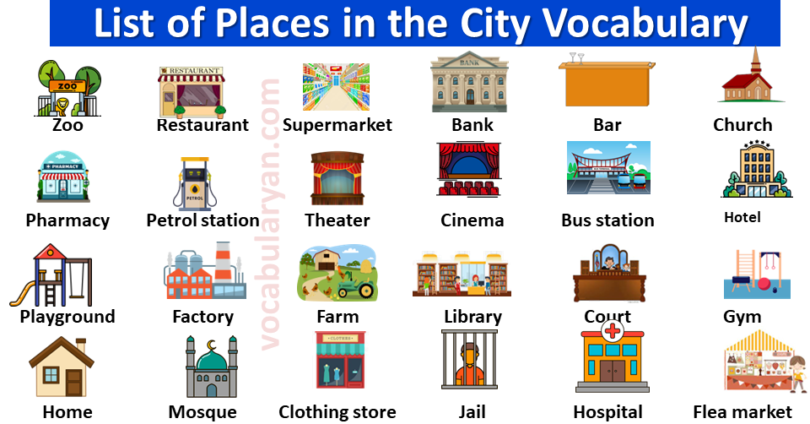
Cities are full of buildings and public spaces with their own English names. The 9 main categories of city places are public services, shopping, food and drink, healthcare, education, transport, worship, entertainment, and street infrastructure.
English cities have 9 main categories of places: public services (bank, police station, fire station, town hall, post office), shopping (mall, supermarket, bakery), food and drink (restaurant, café, bar), healthcare (hospital, clinic, pharmacy), education (school, university, library), transport (airport, train station, bus stop), worship (church, mosque, temple, synagogue), entertainment (cinema, museum, zoo, stadium), and street infrastructure (sidewalk, crosswalk, bridge, tunnel).
Common City Places With Pictures
Each category is defined by the function or service the place provides. Public services, shopping, and food and drink are the three most-common in daily life. The other six are healthcare, education, transport, worship, entertainment, and street infrastructure.
Public Services and Government Buildings
Public services and government buildings are the places run by the city or country for the everyday needs of citizens.
Bank: financial building where people deposit money, take out loans, exchange currency, and use ATMs on the street outside. “I need to go to the bank at lunchtime to deposit a cheque before the counter closes at three.”
Police Station: building where police officers are based, answering emergency calls, filing crime reports, and holding suspects in custody cells. “Sarah went to the police station to report her stolen bicycle and file an insurance claim.”
Fire Station: building where firefighters live on shift with their fire trucks, ambulances, and rescue equipment. “The fire station on Oak Street has a bright red truck parked outside that children love to look at through the fence.”
Town Hall: main government building of a small city or town, where the mayor works and public meetings are held. “The town hall on Main Street is a historic red-brick building with a clock tower visible from all across the city center.”
Post Office: government building where people send letters and parcels, buy postage stamps, and collect mail from a PO box. “I need to stop at the post office on my way home to post my sister’s birthday card before the last collection.”
Courthouse: building where judges hear criminal and civil legal cases, and where trials, sentencing, and hearings take place. “The courthouse downtown has marble columns at the entrance and a statue of justice with her scales above the door.”
Embassy: building in one country where another country’s government has its official representation, issuing visas and helping its own citizens abroad. “He went to the French embassy in London to renew his passport and apply for a student visa.”
Shopping and Retail Places
Shopping and retail places are the shops, stores, and markets where people buy food, clothes, books, and household items.
Mall: large enclosed shopping center with dozens of stores, food courts, cinemas, and department stores under one roof. “The teenagers spent Saturday afternoon at the mall, trying on clothes and eating pizza at the food court.”
Supermarket: large self-service grocery store with rows of shelves selling food, drinks, and everyday household items. “We stopped at the supermarket after work to pick up milk, bread, eggs, and a bag of dog food.”
Grocery Store: smaller neighborhood shop selling fresh food, vegetables, meat, and daily essentials. “The grocery store on our corner is open until midnight for late-night snack runs and last-minute dinner ingredients.”
Department Store: large multi-floor shop selling clothing, cosmetics, jewelry, home goods, and electronics arranged by department. “Macy’s is the biggest department store on Fifth Avenue, with everything from shoes to kitchen appliances across seven floors.”
Bookstore: shop selling books, magazines, and stationery, and with a small café inside in some branches. “She spent an hour in the bookstore on Saturday morning, reading the first chapter of three novels before choosing one.”
Clothing Store: shop selling shirts, pants, dresses, and other apparel for men, women, or children. “I went into the new clothing store on High Street to look for a warm winter coat before the cold weather arrives.”
Shoe Shop: specialty store selling every type of footwear from trainers and sandals to formal shoes and children’s boots. “The shoe shop on the corner has a summer sale, and Mom bought me new school shoes for half the usual price.”
Florist: shop selling fresh cut flowers, potted plants, and floral arrangements for weddings, funerals, and daily gifts. “He stopped at the florist on his way home to buy a bouquet of red roses for his wife’s birthday dinner.”
Bakery: shop selling freshly baked bread, cakes, pastries, and cookies, and one of the best-smelling places in the city. “The bakery opens at six every morning, and by seven the smell of fresh croissants fills the whole neighborhood.”
Butcher Shop: specialty store where a trained butcher cuts and sells meat like beef, pork, chicken, and lamb. “My grandmother always buys her Christmas turkey from the butcher shop on Church Lane, and orders it three weeks in advance.”
Flea Market: open-air or covered market where sellers offer secondhand goods, antiques, vintage clothes, and unique items. “The Sunday flea market by the river is where you find old records, vintage watches, and one-of-a-kind furniture.”
Food and Drink Places in the City
Food and drink places are where people go to eat meals, snacks, and desserts, or to have coffee, beer, or wine.
Restaurant: eating establishment where customers order meals from a menu, sit at a table, and are served by waiters. “We booked a table at an Italian restaurant downtown for our anniversary dinner, and the pasta was the best I have ever tasted.”
Café: small casual eatery serving coffee, tea, sandwiches, cakes, and light meals in a relaxed atmosphere. “I meet my friend at the café near the park every Sunday morning for a cappuccino and a slice of carrot cake.”
Bar: establishment where adults gather for alcoholic drinks like beer, wine, and cocktails, and light snacks. “After work, the whole office team went to the bar on the corner for a few beers and to celebrate the successful project.”
Fast Food Restaurant: counter-service restaurant serving inexpensive quick meals like burgers, fries, pizza, and fried chicken. “The kids begged to eat at the fast food restaurant after the football match, so we ordered burgers, fries, and milkshakes for everyone.”
Ice Cream Shop: small shop selling ice cream in cones or cups, with dozens of flavors from vanilla to mango sorbet. “On hot summer evenings, the ice cream shop on Beach Road has a queue that stretches all the way down the block.”
Pub: traditional British-style bar and restaurant serving beer, wine, and hearty pub food like fish and chips and Sunday roast. “The old pub on the village green has been serving beer for over 400 years and has original wooden beams from the Tudor era.”
Healthcare Places Names
Healthcare places are the buildings where doctors, dentists, and vets treat sick people and animals.
Hospital: large medical building where sick and injured people receive treatment, surgery, and long-term care from doctors and nurses. “She was rushed to the hospital by ambulance after the car accident, and the doctors treated her broken leg the same night.”
Clinic: smaller healthcare facility for outpatient appointments with a family doctor, check-ups, and vaccinations. “My children go to the clinic on Wilson Avenue for their annual vaccinations and general health check-ups.”
Pharmacy: shop where a licensed pharmacist prepares prescription medicines and sells over-the-counter treatments and toiletries. “The pharmacy inside the supermarket fills my grandmother’s prescription in about ten minutes while she does her weekly grocery shopping.”
Dentist Office: healthcare place where a dentist checks, cleans, and treats teeth and gums, and fits fillings, crowns, and braces. “I have a dentist office appointment on Thursday morning for my six-month check-up and a routine cleaning.”
Veterinary Clinic: healthcare place for pets and animals, where a vet gives check-ups, vaccinations, and treatments. “We took the sick puppy to the veterinary clinic, and the vet gave him medicine and told us to bring him back in two days.”
Education Places in the City
Education places in the city are the buildings where children, teenagers, and adults go to learn.
School: building where children between the ages of 5 and 18 learn subjects like math, English, science, history, and art. “My daughter walks to school every morning with her friend from next door, and they meet at the gate at eight sharp.”
University: higher education institution where students study for degrees over three to four years after leaving school. “He is studying computer science at the university, and the campus has libraries, laboratories, and student cafes across a large park.”
Kindergarten: early education place for children aged 3 to 5, learning through play, songs, and hands-on crafts. “Our four-year-old son loves kindergarten because they paint pictures, sing songs, and play outside every day.”
Library: public building with rows of books that people can borrow, plus quiet study areas and computers with internet access. “The library on Green Street is open every day, and I go there to study for my exams because the internet at home is too slow.”
Transport Places in the City
Transport places are the stations, stops, and terminals from which people travel around and out of the city.
Airport: large complex outside the city where airplanes take off and land, with terminals for check-in, security, and boarding. “Our flight leaves from London Heathrow airport at 6 AM, so we need to arrive by 4 AM for check-in and security.”
Train Station: building where passenger trains stop to pick up and drop off travelers, with platforms, ticket offices, and waiting areas. “The train station in the city center has a beautiful Victorian glass roof and platforms for both local commuter trains and long-distance intercity services.”
Bus Station: central terminal building for buses, where multiple bus routes start and end, with a ticket office and waiting area. “The bus station near the shopping mall is the main hub for long-distance coaches to other cities across the country.”
Bus Stop: roadside spot marked by a sign or a small shelter where a city bus picks up and drops off passengers. “The bus stop for the number 43 is right in front of the library, across the road from the coffee shop.”
Subway Station: underground station for the city’s metro or subway trains, with escalators, ticket machines, and platforms below street level. “New York’s Grand Central subway station has connections to more than a dozen lines and is used by half a million commuters every weekday.”
Taxi Stand: designated spot on the street where taxis wait in a line to pick up passengers, marked by a sign or curb marking. “There is a taxi stand outside the train station, and you can hail one within a minute even at midnight on a Saturday.”
Parking Lot: outdoor open area for parking cars, marked with painted lines to show individual parking spaces. “The parking lot behind the supermarket is free for the first two hours and charges by the hour after that.”
Places of Worship
Places of worship are the buildings where people of different religions gather to pray and celebrate their faith.
Church: Christian place of worship where Christians attend services, weddings, funerals, and baptisms, marked by a bell tower or steeple. “We attend the small stone church on the hill every Sunday morning for the 10 AM service and coffee afterwards.”
Mosque: Muslim place of worship where Muslims gather to pray five times a day, especially for Friday afternoon congregational prayer. “The mosque on Elm Street has a golden dome visible from several blocks away and is one of the largest in the city.”
Temple: place of worship for Hindus, Buddhists, Sikhs, Jains, and other faiths, with sacred images, altars, and prayer halls. “The Hindu temple downtown is famous for its intricate stone carvings and hosts colorful festivals throughout the year.”
Synagogue: Jewish place of worship where Jews pray, study the Torah, and celebrate Sabbath and holidays. “The old synagogue in the Jewish quarter has stained-glass windows dating back to the nineteenth century.”
Entertainment and Leisure Places
Entertainment and leisure places are the venues where people go for fun, culture, sport, and free-time activities.
Cinema: entertainment building where audiences watch movies on a huge screen with surround sound and comfortable reclining seats. “We went to the cinema on Friday night to see the new Marvel film, and I ate a whole bucket of popcorn during the previews.”
Theater: performance venue where audiences watch live plays, musicals, ballet, or opera, with actors on a raised stage. “The theater in the city center is showing Shakespeare’s Hamlet this month, and my English class booked a group of thirty tickets.”
Museum: building where art, historical objects, or scientific specimens are displayed in themed exhibitions with information panels. “The Natural History Museum has a full-size dinosaur skeleton in the entrance hall that never fails to amaze first-time visitors.”
Zoo: large park with many animal species from around the world, kept in enclosures designed to resemble their natural habitats. “The city zoo has a new lion cub, and the children stayed for an hour watching him play with his mother in the outdoor enclosure.”
Aquarium: building with large tanks displaying sea creatures like sharks, dolphins, jellyfish, and colorful tropical fish. “The aquarium has a tunnel where you walk under the water with sharks swimming above your head, and my little brother screamed with excitement.”
Amusement Park: large entertainment park with roller coasters, Ferris wheels, water rides, and food stalls for a full-day family visit. “Disneyland is the world’s most famous amusement park, and my parents are taking us there for my tenth birthday next summer.”
Stadium: enormous outdoor arena with tiered seating around a field, hosting soccer, football, cricket, and rock concerts. “Wembley Stadium in London seats 90,000 fans and is the traditional home of the English national football team’s biggest matches.”
Gym: indoor fitness building with weight machines, treadmills, exercise classes, and locker rooms for changing and showering. “I go to the gym three times a week after work to lift weights and use the treadmill for cardio training.”
Hotel: building with dozens of guest rooms for travelers to sleep, plus a reception desk, restaurant, and swimming pool. “We stayed at the Ritz hotel in Paris for our honeymoon, and the room had a beautiful view of the Eiffel Tower.”
Streets and City Infrastructure
Streets and city infrastructure are the roads, paths, and structures that let people move around the city.
Sidewalk: paved path alongside a road, raised slightly above the road level, where pedestrians walk safely away from traffic. “The sidewalk on our street is wide enough for two people to walk side by side, and it has trees planted every ten meters.”
Crosswalk: marked area of a road with painted white stripes, where pedestrians have the right of way to cross the street. “The crosswalk in front of the school has a lollipop lady who stops traffic every morning so the children can cross safely.”
Traffic Light: three-color signal at intersections telling drivers to stop (red), get ready (yellow), or go (green). “The traffic light at the corner of Main and Oak was broken all morning, causing long delays and a police officer directing traffic manually.”
Bridge: structure built across a river, road, or valley, letting cars, trains, or pedestrians cross safely from one side to the other. “The Golden Gate Bridge in San Francisco is a red suspension bridge nearly 3 kilometers long, and one of the most photographed structures in the world.”
Roundabout: circular road intersection where drivers enter and travel around a central island, giving way to traffic already in the circle. “The roundabout at the town entrance has a bronze statue of a horse in the middle, and drivers must go around it clockwise in the UK.”
Tunnel: underground or underwater passage that lets cars, trains, or pedestrians go through a mountain, under a river, or below a busy road. “The Channel Tunnel between England and France is 50 kilometers long and takes 35 minutes to cross by high-speed train.”
City Places That Look Similar
Some city place names look almost identical but describe different places or the same place under a different English variety.
British vs American English
| British English | American English | Meaning |
|---|---|---|
| Petrol Station | Gas Station | Refueling stop for cars |
| Pavement | Sidewalk | Path beside a road |
| Chemist | Pharmacy | Shop for medicines |
| Cinema | Movie Theater | Where you watch films |
| Car Park | Parking Lot | Open parking area |
| Roundabout | Traffic Circle | Circular intersection |
| Flyover | Overpass | Elevated road over another |
| Pedestrian Crossing | Crosswalk | Painted road crossing |
British and American English use different words for many everyday city places. Both are correct in their region.
Bus Stop vs Bus Station
| Term | Meaning |
|---|---|
| Bus Stop | Single roadside spot where a city bus picks up and drops off passengers |
| Bus Station | Central terminal building where many bus routes start and end |
A bus stop is one spot on a route. A bus station is a whole building that many buses use, with waiting areas and ticket offices.
Church vs Cathedral vs Chapel
| Term | Meaning |
|---|---|
| Church | Any Christian place of worship |
| Cathedral | The main church of a diocese, where the bishop is based |
| Chapel | Small church, or a private worship space within a larger building |
Every cathedral is a church, but not every church is a cathedral. Chapels are the smallest of the three.
Store vs Shop vs Boutique
| Term | Meaning |
|---|---|
| Store | American English, for any retail place (bookstore, grocery store) |
| Shop | British English, for any retail place (bookshop, flower shop) |
| Boutique | Small specialty shop selling fashion, jewelry, or unique items |
Store and shop mean the same thing in American and British English. A boutique is a specific small upscale shop.
FAQs
Q1. What are the main places in a city in English?
The main places in a city fit into 9 categories: public services (police station, fire station, town hall), shopping (mall, supermarket, bookstore), food and drink (restaurant, café, bar), healthcare (hospital, clinic, pharmacy), education (school, university, library), transport (airport, train station, bus stop), worship (church, mosque, temple), entertainment (cinema, museum, zoo), and street infrastructure (sidewalk, crosswalk, bridge).
Q2. What is the difference between a bus stop and a bus station?
A bus stop is a small roadside spot marked by a sign or shelter where a single city bus route picks up and drops off passengers. A bus station is a large terminal building where many different bus routes start and end, with waiting areas, ticket offices, and multiple platforms. Cities have hundreds of bus stops but only one or two main bus stations.
Q3. What is the British word for gas station?
The British word for gas station is petrol station. British English uses “petrol” (short for petroleum) where American English uses “gas” (short for gasoline). Both mean exactly the same liquid fuel and refer to exactly the same roadside place where drivers fill up their cars.
Q4. What are places of worship called in different religions?
Christian places of worship are called churches (with cathedrals as the main church of a bishop’s diocese, and chapels as smaller worship spaces). Muslim places of worship are called mosques. Hindu, Buddhist, Sikh, and Jain places of worship are called temples. Jewish places of worship are called synagogues.
Q5. What is the difference between a city, town, and village?
The difference is population size and level of urban development. A village is the smallest, with a few hundred to a few thousand people and mostly farmland around. A town is medium-sized, with a few thousand to tens of thousands of people, and has more shops and services. A city is the largest, with tens of thousands to millions of people, and has universities, hospitals, airports, and public transport systems.
Q6. What is the difference between a church and a cathedral?
Every cathedral is a church, but not every church is a cathedral. A church is any Christian place of worship. A cathedral is specifically the main church of a Christian diocese (region), and it is where the bishop has his official chair (called the cathedra in Latin). Cathedrals are much larger and more elaborately built than regular churches.

Leave a Comment