
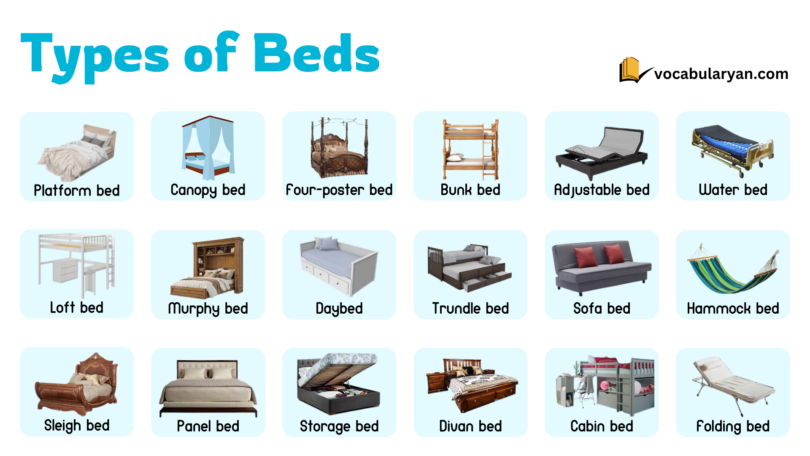
A bed’s frame, size, and build change how it fits a room and how it works for the person sleeping in it, from a low platform bed to a tall four poster frame. Sorting the types of beds by size and function helps a shopper or learner find the right word for the right piece of furniture.
Types of Beds by Size and Function
A bed’s size decides who sleeps in it: one person, two people, or a full family. Frame material, storage, and adjustment decide the exact type of bed within that size. Headboard shape, leg height, and frame build set one bed type apart from another.
Standard and Everyday Beds
These types of beds show up as the most common frames found in ordinary bedrooms, with no special mechanism or added feature.
- Daybed: a bed frame built with raised sides, so it works as a couch during the day and a bed at night. Small apartments and guest rooms rely on this dual role.
- Divan Bed: a solid base with no visible frame, topped with a fitted fabric cover. This base has built-in drawers for storage underneath in many models.
- Folding Bed: a bed frame that hinges in the middle, letting it fold flat or stand upright for storage. Guest rooms without permanent space for a bed use this design.
- Panel Bed: a flat headboard and footboard, made of wood, connect through plain side rails. This straightforward build makes it one of the most common bed frames sold today.
- Modular Bed: separate frame sections connect and can be rearranged or resized to fit a specific room. Shared bedrooms and changing family needs benefit from this flexibility.
- Slat Bed: wooden or metal slats span the frame directly under the mattress instead of a solid base or box spring. This design allows more air to move under the mattress.
- Floor Bed: a mattress rests directly on a low frame close to the floor, without tall legs. Montessori-style children’s rooms use this design to let a child get in and out safely.
- Box Spring Bed: a fabric-covered wooden frame filled with springs sits between the mattress and the bed frame. It absorbs shock and adds height, though many modern mattresses no longer need one.
- Bunk Bed: two beds stack vertically, connected by a ladder or built-in steps. Shared children’s rooms and cabins use this stacked design to save floor space.
- Loft Bed: a raised bed frame leaves open space underneath for a desk, closet, or seating area. College dorm rooms and small bedrooms both rely on this space-saving height.
- Trundle Bed: a second, lower bed slides out from underneath the main bed frame on wheels or a track. It gives a room extra sleeping space without a second bed frame taking up daily floor space.
- Murphy Bed: the entire bed frame folds up and disappears into a wall cabinet when not in use. Studio apartments depend on this design to reclaim the floor space during the day.
- Sofa Bed: a sofa frame conceals a mattress that folds out for sleeping. Living rooms that double as guest rooms use this combination constantly.
- Futon Bed: a thin, foldable mattress rests on a wooden or metal frame that shifts between a flat bed and an upright seat. It sits lower and folds thinner than a full sofa bed.
- Air Bed: an inflatable mattress, paired with or without its own frame, fills with air instead of foam or springs. Temporary guest sleeping and camping both rely on how quickly it inflates and packs away.
- Water Bed: a mattress-shaped bladder filled with water replaces the usual foam or coil interior. Its water-filled core keeps a stable temperature all night, a trait some sleepers specifically seek out.
- Ottoman Bed: a hinged mattress platform lifts up on a gas-lift mechanism, revealing a large storage space underneath. This design turns the entire under-mattress area into usable storage.
- Round Bed: a circular mattress and frame replace the usual rectangular shape. Statement bedrooms and hotel suites favor this shape for its unusual visual impact.
- Cabin Bed: a raised bed frame has a shelf, desk, or storage unit built directly beneath it. Children’s rooms use this combined design to fit sleeping and study space in one footprint.
- Floating Bed: the frame hovers above the floor, supported by a hidden or recessed base. Rooms with hard flooring show off this design’s shadow gap most clearly.
- Wall-Mounted Bed: the frame folds flat against the wall on a hinge system when not in use. This design suits a room that needs to double as a home office or studio during the day.
- Rollaway Bed: a folding frame on caster wheels lets the entire bed roll into a closet or storage room between uses. Hotels and small households both use this design for occasional extra sleeping space.
- Camp Bed: a lightweight, collapsible frame with a stretched fabric surface sets up quickly for temporary sleeping. Its light weight and fast setup suit travel, camping, and emergency use.
- Hammock Bed: a suspended fabric or netted sling replaces a rigid frame entirely, hung between two fixed points. Outdoor and tropical sleeping setups rely on the airflow this design allows underneath the sleeper.
Platform Beds
These types of beds support the mattress directly on a low, solid, or slatted base, skipping the box spring entirely.
- Platform Bed: a solid or slatted base supports the mattress directly, removing the need for a box spring. Its low, bare profile suits a modern bedroom.
- Low-Profile Bed: the frame sits noticeably closer to the floor than a standard platform bed. Small rooms and low ceilings both benefit from the reduced visual height.
- Pallet Bed: repurposed wooden shipping pallets form the visible base and, in some designs, the headboard. This raw, unfinished look suits a rustic or industrial bedroom.
- Floating Platform Bed: a recessed or hidden support structure lifts the platform slightly off the floor. The gap beneath the frame creates the illusion that the bed has no visible legs.
- Solid Wood Platform Bed: thick, solid wood forms the entire base rather than a slatted or metal support. This build gives noticeably more weight capacity and durability than a lighter slatted frame.
- Slatted Platform Bed: evenly spaced wooden slats span the frame to support the mattress. The gaps between slats let air circulate beneath the mattress.
- High-Rise Platform Bed: the platform sits taller than a standard low-profile design, closer to the height of a traditional bed frame. Storage drawers fit into the extra height underneath in many designs.
- Bookcase Platform Bed: a built-in bookcase headboard combines shelving with the sleeping platform. Small bedrooms gain extra storage without adding separate furniture.
- Modular Platform Bed: separate platform sections connect and can be resized or rearranged. Growing families and shared rooms benefit from this adjustable sizing.
- Mid-Century Platform Bed: tapered wooden legs and a low, rectangular frame define this style, tracing back to 1940s and 1950s furniture design. Its spare lines still influence modern platform bed design today.
- Metal Platform Bed: a slatted or solid metal base replaces the usual wood platform. This build resists warping from humidity better than a wood-based platform.
- Fabric Platform Bed: upholstered fabric wraps the platform base and headboard together as one unit. This softer look pairs the low platform shape with a more cushioned feel.
Storage Beds
These types of beds build storage space directly into the frame, using the space beneath or around the mattress.
- Storage Bed: a hollow base beneath the mattress opens to reveal built-in storage space. Small bedrooms rely on this design to avoid a separate dresser or storage chest.
- Drawer Bed: built-in drawers slide out from the sides or foot of the frame. This design keeps stored items reachable without lifting the mattress.
- Hydraulic Lift Bed: a gas-powered hinge lifts the entire mattress platform upward, revealing a deep storage compartment underneath. This mechanism supports far more weight than a plain drawer system.
- Ottoman Storage Bed: the mattress platform lifts on a gas-lift hinge, similar to an ottoman’s lid, opening the full base as storage. This design maximizes storage space more than a drawer-based frame.
- Captain’s Bed: built-in drawers and, in some designs, shelving surround the base on multiple sides, resembling built-in ship cabin furniture. Children’s and guest rooms both use this style for its combined storage and sleeping function.
- Bookcase Bed: shelving built into the headboard adds storage above the mattress rather than underneath it. Books, lamps, and small items all fit within reach of the sleeper.
- Under-Bed Storage Bed: the frame is raised just enough to fit storage bins or boxes underneath without a built-in drawer system. This simpler design costs less than a dedicated drawer or lift mechanism.
- Bed with Footboard Drawers: drawers built into the footboard add storage at the foot of the bed rather than the sides. This placement keeps the storage accessible without disturbing the mattress.
- Lift-Up Mattress Bed: a hinge at the head or foot lets the mattress and platform lift as one piece. This mechanism opens the entire base to storage in one motion.
- Platform Storage Bed: drawers or lift mechanisms are built directly into an otherwise standard platform frame. This combination keeps the platform’s low profile while adding storage function.
- Headboard with Shelves Bed: open or closed shelving is built into the headboard itself. This design adds storage without taking up any additional footprint.
- Built-In Compartment Bed: hidden compartments are built into the frame’s sides, base, or headboard. This design hides storage completely behind flush panels rather than visible drawers.
Adjustable Beds
These types of beds let the head, foot, or both sections raise and lower for a customized sleep position.
- Adjustable Bed: a hinged base lets the head and foot sections raise or lower independently. This mechanism can help with back support, circulation, and general sleep comfort.
- Motorized Bed: an electric motor powers the adjustable base instead of a manual crank or lever. Most modern adjustable beds use this motorized system by default.
- Zero-Gravity Bed: the base tilts until the legs sit level with or above the heart, mimicking the posture astronauts use during liftoff. This position is designed to reduce spinal pressure and improve circulation.
- Split King Adjustable Bed: two separate adjustable bases sit side by side under one king-size mattress. Each side adjusts independently, letting two sleepers choose different positions.
- Remote-Controlled Adjustable Bed: a handheld remote operates the base’s motors instead of a wall switch or built-in panel. This control style lets a sleeper adjust the bed without getting up.
- Hospital Bed: a multi-section adjustable base, paired with side rails, supports medical care and recovery. Its adjustable height also helps caregivers work at a safer, more comfortable level.
- Electric Bed: the base runs on electric motors for all its adjustments rather than a hand crank. This term is used interchangeably with motorized bed.
- Reclining Base Bed: the base tilts back as a single connected unit rather than adjusting the head and foot separately. This simpler mechanism suits a more relaxed, sofa-like recline.
- Dual-Motor Bed: two separate motors control the head and foot sections independently. This setup allows more precise, separate positioning than a single-motor base.
- Programmable Smart Bed: preset positions can be saved and recalled at the touch of a button or through a phone app. Some models add sleep tracking or temperature control alongside the adjustable base.
- Wall-Hugger Adjustable Bed: the base shifts the mattress forward as it reclines, keeping the head close to a nightstand or wall. Small bedrooms benefit from this design not needing extra clearance behind the headboard.
Beds by Material
These types of beds take their name from what forms the visible frame, whether solid wood, metal, or upholstered fabric.
- Oak Bed: a dense, light-colored hardwood forms the frame, known for holding up to decades of daily use. Its natural grain pattern stays visible under a clear or light finish.
- Pine Bed: a soft, pale wood forms the frame at a lower cost than hardwood alternatives. It shows dents and scratches more easily than oak or maple.
- Walnut Bed: a rich, dark brown hardwood forms the frame, prized for its deep color and fine grain. Its cost sits well above pine or standard oak frames.
- Maple Bed: a hard, pale wood with a smooth, even grain forms the frame. Its density makes it highly resistant to warping over time.
- Mahogany Bed: a reddish-brown tropical hardwood forms the frame, traditionally associated with formal, high-end furniture. Its color deepens further as the wood ages.
- Reclaimed Wood Bed: timber salvaged from old buildings, barns, or furniture forms the visible frame, keeping its existing marks and history. Each frame carries slightly different grain and wear from the last.
- Engineered Wood Bed: manufactured wood products, such as particleboard or MDF, form a budget-friendly frame. It sacrifices some long-term durability for a lower price than solid wood.
- Teak Bed: a dense, naturally water-resistant hardwood forms the frame, closely associated with mid-century Scandinavian design. Its natural oils help it resist rot and insects without added chemical treatment.
- Sheesham Bed: a hard, richly grained wood common in South Asian furniture forms the frame. Its warm brown tone and durability make it a common hardwood alternative to teak.
- Rosewood Bed: a dense, dark hardwood with a distinctive fragrance and grain forms the frame. It ranks among the more expensive woods used in bed construction.
- Birch Bed: a pale, fine-grained hardwood forms the frame at a moderate price point. Its smooth surface takes paint and stain evenly.
- Bamboo Wood Bed: fast-growing bamboo stalks are processed and formed into a wood-like frame material. This material regrows far faster than traditional hardwood trees, making it a common eco-friendly choice.
- Hardwood Frame Bed: any dense, durable wood species, such as oak or maple, forms the structural frame. This general category outlasts softwood or particleboard construction by decades.
- Iron Bed: solid iron forms the frame, shaped into decorative curves or scrollwork. Its weight and rigidity give it exceptional long-term durability.
- Steel Bed Frame: steel tubing or sheet metal forms the structural frame instead of iron or wood. It weighs less than solid iron while still supporting significant weight.
- Black Metal Bed: a matte or gloss black finish coats a steel or iron frame. This finish suits modern, minimalist, or industrial bedroom styles.
- Folding Metal Bed: a metal frame hinges to fold flat for storage or transport. Guest rooms and temporary sleeping setups rely on this collapsible design.
- Aluminum Bed: lightweight aluminum forms the frame instead of heavier steel or iron. Its resistance to rust suits humid climates or outdoor-adjacent rooms.
- Brass Bed: a brass finish, applied over a steel or solid brass core, gives the frame a warm, golden tone. This finish was especially popular in Victorian and early 20th-century bedrooms.
- Wrought Iron Bed: iron is heated and shaped by hand into decorative curves and details. This traditional forging method gives each frame slightly individual character.
- Chrome Bed: a bright, reflective chrome finish coats a steel frame. This finish suits a sleek, modern bedroom look.
- Powder-Coated Bed: a durable powder finish is baked onto a metal frame, resisting scratches and rust better than standard paint. This coating comes in a wide range of colors and finishes.
- Industrial Frame Bed: raw or minimally finished metal, paired with exposed bolts or piping, defines this style. Loft apartments and converted warehouse spaces favor this utilitarian look.
- Tubular Metal Bed: hollow metal tubes form the frame instead of solid metal or wood. This construction keeps the frame lightweight without sacrificing structural strength.
- Canopy Metal Frame: metal posts and crossbars form a canopy structure above a metal bed base. This build gives a lighter, more open look than a solid wood canopy frame.
- Tufted Upholstered Bed: buttons pull the headboard fabric into a diamond or grid pattern of indentations. This detailing adds texture to an otherwise plain, padded headboard.
- Velvet Upholstered Bed: short, dense fibers wrap the headboard, creating a soft texture and a subtle sheen that shifts with the light. This fabric adds a plush, formal feel to a bedroom.
- Faux Leather Bed: a synthetic material mimics real leather’s look and texture over the headboard and frame. It costs less than genuine leather and cleans more easily.
- Linen Upholstered Bed: a textured, slightly rough natural fiber wraps the headboard in a relaxed, matte finish. This fabric wrinkles more visibly than a tightly woven synthetic blend.
- Microfiber Padded Bed: extremely fine synthetic fibers wrap a padded headboard, resisting stains and spills well. Households with children or pets choose it for quick cleanup.
- Channel-Tufted Bed: long vertical seams run down the headboard, creating a ribbed pattern instead of the diamond pattern of standard tufting. This detail suits both mid-century and contemporary bedroom styles.
- Wingback Headboard Bed: tall side panels extend forward from the headboard, framing the head and shoulders on each side. This shape borrows directly from the wingback chair and sofa silhouette.
- Nailhead Trim Bed: a row of decorative metal studs lines the edge of the upholstered headboard. This detail adds a formal, tailored finish to an otherwise plain fabric surface.
- Buttoned Headboard Bed: individual buttons are sewn into the headboard fabric at even intervals, without the pulled tufting of a diamond pattern. This gives a flatter, more subtle texture than full tufting.
- Scalloped Edge Bed: the top edge of the headboard curves into a repeated wave or shell pattern. This detail gives an otherwise plain headboard a softer, more decorative silhouette.
- Curved Headboard Bed: the headboard’s top edge arcs into one smooth curve rather than a flat or scalloped line. This shape suits a softer, more rounded bedroom aesthetic.
Beds by Size
These types of beds are named for the mattress dimensions they use, from a narrow single bed to an oversized custom king.
- Single Bed: the narrowest standard mattress size, built for one sleeper with minimal extra room. Children’s rooms and small guest rooms use this size most.
- Twin Bed: slightly wider than a single bed in some regions, or an identical term for the same size in others, built for one sleeper. Bunk beds and dorm rooms rely on this size heavily.
- Twin XL Bed: the same width as a standard twin bed but several inches longer. College dormitories default to this size for taller students.
- Double Bed: wider than a twin, built to sleep one person comfortably or two people snugly. It is also called a full bed in the United States.
- Full Bed: the American term for a double bed, wider than a twin but narrower than a queen. Studio apartments and guest rooms commonly use this size.
- Queen Bed: wider and longer than a full bed, the most common size chosen for a primary bedroom. Its balance of size and space efficiency suits most standard bedrooms.
- King Bed: noticeably wider than a queen bed, giving two sleepers significantly more individual space. Larger primary bedrooms are needed to fit this size comfortably.
- California King Bed: narrower but longer than a standard king bed. Taller sleepers favor this size for the additional length.
- Short Queen Bed: the same width as a standard queen but several inches shorter. Recreational vehicles and boats use this size to fit tighter interior spaces.
- Olympic Queen Bed: a few inches wider than a standard queen while keeping the same length. This size adds shoulder room without the jump to a full king.
- RV Queen Bed: a queen mattress cut slightly smaller in width, length, or both, to fit recreational vehicle bed frames. Custom bedding is needed since standard queen sheets fit loosely.
- Split Queen Bed: two narrow mattresses sit side by side to form one queen-size sleeping surface. Adjustable bed bases use this split design so each side can move independently.
- Split King Bed: two twin XL mattresses sit side by side to form one king-size sleeping surface. This split design lets two sleepers use separate adjustable bases under one shared frame.
- Eastern King Bed: the standard king bed size used across most of the United States, wider and shorter than a California king. This is simply the default king size outside specialty or custom orders.
- Texas King Bed: a custom, non-standard size larger than both a standard king and a California king in both directions. Extra-large primary bedrooms are needed to fit this size.
- Alaskan King Bed: one of the largest mattress sizes made, wider and longer than a Texas king. Very few manufacturers produce bedding sized for this frame.
- Wyoming King Bed: a custom size wider than a standard king but not as oversized as an Alaskan king. This size fills the gap between a standard king and the largest custom frames.
- Custom King-Size Bed: built to a specific width and length outside the standard king or California king dimensions. Bedding for this size is made to order.
- Junior Bed: a small frame slightly larger than a crib, built for a toddler transitioning out of a crib. Its low height makes it easier for a small child to climb in and out safely.
- Toddler Bed: similar in purpose to a junior bed, shaped or styled specifically for young children. Guard rails are common on this size to prevent rolling off during sleep.
- Crib-to-Bed Conversion: a crib frame converts into a toddler-size bed by removing or lowering one side. This design extends the life of a single piece of furniture through a child’s early years.
Canopy and Sleigh Beds
These types of beds are shaped by a distinctive frame feature, either a structure above the mattress or a curved head and foot.
- Canopy Bed: four tall posts support an overhead frame above the mattress. Drapes, netting, or string lights hang from this overhead structure.
- Traditional Canopy Bed: ornate wood or metal posts and crossbars form a classic, formal canopy structure. This style is closely associated with historical and period bedroom design.
- Metal Canopy Bed: slim metal posts and crossbars form a lighter, more modern canopy structure. This build gives an airier look than a solid wood canopy frame.
- Square Frame Canopy Bed: the overhead frame forms a bare rectangle directly above the mattress’s outline. This minimal shape suits a modern bedroom better than heavily ornamented posts.
- Curtain-Draped Canopy Bed: fabric panels hang from the overhead frame on all four sides, fully enclosing the bed when drawn. This setup adds privacy and blocks drafts, echoing historical bed-curtain use.
- Princess Canopy Bed: a canopy frame is designed specifically for a child’s bedroom, paired with soft draping fabric. This style is marketed heavily toward young children’s rooms.
- Colonial Canopy Bed: turned wooden posts and plain crossbars define this early American furniture style. Its design draws directly from 18th-century colonial homes.
- Sleigh Bed: curved headboard and footboard panels give this frame a shape resembling a horse-drawn sleigh. This shape brings a formal, traditional look to a bedroom.
- Upholstered Sleigh Bed: fabric wraps the curved headboard and footboard of a sleigh bed frame. This softens the traditionally hard wood or metal curve into a padded surface.
- Wooden Sleigh Bed: solid wood forms the curved headboard and footboard without any fabric covering. This construction keeps the frame’s traditional, unupholstered look.
- Modern Sleigh Bed: the curved sleigh silhouette is simplified with cleaner lines and a lower profile. Contemporary bedrooms use this style for an updated take on the traditional shape.
Four Poster Beds
These types of beds are defined by four tall corner posts, with or without a connecting frame overhead.
- Four Poster Bed: four tall vertical posts rise from each corner of the frame without a full overhead canopy structure. These posts support canopy fabric or decorative finials on top.
- Colonial Poster Bed: turned wooden posts in an early American style define this frame. Its design closely echoes the colonial canopy bed’s period styling.
- Carved Wood Poster Bed: hand-carved detailing runs along the length of each corner post. This craftsmanship reflects a more traditional, ornate furniture-making style.
- Modern Four Poster Bed: slim, unornamented posts replace the heavy carved columns of a traditional design. Contemporary bedrooms use this simplified take on the classic four-post shape.
- Metal Poster Bed: slim metal columns form the four corner posts instead of turned wood. This build gives the frame a lighter, more modern silhouette.
- Canopy Poster Bed: crossbars connect the four corner posts at the top, forming a full canopy frame. This design blurs the line between a four poster bed and a true canopy bed.
- Traditional Poster Bed: classic turned or fluted wooden posts define this long-standing furniture style. It remains one of the most recognized bedroom furniture silhouettes.
- Gothic Poster Bed: pointed finials, dark wood, and elaborate carving define this dramatic frame style. Its design borrows directly from Gothic architecture and furniture traditions.
- Tall Post Bed: the four corner posts rise noticeably higher than a standard four poster frame. This added height gives the bed a more dramatic visual presence in a room.
- Baroque-Style Poster Bed: heavy ornamentation, gilded detailing, and elaborate carving define this opulent frame style. This design reflects the dramatic, decorative furniture standards of the Baroque period.
FAQs
Q1. What is the difference between a twin bed and a full bed?
A twin bed is narrower and built for one sleeper, while a full bed, also called a double bed, is wider and offers enough room for one person to spread out or two people to share snugly.
Q2. What kind of bed is best for back pain?
An adjustable bed lets you raise or lower the head and foot sections, which can help with back support, circulation, and comfort, particularly for conditions such as spinal stenosis or general lower back strain.
Q3. What is a futon bed and how is it different from a sofa bed?
A futon bed is a thin, foldable mattress on a wooden or metal frame that shifts between a flat bed and an upright seat. It sits lower and folds thinner than a sofa bed, which conceals a separate mattress inside a full sofa frame.
Q4. Among types of beds, what is the difference between a California king and an Eastern king?
An Eastern king bed is the standard king size used across most of the United States, while a California king is narrower but longer. Taller sleepers prefer the California king for its extra length.
Q5. Of all types of beds, what makes a platform bed different from a standard frame?
A platform bed supports the mattress directly on a solid or slatted base, removing the need for a box spring. A standard frame still expects a box spring between the frame and the mattress for proper support.
Q6. Among common types of beds, is a daybed the same as a sofa bed?
Not exactly. A daybed has raised sides that let it work as a couch by day and a bed by night without hiding a separate mattress, while a sofa bed conceals a fold-out mattress inside a full sofa frame.

Leave a Comment