
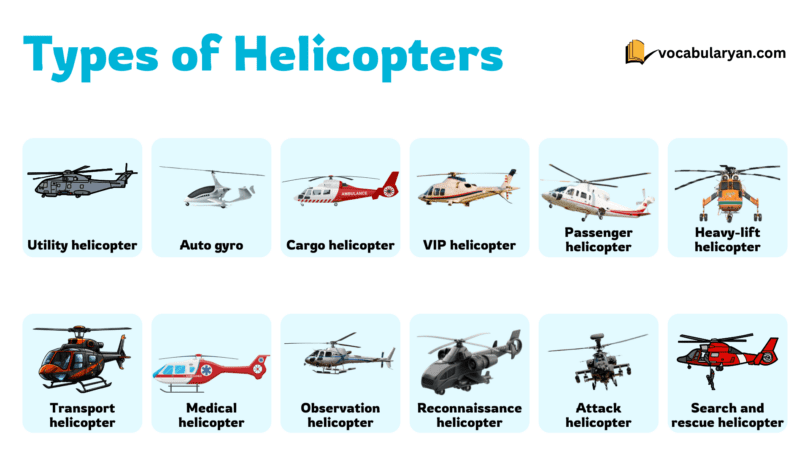
Helicopters lift straight up and down instead of using a runway, which lets them reach places airplanes can’t. The types below group by size, function, and rotor design, since a single real helicopter often fits more than one of these categories at once.
Helicopters by Size and Lift
- Light Utility Helicopters: small, fast, and straightforward to operate, built for patrol, observation, training, and everyday transport rather than heavy cargo. Examples: Bell 206, Airbus H125, Robinson R44, MD 500, Guimbal Cabri G2.
- Medium Utility Helicopters: balance power and range for mixed missions such as rescue work, police patrol, and regional transport that light helicopters can’t handle alone. Examples: UH-60 Black Hawk, AW139, Mil Mi-8, Bell 412, Sikorsky S-76.
- Heavy Lift Helicopters: large, powerful machines built specifically to carry supplies, equipment, or vehicles too heavy for utility helicopters. Examples: CH-53 Super Stallion, Mil Mi-26, CH-47 Chinook, Sikorsky CH-54 Tarhe, Kaman K-MAX.
Civilian Helicopters by Function
- Medical Helicopters: equipped to move patients to a hospital quickly or carry medical teams to an accident site, often fitted with stretchers and onboard equipment. Examples: Eurocopter EC135, Bell 429, Airbus H145, MD 902 Explorer, AgustaWestland AW109.
- News and Media Helicopters: used for live traffic updates and news coverage, valued for stable filming platforms and the ability to hover over a scene. Examples: Bell 206 JetRanger, Robinson R44, Airbus AS350, Hughes 500, MD 500E.
- Agricultural Helicopters: built to spray crops across large or hard-to-reach fields, often fitted with spray booms and tanks instead of passenger seats. Examples: Bell 47, Kamov Ka-26, Mil Mi-2, Hiller UH-12, Robinson R22 Beta.
- Private and Charter Helicopters: used for business trips or tourism by individuals or companies who value speed over cost. Examples: Agusta A109, Bell 407, Eurocopter EC120, Sikorsky S-76, Airbus H160.
Military Helicopters by Role
- Attack Helicopters: built specifically for combat, carrying missiles, rockets, or machine guns and armored to survive ground fire. Examples: AH-64 Apache, Mil Mi-24 Hind, Bell AH-1Z Viper, Eurocopter Tiger, Kamov Ka-52 Alligator.
- Transport Helicopters: carry soldiers, gear, or cargo to and from the battlefield, prioritizing cabin space and lift capacity over speed. Examples: CH-47 Chinook, UH-60 Black Hawk, Mil Mi-17, NHIndustries NH90, AgustaWestland AW101.
- Reconnaissance Helicopters: designed for gathering information or observing enemy movement, often smaller and quieter than combat or transport designs. Examples: OH-58 Kiowa, MQ-8 Fire Scout, Eurocopter AS565 Panther, Bell OH-58D, Kamov Ka-60.
- Search and Rescue Helicopters: equipped to find and recover people in emergencies, floods, or war zones, carrying hoists, medical gear, and long-range fuel tanks. Examples: Sikorsky HH-60 Pave Hawk, AgustaWestland AW101 Merlin, Eurocopter AS332 Super Puma, MH-65 Dolphin, Mil Mi-14.
Helicopters by Rotor System
- Single Rotor Helicopters: the most common design, using one large main rotor for lift and a smaller tail rotor to counter the main rotor’s spin and keep the aircraft stable. Examples: Bell 407, Robinson R22, MD 500, Eurocopter AS350, Agusta A119.
- Twin Rotor Helicopters: use two large rotors instead of one, improving lift and stability for heavier loads without needing a tail rotor for balance. Examples: CH-47 Chinook, Piasecki H-21, Mil Mi-12, V-22 Osprey, CH-46 Sea Knight.
- Coaxial Rotor Helicopters: stack two rotors on the same axis spinning in opposite directions, canceling out the twisting force without a tail rotor and giving a more compact design for tight or windy spaces. Examples: Kamov Ka-32, Kamov Ka-50, Kamov Ka-226, Sikorsky X2, Kamov Ka-27.
- Tandem Rotor Helicopters: place one rotor at the front and one at the back, letting the aircraft carry very heavy loads by spreading lift across two separate rotor systems. Examples: CH-47 Chinook, CH-46 Sea Knight, Boeing Vertol 107, Yakovlev Yak-24, Piasecki H-21.
Passenger and VIP Helicopters
- Executive Helicopters: used by business leaders for fast travel between meetings, prioritizing a quiet, comfortable cabin over cargo space. Examples: AgustaWestland AW109 Grand, Bell 429, Airbus H155, Sikorsky S-76, MD 902 Explorer.
- Sightseeing Helicopters: used by tour operators for scenic flights over cities, mountains, or coastlines, often fitted with larger windows for better views. Examples: Robinson R44, Airbus H125, Bell 505 Jet Ranger X, Eurocopter EC130, Sikorsky S-300.
- Group Transport Helicopters: carry small groups over short to medium distances, balancing passenger capacity with the speed a car or bus can’t match. Examples: Bell 525 Relentless, Airbus H160, Sikorsky S-92, AgustaWestland AW139, Mil Mi-38.
Specialized Industrial Helicopters
- Construction Helicopters: lift building parts, antennas, or heavy materials to locations a crane can’t easily reach, often flying with an external cargo hook instead of an enclosed cabin load. Examples: Sikorsky CH-54 Tarhe, Kamov Ka-32, Erickson S-64 Aircrane, Boeing Vertol 234, Mil Mi-10.
- Firefighting Helicopters: fight wildfires by dropping water or fire retardant from a bucket or tank, often refilling directly from a nearby lake or reservoir. Examples: Bell 212, Erickson Aircrane, Eurocopter AS350, Mil Mi-8, Kamov Ka-32.
- Logging Helicopters: lift cut logs out of thick forests where trucks can’t reach, carrying timber externally on a cable rather than inside the cabin. Examples: Kaman K-MAX, Bell 204, Sikorsky S-64 Skycrane, Mil Mi-26, Kamov Ka-27.
- Utility Maintenance Helicopters: monitor, repair, and inspect powerlines or pipelines in remote areas, often hovering close to equipment while a technician works from the aircraft. Examples: MD 500E, Bell 206, Eurocopter EC135, Robinson R66, Airbus H145.
Training and Experimental Helicopters
- Training Helicopters: light, low-speed aircraft used by flight schools to teach new pilots the basics of hovering, control, and landing before moving to larger models. Examples: Robinson R22, Guimbal Cabri G2, Schweizer 300, Bell 206, Enstrom F28.
- Experimental Helicopters: built to test future designs such as hybrid propulsion or new approaches to vertical takeoff, rather than for everyday commercial or military use. Examples: Sikorsky X2, Eurocopter X3, NASA Greased Lightning, Bell V-280 Valor, Urban Aeronautics Cormorant.
FAQs
Q1. What is the difference between a helicopter and an airplane?
Helicopters can take off vertically, hover in place, and maneuver into tight spaces, while airplanes need a runway for takeoff and landing. This makes helicopters better suited to rescue operations and transport into terrain a runway could never reach.
Q2. How fast can helicopters fly?
Civilian helicopters typically cruise between 190 and 220 km/h, while military helicopters average closer to 260 km/h, and the fastest specialized designs can exceed 400 km/h. Speed depends heavily on the helicopter’s rotor design, weight, and intended mission.
Q3. What are helicopters mainly used for?
Helicopters are used for military operations, rescue missions, medical evacuations, transport, and tourism. They fill a role airplanes and ground vehicles cannot, reaching remote or disaster-affected areas where a runway or road may not exist.
Q4. What is the difference between a single-rotor and a twin-rotor helicopter?
A single-rotor helicopter uses one large main rotor for lift and a smaller tail rotor to stay balanced, the most common design in use today. A twin-rotor helicopter uses two large rotors instead, improving lift and stability for heavier loads without needing a separate tail rotor.
Q5. Why do some helicopters have two rotors on the same axis?
Coaxial rotor helicopters stack two rotors on the same axis, spinning in opposite directions so their twisting forces cancel out without a tail rotor. This design gives a shorter, more compact aircraft that handles tight or windy spaces well.
Q6. What makes a helicopter suited for heavy lifting?
Heavy lift helicopters combine powerful engines with either twin or tandem rotor systems, spreading lift across more than one rotor to handle loads a single-rotor design could not safely carry. This is why models like the CH-47 Chinook and Mil Mi-26 dominate cargo and construction work.

Leave a Comment