
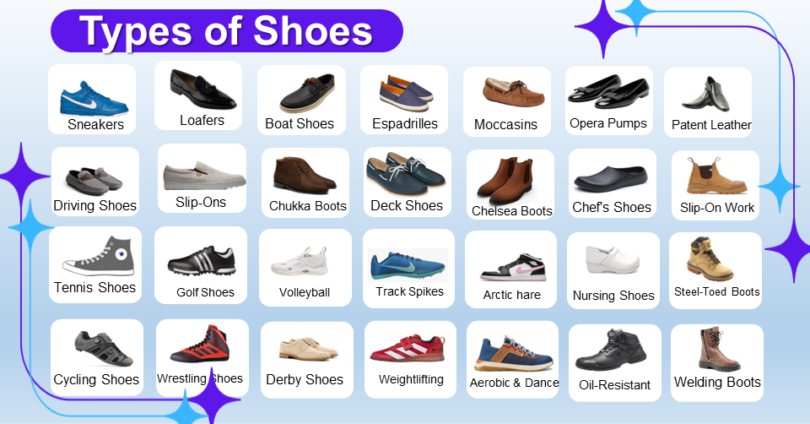
The nine main families of shoes in English are formal, casual, athletic, boots, high heels, sandals, slippers, outdoor and work, and traditional. Each style has its own English name and its own place in a wardrobe.
The nine main shoe families are formal shoes (Oxford, Derby, brogue), casual shoes (sneakers, loafers, ballet flats), athletic shoes (running, tennis, football), boots (Chelsea, hiking, cowboy), high heels (stiletto, pump, wedge), sandals (flip flop, gladiator, slide), slippers, outdoor and work shoes, and traditional shoes from around the world (Kolhapuri, zori, huarache). Every shoe that follows fits one of those nine families.
Common Types of Shoes With Pictures
Each family is defined by what the shoes are worn for, not by shape or material. Formal, casual, and athletic are the three most common. The other six are boots, high heels, sandals, slippers, outdoor and work shoes, and traditional shoes from around the world.
Formal Shoe Types With Names
Formal shoes are the leather styles worn with a suit, a tuxedo, or an evening gown.
Oxford: classic lace-up dress shoe with closed lacing stitched under the vamp, the model dress shoe for suits, weddings, and job interviews.
Derby: lace-up dress shoe with open lacing stitched on top of the vamp, slightly less formal than the Oxford and better suited to business casual and semi-formal events.
Brogue: traditional dress shoe patterned with decorative perforations along the edges and toe cap, in Oxford or Derby construction, originally made in Scotland and Ireland.
Monk Strap: slip-on dress shoe fastened with one or two leather straps and metal buckles instead of laces, worn for both semi-formal and business-casual wear.
Wingtip: formal shoe with a W-shaped toe cap that stretches across the vamp, decorated with brogue perforations along the pattern.
Whole-cut: ultra-formal dress shoe made from a single piece of leather with no seams across the vamp, giving the sleekest possible silhouette.
Cap Toe: distinctive Oxford or Derby style with an extra piece of leather stitched across the toe as a decorative “cap,” the most common Oxford variation.
Opera Pump: patent leather slip-on dress shoe with a small silk bow at the toe, worn traditionally with black-tie tuxedos.
Casual Shoe Types in English
Casual shoes are the everyday shoes worn when the dress code is relaxed.
Sneaker: flat rubber-soled shoe with a fabric or leather upper, worn every day and originally made for tennis and gym work (called a “trainer” in British English).
Slip-On: casual shoe with no laces or buckles, built to slip onto the foot with an elastic panel or an open construction.
Loafer: slip-on leather shoe with a low heel, worn both casually and in semi-formal office settings.
Penny Loafer: classic loafer with a slot across the top of the vamp where American college students once slid in a lucky penny.
Moccasin: soft handmade leather shoe with a distinctive puckered stitch around the toe, originally the everyday footwear of Native Americans.
Espadrille: lightweight canvas summer shoe with a jute rope sole, first made in the Pyrenees region of Spain and France.
Boat Shoe: casual leather or canvas shoe with a white non-marking rubber sole cut in grooves that grip a wet deck, the classic style for sailing.
Driving Shoe: flexible slip-on with tiny rubber studs on the sole and heel, designed for feel on the pedals of a car.
Canvas Shoe: everyday cotton-canvas sneaker with a rubber sole, best known through the Converse Chuck Taylor and the Vans slip-on.
Ballet Flat: low soft slip-on shoe with a rounded toe and a thin sole, modelled on the ballet slipper worn in dance.
Athletic Shoe Types With Names
Athletic shoes are the sport-specific shoes designed for running, jumping, kicking, or lifting.
Running Shoe: cushioned road shoe with a springy midsole and a lightweight breathable upper, built for repeated impact over long distances.
Trail Runner: off-road running shoe with a rugged tread pattern and reinforced upper for grip on mud, rocks, and roots.
Cross-Trainer: flat gym shoe built for a mix of activities, from weightlifting and step class to short runs and circuit training.
Basketball Shoe: high-top athletic shoe with strong ankle support and thick cushioning for the jumps, landings, and sharp turns of the sport.
Soccer Cleat: low athletic shoe with plastic or metal studs on the sole for grip on grass, called a “football boot” in British English.
Tennis Shoe: rubber-soled court shoe with reinforced side-to-side support for the quick lateral movement of tennis.
Golf Shoe: athletic shoe with small spikes or nubs on the sole for stability during a golf swing on wet grass.
Track Spike: ultra-light racing shoe with sharp metal or plastic spikes on the sole for maximum grip on a running track.
Cycling Shoe: stiff-soled shoe with a metal clip on the bottom that locks onto the pedal of a road or mountain bike.
Weightlifting Shoe: flat gym shoe with a solid raised wooden or plastic heel that keeps the lifter upright during heavy squats and cleans.
Wrestling Shoe: lightweight high-top shoe with a thin flexible sole and grippy rubber, designed to feel the mat and move without slipping.
Walking Shoe: cushioned lace-up with a rocker sole shape that supports long walks and low-impact fitness routines.
Types of Boots and Their Names
Boots come in every height from the ankle to the thigh.
Ankle Boot: boot cut to just above the ankle, one of the most versatile styles for everyday wear with jeans, trousers, or dresses.
Chelsea Boot: ankle-height boot with elastic side panels and a small pull tab at the back, first designed in Victorian London for horse riders.
Chukka Boot: short ankle boot with two or three lace eyelets, originally worn by polo players in India and named after a period of play in the game.
Combat Boot: heavy lace-up boot with a thick rubber sole and reinforced upper, developed for military use and now a streetwear classic.
Cowboy Boot: tall leather boot with a pointed toe, a slanted “cowboy” heel, and a decorative stitched shaft, worn in the American West since the 1800s.
Hiking Boot: sturdy waterproof boot with a rugged tread and reinforced ankle support, made for uneven trails and mountain paths.
Wellington Boot: waterproof rubber boot up to the knee, named after the Duke of Wellington who wore an early leather version at Waterloo, and called a “rain boot” in American English.
Snow Boot: insulated waterproof boot with thick padding and a deeply grooved sole, made for cold, snowy, or icy conditions.
Work Boot: durable leather boot with an oil-resistant sole and reinforced upper, built for construction sites, landscaping, and heavy labour.
Steel-Toed Boot: safety work boot with a hard steel or composite cap inside the toe, protecting the foot from falling objects and crushing.
Knee-High Boot: tall leather or synthetic boot reaching the knee, worn dressed up with skirts or pulled on over jeans.
Thigh-High Boot: boot rising above the knee to the upper thigh, a statement style in fashion editorial and high-end streetwear.
Ugg Boot: sheepskin boot lined with soft wool inside, originally Australian surfer footwear and now a global winter classic.
Types of High Heels in English
High heels vary by the height, thickness, and shape of the heel.
Stiletto: high heel with an extremely thin, tall spike heel from three to over eight inches, the iconic dress-up heel of formal wear.
Pump: low-cut dress shoe covering the toe and heel but leaving the top of the foot bare, called a “court shoe” in British English.
Kitten Heel: low delicate heel between one and two inches, comfortable enough for a full workday.
Wedge: high heel where the sole rises continuously from toe to heel in one solid piece, more stable to walk in than a stiletto.
Platform: heeled shoe with a thick raised sole under the front of the foot as well as the heel, boosting height without steepening the angle.
Mary Jane: flat or low-heeled shoe with a strap across the top of the foot, named after a girl in the 1902 Buster Brown newspaper cartoon.
Slingback: heeled shoe with an open back and a strap around the heel, exposing the top of the foot but securing the shoe on.
Mule: backless slip-on heel that dates to the ceremonial red leather calceus mulleus worn by ancient Roman aristocrats.
Court Shoe: the British English name for a pump, a closed low-cut dress shoe with a small-to-medium heel.
Types of Sandals With Pictures
Sandals are open shoes for warm weather.
Flip Flop: flat rubber or foam sandal with a Y-shaped thong strap between the toes, the world’s most-worn beach shoe.
Slide: backless sandal with one wide strap across the top of the foot, common in gyms, pools, and hotels.
Gladiator Sandal: criss-cross sandal with multiple straps that criss-cross up the ankle or calf, modelled on the sandals of ancient Roman soldiers.
Strappy Sandal: dressy heeled sandal held on by thin decorative straps around the foot and ankle, popular with cocktail and evening wear.
T-Strap Sandal: sandal with a T-shaped strap running from the front of the foot back to a strap around the ankle.
Sport Sandal: adjustable Velcro-strap sandal with a grippy rubber sole, designed for hiking, water crossings, and river walks.
Thong Sandal: leather or fabric sandal with a single strap between the big toe and second toe, a dressier version of the flip flop.
Slippers and House Shoe Types
Slippers are the soft indoor shoes worn inside instead of outdoor footwear.
House Slipper: soft indoor shoe with a fabric upper and a flexible sole, worn around the house instead of outdoor shoes.
Moccasin Slipper: indoor slipper cut in the shape of a moccasin, made from soft suede with a fleece lining.
Slide Slipper: open-back indoor slipper you step into like a slide, comfortable for a quick trip to the door or the kitchen.
Bootie Slipper: ankle-high slipper with a thick padded upper and a soft sole, warm enough to replace socks in winter.
Outdoor and Work Shoe Types
Outdoor and work shoes are the specialised styles built for a specific job or environment.
Mountaineering Boot: heavy insulated boot with a rigid sole made to take crampons, designed for ice climbing and high-altitude ascents.
Rock Climbing Shoe: tight rubber-toed shoe with a downturned shape, worn one size smaller than usual for precise grip on small edges and pockets in the rock.
Fishing Wader: waterproof one-piece boot-and-trouser combination reaching the chest, for wading into rivers and lakes to fish.
Nursing Shoe: slip-resistant supportive shoe with a padded insole, made for the long standing shifts of hospital and clinic staff.
Chef Shoe: slip-resistant closed-toe shoe with a wipeable non-porous upper, protecting the foot in a hot busy kitchen.
Electrician Boot: insulated safety boot with a rubber sole rated against electrical shock, worn by electricians and utility workers.
Welding Boot: fire-resistant leather boot with a metatarsal guard over the top of the foot, protecting against sparks and molten metal.
Bowling Shoe: rented shoe with a sliding leather sole on the lead foot and a braking rubber sole on the trailing foot, for the approach and release of a bowling ball.
Traditional Shoes From Around the World
Traditional shoes are the regional footwear tied to a country or culture.
Kolhapuri (India): flat tan leather sandal with braided straps, handmade in Kolhapur in western India since the 13th century.
Zori (Japan): flat thonged sandal made from woven rice straw, silk, or leather, worn with a kimono at formal Japanese occasions.
Geta (Japan): wooden platform sandal with two slats underneath and a fabric thong, worn with yukata robes at summer festivals.
Huarache (Mexico): flat leather sandal with a woven upper, an ancient Mexican shoe now worn everywhere from village markets to summer city streets.
Paduka (India): ancient wooden platform sandal held to the foot by a peg between the big toe and second toe, once worn by Hindu and Jain holy men.
Klomp (Netherlands): hand-carved wooden clog worn by Dutch farmers and gardeners for centuries, warm and waterproof against wet soil.
Shoe Types That Look Similar
Some shoe words name identical styles under different regional names.
Oxford vs Derby
| Term | Lacing | Where you wear it |
|---|---|---|
| Oxford | Closed lacing (eyelets stitched under the vamp) | Weddings, black tie, business meetings |
| Derby | Open lacing (eyelets stitched on top of the vamp) | Business casual, semi-formal, weekends |
Sneakers vs Trainers
| Term | Region | What it means |
|---|---|---|
| Sneakers | American English | Flat rubber-soled athletic shoe for everyday wear |
| Trainers | British English | The same shoe, different name |
A shop in New York sells sneakers; a shop in London sells trainers. Both name the same style.
Pumps vs Court Shoes
| Term | Region | What it means |
|---|---|---|
| Pump | American English | Closed low-cut dress shoe with a small-to-medium heel |
| Court Shoe | British English | The same shoe, different name |
In British English, “pumps” also names plimsolls (flat canvas gym shoes), so the country of the speaker changes the meaning of the word.
Boat Shoes vs Deck Shoes
| Term | What it is |
|---|---|
| Boat Shoe | Casual leather shoe with non-marking rubber sole and lacing around the ankle |
| Deck Shoe | Another name for the same shoe, especially in nautical or catalogue use |
The two are the same style. “Boat shoe” is the more common name in casual conversation; “deck shoe” turns up in catalogues and yacht-club vocabulary.
FAQs
Q1. What are the main types of shoes?
The main types of shoes are formal shoes (Oxfords, Derbys, brogues), casual shoes (sneakers, loafers, moccasins), athletic shoes (running shoes, tennis shoes, football boots), boots (Chelsea, hiking, cowboy), high heels (stilettos, pumps, wedges), sandals (flip flops, gladiators, slides), slippers, outdoor and work shoes, and traditional shoes from around the world.
Q2. What is the difference between Oxford and Derby shoes?
Oxford shoes have closed lacing, meaning the eyelet tabs are stitched under the vamp and pull together in a sleek closed line. Derby shoes have open lacing, meaning the eyelet tabs are stitched on top of the vamp and open outward. The Oxford is the more formal of the two and suits weddings and black-tie events, while the Derby handles wider feet and works for semi-formal and business-casual outfits.
Q3. What are the different types of women’s heels?
The different types of women’s heels are stilettos (very thin, very tall), kitten heels (delicate one to two inches), pumps or court shoes (closed low-cut), wedges (solid sole rising from toe to heel), platforms (thick sole under the whole foot), Mary Janes (with a strap across the top), slingbacks (with a strap around the heel), and mules (backless slip-on heels).
Q4. What is the difference between sneakers and trainers?
Sneakers and trainers are the same shoe under different regional names. Sneakers is the American English word, trainers is the British English word, and both name a flat rubber-soled athletic shoe worn every day. A shop in New York sells sneakers; a shop in London sells trainers.
Q5. What types of shoes should every man own?
Every man should own at least one pair of Oxford or Derby dress shoes for weddings and interviews, a pair of loafers for smart-casual settings, comfortable sneakers for everyday wear, a pair of Chelsea or ankle boots for cooler months, hiking or work boots if the lifestyle calls for it, and sandals or flip flops for summer and the beach.
Q6. What types of shoes should every woman own?
Every woman should own at least one pair of black pumps or court shoes for formal events, ballet flats or loafers for everyday walking, sneakers for casual wear and exercise, ankle boots or knee-high boots for cooler weather, one pair of dressy heels (stilettos, wedges, or slingbacks) for evening outfits, and sandals or flip flops for summer.

Leave a Comment