
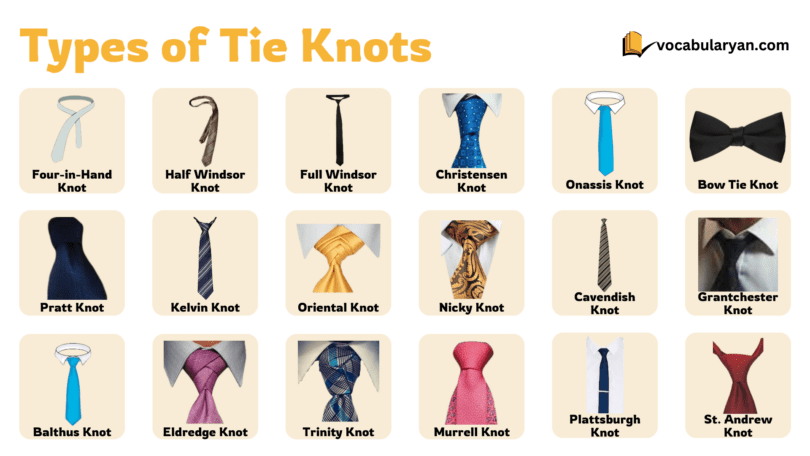
A tie knot’s name usually points to its shape, its inventor, or the region where it first caught on, and each one suits a different collar width and occasion. The knots below group by everyday use, distinctive style, and formal occasions, so each name stays connected to how it looks and when to wear it.
What Names of Tie Knots Cover
Tie knots range from the narrow, quick Four-in-Hand to wide, formal knots like the Windsor, along with a smaller set of distinctive knots favored for their look rather than their speed. Mathematicians Thomas Fink and Yong Mao formally identified 85 ways to tie a tie in a well-known 1999 paper, and knot enthusiasts have since documented dozens more, including modern additions like the Trinity and Eldredge knots.
Everyday Tie Knots
- Four-in-Hand Knot: narrow and slightly asymmetrical, and the fastest common knot to tie. It suits casual shirts and thinner ties well, and is also known as the Simple Knot or Schoolboy Knot.
- Half Windsor Knot: triangular and neat, giving a fuller look than the Four-in-Hand without the bulk of a full Windsor. It works well for most office shirts and medium-weight ties.
- Windsor Knot: wide and symmetrical, forming a thick triangle suited to spread collars and formal business wear. It is also called the Full Windsor or Double Windsor.
- Pratt Knot: creates a neat, centered, symmetrical knot that works with most fabrics. It is also known as the Shelby Knot.
Distinctive Tie Knots From Around the World
- Kelvin Knot: firm and angular, giving a sharp, professional shape on medium-weight fabric. It is common in European business settings.
- Oriental Knot: fast and compact, tied with fewer wraps than most knots. It suits shorter ties or taller wearers who need less length taken up by the knot.
- Balthus Knot: large and heavily wrapped, making a deliberately bold statement. It needs a longer tie and works best with wide-spread collars.
- Nicky Knot: small and symmetrical, a neat option for everyday wear with medium collars.
- Trinity Knot: a modern, three-way symmetrical knot resembling a Celtic triquetra, converging at one center point. It looks intricate but is tied with fairly simple moves once learned.
- Eldredge Knot: an elaborate knot tied using the narrow end of the tie instead of the wide end, creating a distinctive woven, textured front. It takes practice and suits occasions where a striking look matters more than speed.
Formal Tie Knots for Business and Events
- Full Windsor: the same wide, symmetrical knot as the Windsor, favored for business suits and formal blazers with spread collars.
- Double Knot: adds an extra wrap for more height and body, helping shape softer or thinner ties that would otherwise look too flat.
- St. Andrew Knot: symmetrical and moderately sized, sitting between the Four-in-Hand and the Windsor in both formality and difficulty.
- Victoria Knot: neat and compact, similar in look to the Kelvin but tied with a different wrap sequence.
Choosing a Knot by Collar and Occasion
The knots above already cover shape and style; the groupings below simply note which ones suit a particular collar or setting, without repeating their descriptions.
- Narrow or short collars: the Four-in-Hand, Nicky, and Oriental knots stay small enough to avoid overwhelming a tight collar.
- Wide spread collars: the Windsor, Full Windsor, and Balthus knots fill the extra space between collar points.
- Casual or open-collar shirts: the Four-in-Hand, Pratt, and Kelvin knots tie quickly and sit comfortably without a jacket.
- Tuxedos and black-tie events: the Full Windsor and Half Windsor give the symmetrical, formal look black-tie dress codes call for.
FAQs
Q1. What is the easiest tie knot to learn?
The Four-in-Hand Knot is the easiest to learn, since it needs the fewest steps of any common knot. It works well for beginners who want a quick, reliable way to tie a tie.
Q2. What is the difference between a Windsor and a Four-in-Hand knot?
The Four-in-Hand knot is narrow and slightly off-center, suiting casual wear and thicker ties. The Windsor knot is wide, symmetrical, and formal, better suited to spread-collar dress shirts.
Q3. What is the most common tie knot for formal events and interviews?
The Half Windsor and Full Windsor are the most common choices for interviews and formal events, since both give a neat, symmetrical look that reads as professional across most collar types.
Q4. What knot works best with a spread collar shirt?
Wider knots such as the Windsor, Full Windsor, and Balthus fill the extra space between a spread collar’s points better than narrower knots like the Four-in-Hand.
Q5. Is the Half Windsor or the Full Windsor more formal?
The Full Windsor is generally considered more formal, since its larger, fuller triangle shape reads as more deliberate and structured than the Half Windsor’s smaller version of the same shape.
Q6. Are the Trinity and Eldredge knots practical for everyday wear?
Not usually. Both are more elaborate than standard knots and are better suited to occasions where the tie itself is meant to stand out, rather than daily office wear where a faster, simpler knot is more practical.

Leave a Comment