
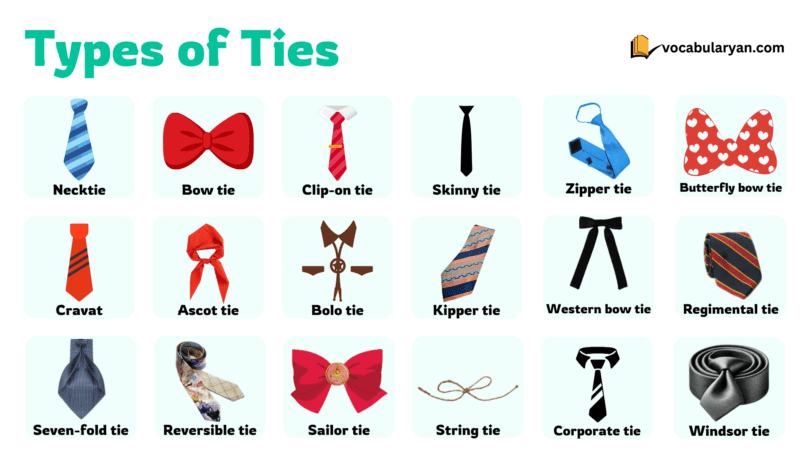
Ties range from the everyday necktie to specialized styles worn for weddings, uniforms, and Western fashion, and each one differs in shape, width, and occasion. Learning the different types of ties helps you match the right style to the right event, whether that’s a business meeting, a wedding, or a costume party.
Types of Ties by Style and Occasion
The types of ties below group by how formal the setting is and where each style actually comes from, so a business necktie and a Western bolo tie never end up mixed under the same label.
Everyday and Business Ties
- Necktie: a strip of fabric knotted at the throat, the default choice for offices, meetings, and most business dress codes. Width and pattern vary widely, from narrow modern cuts to broader, more traditional styles.
- Skinny Tie: takes the standard necktie and trims its width down, giving a slimmer, more contemporary line. Younger professionals and fashion-conscious dressers tend to reach for this cut over a wider, traditional one.
- Clip-On Tie: skips the knot entirely, arriving pre-shaped and fastening to the collar with a small clip. Children, security staff, and anyone who wants a finished look without learning to tie one all rely on this shortcut.
Formal and Special-Occasion Ties
- Bow Tie: two loops meeting at a small center knot, tied short against the collar rather than hanging down the chest. Weddings and black-tie events are where this shape shows up most.
- Ascot Tie: wider and pleated compared to a standard necktie, held in place with a pin rather than tied in a knot. Daytime formal events, such as horse races and garden weddings, call for this specific style.
- Cravat: worn loosely draped around the neck long before the necktie existed, once a mark of aristocratic dress. Modern neckwear traces its lineage directly back to this older, softer style.
Regional and Statement Ties
- Bolo Tie: trades the fabric knot for a cord and decorative clasp, fastened at the throat with a slide instead of any tying. Western wardrobes and cowboy-inspired fashion claim this style as their own.
- String Tie: thin as a shoelace and just as quick to loop, bringing a narrow, ribbon-like strip to Southern and Western outfits. Vintage styling and cowboy fashion both lean on this understated option.
- Sailor’s Tie: a short, wide band of fabric distinct from a standard necktie’s shape, worn as part of naval uniforms and school dress codes alike.
- Kipper Tie: nothing subtle about this one: an oversized width paired with loud patterns and bright colors defined a specific strand of 1970s fashion. It still reads as a statement piece rather than a background accessory.
Notable Tie Facts and Records
- Terracotta soldiers built for China’s first emperor around 221 B.C. show neck cloths that count among the earliest depictions of tie-like neckwear.
- The word “cravat” traces back to Croatian mercenaries, whose knotted neckerchiefs caught on in 17th-century France and eventually shaped the modern tie.
- Academia Cravatica set the record for the longest tie in the world in 2003, stretching a single necktie 808 meters, about 2,650 feet, around an arena in Pula, Croatia.
- The Suashish Necktie holds the record for the most expensive tie ever made: pure silk worked with 150 grams of gold and set with 271 diamonds, valued at roughly $220,000.
- The bow tie rose to prominence in the 19th century as a shorter, simpler alternative to the cravat.
FAQs
Q1. What are the most common types of ties?
The most common types of ties are the necktie, the bow tie, and the skinny tie, since these three appear most often in everyday business and formal wear. Other types, such as the bolo tie and the ascot, tend to stay tied to a specific region or occasion.
Q2. What is the difference between a necktie and a bow tie?
A necktie hangs long and straight down the chest, while a bow tie ties short against the collar in a symmetrical bow shape. Business settings favor the necktie, while formal events lean toward the bow tie.
Q3. When should you wear an ascot tie?
Save the ascot for formal daytime occasions such as weddings and horse races, where its wide, pleated shape and pinned styling add a classic, aristocratic touch.
Q4. What is a bolo tie, and where is it commonly worn?
A bolo tie replaces the usual knot with a cord and decorative clasp fastened at the throat. It belongs to Western and Southwestern U.S. fashion, closely tied to cowboy culture.
Q5. What is the difference between a cravat and a necktie?
A cravat drapes loosely around the neck in a soft, informal style, while a necktie knots more tightly against the collar. The cravat came first historically, and the necktie developed from it.
Q6. Is a clip-on tie appropriate for a job interview?
A regular tied necktie reads as more polished for a job interview, so a clip-on is worth avoiding when that option exists. Clip-ons work better for uniforms, young children, or situations where a traditional knot poses a safety risk.
Q7. What makes a kipper tie different from a standard necktie?
Width is the giveaway: a kipper tie runs noticeably wider than a standard necktie and typically shows bold, bright patterns from its 1970s heyday. That combination makes it a statement piece rather than an everyday choice.

Leave a Comment