
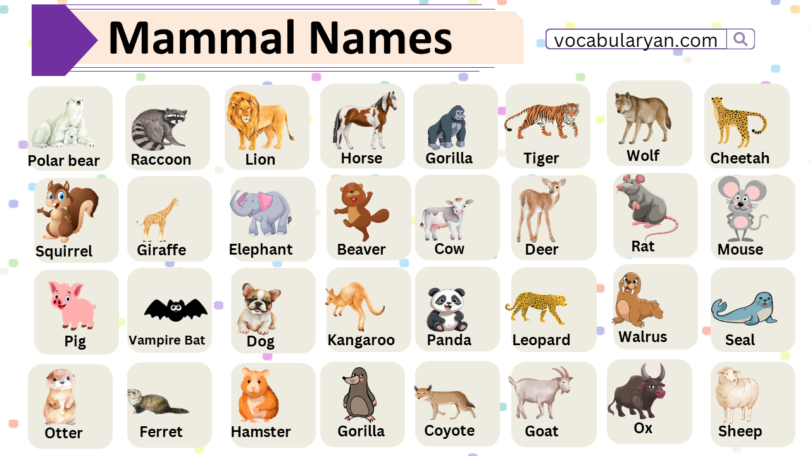
Mammals are warm-blooded animals with hair or fur that feed their young with milk. Almost all give birth to live young; only the platypus and the echidna lay eggs. The main habitats a learner meets in English are homes, farms, forests, deserts, mountains, the Arctic, the African savanna, and the sea.
Mammals are warm-blooded vertebrate animals with hair or fur that feed their young with milk. There are 11 main groups by habitat and biological order: common and pet, farm, forest, desert and mountain, Arctic, savanna, aquatic, rodent, primate, big cat, and unusual mammals.
Common Mammal Names With Pictures
Each family is defined by where the mammals are found or by the biological order they share. Common and pet mammals, farm animals, and forest mammals are the three most familiar. The other eight are desert and mountain, Arctic and polar, savanna, aquatic, rodent, primate, big cat, and unusual mammals.
Common and Pet Mammal Names
Common and pet mammals are the animals you meet at home, in the family, or as household pets.
Human: the only mammal that walks upright on two legs and uses complex language, and the mammal reading this list right now.
Dog: loyal domesticated mammal descended from the wolf, kept as a family pet, working animal, and hunting companion for over 15,000 years.
Cat: small domesticated mammal with retractable claws and a sharp sense of hearing, one of the two most popular pets in the world.
Rabbit: long-eared herbivore with strong back legs, kept as a pet and also raised on farms for meat and fur.
Hamster: small round rodent with cheek pouches used to store food, popular as a first pet for children because of its calm nature and short lifespan.
Guinea Pig: larger tailless rodent from the Andes of South America, kept as a friendly pet that squeaks and chirps.
Ferret: long slender pet related to the weasel, curious and playful, and trained in some countries to hunt rabbits.
Chinchilla: soft grey rodent from the Andes with the densest fur of any mammal on Earth, kept as a quiet, dust-bathing pet.
Farm and Livestock Mammal Names
Farm and livestock mammals are the animals raised for milk, meat, wool, or work.
Cow: large hoofed mammal kept for milk, meat, and leather, raised on farms across the world in more than 900 breeds.
Horse: long-limbed hoofed mammal domesticated 5,000 years ago, used for riding, farm work, racing, and companionship.
Donkey: small hoofed cousin of the horse with long ears, patient and sure-footed on rough ground.
Sheep: wool-covered farm mammal kept for wool, meat, and milk, with more than one billion raised worldwide.
Goat: hardy hoofed mammal with a beard and curved horns, kept for milk, meat, and cashmere wool.
Pig: intelligent hoofed mammal with a flat snout, raised for pork, bacon, and ham, and one of the smartest domesticated animals.
Buffalo: heavy horned mammal used across Asia for milk, meat, and pulling ploughs in rice paddies.
Yak: long-haired horned mammal of the Himalayas, providing milk, meat, wool, and transport across the Tibetan Plateau.
Alpaca: small woolly mammal of the South American Andes, raised for its soft, warm fleece.
Llama: taller cousin of the alpaca, used as a pack animal across Peru and Bolivia to move loads on mountain trails.
Forest and Jungle Mammal Names
Forest and jungle mammals are the wild mammals of temperate and tropical woodlands.
Deer: graceful hoofed mammal with antlers on the males, common across forests of Europe, Asia, and the Americas.
Fox: cunning nocturnal mammal with a bushy tail and pointed ears, common in the countryside and city outskirts alike.
Wolf: wild dog that hunts in packs, the ancestor of every domestic dog and still found across the wilderness of North America, Europe, and Asia.
Bear: large heavy-bodied mammal with thick fur, hibernating through winter in cold climates and known in brown, black, grizzly, and polar species.
Wild Boar: large tusked wild pig with coarse hair, aggressive when cornered and the ancestor of every farm pig.
Raccoon: clever masked mammal with a striped tail, well known for raiding rubbish bins in North American cities and towns.
Skunk: black-and-white mammal that sprays a foul-smelling liquid when threatened, common across the woodlands and suburbs of the Americas.
Opossum: North American marsupial with a bare tail that plays dead when scared, and the only marsupial found north of Mexico.
Weasel: long slim carnivore with short legs, quick enough to hunt animals much larger than itself.
Badger: stout burrowing mammal with a striped black-and-white face, making its home in setts under woodland floors across Europe and Asia.
Desert and Mountain Mammal Names
Desert and mountain mammals are the animals adapted to hot dry deserts or steep rocky heights.
Camel: tall hoofed mammal with one or two humps, storing fat for long crossings of hot deserts in the Middle East and North Africa.
Fennec Fox: tiny sand-coloured fox with huge ears, adapted to hot Saharan nights and cool desert dawns.
Meerkat: small upright-standing mammal of southern Africa, forming tight family groups called mobs that take turns as sentries.
Ibex: wild mountain goat with long backward-curving horns, climbing steep rock faces across the Alps and the Himalayas.
Mountain Goat: white-coated cliff-dwelling mammal of the Rocky Mountains, with hooves designed for gripping vertical rock.
Chamois: small mountain antelope of the Alps, known for its agility on rocky slopes and its soft leather.
Oryx: tall desert antelope with straight blade-like horns, surviving without drinking water for long periods in the deserts of Arabia and southern Africa.
Arctic and Polar Mammal Names
Arctic and polar mammals are the animals adapted to the freezing conditions of the far north.
Polar Bear: largest land carnivore in the world, hunting seals across the Arctic sea ice and swimming for miles between floes.
Arctic Fox: small fox that turns white in winter and brown in summer, surviving on lemmings and scraps in the polar tundra.
Arctic Wolf: thick-coated white wolf that hunts in packs across the ice fields of northern Canada and Greenland.
Arctic Hare: large snow-white hare with short ears, able to leap 40 miles per hour across frozen tundra.
Caribou: large migrating deer of the Arctic, called reindeer in Europe and travelling thousands of miles each year between summer and winter grazing grounds.
Musk Ox: shaggy horned mammal of the Arctic tundra, forming a defensive circle around its calves when attacked by wolves.
Walrus: huge tusked seal-like mammal that hauls itself onto Arctic beaches in large herds, using its tusks to break through ice.
Snow Leopard: rare grey-white big cat of the high Himalayas, so quiet and camouflaged that it has been called the “ghost of the mountains.”
African Savanna Mammal Names
African savanna mammals are the iconic large mammals of Africa’s grasslands.
Lion: golden-brown big cat of the African savanna, the only cat that forms family groups called prides and one of the “big five” African game animals.
Elephant: largest land mammal on Earth, with a long trunk, curved tusks, and a memory strong enough to recognise faces years later.
Giraffe: tallest mammal on Earth, with a long neck for reaching leaves five metres above the ground and a spotted coat that camouflages against branches.
Zebra: black-and-white striped mammal of Africa, related to horses and donkeys, and one of the most recognised silhouettes on the savanna.
Rhinoceros: enormous horned mammal with thick armour-like skin, hunted almost to extinction for the ivory in its horn.
Hippopotamus: massive semi-aquatic mammal that spends the day submerged in African rivers and lakes, one of the most dangerous animals in Africa despite its round shape.
Wildebeest: shaggy antelope of East Africa, migrating in herds of a million or more between the Serengeti and the Masai Mara each year.
Warthog: wild African pig with two curved tusks and warty growths on its face, and the mammal Pumbaa was drawn from in The Lion King.
Antelope: graceful long-legged mammal with slender horns, from the tiny dik-dik to the tall eland across the African savanna.
Gazelle: small slender antelope known for enormous leaping stotting jumps to confuse predators.
Aquatic and Marine Mammal Names
Aquatic and marine mammals are the mammals that spend most or all of their time in water.
Whale: enormous sea mammal that breathes air through a blowhole and gives birth in the ocean, from the belugas of the Arctic to the enormous blue whales of every deep sea.
Blue Whale: largest animal ever known to exist, reaching 30 metres and 200 tons, and feeding almost entirely on tiny krill.
Dolphin: intelligent sea mammal with a beak-like snout, communicating through clicks and whistles and swimming in family groups called pods.
Porpoise: small stocky cousin of the dolphin with a rounded head and no beak, found in coastal waters of North America, Europe, and Asia.
Orca: largest species of dolphin, called the “killer whale” for its habit of hunting seals, fish, and even other whales in family pods.
Seal: rounded flippered mammal that swims fast in cold seas and hauls out on beaches to rest, with over 30 species across the Arctic, Antarctic, and temperate coasts.
Sea Lion: larger seal-like mammal with visible external ear flaps and stronger front flippers, able to walk on land unlike true seals.
Otter: playful river mammal with waterproof fur and webbed feet, floating on its back to crack shellfish on its chest.
Sea Otter: marine cousin of the river otter, linking paws while sleeping so ocean currents do not separate the group.
Manatee: slow-moving vegetarian sea mammal found in warm coastal waters of Florida, the Amazon, and West Africa, nicknamed the “sea cow.”
Dugong: cousin of the manatee found in the Pacific and Indian Oceans, and the mammal that inspired mermaid legends among ancient sailors.
Rodent and Small Mammal Names
Rodents are the largest order of mammals, characterised by continuously growing front teeth for gnawing.
Rat: medium-sized rodent with a long naked tail, adapted to almost every human city on Earth and one of the most successful mammals in history.
Mouse: small quick rodent with big ears and a long thin tail, found in every home, field, and grain store across the temperate world.
Squirrel: bushy-tailed rodent that stores nuts in hidden caches, seen in trees and on the ground in parks, forests, and gardens.
Chipmunk: small striped rodent of North America with cheek pouches, gathering seeds and nuts for winter storage underground.
Capybara: largest rodent in the world, native to South America, famous for its calm nature and its close friendships with almost every other animal.
Mole: small blind burrowing mammal with strong shovel-like paws, digging tunnels underground to catch worms and insects.
Hedgehog: small spiny nocturnal mammal that curls into a ball when threatened, common in European gardens and hedgerows.
Beaver: large flat-tailed rodent that builds dams and lodges across streams and rivers in North America and Europe.
Primate Names in English
Primates are the mammal order of humans, apes, monkeys, and lemurs, sharing forward-facing eyes and grasping hands.
Chimpanzee: African great ape, the closest surviving relative of the human, sharing over 98% of our DNA and using tools in the wild.
Gorilla: largest of the great apes, quiet vegetarian giant of central African rainforests, sleeping in fresh leaf nests every night.
Orangutan: red-haired great ape of the rainforests of Borneo and Sumatra, spending most of its life swinging between trees.
Baboon: dog-faced monkey of Africa and Arabia, moving in large troops led by dominant males and known for its long muzzle and calloused rump.
Macaque: medium-sized monkey found across Asia, from Japanese snow macaques bathing in hot springs to Indian macaques thriving beside people in temples.
Lemur: long-tailed primate found only on the island of Madagascar, most active in the early morning and evening.
Big Cat Names in English
Big cats are the largest wild cats, hunting alone or in groups across the world’s grasslands and forests.
Tiger: largest cat in the world, orange with black stripes and a solitary night hunter of the Asian forests, and the national animal of India, Bangladesh, and Malaysia.
Leopard: medium-sized spotted cat of Africa and Asia, stealthy and strong enough to drag prey twice its weight up into a tree.
Jaguar: stockier spotted cat of the Central and South American rainforests, with the strongest bite of any big cat and a taste for caimans.
Cheetah: slender spotted cat of the African plains, and the fastest land animal on Earth, sprinting up to 70 miles per hour in short bursts.
Cougar: large tan cat of the Americas, also called the puma or mountain lion, hunting deer from the Canadian Rockies to Patagonia.
Lynx: medium-sized wild cat with tufted ears and a short tail, hunting hares and small deer across the forests of North America, Europe, and Asia.
Unusual Mammal Names in English
Unusual mammals are the ones that break the usual rules: they fly, lay eggs, keep young in pouches, or move extremely slowly.
Bat: the only mammal that truly flies, with wings made of thin skin stretched across long finger bones, and about 1,400 species from tiny fruit bats to fox-sized flying foxes.
Platypus: duck-billed egg-laying mammal of eastern Australia, one of only two mammal groups (monotremes) that lay eggs instead of giving birth.
Echidna: spiny egg-laying mammal of Australia and New Guinea, the other monotreme alongside the platypus, digging out ants and termites with a long sticky tongue.
Kangaroo: large hopping marsupial of Australia that keeps its baby (a joey) in a front pouch for the first six months of life.
Koala: grey tree-climbing marsupial of eastern Australian eucalyptus forests, sleeping up to 20 hours a day.
Wombat: stocky burrowing marsupial of Australia and Tasmania, known for cube-shaped droppings and speeds of 25 miles per hour in short bursts.
Sloth: extremely slow tree-dwelling mammal of the Central and South American rainforest, hanging upside down from branches most of its life.
Anteater: long-snouted mammal of Central and South America, sweeping a sticky metre-long tongue through anthills and termite mounds.
Pangolin: scaly ant-eating mammal of Africa and Asia, the only mammal covered in hard keratin scales and the most trafficked animal in the world.
Armadillo: small armoured mammal of the Americas with a bony shell over its back, curling into a ball when threatened.
Mammal Names That Look Similar
Some mammal names look almost the same but name different animals.
Seal vs Sea Lion vs Walrus
| Term | Ears | Movement on land | Tusks |
|---|---|---|---|
| Seal | No external ear flaps | Wriggles on its belly | No |
| Sea Lion | External ear flaps visible | Walks on rotating front flippers | No |
| Walrus | No external ear flaps | Lumbers on all four flippers | Two long tusks |
Rabbit vs Hare
| Term | Size | Nest | Newborns |
|---|---|---|---|
| Rabbit | Smaller, shorter ears | Underground burrow | Born blind, hairless, helpless |
| Hare | Larger, longer ears | Above-ground scrape called a form | Born furred with eyes open, running within an hour |
Alpaca vs Llama vs Camel
| Term | Size | Humps | Use |
|---|---|---|---|
| Alpaca | Smallest | None | Kept for soft wool |
| Llama | Larger than alpaca | None | Used as a pack animal |
| Camel | Largest | One or two | Ridden and used for milk, meat, and desert transport |
Cheetah vs Leopard vs Jaguar
| Term | Pattern | Where you find it | Standout feature |
|---|---|---|---|
| Cheetah | Small solid black spots | African plains | Fastest land animal, no rosettes |
| Leopard | Small ring-shaped rosettes | Africa and Asia | Strong climber that hauls prey into trees |
| Jaguar | Larger rosettes with a black centre dot | Central and South America | Strongest bite of any big cat |
FAQs
Q1. What are mammals?
Mammals are warm-blooded vertebrate animals with hair or fur that feed their young with milk from mammary glands. Almost all mammals give birth to live young and breathe air through lungs. Common examples are dogs, cats, elephants, whales, and humans.
Q2. Are humans mammals?
Yes, humans are mammals. Humans have hair, are warm-blooded, feed their babies with milk, and give birth to live young. All these traits define the mammal class. Humans are members of the primate order, sharing a common ancestor with chimpanzees and gorillas.
Q3. Are whales and dolphins mammals?
Yes, whales and dolphins are mammals despite living in the sea. They breathe air through blowholes on top of their heads, give birth to live young, and nurse their calves with milk. They evolved from land-dwelling ancestors that returned to the sea about 50 million years ago.
Q4. Which mammals can fly?
Bats are the only mammals that can truly fly, using wings made of thin skin stretched across long finger bones. Other mammals like flying squirrels and sugar gliders can glide from tree to tree using a skin flap between their limbs, but they cannot flap their wings and take off from the ground.
Q5. Which mammals lay eggs?
Only two groups of mammals lay eggs: the platypus and the four species of echidna, both found in Australia and New Guinea. These egg-laying mammals are called monotremes. They still produce milk to feed their young, which is what makes them mammals despite laying eggs.
Q6. What is the difference between a seal and a sea lion?
Seals have no visible external ear flaps and wriggle along the ground on their bellies, while sea lions have visible external ear flaps and walk on their rotating front flippers. Sea lions are also larger, more social, and noisier than seals. Walruses, a third group, have long tusks that neither seals nor sea lions grow.

Leave a Comment