
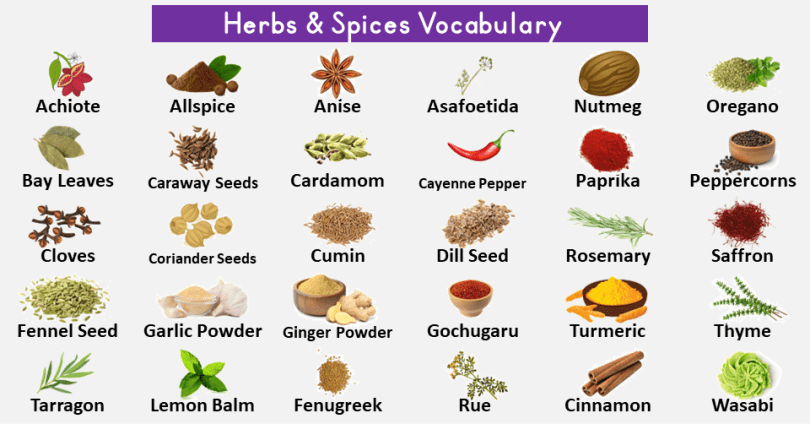
Herbs and spices are the plant-derived flavorings that give food its aroma, color, and taste, from fresh green herbs to warm ground spices. English herb and spice names have 14 main categories by part of plant, cuisine, and use.
English herb and spice names have 14 main categories: Mediterranean herbs, fresh green herbs, leaf spices, seed spices, root spices, bark spices, pod spices, fruit and flower spices, peppercorns, chili and paprika, Indian and Asian blends, Western and Mediterranean blends, Middle Eastern regionals, and salt.
Common Herbs and Spices Names With Pictures
Each category is defined by the part of the plant used, the cuisine region, or the finished blend. Mediterranean herbs, fresh green herbs, and seed spices are three of the most-used categories. The other 11 are leaf spices, root spices, bark spices, pod spices, fruit and flower spices, peppercorns, chili and paprika, Indian and Asian blends, Western and Mediterranean blends, Middle Eastern regionals, and salt.
Common Mediterranean Herb Names in English (Lamiaceae Family)
Mediterranean herbs (family Lamiaceae) are the aromatic leaves of the mint family, the essential herbs of Italian, Greek, and French cooking.
Basil
sweet peppery aromatic herb with soft green leaves, star ingredient of Italian pesto and Thai cuisine. Basil pairs with tomato, mozzarella, and garlic across Mediterranean and Southeast Asian dishes worldwide.
Oregano
robust pungent herb with small dark green leaves and a peppery earthy flavor. Oregano is the classic pizza and pasta herb, used dried in Italian cooking and fresh in Greek dishes.
Rosemary
piney needle-shaped evergreen herb with strong pine-camphor flavor. Rosemary is the classic Mediterranean roast meat herb, essential with lamb, chicken, potatoes, and focaccia bread.
Thyme
tiny leafy herb with earthy floral peppery flavor and delicate branching stems. Thyme is a staple of French bouquet garni, Cajun cooking, and Middle Eastern za’atar spice blend.
Sage
soft silvery-green herb with strong pine-camphor woody flavor. Sage is the classic Thanksgiving stuffing herb, and pairs with roast turkey, brown butter, and Italian saltimbocca dishes.
Marjoram
delicate sweet-oregano-flavored herb with small oval leaves. Marjoram is oregano’s milder cousin, used in French and German sausages and Middle Eastern za’atar blends.
Fresh Green Herb Names in English
Fresh green herbs are the bright leafy herbs added at the end of cooking for grassy citrus notes.
Parsley
bright green flat or curly-leaf herb with mild grassy flavor. Parsley is the world’s most-used culinary herb as flat-leaf Italian or curly for garnish, and a star ingredient in tabbouleh salad.
Cilantro (Coriander Leaf)
bright green flat-leaf herb with citrusy fresh flavor. Called “cilantro” in American English and “coriander leaf” in British English, essential in Mexican, Indian, Thai, and Vietnamese cuisines.
Chives
long thin hollow onion-related herb tubes with mild garlic-onion flavor. Chives are the classic garnish for baked potatoes, cream cheese, and cottage cheese, and grow well in kitchen windowsills.
Dill
feathery green herb with sweet grassy anise-like flavor. Dill is the classic pickle herb, used in Scandinavian fish dishes, Middle Eastern yogurt sauces, and Russian borscht soup.
Tarragon
slender-leaved herb with anise-licorice flavor. Tarragon is one of the four French “fines herbes” (with parsley, chives, and chervil), essential in Béarnaise sauce and roast chicken.
Mint
bright green square-stemmed herb with fresh cooling menthol flavor. Mint comes in spearmint (most-used), peppermint (candy), and Moroccan mint tea varieties, and garnishes both sweet and savory dishes.
Leaf Spice and Aromatic Names in English
Leaf spices and aromatics are the whole dried leaves and grass stalks added early in cooking for slow-release flavor.
Bay Leaf
smooth glossy dark green leaf with woodsy floral flavor added whole to slow-cooked dishes. Bay leaves are removed before serving and are essential in French bouquet garni, Indian curry, and Italian tomato sauce.
Curry Leaf
small glossy dark green leaf with unique nutty citrus flavor. Curry leaves are the essential ingredient of South Indian curries, tempered in hot oil at the start of cooking.
Lemongrass
long fibrous stalk with bright lemon-citrus flavor. Lemongrass is the essential herb of Thai and Vietnamese cuisines, used in tom yum soup, curry pastes, and green herbal teas.
Chervil
delicate feathery herb with subtle anise-parsley flavor. Chervil is one of the four French “fines herbes” essential in Béarnaise sauce and traditional French omelets and cream sauces.
Sorrel
tart bright green leafy herb with lemon-sour flavor from oxalic acid. Sorrel is essential in French sorrel soup, English wild-food dishes, and Eastern European borscht variations.
Seed Spice Names in English
Seed spices are the dried seeds of aromatic plants, ground or whole, used across Indian, Middle Eastern, and European cuisines.
Cumin
warm earthy pungent seed spice with distinct yellow-brown color. Cumin is the essential spice of Mexican, Indian, and Middle Eastern cuisine, used in tacos, curry, and hummus worldwide.
Coriander Seed
round tan citrus-earthy seed of the coriander/cilantro plant. Coriander seeds are essential in curry powder, garam masala, and Middle Eastern spice blends, with lemony-nutty flavor unlike the leaves.
Fennel Seed
oval yellow-green seed with sweet anise-licorice flavor. Fennel seeds are the classic Italian sausage spice, chewed after Indian meals as breath freshener, and essential in Chinese five-spice powder.
Mustard Seed
tiny round yellow, brown, or black seed with pungent sharp heat. Mustard seeds are ground into mustard paste, tempered in Indian dals, and essential in pickling brines worldwide.
Caraway Seed
crescent-shaped brown seed with pungent nutty anise-like flavor. Caraway seeds are essential in German sauerkraut, rye bread, Hungarian goulash, and Eastern European sausages.
Anise
small brown seed with strong licorice sweet flavor, the classic flavoring of Italian biscotti and pizzelle. Anise is essential in Mediterranean liqueurs like sambuca, ouzo, and pastis.
Fenugreek
yellow-brown angular seed with distinctive maple-syrup-like flavor after cooking. Fenugreek is essential in Indian curry powder and Ethiopian berbere, giving the maple-syrup aroma to Indian curry dishes.
Root and Rhizome Spice Names in English
Root and rhizome spices are the underground stem and root spices with warm pungent flavors, used fresh, dried, or powdered.
Ginger
knobby brown root with pungent sweet-hot flavor and fresh aroma. Ginger is essential in Asian cuisine, gingerbread, ginger ale, and Indian chai, used fresh, dried, or powdered.
Turmeric
bright yellow-orange root with earthy bitter flavor, giving curry its golden color. Turmeric has curcumin with anti-inflammatory properties, and stains everything it touches golden yellow.
Galangal
pale pink-white root cousin of ginger with sharper citrus-piney flavor. Galangal is essential in Thai tom yum soup, Indonesian curries, and Malaysian rendang beef.
Horseradish
long white root with intense fiery mustard-like heat. Horseradish is grated fresh and mixed with vinegar into the classic condiment for prime rib and cocktail sauce.
Wasabi
bright green Japanese root paste with fiery hot mustard flavor. True wasabi is rare and expensive; most restaurant wasabi is dyed horseradish paste with green food coloring.
Bark Spice Names in English
Bark spices are the dried inner bark of aromatic trees, sold as quills or ground into warm sweet powders.
Cinnamon
warm sweet bark spice with distinctive golden-brown quill shape. Cinnamon comes in Ceylon (“true cinnamon”) and Cassia varieties, essential in apple pie, mulled wine, and Middle Eastern lamb dishes.
Cassia
robust dark reddish-brown bark spice from Southeast Asian trees, with stronger sweeter flavor than Ceylon cinnamon. Cassia is the cinnamon of most American and European grocery stores despite the label.
Licorice Root
sweet woody root with distinctive anise-like flavor, up to 50 times sweeter than sugar. Licorice root is essential in Chinese five-spice powder, herbal teas, and traditional black licorice candy.
Pod Spice Names in English
Pod spices are the dried seed pods and beans with aromatic seeds or paste inside their protective shell.
Cardamom
small green or black pod with tiny black seeds and intense citrus-eucalyptus-camphor flavor. Cardamom is the world’s third-most-expensive spice (after saffron and vanilla) and essential in Indian chai and Scandinavian baking.
Vanilla
long thin dark brown bean pod with sweet floral creamy flavor. Vanilla is the world’s second-most-expensive spice (after saffron) and essential in ice cream, custard, and every sweet baked good.
Star Anise
striking star-shaped brown pod with strong licorice-anise flavor. Star anise is essential in Chinese five-spice powder, Vietnamese pho broth, and warm mulled wine spice blends.
Fruit and Flower Spice Names in English
Fruit and flower spices are the dried berries, seeds, buds, and stigmas of aromatic plants used whole or ground.
Allspice
small dark brown round berry that tastes like a blend of cinnamon, cloves, and nutmeg. Allspice is essential in Caribbean jerk seasoning, Middle Eastern rice dishes, and classic pumpkin pie spice.
Nutmeg
brown seed of the nutmeg fruit with sweet warm nutty flavor when freshly grated. Nutmeg is essential in béchamel sauce, eggnog, custard, and Middle Eastern rice dishes across many cuisines.
Mace
reddish-orange lacy covering (aril) of the nutmeg seed with milder more delicate nutmeg flavor. Mace is essential in classic Old Bay seasoning, doughnuts, and Middle Eastern pilaf rice dishes.
Juniper Berry
small purple-black dry berry with distinctive pine-piney gin-like flavor. Juniper berries are essential in gin production, German sauerkraut and sausages, and Scandinavian venison dishes.
Cloves
small dark brown dried flower buds shaped like tiny nails, with intense sweet-warm-numbing flavor. Cloves are essential in Indian garam masala, Chinese five-spice, mulled wine, and studded holiday ham.
Saffron
bright red-orange stigmas of the crocus flower, the world’s most-expensive spice by weight ($5,000+ per pound). Saffron gives golden color and floral flavor to Spanish paella, Italian risotto, and Persian rice.
Peppercorn Names in English
Peppercorns are the dried berries of the pepper vine, the world’s most-traded spice, from the same plant at different ripeness stages.
Black Pepper
mature dried peppercorn with sharp pungent heat, the world’s most-used spice by volume. Black pepper is ground fresh or pre-ground in every restaurant and home kitchen across the globe.
White Pepper
peeled ripe pepper berry with milder sharper flavor and no black specks. White pepper is essential in Chinese and Thai white sauces, French béchamel, and dishes where black flecks would spoil the visual.
Green Peppercorn
unripe fresh green peppercorn with mild fresh peppery flavor, sold in brine or freeze-dried. Green peppercorns are essential in French steak au poivre and Thai green curry.
Pink Peppercorn
soft pink-red berry (not a true pepper) with mild sweet-peppery flavor. Pink peppercorns are used decoratively in peppercorn medley grinders and pair beautifully with pale-colored dishes.
Chili and Paprika Spice Names in English
Chili and paprika spices are the ground dried peppers giving heat, color, and smoky flavor to cuisines worldwide.
Cayenne Pepper
bright red hot chili powder ground from dried cayenne peppers. Cayenne pepper adds sharp burning heat to Cajun cooking, hot wings, and homemade hot sauces at 30,000-50,000 Scoville units.
Paprika
mild red powder ground from sweet peppers, giving bright red color without heat. Paprika is essential in Hungarian goulash, Spanish chorizo, and gives color to deviled eggs and roast potatoes.
Smoked Paprika
Spanish paprika smoked over oak wood, with distinctive smoky depth. Smoked paprika (pimentón) is essential in Spanish paella, chorizo sausage, and gives smoky flavor without cooking meat.
Chili Powder
American spice blend of ground chili, cumin, oregano, garlic, and salt, not pure chili. Chili powder is the essential blend for Tex-Mex chili con carne and taco seasoning.
Red Pepper Flakes
dried crushed red chili peppers with seeds intact, packing moderate heat. Red pepper flakes are the classic Italian pizza-topping shaker and used in Chinese stir-fries.
Gochugaru
Korean coarse red chili flakes with sweet smoky moderate heat. Gochugaru is essential in Korean kimchi, gochujang paste, and every Korean stew and side dish.
Indian and Asian Spice Blend Names in English
Indian and Asian spice blends are the ground mixed-spice powders and pastes that give regional Asian cuisines their signature flavors.
Curry Powder
British-Indian blend of turmeric, coriander, cumin, fenugreek, ginger, and chili. Curry powder is a Western simplification of India’s regional masalas, standardized by British colonial cooks in the 1800s.
Garam Masala
warm Indian spice blend of cinnamon, cardamom, cloves, cumin, coriander, and black pepper. Garam masala is added at the end of Indian dishes for aromatic warmth rather than at the start.
Chinese Five Spice
Chinese blend of star anise, cloves, cinnamon, Sichuan pepper, and fennel seed. Chinese five spice balances the five flavors (sweet, sour, bitter, salty, umami) and is essential in Chinese roast duck and pork.
Western and Mediterranean Spice Blend Names in English
Western and Mediterranean spice blends are the mixed dried herbs and spices packaged for European and American home cooking.
Italian Seasoning
American blend of oregano, basil, thyme, rosemary, marjoram, and sage. Italian seasoning is convenient for American home cooks and used in pizza, pasta, and marinara sauces.
Herbes de Provence
French dried blend of thyme, rosemary, savory, oregano, and lavender. Herbes de Provence is essential in classic French roasted chicken, grilled lamb, and Provençal ratatouille.
Za’atar
Middle Eastern blend of dried thyme, sumac, sesame seeds, and salt. Za’atar is essential on Lebanese and Palestinian flatbread with olive oil, and sprinkled on hummus, eggs, and roast vegetables.
Cajun Seasoning
American Louisiana blend of paprika, cayenne, garlic, oregano, thyme, and salt. Cajun seasoning is essential in blackened fish, jambalaya, gumbo, and dirty rice from Louisiana Creole cooking.
Middle Eastern and Regional Spice Names in English
Middle Eastern and regional spices are the specialty spices of Persian, Arab, Moroccan, and Latin American cuisines less familiar to Western cooks.
Sumac
tangy dark red powder from ground sumac berries with bright lemony flavor. Sumac is essential on Middle Eastern kebabs, sprinkled on hummus and fattoush salad, and used in za’atar spice blend.
Loomi (Dried Lime)
whole dried limes with intense tart musty flavor, black or brown in color. Loomi are essential in Persian, Iraqi, and Gulf Arab stews, added whole to broths and rice dishes.
Mahleb
ground pit of the St. Lucie cherry with sweet almond-cherry flavor. Mahleb is essential in Greek Easter tsoureki bread, Middle Eastern pastries, and Cypriot Christmas cake.
Achiote (Annatto)
red seed pod paste from Central American trees, giving reddish-orange color and mild earthy flavor. Achiote is essential in Mexican al pastor pork, Yucatecan cochinita pibil, and Filipino chicken adobo.
Ras el Hanout
Moroccan blend of up to 30 spices with cinnamon, cardamom, coriander, cumin, and rose petals. Ras el hanout (“top of the shop”) is essential in Moroccan tagines, couscous, and lamb dishes.
Salt Names in English
Salt is not a herb or spice but a mineral, sold in different crystal sizes and mineral profiles for cooking and finishing.
Sea Salt
salt evaporated from ocean water with coarse crystals and minerally briny flavor. Sea salt comes in fine, coarse, and flake forms (Maldon is the classic English flake salt) for finishing dishes.
Kosher Salt
coarse flaky salt with large crystals that adhere to meat surfaces. Kosher salt is the standard American professional-kitchen salt, preferred by chefs for even seasoning by hand.
Himalayan Pink Salt
mined salt from Pakistani salt mines with pink color from iron oxide traces. Himalayan pink salt is sold as fine table salt, cooking blocks, and decorative salt lamps worldwide.
Rock Salt
large chunk crystals of unrefined salt, harder and less pure than table salt. Rock salt is used to salt roads in winter, freeze homemade ice cream, and season crusted whole fish baking.
Herbs and Spices That Look Similar
Some herb and spice names cause confusion for English learners and home cooks.
Herbs vs Spices: The Fundamental Difference
| Type | Meaning |
|---|---|
| Herb | Green leafy part of a plant (fresh or dried leaves), used for flavor and aroma |
| Spice | Seed, root, bark, fruit, flower bud, or stigma of a plant (never leaves), dried and ground |
Herbs come from leaves (basil, mint, oregano, rosemary, sage, thyme, parsley). Spices come from every OTHER plant part: seeds (cumin, coriander), roots (ginger, turmeric), bark (cinnamon), pods (cardamom, vanilla), fruits (allspice, nutmeg), buds (cloves), or stigmas (saffron).
Cilantro vs Coriander
| Region | Meaning |
|---|---|
| American English | Cilantro = the fresh leaves; Coriander = the dried seeds |
| British English | Coriander = both the fresh leaves and the dried seeds |
Both terms refer to the same plant (Coriandrum sativum). American English distinguishes leaves (“cilantro”) from seeds (“coriander”); British English uses “coriander” for both.
Cinnamon vs Cassia
| Trait | Ceylon Cinnamon | Cassia Cinnamon |
|---|---|---|
| Origin | Sri Lanka | China, Vietnam, Indonesia |
| Color | Tan-brown | Dark reddish-brown |
| Flavor | Delicate sweet floral | Robust strong pungent |
| Price | Expensive (rare) | Cheap (common) |
Most cinnamon sold in American and European grocery stores is actually Cassia. “True cinnamon” is Ceylon cinnamon, more delicate and used in fine baking and Sri Lankan cooking.
Chili Powder vs Red Pepper Flakes vs Cayenne
| Type | Meaning |
|---|---|
| Chili Powder | American blend of chili plus cumin plus garlic plus oregano plus salt (not pure chili) |
| Red Pepper Flakes | Crushed dried red chilies with seeds |
| Cayenne Pepper | Ground pure cayenne pepper (very hot, 30,000-50,000 Scoville) |
| Gochugaru | Korean coarse chili flakes (sweet moderate heat) |
These four look similar in the pantry but are quite different. Chili powder is a blend; the others are pure ground chili in different forms.
Fresh vs Dried Herbs
| Form | Flavor | Ratio |
|---|---|---|
| Fresh Herb | Bright grassy delicate | 1 tablespoon fresh |
| Dried Herb | Concentrated stronger | 1 teaspoon dried |
Fresh herbs are added at the end of cooking (parsley, cilantro, basil). Dried herbs are added early (bay leaf, oregano, thyme) so their flavors have time to bloom. Use 1 teaspoon dried for every 1 tablespoon fresh in recipes.
FAQs
Q1. What is the difference between herbs and spices?
Herbs are the green leafy parts of a plant (basil, mint, oregano, rosemary, sage, thyme, parsley) used fresh or dried for flavor. Spices are all the OTHER parts of a plant: seeds (cumin, coriander), roots (ginger, turmeric), bark (cinnamon), pods (cardamom, vanilla), fruits (allspice, nutmeg), or flower buds (cloves). Herbs tend to be delicate and grassy; spices tend to be stronger and warmer.
Q2. What are the most common cooking herbs?
The 10 most-used cooking herbs are: basil (Italian and Thai cuisine), oregano (pizza and pasta), rosemary (roast meats and potatoes), thyme (French cooking), sage (Thanksgiving stuffing), parsley (garnish and tabbouleh), cilantro/coriander (Mexican, Indian, Thai), chives (garnish for eggs and potatoes), dill (pickles and fish), and mint (Middle Eastern and Vietnamese). These 10 fresh or dried herbs handle 80% of daily cooking.
Q3. What are the most common cooking spices?
The 10 most-used cooking spices are: black pepper (universal), salt (mineral), cinnamon (sweet and savory), cumin (Mexican and Indian), turmeric (Indian and Middle Eastern), ginger (Asian), paprika (Mediterranean and Hungarian), cayenne (hot dishes), nutmeg (baking and béchamel), and cloves (baking and mulled wine). These 10 spices handle 80% of daily cooking recipes worldwide.
Q4. What is the difference between cilantro and coriander?
Cilantro and coriander are the same plant (Coriandrum sativum) at different stages. In American English, “cilantro” refers to the fresh leaves and “coriander” refers to the dried seeds. In British English, “coriander” refers to both the leaves and the seeds. The leaves taste bright citrusy grassy; the dried seeds taste warm nutty lemony. Both are essential in Mexican, Indian, Thai, and Middle Eastern cuisine.
Q5. What are the essential spices for a beginner’s kitchen?
Essential spices for a beginner’s kitchen are: black pepper, salt, cinnamon, cumin, paprika, garlic powder, onion powder, oregano, thyme, basil, red pepper flakes, chili powder, curry powder, ginger powder, and bay leaves. These 15 herbs and spices handle Italian, Mexican, Indian, and American home cooking. Buy small amounts and replace every 6-12 months for best flavor.
Q6. How do you store herbs and spices?
Store dried herbs and spices in airtight glass jars away from heat, light, and moisture (never above the stove). Ground spices lose flavor after 6-12 months; whole spices last 2-4 years. Store fresh herbs like flowers in a glass of water on the counter (basil, parsley) or wrapped in damp paper towel in the fridge (mint, cilantro, chives).

Leave a Comment