
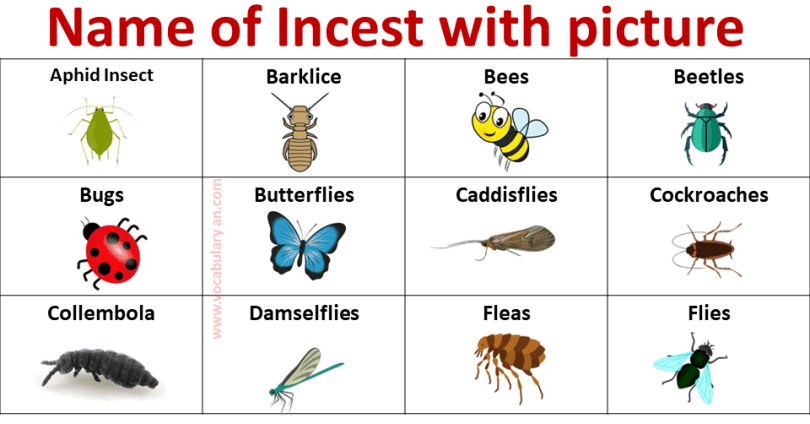
Insects are 6-legged arthropods of the class Insecta, with over 1 million described species making up 80% of all animal species on Earth. English insect names have 15 main categories by scientific order and habitat.
English insect names have 15 main categories: beetles, butterflies and moths, bees, wasps and hornets, ants, flies, mosquitoes and gnats, dragonflies and damselflies, grasshoppers and crickets, true bugs, cockroaches and termites, common household pests, garden and crop pests, aquatic and wetland insects, and glowing and camouflage insects.
Common Insect Names With Pictures
Each category is defined by insect order or living environment. Beetles, butterflies and moths, and bees are the three largest orders of insects. The other 12 are wasps and hornets, ants, flies, mosquitoes and gnats, dragonflies and damselflies, grasshoppers and crickets, true bugs, cockroaches and termites, common household pests, garden and crop pests, aquatic and wetland insects, and glowing and camouflage insects.
Beetle Names in English (Coleoptera Order)
Beetles (order Coleoptera) are the largest insect group, with 400,000 species making up 25% of all animal species on Earth.
Ladybug (Ladybird)
small round-bodied red beetle with black spots, one of the most-recognized garden beetles worldwide. Ladybugs eat aphids and other plant pests as the gardener’s best natural pest control partner.
Stag Beetle
large European and Asian beetle with massive antler-like mandibles in males. Stag beetles get their name from the stag-like appearance of the male’s oversized jaws, harmless to humans despite their size.
Rhinoceros Beetle
large tropical beetle with a curved horn on the head (males), one of the strongest insects on Earth. Rhinoceros beetles lift 850 times their body weight and are popular pets in Japan.
Weevil
small brown beetle with a distinctive long snout for boring into seeds and grains. Weevils are the major stored-grain pest worldwide, infesting flour, rice, and pantry staples in home kitchens.
Ground Beetle
long dark shiny beetle that hunts on the ground at night. Ground beetles are found in every temperate garden and are beneficial predators, eating slugs, caterpillars, and other soft-bodied garden pests.
Butterfly and Moth Names in English (Lepidoptera Order)
Butterflies and moths (order Lepidoptera) are the scaled-wing flying insects with over 180,000 species worldwide.
Butterfly
colorful daytime flying insect with 4 large scaled wings and slim clubbed antennae. Butterflies are the classic beautiful insects of gardens and meadows, with over 20,000 species worldwide.
Moth
nighttime flying insect with 4 scaled wings, feathery antennae, and muted brown or grey colors. Moths outnumber butterflies 8 to 1 (160,000 species), with the atlas moth reaching 27 cm wingspan.
Caterpillar
larval feeding stage of butterflies and moths, worm-like with 3 pairs of true legs plus soft prolegs. Caterpillars molt 4-5 times as they grow before forming a chrysalis or cocoon.
Silkworm
larva of the silk moth (Bombyx mori), producing silk from a single unbroken thread up to 1,600 meters long. Silkworms have been farmed in China for over 5,000 years for silk production.
Bee Names in English (Apidae Family)
Bees (family Apidae) are the fuzzy nectar-drinking pollinators essential for flowering plants and world food production.
Honey Bee
striped yellow-and-black social bee that produces honey and beeswax. Honey bees form colonies of 20,000-80,000 workers and are the world’s most economically valuable pollinator for agriculture.
Bumblebee
large fuzzy yellow-and-black or orange-and-black bee with a buzzing flight. Bumblebees pollinate tomatoes, peppers, and other crops through vibration (buzz pollination) as the classic garden bumbling pollinator.
Carpenter Bee
large black bee that bores tunnels into wood for nests, resembling a bumblebee but with a shiny black abdomen. Carpenter bees pollinate flowers but damage wooden structures in older homes.
Leafcutter Bee
solitary bee that cuts perfectly round pieces of leaves to line its nest tunnels. Leafcutter bees are efficient pollinators of alfalfa, blueberries, and onions across North America and Europe.
Mason Bee
solitary blue-black bee that seals its nest cells with mud. Mason bees are extremely efficient early-spring pollinators of fruit trees, doing the pollination work of 100 honey bees each.
Wasp and Hornet Names in English (Vespidae Family)
Wasps and hornets (family Vespidae) are the narrow-waisted stinging insects related to bees but with smooth bodies and hunting behavior.
Wasp
narrow-waisted winged stinging insect related to bees but with fewer body hairs and a smooth body. Wasps are found worldwide with over 30,000 species, from solitary hunters to social colony builders.
Yellowjacket
aggressive small yellow-and-black social wasp that builds nests in ground holes or wall voids. Yellowjackets are the wasps most responsible for painful summer picnic stings across North America and Europe.
Hornet
largest of the social wasps with brown-and-yellow or brown-and-white body. Hornets build large papery nests in trees or under eaves, and the Asian giant hornet is the world’s largest wasp.
Paper Wasp
slender wasp with distinctive dangling hind legs in flight, building umbrella-shaped nests under eaves. Paper wasps are less aggressive than yellowjackets but sting when their nests are disturbed.
Mud Dauber
solitary black or metallic-blue wasp that builds tubular mud nests on walls and under eaves. Mud daubers hunt spiders to feed their larvae and are rarely aggressive toward humans.
Ant Names in English (Formicidae Family)
Ants (family Formicidae) are the most-successful social insects on Earth, forming colonies of hundreds to millions.
Ant
small social insect with elbowed antennae and narrow waist, forming colonies of hundreds to millions. Ants are the world’s most-successful social insects, with over 12,000 species worldwide.
Fire Ant
aggressive small red-brown ant with painful burning sting, native to South America and now invasive across the southern USA. Fire ant colonies form large above-ground mounds and swarm when disturbed.
Carpenter Ant
large black ant that excavates wood for its nest galleries. Carpenter ants damage wooden structures over years and are a major structural pest across North America along with termites.
Army Ant
nomadic tropical ant that hunts in swarms of hundreds of thousands, with no permanent nest. Army ants swarm through Central and South American rainforests, overwhelming prey from insects to small vertebrates.
Leafcutter Ant
tropical ant that cuts leaves and delivers them to underground fungus gardens for food. Leafcutter ants are the sophisticated farmer of the insect world, tending fungus colonies as their sole food source.
Fly Names in English (Diptera Order)
Flies (order Diptera) are the two-winged insects, one of the largest insect orders with over 160,000 species.
Housefly
common grey fly with 4 dark stripes on the thorax, found in every human dwelling worldwide. Houseflies transmit over 100 pathogens through contact with food and are the classic summer kitchen nuisance.
Fruit Fly
tiny yellow-brown fly with distinctive red eyes, found around overripe fruit and fermenting food. Fruit flies (Drosophila melanogaster) are the classic genetics laboratory insect and reproduce every 8-12 days.
Horsefly
large aggressive fly with slicing mouth parts (females) that inflict painful bites on horses, cattle, and humans. Horseflies are one of the most persistent biting flies in temperate summer weather.
Hoverfly
small yellow-and-black striped fly that mimics wasps and bees, hovering motionless in mid-air. Hoverflies are beneficial pollinators and their larvae eat aphids in gardens.
Blowfly
metallic blue or green fly attracted to carrion and rotting meat. Blowflies are the first insects to arrive at dead animals and are used by forensic scientists to estimate time of death.
Mosquito and Gnat Names in English
Mosquitoes and gnats are the tiny biting or swarming flies of temperate and tropical regions worldwide.
Mosquito
tiny long-legged fly whose females bite mammals for blood to develop eggs. Mosquitoes transmit malaria, dengue, Zika, and West Nile virus, causing more human deaths per year than any other insect.
Gnat
tiny short-bodied fly attracted to fruit, drains, and houseplants. Gnats swarm around eyes and faces in warm weather and are the annoying small flies at outdoor gatherings.
Midge
tiny non-biting fly that swarms in mating clouds above water. Midges are the food source of many pond fish and their aquatic larvae are the fisherman’s bloodworm bait.
Sandfly
tiny hairy biting fly found in warm coastal and desert regions. Sandflies transmit leishmaniasis and sandfly fever in the Mediterranean, Middle East, and Central and South America.
Dragonfly and Damselfly Names in English (Odonata Order)
Dragonflies and damselflies (order Odonata) are the ancient large-eyed predatory insects with 4 transparent wings.
Dragonfly
large-eyed hunting insect with 4 transparent wings that fly forward, backward, and hover. Dragonflies eat mosquitoes and other flying insects, and their larvae are aquatic predators in freshwater ponds.
Damselfly
smaller cousin of the dragonfly with slender body and wings folded together at rest (unlike dragonfly wings held open). Damselflies are found near ponds, streams, and marshes worldwide.
Blue Dasher
common American blue dragonfly with a bright blue abdomen in males. Blue dashers are found around ponds and slow streams across the eastern USA as one of the most-photographed backyard dragonflies.
Grasshopper and Cricket Names in English (Orthoptera Order)
Grasshoppers and crickets (order Orthoptera) are the jumping insects with strong hind legs and musical sound production.
Grasshopper
green or brown long-legged jumping insect with strong hind legs that launch it up to 20 times its body length. Grasshoppers eat leaves and are found in every temperate grassland worldwide.
Cricket
brown or black jumping insect that produces a musical chirp by rubbing wings together at night. Cricket chirp frequency indicates temperature, and the field cricket is a traditional lucky charm in China.
Locust
migratory grasshopper that swarms in millions to strip crops bare. Locust swarms cause famine across Africa, Middle East, and Asia, with the desert locust the most destructive agricultural pest in history.
Katydid
green leaf-mimicking cricket with extremely long antennae and loud rhythmic night singing. Katydids get their name from the “katy-did, katy-didn’t” call of the North American species.
Mole Cricket
underground-burrowing cricket with shovel-like front legs for digging. Mole crickets produce loud trilling songs from tunnel openings and damage lawn grass roots across the southern USA.
True Bug Names in English (Hemiptera Order)
True bugs (order Hemiptera) are the piercing-mouthed insects that suck sap from plants or blood from animals.
Stink Bug
shield-shaped brown or green bug that releases foul-smelling chemical when threatened. Stink bugs damage fruit crops, and the brown marmorated stink bug is a major invasive pest across North America.
Bedbug
tiny reddish-brown flat oval bug that bites sleeping mammals for blood. Bedbugs hide in mattress seams and cracks near beds, and their global infestations have resurged since 2000.
Aphid
tiny soft-bodied green or black bug that sucks sap from plant stems and leaves. Aphids reproduce so fast that a single female produces billions of descendants in one summer.
Whitefly
tiny white flying bug that damages tomatoes, cucumbers, and other greenhouse crops. Whiteflies are a major agricultural pest across the world and reproduce continuously in warm weather.
Cicada
large winged bug with piercing mouth and transparent-veined wings, famous for loud buzzing summer calls. Cicadas emerge from underground after 13 or 17 years in massive North American broods.
Leafhopper
small colorful bug that hops from leaf to leaf, sucking sap and spreading plant viruses. Leafhoppers are found on nearly every plant in temperate and tropical regions.
Cockroach and Termite Names in English (Blattodea Order)
Cockroaches and termites (order Blattodea) are the ancient insects, with cockroaches surviving 300 million years unchanged.
Cockroach
flat oval brown or black nocturnal insect that scuttles fast and hides in dark cracks. Cockroaches survive nuclear radiation better than any other insect and have existed for 300 million years.
German Cockroach
small light-brown cockroach with two dark stripes behind the head, the most common indoor cockroach worldwide. German cockroaches infest kitchens and bathrooms in homes, restaurants, and hospitals globally.
Termite
pale white or cream ant-like insect that eats wood as a colony. Termites cause $5 billion in damage annually to USA homes and are found on every continent except Antarctica.
Termite Queen
huge egg-laying queen at the center of a termite colony, producing 30,000 eggs per day. Termite queens are among the longest-lived insects (25-50 years) and 100 times larger than workers.
Common Household Pest Insect Names in English
Common household pests are the small insects that infest homes, kitchens, bathrooms, and bedrooms worldwide.
Silverfish
tiny wingless silver-gray insect with 3 long tail bristles, found in damp bathrooms and basements. Silverfish eat paper, book glue, and cereals as one of the oldest insect lineages on Earth.
Earwig
long dark-brown insect with distinctive pincer-like tail forceps. Earwigs are harmless despite folklore about crawling into ears, and are found in damp garden areas, under stones, and inside houseplants.
Booklouse
tiny pale wingless insect found in damp books, wallpaper, and food packaging. Booklice eat mold and starch in old books and cereals, and are not true lice despite the name.
Flea
tiny wingless jumping insect that bites mammals for blood. Fleas jump 100 times their body length and are the historical vector of the bubonic plague through their bite on rats.
Garden and Crop Pest Insect Names in English
Garden and crop pest insects are the leaf-eating, stem-boring, and sap-sucking insects that damage agriculture.
Cutworm
grey-brown moth caterpillar that hides in soil by day and cuts young plant stems at night. Cutworms destroy seedlings in gardens and are a classic spring garden pest.
Armyworm
striped green or brown moth caterpillar that marches in armies across crop fields at night. Armyworms strip corn, grass, and pasture bare as one of the world’s most destructive agricultural pests.
Leaf Miner
tiny fly or moth larva that tunnels between the upper and lower layers of leaves. Leaf miners leave distinctive white or brown squiggle trails on leaves, damaging spinach, chard, and other crops.
Scale Insect
tiny sap-sucking bug that attaches to plants under a hard protective scale or waxy coating. Scale insects look like bumps on stems and leaves, and heavy infestations kill houseplants and citrus trees.
Mealybug
tiny white cotton-covered sap-sucking bug found on houseplants and greenhouse crops. Mealybugs cluster in leaf axils and stems, secreting sticky honeydew that grows sooty mold on infested plants.
Aquatic and Wetland Insect Names in English
Aquatic and wetland insects are the water-dwelling species that spend part or all of their life cycle in ponds, streams, and marshes.
Water Strider
long-legged bug that walks on water surface using surface tension. Water striders are found on still ponds and slow streams worldwide, with tiny leg hairs keeping them from breaking the surface.
Diving Beetle
oval-shaped smooth black beetle that swims underwater and surfaces to breathe. Diving beetles are voracious aquatic predators, eating tadpoles, fish eggs, and other insect larvae in freshwater ponds.
Water Boatman
small oval bug with oar-like hind legs that rows across pond surfaces and dives underwater. Water boatmen eat algae and are the peaceful cousin of the more aggressive backswimmer.
Mayfly
delicate short-lived flying insect that emerges from water in mating swarms. Mayfly adults live only 1-2 days (some just hours) and their nymphs indicate healthy pristine stream water.
Caddisfly
small brown moth-like insect whose aquatic larva build protective cases from sand, twigs, and pebbles. Caddisfly larvae indicate pristine stream water and are essential food for trout and salmon.
Glowing and Camouflage Insect Names in English
Glowing and camouflage insects are the specialized species with unique defensive or communication adaptations.
Firefly
small brown beetle whose abdomen produces flashing yellow-green light through chemical reaction. Fireflies flash to attract mates on warm summer nights across North America, Asia, and parts of Europe.
Praying Mantis
long thin green or brown predatory insect with folded prayer-like front legs and triangular head. Praying mantises catch and eat other insects with lightning-fast strike and rotate their heads 180 degrees.
Walking Stick
extremely thin twig-like insect that mimics tree branches for camouflage. Walking sticks are among the longest insects on Earth (up to 22 inches / 56 cm for Chan’s megastick from Borneo).
Leaf Insect
flat green or brown insect with wings and body shaped like a leaf, complete with fake veins. Leaf insects are found in Southeast Asian rainforests as the world’s best camouflage masters.
Insects That Look Similar
Some insect names and species cause confusion for English learners and nature enthusiasts.
Insect vs Bug vs Arthropod
| Term | Meaning |
|---|---|
| Insect | 6-legged arthropod with 3 body parts (head, thorax, abdomen) and 2 antennae |
| Bug | Loose sense: any small crawling creature. Strict sense: true bug of order Hemiptera (stink bug, aphid, cicada) |
| Arthropod | Larger group with hard exoskeleton and jointed legs, encompassing insects plus spiders, crustaceans, and millipedes |
All insects are bugs (loose sense) and arthropods, but not all arthropods are insects. Spiders (8 legs), centipedes (many legs), and crabs (crustaceans) are arthropods but NOT insects.
Bee vs Wasp vs Hornet
| Trait | Bee | Wasp | Hornet |
|---|---|---|---|
| Body | Round hairy fuzzy | Narrow smooth waist | Very large narrow waist |
| Color | Yellow-black stripes | Yellow-black with sharp lines | Brown or brown-yellow |
| Diet | Nectar and pollen | Nectar and other insects | Nectar and other insects |
| Aggression | Low unless threatened | Aggressive | Very aggressive |
| Sting | Once (dies after) | Repeatedly | Repeatedly |
Bees pollinate. Wasps hunt. Hornets are the largest most aggressive wasps. If it is fuzzy, it is a bee. If it is smooth and narrow-waisted, it is a wasp or hornet.
Cricket vs Grasshopper vs Locust
| Trait | Cricket | Grasshopper | Locust |
|---|---|---|---|
| Activity | Night singer | Day feeder | Day swarmer |
| Antennae | Long thin | Short thick | Short thick |
| Sound | Chirps by wing-rubbing | Buzzes by leg-rubbing | Buzzes in swarms |
| Behavior | Solitary | Solitary or grouped | Swarms in millions |
Locusts are migratory grasshoppers that swarm. Crickets are nocturnal and sing. Grasshoppers are diurnal and feed on grass.
Ant Queen vs Termite Queen
| Trait | Ant Queen | Termite Queen |
|---|---|---|
| Family | Hymenoptera (bees, wasps, ants) | Blattodea (cockroaches, termites) |
| Body | Small enlarged abdomen | Grossly swollen 100 times worker size |
| Egg output | 1,000-2,000 per day | 30,000 per day |
| Lifespan | 15-30 years | 25-50 years (longest-lived insect) |
Termite queens are the record-holders for insect egg production and lifespan.
Which Are Not Really Insects
| Creature | Correct Group |
|---|---|
| Spider | Arachnid (8 legs) |
| Tick, Mite | Arachnid |
| Centipede | Myriapod (many legs) |
| Millipede | Myriapod |
| Woodlouse, Pill Bug | Crustacean |
| Scorpion | Arachnid |
These are mistaken for insects in casual conversation but are NOT insects. Insects have exactly 6 legs and 3 body parts. Anything with 8 legs, many legs, or a jointed tail is not an insect.
FAQs
Q1. What is the difference between an insect and a bug?
In loose everyday English, “bug” means any small crawling creature. In strict scientific English, “bug” means a member of the order Hemiptera: the true bugs, with stink bugs, aphids, cicadas, and bedbugs as examples. All insects are part of the class Insecta with 6 legs and 3 body parts (head, thorax, abdomen). All true bugs are insects, but not all insects are bugs in the strict sense.
Q2. What is the difference between a bee, wasp, and hornet?
Bees are fuzzy round-bodied pollinators that eat nectar and pollen. Wasps are smooth narrow-waisted predators that eat other insects. Hornets are the largest most-aggressive wasps. Bees sting once and die; wasps and hornets sting repeatedly. If it is fuzzy, it is a bee. If it is smooth and narrow-waisted, it is a wasp or hornet. Yellowjackets and paper wasps are the wasps most responsible for painful stings.
Q3. What are the main insect orders?
The 7 largest insect orders are: Coleoptera (beetles, 400,000 species), Lepidoptera (butterflies and moths, 180,000 species), Hymenoptera (bees, wasps, ants, 150,000 species), Diptera (flies, 160,000 species), Hemiptera (true bugs, cicadas, aphids, 80,000 species), Orthoptera (grasshoppers and crickets, 25,000 species), and Odonata (dragonflies and damselflies, 5,000 species). Beetles make up 25% of all animal species on Earth.
Q4. Which creatures are not really insects?
Spiders (8 legs, arachnids), ticks and mites (arachnids), scorpions (arachnids), centipedes and millipedes (myriapods), woodlice and pill bugs (crustaceans), and worms (annelids) are NOT insects despite being grouped with them in everyday conversation. Insects have exactly 6 legs, 3 body parts (head, thorax, abdomen), and 2 antennae. Anything with more or fewer legs is not an insect.
Q5. What insect has the longest lifespan?
The termite queen has the record for longest-lived insect, with a lifespan of 25-50 years in some tropical species. She lays up to 30,000 eggs per day for decades. Ant queens are the second-longest at 15-30 years. Most adult insects live only weeks to months (mayflies live 1-2 days as adults).
Q6. What do insects eat?
Insects eat everything organic: nectar and pollen (bees, butterflies), leaves and stems (caterpillars, grasshoppers), sap (aphids, cicadas), wood (termites, carpenter ants), blood (mosquitoes, fleas, bedbugs), other insects (dragonflies, mantises, wasps), dead animals (blowflies), decaying matter (earwigs, silverfish), and specific plants (leafcutter ants cultivate fungus, silkworms eat only mulberry leaves).

Leave a Comment