
"I hope not" answers a yes-or-no question, and it means you want the answer to be no. "Is the train late?" "I hope not." The full sentence would be "I hope the train is not late", and the short reply keeps only the "not". The other ways to say I hope not change how strong or how polite that wish sounds, and the everyday forms come first.
Common Ways to Say I Hope Not in Everyday English
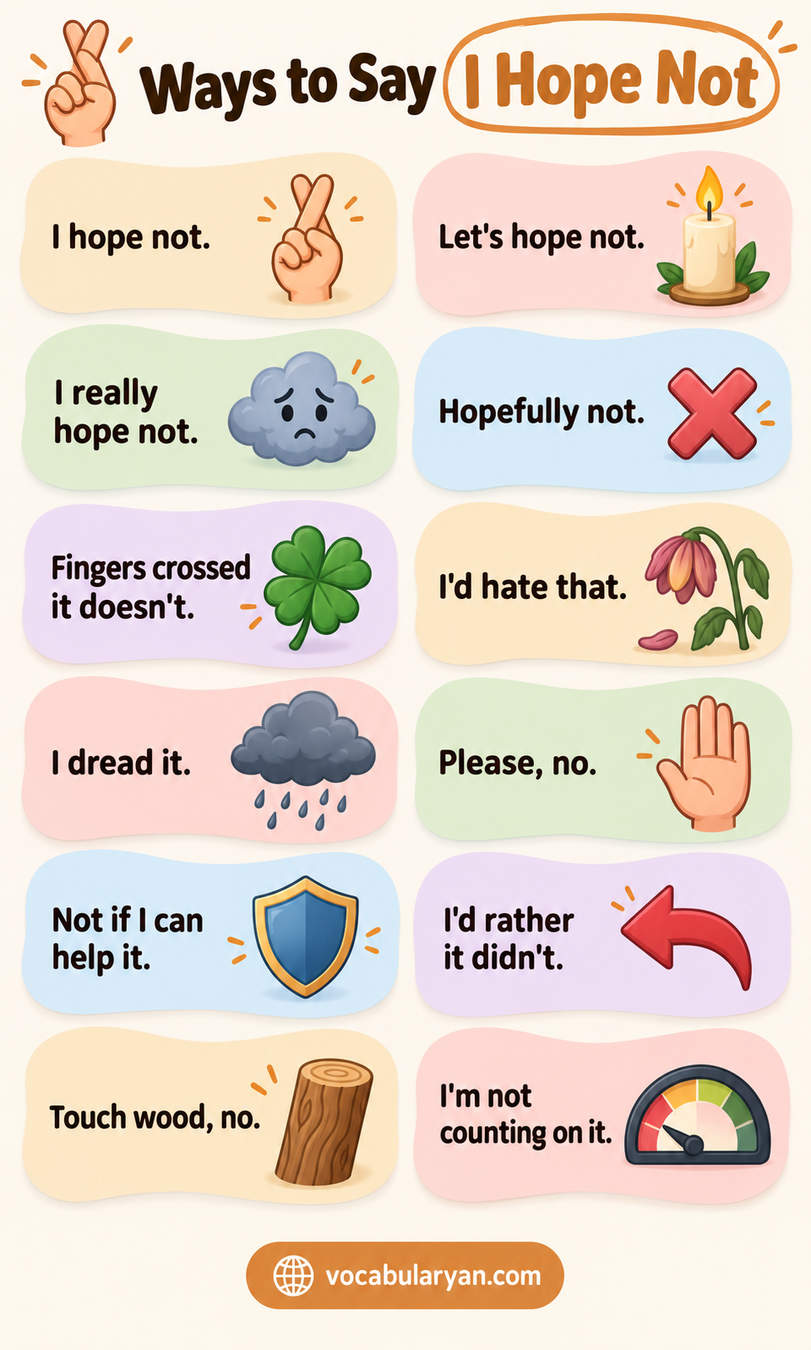
These replies fit a yes-or-no question from anyone, at home, at work, or in a shop.
I hope not: the standard reply, correct at every level with every person. It answers a question about the future or about a fact you do not know yet.
- "Is the museum closed on Mondays?" "I hope not, we only have today."
- I hope not, because I left my umbrella at home.
- "Did I miss the deadline?" "I hope not, the form said Friday."
Hope not: the same reply with "I" dropped, common in speech between people who know each other. In writing it fits a text rather than an email.
- "Will it rain at the picnic?" "Hope not, I made a cake."
- Hope not, that’s the last thing we need this week.
- "Is the boss coming to the party?" "Hope not."
Hopefully not: the most relaxed everyday form, and the word "hopefully" means "I hope" here. It fits friends, family, and colleagues you speak to every day.
- "Do we need a visa for the trip?" "Hopefully not, I read that we don’t."
- Hopefully not, but I’ll bring a spare key just in case.
- "Are they going to cancel the match?" "Hopefully not, the pitch looks fine."
Let’s hope not: a reply that puts the wish on both of you, so it sounds friendly and a little less certain. It fits a colleague, a neighbour, or a friend.
- "Is that the last bus?" "Let’s hope not, or we’re walking."
- Let’s hope not, the tickets cost a fortune.
- "Will the price go up again?" "Let’s hope not."
I hope that’s not the case: a fuller reply for a fact that is not known yet, and it sounds a step more careful than "I hope not".
- "Is the flight delayed?" "I hope that’s not the case, the board still says on time."
- I hope that’s not the case, but the doctor will tell us tomorrow.
- "Is the shop closing down?" "I hope that’s not the case, it’s the only one nearby."
I hope it doesn’t: the reply when the question is about an action, such as "will it rain" or "will it break". The verb after "doesn’t" is dropped because the question already said it.
- "Do you think the storm will hit us?" "I hope it doesn’t."
- I hope it doesn’t take all day, I promised to be home by five.
- "Will the paint peel in the sun?" "I hope it doesn’t, we paid extra for that brand."
I hope you’re wrong: a reply for a warning or a prediction from the other person. It disagrees politely by wishing rather than by arguing.
- "I think they’ve already sold the house." "I hope you’re wrong."
- I hope you’re wrong about the weather, we’re camping this weekend.
- "He won’t pass without more practice." "I hope you’re wrong, he has worked so hard."
Answer with "I hope not" when you are unsure, and add "hopefully not" once you know the person.
Casual Ways to Say I Hope Not to Friends
Casual replies are for friends and family, and each one sounds quick, warm, and a little dramatic.
Please no: two words that say you would hate the answer to be yes. It sounds playful between friends and too strong for a manager.
- "Is Dan bringing his guitar?" "Please no, not again."
- Please no, I can’t sit through another three-hour film.
- "Do you think the exam is on Monday?" "Please no, I need the weekend."
Don’t say that: a reply that treats the question as bad luck, and it means "I don’t even want to think about it". Friends say it with a laugh.
- "What if the car breaks down on the motorway?" "Don’t say that!"
- Don’t say that, we’ve had enough bad news this month.
- "Maybe they’ll cancel the festival." "Don’t say that, I’ve bought the tent."
Don’t jinx it: a reply that asks the other person to stop, because saying a bad thing out loud feels like it makes the bad thing happen. It fits sport, travel, and exams.
- "We’ve had no rain all week, so it’ll pour tomorrow." "Don’t jinx it!"
- Don’t jinx it, we’re two goals up with ten minutes left.
- "You haven’t been ill once this year." "Don’t jinx it, I’ve got a flight on Friday."
Fingers crossed it doesn’t: the wish plus the gesture, and it fits any friend who is waiting for news with you.
- "Will the shop run out before we get there?" "Fingers crossed it doesn’t."
- Fingers crossed it doesn’t snow, the roads are bad enough already.
- "Is the app going to crash again?" "Fingers crossed it doesn’t, I’ve saved everything."
I’d better not: the reply when the question is about you, such as "will you be late", and it means you will try hard not to be.
- "Are you going to oversleep again?" "I’d better not, it’s my first day."
- I’d better not forget the passports this time.
- "Will you cry at the wedding?" "I’d better not, I’m doing the speech."
Say "please no" and "don’t jinx it" only to friends, because both sound like a joke with a stranger.
Formal Ways to Say I Hope Not at Work
Formal replies fit a manager, a client, or a meeting, and each one adds a polite word or a full clause to "I hope not".
I certainly hope not: the polite strong form, and it fits a manager or a client in speech or in writing. It also fits a promise you want kept, such as "I won’t be late again".
- "Will the delay affect the launch date?" "I certainly hope not, the team is on track."
- I certainly hope not, we agreed the price in writing.
- "Is this going to happen every month?" "I certainly hope not, Ms Adams."
I should hope not: a British formal reply, and it means "that would be wrong, so no". It fits a manager replying to a worry about bad behaviour or a mistake.
- "Did anyone leave the office unlocked?" "I should hope not."
- I should hope not, the policy is on every wall in the building.
- "Will the client be charged twice?" "I should hope not, please check the invoice now."
I’d rather it didn’t: a polite reply about an event you do not want, and it fits a colleague or a client. The verb after "didn’t" is dropped.
- "The meeting could run past six." "I’d rather it didn’t, I have a call at six thirty."
- I’d rather it didn’t come to a formal complaint.
- "Will the change affect your team?" "I’d rather it didn’t, we are already short-staffed."
I hope that won’t be necessary: the polite reply when the question is about a step you want to avoid, such as a second meeting, a refund, or a formal letter.
- "Do we need to involve the legal team?" "I hope that won’t be necessary."
- I hope that won’t be necessary, the client accepted the new date.
- "Should we cancel the order?" "I hope that won’t be necessary, the parts arrive on Monday."
We hope that can be avoided: a reply for a company rather than a person, and it fits a meeting, a report, or a message to a customer.
- "Is a price rise on the way?" "We hope that can be avoided."
- We hope that can be avoided, and we are reviewing the costs now.
- "Will the site close during the works?" "We hope that can be avoided, sir."
That is not the outcome we want: the most formal form, and it fits a presentation or a written reply to a serious risk.
- "Could the deal fall through?" "That is not the outcome we want, and we are meeting them again on Thursday."
- That is not the outcome we want, so the plan has two backup dates.
- "Will staff be moved to another office?" "That is not the outcome we want."
The most common mistake with this phrase is to put the "not" on "hope".
- Will it rain tomorrow? I don’t hope so. ❌
In English the "not" moves to the end after "hope", and "I don’t hope so" sounds like a translation.
- Will it rain tomorrow? I hope not. ✅
Every reply on this page belongs to one of five levels.
| Level | Replies | Who it fits |
|---|---|---|
| Slang | God no, big nope, please no | Close friends your own age |
| Casual | Hopefully not, hope not, don’t jinx it | Friends, family, relaxed colleagues |
| Neutral | I hope not, let’s hope not, I hope that’s not the case | Anyone at any level |
| Formal | I certainly hope not, I should hope not, I’d rather it didn’t | Managers, clients, strangers |
| Very formal | I hope that won’t be necessary, that is not the outcome we want | Meetings, reports, written replies |
Use "I certainly hope not" with a manager and "I hope that won’t be necessary" when the question is about a step you want to skip.
Ways to Say I Hope Not in an Email
An email reply to a worry is a full sentence, because the short spoken forms read as cold on a screen.
I hope that won’t be the case: the standard written form, and it fits a client, a colleague, or a landlord. It goes after the worry and before the plan.
- I hope that won’t be the case, and I will confirm the delivery date by Friday.
- Thank you for the warning. I hope that won’t be the case, but we have a second supplier ready.
- I hope that won’t be the case, as the room is already booked for the 12th.
I trust that won’t be necessary: a formal written form, and "trust" here means "expect". It fits a reply to a threat of a fee, a cancellation, or a complaint.
- I trust that won’t be necessary, since the payment left our account this morning.
- We are happy to talk again on Monday. I trust that won’t be necessary, though.
- I trust that won’t be necessary, Mr Petrov, and I have attached the signed form.
We hope to avoid that: a short written form for a company, and it fits a customer who asks about a delay or a price rise.
- We hope to avoid that, and we will update you on Thursday.
- The works could take longer than planned. We hope to avoid that.
- We hope to avoid that by starting the order a week early.
With luck that won’t happen: a warm written form for a colleague or a friend, and "with luck" means "if we are lucky".
- With luck that won’t happen, the new server went live last night.
- With luck that won’t happen, but I have kept the old files just in case.
- The rain could delay the roof again. With luck that won’t happen twice.
I hope we can avoid that: a reply that puts the wish on the whole team, and it fits an email to several colleagues.
- I hope we can avoid that, so please send your numbers by noon.
- I hope we can avoid that, as a second delay would cost us the contract.
- Nobody wants another late night. I hope we can avoid that this time.
Write "I hope that won’t be the case" in an email, and follow it with the step you are taking.
Stronger Ways to Say I Hope Not
Strong replies mean the answer yes would be very bad, and most of them belong to friends and family rather than to work.
God, I hope not: the strongest everyday form, and the name at the front adds feeling rather than religion. It fits close friends and family, and it is wrong for a client.
- "Is that his car in the ditch?" "God, I hope not."
- God, I hope not, we’ve only just paid off the last one.
- "Do you think she heard us?" "God, I hope not."
I really hope not: "I hope not" with "really", and it fits any person when the answer is a big one for you.
- "Will the surgery be moved again?" "I really hope not, Dad has waited months."
- I really hope not, that flat was the only one we could afford.
- "Is the school closing?" "I really hope not, both kids are settled there."
I sure hope not: the American strong form, common in speech and in texts, and it sounds warm rather than angry.
- "Is the store out of the size you need?" "I sure hope not."
- I sure hope not, I drove two hours to get here.
- "Will the game go to extra time?" "I sure hope not, my parking runs out at nine."
I’d hate that: a reply that names your feeling instead of a hope, and it fits family and friends. It sounds honest and a little sad.
- "What if they move you to the night shift?" "I’d hate that."
- I’d hate that, the kids would never see me.
- "Do you think they’ll sell Grandma’s house?" "I’d hate that, we grew up there."
God forbid: the same as "heaven forbid" but stronger, and it fits a serious risk such as illness or an accident. It goes before the bad event or on its own.
- "Is the roof going to hold in this wind?" "God forbid it doesn’t."
- God forbid anything happens to the dog while we’re away.
- "Could the bank take the house?" "God forbid."
I dread to think: a reply that means "the answer is too bad to imagine", and it fits a friend or a colleague you trust.
- "How much will the repair cost?" "I dread to think."
- I dread to think what happens if the boiler fails in January.
- "Was anyone hurt?" "I dread to think, the road was so icy."
Keep "God, I hope not" and "God forbid" for friends and family, and say "I really hope not" with everyone else.
Softer Ways to Say I Hope Not
Soft replies say you want the answer to be no without sounding upset, and they fit a person you do not know well.
I’d rather not: the reply when the question is about you doing something, such as "will you have to move". It means "I hope I don’t have to".
- "Will you have to work Christmas?" "I’d rather not."
- I’d rather not, but I will if the team needs me.
- "Are you moving to the new office?" "I’d rather not, the trains are terrible from there."
I hope not, but we’ll see: "I hope not" with an honest "we’ll see", and it fits any person when the answer is out of your hands.
- "Will the price go up before we sign?" "I hope not, but we’ll see."
- I hope not, but we’ll see what the tests show next week.
- "Is the flight going to be full?" "I hope not, but we’ll see."
It’d be a shame: a reply that names the loss gently, and it fits a neighbour, an older person, or a colleague.
- "Is the bakery closing?" "It’d be a shame, they’ve been here forty years."
- It’d be a shame if the rain stopped the parade.
- "Will they cut the evening class?" "It’d be a shame, it’s the only one I can get to."
I’m hoping it won’t come to that: a soft reply about a serious step, such as a lawsuit, an operation, or a sale. It fits any level.
- "Will you have to sell the shop?" "I’m hoping it won’t come to that."
- I’m hoping it won’t come to that, the doctor wants to try tablets first.
- "Are you going to take him to court?" "I’m hoping it won’t come to that."
Choose "it’d be a shame" or "I’d rather not" when the other person is a stranger, because both sound calm.
Ways to Say I Hope Not About Bad News That Is Not Certain
These replies fit a rumour, a worry, or a first report, when nobody knows yet whether the news is true.
I hope it’s nothing serious: the reply to news of illness, an accident, or a problem at work, and it fits family, friends, and colleagues.
- "Mum’s gone to the hospital with chest pain." "I hope it’s nothing serious."
- I hope it’s nothing serious, the engine only started making that noise today.
- "The head teacher wants to see you." "I hope it’s nothing serious."
Let’s not jump to conclusions: a reply that asks for patience before the bad news is confirmed, and it fits a colleague or a friend who worries early.
- "They didn’t reply, so they must have said no." "Let’s not jump to conclusions."
- Let’s not jump to conclusions, the letter could be about anything.
- "The shop was dark, so it’s closed down." "Let’s not jump to conclusions, it’s a Sunday."
Let’s wait and see: the calm reply that puts the wish aside until the facts arrive, and it fits any level.
- "Do you think the tests will be bad?" "Let’s wait and see."
- Let’s wait and see, the results come out on Tuesday.
- "Will the company cut jobs?" "Let’s wait and see what the meeting says."
I’m hoping for the best: a reply that says you are choosing hope over worry, and it fits family and close colleagues.
- "Has the biopsy come back?" "Not yet. I’m hoping for the best."
- I’m hoping for the best, but I’ve packed a bag in case.
- "Will your visa be approved in time?" "I’m hoping for the best."
Surely not: a reply that doubts the bad news as well as hoping against it, and it fits a friend or a colleague. In British speech it is very common.
- "I heard the whole team is being moved." "Surely not, they only hired us in March."
- Surely not, he was fine yesterday.
- "They say the bridge is closed for a year." "Surely not."
Say "I hope it’s nothing serious" first, and ask what happened second, because the wish comes before the question.
Ways to Say I Hope Not About Your Own Risk
When the question is about a risk of your own, the reply adds luck, effort, or a small joke.
Touch wood: the British phrase said while tapping a table, and it means "I hope my luck holds". It answers a question such as "have you ever crashed?"
- "You’ve never lost your passport?" "Never, touch wood."
- Touch wood, the car hasn’t broken down once this year.
- "Have you had any trouble with the neighbours?" "Not yet, touch wood."
Knock on wood: the American form of "touch wood", said and done in the same way.
- "Has the basement flooded this spring?" "Not so far, knock on wood."
- Knock on wood, I’ve never missed a flight.
- "Any problems with the new hire?" "None, knock on wood."
I hope I haven’t: the reply when the question is about a mistake you made, such as "did you leave the oven on?"
- "Did you forget to lock the back door?" "I hope I haven’t."
- I hope I haven’t sent that message to the whole company.
- "Have you double-booked the room?" "I hope I haven’t, let me check."
I’d like to think not: a reply that means "I believe I didn’t, but I’m not sure", and it fits a colleague or a friend.
- "Did you offend her with that comment?" "I’d like to think not."
- I’d like to think not, I read the email twice before sending it.
- "Have you missed anything on the form?" "I’d like to think not."
Say "touch wood" in Britain and "knock on wood" in America, and tap something wooden as you say it.
Ways to Say I Hope Not in a Text
Text replies are two to four words long, and a full stop or a capital letter changes how they read.
Hope not!: the standard text reply, and the exclamation mark makes it warm rather than short.
- "Is the party cancelled?" "Hope not! I’ve bought a dress."
- Hope not! Text me when you hear.
- "Train’s late again?" "Hope not!"
Hopefully not: the same word as in speech, and in a text it fits friends, family, and colleagues on a work chat.
- "Do we have to redo the whole slide deck?" "Hopefully not, just page three."
- Hopefully not, see you at eight either way.
- "Is it going to storm tonight?" "Hopefully not, the tent is up already."
Pls no: the shortest text form, and it fits close friends only. The spelling is part of the joke.
- "Group project with Mark again?" "Pls no."
- Pls no, I can’t do another Monday start.
- "Karaoke after dinner?" "Pls no."
Better not: a text reply for a risk that would annoy you, and it means "it had better not happen".
- "Might be late tonight." "Better not, we’ve got a table at seven."
- Better not rain, I’ve just washed the car.
- "The delivery could slip to Monday." "Better not, the party is Sunday."
God no: the strongest text form, and it fits friends who share your sense of humour.
- "Are your parents coming to the gig?" "God no."
- God no, I’m not wearing that.
- "Reunion this year?" "God no, not after last time."
Text "hope not!" with an exclamation mark, and keep "pls no" and "God no" for close friends.
Ways to Say I Hope Not to a Group
A group reply speaks for everyone in the room, so it changes "I" to "we" or "let’s".
Let’s hope not: the standard group form in a meeting, a class, or a family kitchen, and it fits any level.
- "Will the coach be late again?" "Let’s hope not, everyone."
- Let’s hope not, or the whole day shifts by an hour.
- "Could the venue double-book us?" "Let’s hope not, they confirmed by email."
Let’s hope it doesn’t come to that: the group form for a serious step, such as a strike, a closure, or a court case.
- "Will we have to cancel the trip?" "Let’s hope it doesn’t come to that."
- Let’s hope it doesn’t come to that, we still have two weeks to raise the money.
- "Are they going to close the branch?" "Let’s hope it doesn’t come to that."
None of us wants that: a reply that names the whole group’s wish, and it fits a team meeting or a family talk.
- "Would the merger mean job losses?" "None of us wants that."
- None of us wants that, so let’s find another way to cut costs.
- "Should we sell the family house?" "None of us wants that, Mum."
We’d better hope not: the group form of "I’d better not", and it means the result would hurt everyone.
- "What if the generator fails during the show?" "We’d better hope not."
- We’d better hope not, the backup is still in the van.
- "Could the exam be moved to the same day as the trip?" "We’d better hope not."
Say "let’s hope not" in a meeting and "none of us wants that" when the group needs to feel like one.
Regional Ways to Say I Hope Not in English
Each English-speaking country adds a word or two of its own to the wish, and the level changes with the country.
British Ways to Say I Hope Not
I should think not: a British reply that means "no, and it would be wrong if the answer were yes". It fits a parent, a teacher, or a manager.
- "Did he charge you for the second coffee?" "I should think not."
- I should think not, we booked the table a month ago.
- "Will the kids be up past midnight?" "I should think not, they have school."
I bloody well hope not: a strong British reply, and "bloody" is a mild swear word, so it fits friends and family only.
- "Is the pub shut for the whole summer?" "I bloody well hope not."
- I bloody well hope not, I’ve paid for the season ticket.
- "Are we doing the whole walk in the rain?" "I bloody well hope not."
American Ways to Say I Hope Not
I sure hope not: the everyday American strong form, and it fits friends, family, and colleagues you know well.
- "Is the diner closed for good?" "I sure hope not."
- I sure hope not, that was the best pie in town.
- "Are they raising the rent again?" "I sure hope not."
Man, I hope not: the casual American reply with "man" as a word of feeling, and it fits friends of any gender.
- "Do you think we missed the last bus?" "Man, I hope not."
- Man, I hope not, I’ve got a shift at six.
- "Is the game sold out?" "Man, I hope not."
Australian and Irish Ways to Say I Hope Not
Hope not, mate: the Australian reply with "mate", and it fits friends, workmates, and strangers on a bus.
- "Reckon it’ll rain on the barbecue?" "Hope not, mate."
- Hope not, mate, I’ve been waiting all week for this swim.
- "Is the road closed after the storm?" "Hope not, mate."
Please God, no: the Irish strong form, common in speech and said with feeling, and it fits family and friends.
- "Is that Auntie Mary at the door?" "Please God, no."
- Please God, no, not another wet weekend.
- "Do you think the exam is on Friday?" "Please God, no."
Say "I should think not" in Britain, "I sure hope not" in America, "hope not, mate" in Australia, and "please God, no" in Ireland.
Slang and Funny Ways to Say I Hope Not
Slang and funny replies belong to close friends, and each one turns the wish into a joke.
Big nope: a slang reply that means "no, and I hope not", and it fits a group chat or a joke at lunch.
- "Camping in December?" "Big nope."
- Big nope, I’m not sitting next to him again.
- "Will you sing at the party?" "Big nope."
Not on my watch: a reply that means "I will stop it", said as a joke from an old film. It fits a friend who asks about a risk you can control.
- "Will the kids eat all the cake before the party?" "Not on my watch."
- Not on my watch, the plants are getting water every day.
- "Is the team going to lose again?" "Not on my watch."
Over my dead body: a dramatic reply that means "I will never allow it", said with a smile between friends and family.
- "Is your sister borrowing the car?" "Over my dead body."
- Over my dead body are we painting the kitchen purple.
- "Will Dad do the karaoke?" "Over my dead body."
Bite your tongue: a joke reply that asks the other person to take the bad words back, and it fits older friends and family.
- "The cake will probably burn." "Bite your tongue!"
- Bite your tongue, the oven is brand new.
- "Maybe your team gets knocked out early." "Bite your tongue."
Keep "over my dead body" and "bite your tongue" for family and friends, because a stranger hears them as a real threat.
How Do You Reply When Someone Says I Hope Not?
"I hope not" is already a reply, so the answer to it is short agreement, a comfort, or a joke about luck.
Me neither: the standard agreement, and it means "I hope not as well". "Same here" and "neither do I" mean the same.
- "I hope not." "Me neither, the trip cost a fortune."
- "I hope not." "Same here."
- "I hope not." "Neither do I, let’s check the website."
Let’s hope not: a reply that repeats the wish and shares it, and it fits any level.
- "I hope not." "Let’s hope not."
- "I hope not." "Let’s hope not, we’ve worked too hard."
- "I hope not." "Let’s hope not, the forecast was fine an hour ago."
Don’t worry, it won’t: a comfort reply that turns the wish into a promise, and it fits family and friends.
- "I hope not." "Don’t worry, it won’t, I checked twice."
- "I hope not." "Don’t worry, it won’t, the boss already signed it off."
- "I hope not." "Don’t worry, it won’t happen again."
Fingers crossed: a light reply that agrees and adds luck, and it fits a colleague or a friend.
- "I hope not." "Fingers crossed."
- "I hope not." "Fingers crossed, we’ll know by Friday."
- "I hope not." "Fingers crossed it stays dry."
We’ll find out soon: a calm reply that agrees and names the moment the answer comes, and it fits any level.
- "I hope not." "We’ll find out soon, the email comes at nine."
- "I hope not." "We’ll find out soon enough."
- "I hope not." "We’ll find out soon, the doctor calls this afternoon."
Reply to "I hope not" with "me neither" among friends and "let’s hope not" with everyone else.
More Everyday English Phrases
FAQs
The plainest swaps are "hopefully not", "let’s hope not", and "I hope that’s not the case". "I certainly hope not" is the formal form for a manager, and "God, I hope not" is the strong form for a friend. Each one still answers a yes-or-no question and still means you want the answer to be no.
No, because "hope" takes "not" after it, and the sentence "I hope it does not rain" shortens to "I hope not". "I don’t hope so" copies a form from languages such as German and French, and to an English speaker it sounds like a translation. "I don’t think so" works with "don’t" because "think" is a different verb, and that phrase has its own page.
The difference is the answer you want: "I hope not" means you want the answer to be no, and "I hope so" means you want it to be yes. "Is the shop open?" "I hope so." "Is the shop closed?" "I hope not." Both replies fit any level, and "I hope so" has its own page on this site.
Agree with "me neither", "same here", or "let’s hope not", or comfort the person with "don’t worry, it won’t". A new answer such as "yes, it will" sounds cold after a wish. Among friends "fingers crossed" or "I know, right?" also works.
Yes, "hopefully not" is correct and very common, and "hopefully" here means "I hope". Some older grammar books said "hopefully" should only mean "in a hopeful way", but everyday English has used it to mean "I hope" for decades. It fits speech and texts, and in a formal email "I hope not" reads better.
"I should hope not" means "no, and it would be wrong if the answer were yes". A parent says it when a child asks whether lying will make them angry. A manager says it when a colleague asks whether the client will be charged twice. It is British and formal, and "I certainly hope not" is the American form of the same idea.
Say "I certainly hope not" in speech and "I hope that won’t be the case" in writing. When the question is about a step you want to skip, "I hope that won’t be necessary" is the polite reply, and "we hope that can be avoided" speaks for the company. Keep "God, I hope not" and "please no" out of the office.
The Spanish reply is "espero que no", which follows the same order as the English: the verb "espero" means "I hope" and "que no" means "that not". In French the reply is "j’espère que non", and in Italian it is "spero di no". Each language keeps "hope" positive and puts the "no" at the end, in the same way English does.