
"Well done" is praise from someone who judged the work, so it sounds best from a teacher, a parent, or a manager. Said upwards, to your own boss, it can sound patronising. The ways to say well done in English each match a different person: "nice one" for a friend, "excellent work" for a colleague, "congratulations" for anyone senior to you. The everyday phrases are the first ones to learn.
Common Ways to Say Well Done in Everyday English
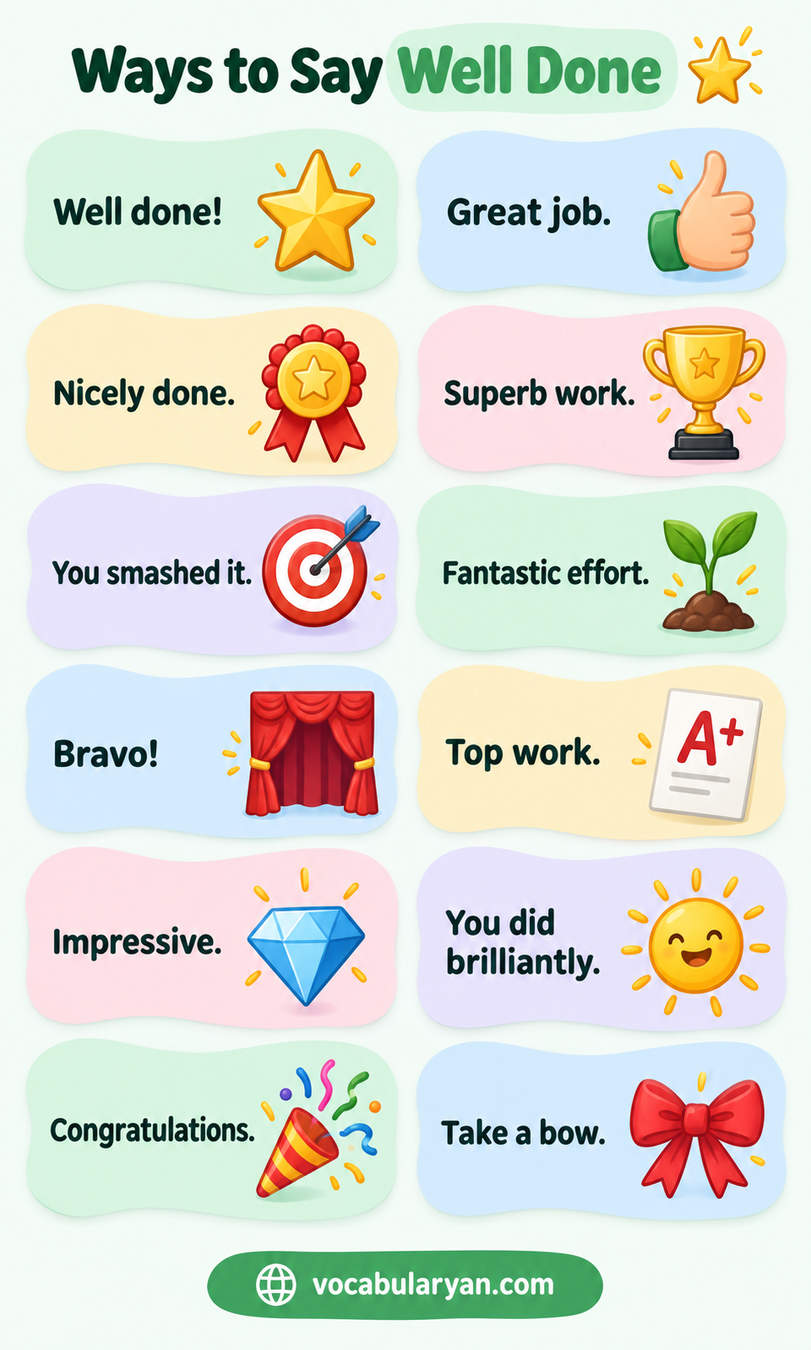
These six phrases praise a finished task in any setting, and each one is safe with a friend, a child, or a colleague.
Well done: the standard British praise for a task done right, and it goes with a name or with "on" plus the task. From a parent, a teacher, or a manager it sounds warm.
- Well done, Amira, that was a hard exam and you passed it first time.
- Well done on the presentation, the numbers were very well explained.
- Oh, well done! You fixed the printer.
Nice work: neutral praise that fits a colleague, a classmate, or a friend, and it sounds relaxed without sounding childish.
- Nice work on the garden, the roses look better than last year.
- That was nice work, Sam, the customer left smiling.
- Nice work, both of you, the stall was the busiest one at the fair.
Great job: warmer than "nice work", and it fits a friend, a child, or a colleague you know well. It is the most common praise in American English.
- Great job, Leo, your reading has improved so much this term.
- You did a great job with the wedding speech.
- Great job, everyone, the launch went without a single problem.
Good work: short, calm praise from a manager or a teacher, and it fits the end of a task rather than a big result.
- Good work, Hana, the report is ready to send.
- That’s good work for a first attempt at the recipe.
- Good work today, team, see you all tomorrow.
Nicely done: praise for the way a task was done, so it fits a skilled move, a neat answer, or a tidy piece of work.
- Nicely done, that parking space was tiny.
- Nicely done, Ravi, you kept the meeting to twenty minutes.
- Nicely done! I didn’t think that shelf would fit.
Good job: the American form of "well done", and it fits a child, a friend, or a colleague. The full set of forms is on the ways to say good job page.
- Good job, Mia, you tied your laces by yourself.
- Good job on the interview, Dad said you sounded confident.
- Good job, guys, the tent is up before the rain.
Say "nice work" to a colleague and "great job" to a friend, and keep "well done" for someone you teach, manage, or raise.
Casual Ways to Say Well Done to Friends
Casual praise between friends is short, excited, and a little dramatic, and each phrase here fits speech and messages.
You nailed it: slang for "you did it perfectly", and it fits an exam, a speech, a job interview, or a tricky recipe.
- You nailed it, Jo, every joke in the speech landed.
- The interview? You nailed it, they’ve already called back.
- You nailed it with that cake, nobody believed it was homemade.
You smashed it: the British slang for "you nailed it", and it sounds louder and prouder.
- You smashed it in the second half, two goals!
- Honestly, you smashed it, best set of the night.
- You smashed it, mate, top of the class again.
Way to go: American slang that praises the result and the person in three words, and it fits friends and family.
- Way to go, Ben, first place in your age group!
- Way to go, Mum, you passed your driving test at sixty.
- You quit smoking for a whole year? Way to go.
You crushed it: American slang for a big win, used for sport, a presentation, or a performance.
- You crushed it on stage last night, Dani.
- Ten kilometres in under an hour? You crushed it.
- You crushed it, that pitch was the best in the room.
Get in!: a British shout of joy at a result, said for a goal, a pass, or a job offer, and it works for your own news as well as a friend’s.
- Get in! You got the flat!
- She passed? Get in! Tell her I’m so pleased.
- Get in, that’s the deal signed.
Look at you: playful praise for a friend who has done something new or surprising, said with a big smile.
- Look at you, running a marathon like it’s nothing.
- Homemade bread? Look at you!
- Look at you, all suited up for your first day.
Use "you nailed it" for a friend after a test or a speech, and keep "get in!" for a result you are both shouting about.
Formal Ways to Say Well Done at Work
Formal praise at work names the task and the quality, and it fits a manager speaking to staff or a colleague speaking to a peer.
Excellent work: the standard formal praise in an office, and it goes with "on" plus the task. It sounds right from a manager and between equals.
- Excellent work on the audit, Marta, the client had no questions at all.
- That was excellent work under a very tight deadline.
- Excellent work, everyone, the board approved the whole plan.
That was well handled: praise for a difficult moment managed calmly, such as a complaint, a delay, or an angry customer.
- That was well handled, Omar, the customer left with an apology and a refund.
- That was well handled, I would have lost my temper.
- The press question at the end? That was well handled.
Outstanding: formal praise for work far beyond the normal level, and it fits a review, a reference, or a speech.
- Your results this quarter were outstanding.
- Outstanding, Dr Bello, the whole department is talking about the paper.
- That was an outstanding piece of research.
Commendable: very formal praise for effort or conduct, common in written reviews and school reports. In speech it sounds a little cold.
- Your patience with the new starters has been commendable.
- The team showed commendable care with the patient records.
- It is commendable that you raised the problem before anyone noticed it.
I was impressed by: praise with a reason, and the reason is what makes it sound sincere in a formal setting.
- I was impressed by how quickly you learned the new system.
- I was impressed by the way you answered the auditor’s questions.
- Honestly, I was impressed by every slide in that deck.
Keep up the good work: praise that asks for more of the same, so it fits a manager or a teacher and sounds strange from a junior to a senior.
- Keep up the good work, Sofia, your sales are up again this month.
- The new rota is working well, keep up the good work.
- Keep up the good work and the promotion will follow.
"Well done" from a junior to a manager sounds like a teacher marking homework.
- Well done on the merger, Ms Adams. (said by a new junior to the director) ❌
Praise from a junior needs a form that does not judge, and "congratulations" fits because it shares the joy without grading the work.
- Congratulations on the merger, Ms Adams. ✅
Praise runs across five levels, from slang to very formal, and the table sorts the phrases on this page.
| Level | Phrases | Who it fits |
|---|---|---|
| Slang | You smashed it, you crushed it, get in, legend | Close friends your own age |
| Casual | You nailed it, way to go, nice one, great job | Friends, family, relaxed colleagues |
| Neutral | Nice work, nicely done, well done, good work | Anyone you teach, manage, or work beside |
| Formal | Excellent work, that was well handled, congratulations | Managers, clients, senior colleagues |
| Very formal | Outstanding, commendable, my sincere congratulations | Reviews, speeches, letters, ceremonies |
Write "excellent work" for a colleague and "congratulations" for anyone senior, and save "commendable" for a written review.
Ways to Say Well Done in an Email
Praise in an email names the task in the first line, because the reader cannot hear your voice or see your face.
Well done on the report: "well done" plus "on" plus the task is the standard praise line from a manager to a team member, and it fits the first line of a short email.
- Well done on the report, it went to the client without a single change.
- Well done on the report, Tom, the charts made the numbers very easy to follow.
- Well done on the report and on getting it in a day early.
Great work on: a warmer email opening that fits a colleague at the same level.
- Great work on the newsletter, the open rate doubled.
- Great work on the client call yesterday, Nadia.
- Great work on the redesign, the whole team noticed.
Thank you for your hard work on: praise and thanks in one line, and it fits a manager writing to a team after a long project.
- Thank you for your hard work on the conference, it ran without a hitch.
- Thank you for your hard work on the migration over the weekend.
- Thank you for your hard work on the bid, we won it.
Congratulations on: the email praise for a result rather than a task: a promotion, a degree, a new job, a prize.
- Congratulations on the promotion, Sunil, it is very well deserved.
- Congratulations on passing the final exam.
- Congratulations on the award, the whole office is proud.
I just wanted to say well done: a soft opening for a short email whose only purpose is praise, and it fits a colleague or a student.
- I just wanted to say well done for the way you ran the meeting today.
- I just wanted to say well done on the essay, your argument was very strong.
- I just wanted to say well done, the new starters said your training was the best they’d had.
Open an email with "well done on" plus the task for someone you manage, and with "congratulations on" for anyone at your level or senior to you.
Ways to Say Well Done to a Child
Praise for a child works best when it names what the child did, because "well done" on its own teaches nothing about what went right.
You worked so hard on that: praise for effort rather than talent, and it fits a drawing, a puzzle, a spelling test, or a tidy room.
- You worked so hard on that castle, look at all the towers.
- You worked so hard on that spelling, ten out of ten!
- I can see you worked so hard on that, sweetheart.
Clever girl / clever boy: warm British praise for a small child who has done something new, and it fits a parent or grandparent.
- Clever girl, you did the zip all by yourself.
- Clever boy, Arlo, you remembered where the shoes go.
- Oh, clever girl, that’s the right answer.
I’m so proud of you: the praise a child remembers, and it fits a school play, a first swim, or a brave moment at the dentist.
- I’m so proud of you, you sang every word.
- I’m so proud of you for saying sorry to your sister.
- I’m so proud of you, Maya, you didn’t cry at the injection.
High five: praise with a hand slap, and it fits any small win with a child from about three to ten.
- High five! You rode the bike without stabilisers.
- High five, Kai, all your homework is done before dinner.
- Give me a high five, that was a great goal.
Look what you did: praise that names the result, so the child looks at the work and feels the pride.
- Look what you did, the whole tower is standing!
- Look what you did, you read the whole page alone.
- Wow, look what you did with the paints.
Name the effort with "you worked so hard on that", and keep "clever girl" and "clever boy" for the very young.
Ways to Say Well Done to a Student
Praise in a classroom marks the answer, the effort, or the progress, and each phrase here fits a teacher speaking to a class or writing on a page.
Good effort: praise for the work put in, and it fits an answer that was not quite right. It softens the correction that follows.
- Good effort, Jamal, you were one step from the answer.
- Good effort on the essay, now let’s look at the second paragraph.
- That was a good effort, the accent is much better than last week.
Spot on: British praise for an answer that is exactly right, and it fits a quick reply in class.
- Spot on, Priya, the past participle is "written".
- That’s spot on, the answer is fourteen.
- Spot on, that’s the difference between "since" and "for".
Full marks: praise for a perfect score, and it works as praise for a perfect answer even when there is no real test.
- Full marks, Emma, not one mistake on the whole paper.
- Full marks for that answer, nobody else spotted the trick.
- Full marks to the back row for the reading this morning.
You’ve improved so much: praise for progress, and it fits a student who was struggling a month ago.
- You’ve improved so much since September, Ali.
- You’ve improved so much, your handwriting is neat now.
- Honestly, you’ve improved so much that I’d like you to read for the class.
Keep it up: praise that asks for the same effort next week, and it fits a report card or the end of a lesson.
- Keep it up, Sara, the practice is working.
- Good marks again, keep it up.
- Keep it up and you’ll be ready for the exam in June.
You’ve got it: praise at the moment a student understands a rule for the first time.
- You’ve got it, Ken, that’s exactly how the third conditional works.
- Yes! You’ve got it, now try the next one.
- You’ve got it, the "h" in "hour" is silent.
Praise that compares good work with past bad work is not praise.
- It’s about time you did some proper work. ❌
The line names the past failure, so the student hears a complaint, and praise for the present effort fits the moment.
- You’ve improved so much, that’s your best work this year. ✅
Say "good effort" for a wrong answer with real work behind it, and "spot on" for the right one.
Ways to Say Well Done to a Team
Praise for a team names everyone at once, and the strongest lines share the credit rather than pointing at one person.
Great work, everyone: the standard praise at the end of a meeting, a match, or a project, in speech or in a message.
- Great work, everyone, the shop was ready two hours early.
- Great work, everyone, that’s the fastest we’ve ever closed a month.
- Great work, everyone, go home and rest.
Well done, team: the British form of the same praise, and it fits a manager, a coach, or a teacher.
- Well done, team, four stars from every customer this week.
- Well done, team, that was a hard match and you never gave up.
- Well done, team, the exhibition is finally open.
Hats off to all of you: warm praise for a whole group, and it sounds sincere in a speech or an email.
- Hats off to all of you, the wedding was perfect.
- Hats off to all of you for working through the storm.
- Hats off to all of you, the new site went live without a single bug.
Take a bow: praise that asks the team to enjoy the applause, used after a performance, a launch, or a win.
- Take a bow, all of you, the audience loved every minute.
- The kitchen staff can take a bow tonight, sixty covers and no complaints.
- Take a bow, the whole village came to the fair.
We couldn’t have done it without you: praise that thanks the team for a result nobody managed alone, and it fits a leader speaking to volunteers or staff.
- We couldn’t have done it without you, every single one of you.
- The grant is ours, and we couldn’t have done it without you.
- We couldn’t have done it without you, thank you for every late night.
Say "great work, everyone" at the end of a meeting, and "we couldn’t have done it without you" when the team gave up their evenings.
Ways to Say Well Done in a Text
Praise in a text is short, and extra letters, capitals, and exclamation marks replace the sound of your voice.
Nailed it: the two-word text form of "you nailed it", and it fits a friend who just sent good news.
- Nailed it!!! Knew you would.
- Nailed it, see you at the party.
- Ha, nailed it, told you the plan would work.
So proud of you: a warm text for family or a close friend after a result, and it goes with a name or a heart.
- So proud of you, Nan will be over the moon.
- So proud of you, that’s years of work paid off.
- Just saw the results, so proud of you xx
Congrats: the short text form of "congratulations", and it fits anyone you would text at all.
- Congrats on the new job!
- Congrats!! Dinner is on me.
- Big congrats to you both.
Go you: playful British praise in a text, used for small wins like a gym session or a job application sent.
- Application done? Go you!
- Go you, five days without sugar.
- Ooh, go you, front row seats.
Yesss: a shout of joy typed with extra letters, and it fits a friend’s news in a group chat.
- Yesss!!! Told you the interview went well.
- Yesss, get in, that’s the flat sorted.
- Yesss Priya, you legend.
Keep a praise text to three words, and let the exclamation marks carry the feeling.
Ways to Say Well Done for a Big Achievement
A big achievement means a degree, a promotion, a wedding, a new baby, or a prize, and the praise names the result rather than the work.
Congratulations: the standard praise for any big result at every level, from a friend to a head of department.
- Congratulations, Dr Rahman, the whole family is thrilled.
- Congratulations on the baby, she’s beautiful.
- Congratulations! First in the whole year!
You’ve outdone yourself: praise for someone who has beaten their own best, and it fits a cook, an artist, a runner, or a colleague.
- You’ve outdone yourself with this dinner, Grandma.
- Twenty thousand raised for the hospice? You’ve outdone yourself.
- You’ve outdone yourself, that’s the best painting in the show.
What an achievement: praise that names the size of the result, and it fits a speech, a card, or a call.
- What an achievement, a whole book written in a year.
- Ten years without a single day off sick, what an achievement.
- What an achievement, you should be very proud.
Hats off to you: praise with a touch of respect for a hard result, and it fits a colleague, a neighbour, or a rival.
- Hats off to you, Tom, I couldn’t have run that far.
- Hats off to you for finishing the course with two small children at home.
- Hats off to you, that was the deal of the year.
Bravo: praise borrowed from the theatre, said aloud after a performance or written in a card for a big result.
- Bravo, Elena, that was a beautiful solo.
- Bravo! Twenty years at the firm.
- Bravo to the whole cast.
Say "congratulations" for the result itself, and "you’ve outdone yourself" when the person has beaten their own record.
Ways to Say Well Done for a Hard Task
Praise for a hard task names the effort, the time, or the trouble, because the person wants to know that you saw how difficult it was.
You pulled it off: praise for a task that looked impossible until it was done.
- You pulled it off, the whole conference in three weeks.
- I didn’t think we’d make the deadline, but you pulled it off.
- You pulled it off again, Mo, the client signed.
That took real effort: praise that names the work, and it fits a child, a student, or a colleague after a long struggle.
- That took real effort, Ana, and it shows in every page.
- That took real effort, most people give up at the first draft.
- I know that took real effort, thank you.
You stuck with it: praise for not giving up, and it fits anyone who kept going after a failure.
- You stuck with it when everyone else quit, and now you’ve passed.
- You stuck with it through three rounds of edits.
- You stuck with it, Dad, and the shed is finally finished.
All that work paid off: praise said at the moment the result arrives after a long wait.
- All that work paid off, the offer came this morning.
- Look at the grade, all that work paid off.
- All that work paid off, the garden is full of vegetables.
You made it look easy: praise for someone who did a hard task without any visible stress.
- You made it look easy, and I know it wasn’t.
- Two hundred guests and no fuss, you made it look easy.
- You made it look easy, Chloe, that was a hard question.
Name the effort with "that took real effort", and say "you pulled it off" when the task looked impossible.
Ways to Say Well Done to Someone Older or Senior
Praise for a boss, a professor, or an older relative must not sound like marking, so the phrases here share the joy or name what you learned.
Congratulations on: the safest praise for anyone senior, because it celebrates the result without judging the work.
- Congratulations on the award, Professor Okafor.
- Congratulations on the new role, Ms Adams, the team is delighted.
- Congratulations on forty years of teaching, Grandad.
I learned a lot from that: praise for a talk, a lesson, or a piece of advice from someone senior to you, and it fits a student or a junior colleague.
- I learned a lot from that, thank you for taking the time.
- I learned a lot from that talk, especially the part on planning.
- I learned a lot from that, Mr Chen, I’d never seen it done that way.
That was a great talk: praise for a speech or a lecture, and it names the event rather than the person’s skill.
- That was a great talk, Dr Silva, the room was full to the back.
- That was a great talk, I’ve got three pages of notes.
- That was a great talk, the students are still discussing it.
Thank you for: praise as thanks, and it fits a senior person who helped, taught, or led.
- Thank you for leading us through such a hard year.
- Thank you for your support with the application, it made the difference.
- Thank you for the advice, Aunt Rose, it worked.
"Well done" from a junior to a senior person sounds as if you are grading them.
- Well done, Professor, that was a good lecture. ❌
A student is not the judge of a professor’s lecture, so the praise names what the student gained from it.
- I learned a lot from that lecture, Professor. ✅
Say "congratulations on" to anyone senior to you, and keep "well done" for people you teach, manage, or raise.
Regional Ways to Say Well Done in English
Each English-speaking country keeps a few praise phrases of its own, and the right one in the right country sounds like a native speaker.
British Ways to Say Well Done
Nice one: the everyday British praise between friends and colleagues, and it also works as "thanks" for a small favour.
- Nice one, Dave, that’s the leak fixed.
- You fixed the printer? Nice one.
- Nice one, mate, drinks are on me.
Top work: short British praise from a colleague or a manager, common in offices and in messages.
- Top work on the pitch, Alex.
- Top work, everyone, that’s the site live.
- Top work, the client emailed to say thanks.
Well played: British praise for a smart move, borrowed from sport and used for any good decision.
- Well played, you booked the flights before the price went up.
- Well played, Sir, that was a clever answer.
- Oh, well played, I didn’t see that coming.
American Ways to Say Well Done
Awesome job: the warmest American praise for a friend, a child, or a colleague.
- Awesome job, Tyler, that was the best game of the season.
- Awesome job on the science fair project.
- Awesome job, everyone, the fundraiser doubled its target.
You killed it: American slang for a great performance, used for sport, music, and presentations.
- You killed it on stage, the crowd went wild.
- Ten out of ten from the judges, you killed it.
- You killed it, that demo was flawless.
Attaboy / attagirl: old American praise for a child or a young player, still heard from coaches and grandparents.
- Attaboy, Jake, that’s the way to swing.
- Attagirl, first try and you got it.
- Attaboy! Keep your eye on the ball.
Australian and Irish Ways to Say Well Done
Good on you: the Australian praise for a good deed or a good result, and it fits strangers as well as friends.
- Good on you, mate, you handed the wallet in.
- Good on you for finishing the course.
- Good on you, Liv, first surf and you stood up.
Fair play to you: the Irish praise for something hard or brave, and it also means "I admit you did well" between rivals.
- Fair play to you, Sean, up at five to train every day.
- Fair play to you, I wouldn’t have had the nerve.
- Fair play to you, that’s a fine bit of work.
Use "nice one" in Britain, "awesome job" in America, "good on you" in Australia, and "fair play to you" in Ireland.
Funny Ways to Say Well Done
Funny praise works between close friends and family, and each phrase here makes the person laugh while it praises them.
Who’s a clever clogs: a British tease for a friend who has just been clever, said with a grin.
- Who’s a clever clogs, then? Fixed the wifi in two minutes.
- Ooh, who’s a clever clogs, first in the quiz again.
- Who’s a clever clogs? Spelled "necessary" right first time.
Give yourself a pat on the back: an instruction to praise yourself, and it works as a joke or as real praise.
- Give yourself a pat on the back, the whole house is clean.
- Go on, give yourself a pat on the back, you deserve it.
- Give yourself a pat on the back, Ruby, you did the whole tax return alone.
Somebody’s been practising: a teasing way to say a skill has improved, and it fits a cook, a musician, or a player.
- Somebody’s been practising, that’s the first time you’ve beaten me.
- Ooh, somebody’s been practising their Spanish.
- Somebody’s been practising, those pancakes are perfect.
You absolute legend: British slang praise for a friend who has done something brilliant or very kind.
- You absolute legend, you brought coffee.
- You absolute legend, three goals in one match.
- Tickets for Saturday? You absolute legend.
Save the funny praise for people who laugh with you, because a tease read as an insult undoes the praise.
How Do You Reply When Someone Says Well Done?
The reply to praise accepts it in one short line, because a long reply sounds proud and a refusal sounds rude.
Thanks, I’m really pleased with it: the standard reply that accepts the praise and names your own feeling.
- Well done on the essay. Thanks, I’m really pleased with it.
- Nice work today. Thanks, I’m really pleased with how it went.
- Great job on the cake. Thanks, I’m really pleased with it, the icing took ages.
Thank you, that means a lot: a warm reply for praise from someone you respect, and it fits a boss or a teacher.
- Excellent work, Marta. Thank you, that means a lot coming from you.
- Outstanding lecture. Thank you, that means a lot.
- Well played. Thank you, that means a lot.
It was a team effort: the reply that shares the credit, and it fits work praise given in front of other people.
- Congratulations on the launch. Thanks, it was a team effort.
- Great work on the bid. It was a team effort, Sunil did most of the numbers.
- Well done, you. Honestly, it was a team effort.
Cheers: the casual British reply between friends, and it fits "nice one" or "top work".
- Nice one, Dave. Cheers.
- Top work on the shed. Cheers, mate, took all weekend.
- Get in! Cheers, I still can’t believe it.
I couldn’t have done it without you: the reply that returns the praise to the person who helped.
- Well done on passing. I couldn’t have done it without you, thanks for all the lifts.
- Congratulations, Doctor. I couldn’t have done it without you, Mum.
- Great job, both of you. We couldn’t have done it without you, boss.
"It was nothing" refuses the praise, and the person who gave it feels corrected.
- Well done on the presentation. Oh, it was nothing. ❌
Praise needs a short acceptance, so the reply thanks the speaker and adds one honest sentence.
- Well done on the presentation. Thanks, I worked hard on it. ✅
Reply with "thanks" plus one honest sentence, and share the credit with "it was a team effort" when other people helped.
More Everyday English Phrases
FAQs
The professional forms are "excellent work", "great work on" plus the task, "that was well handled", and "congratulations on" plus the result. Each one names what the person did, and that is what makes it sound sincere in an office. To a manager or a client, use "congratulations on" rather than "well done", because "well done" sounds like a mark from a teacher.
"Well done" is neutral rather than formal, and it fits a teacher, a parent, or a manager speaking to someone they lead. It is not formal enough for a written review, where "commendable" or "outstanding" fits, and it is too much like marking for a boss. In an email from a manager it is polite and warm.
Say "well done" when someone has finished a task and you are in a position to judge it: a student’s essay, a child’s drawing, a colleague’s report. It fits the moment the work is finished, not the moment the work begins. For a result rather than a task, such as a promotion or a wedding, the phrase is "congratulations".
The closest forms are "nice work", "nicely done", "excellent work", and "that was well handled". "Nicely done" praises how the job was done, "excellent work" praises the quality, and "that was well handled" praises calm under pressure. In American English "good job" and "great job" are the everyday forms.
The slang forms are "you nailed it", "you smashed it", "you crushed it", "nice one", and "you absolute legend". "You smashed it" and "nice one" are British, and "you crushed it" and "you killed it" are American. All of them belong to friends your own age and sound wrong in an email to a manager.
Name the task, the effort, or the moment: "well done on the second half" says more than "well done". Add the person’s name, and add one reason, such as "the charts made it easy to follow". Praise with a reason is remembered, and praise without one is forgotten by the next day.
No, because "well done" for a steak means cooked all the way through with no pink inside, and it is an order rather than praise. The other levels are "rare", "medium rare", and "medium". In a restaurant the waiter hears "well done" as a cooking instruction, so no confusion happens.