
"Keep it up" is praise for work that is still going on, not for work that is finished. That one fact separates it from "good job", which fits a task that is done. The other ways to say keep it up in English change with the listener: "keep going" for a friend mid-run, "please continue the excellent work" for an employee, "you’re almost there" for a child. Start with the everyday group, because those phrases fit almost anyone.
Common Ways to Say Keep It Up in Everyday English
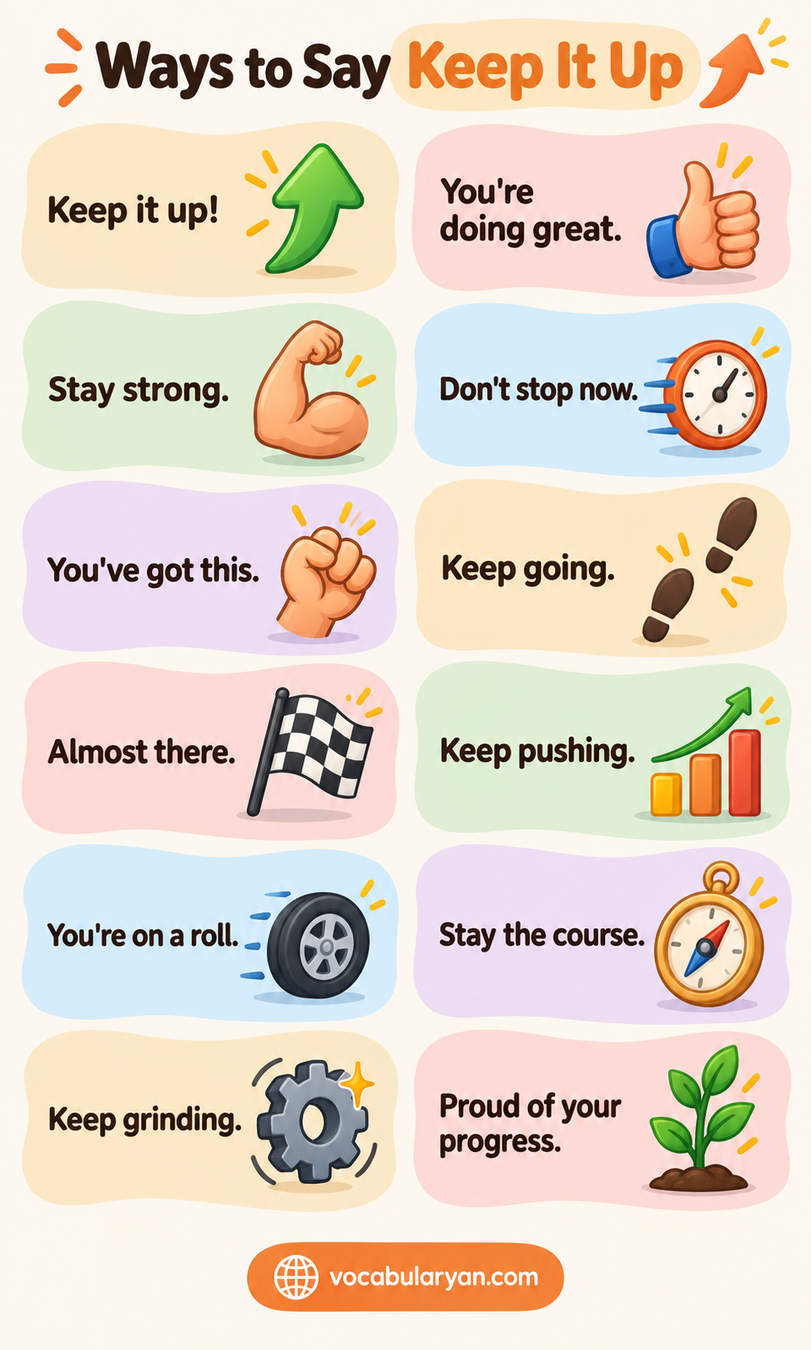
These phrases fit a friend, a colleague, a child, or a neighbour, and none of them sounds too formal or too casual.
Keep going: the most common phrase for someone in the middle of a task. It works in speech and in writing, and it fits every level from a child to a client.
- Keep going, you’re nearly at the top of the hill.
- The first draft reads well, so keep going and send me the rest on Friday.
- Keep going, Dad, only three more boxes and the van is empty.
Keep up the good work: the standard longer form, and it fits a manager to an employee, a teacher to a student, or a coach to a player. It sounds warm without sounding personal.
- Keep up the good work, Priya, the client noticed the change.
- Your reading has improved so much this term, keep up the good work.
- Keep up the good work, lads, the pitch has never looked better.
You’re doing great: a phrase for the person rather than the work, so it fits a friend, a child, or a new colleague who is nervous.
- You’re doing great, Sam, nobody gets every question on the first day.
- Honestly, you’re doing great for someone who only started running in March.
- You’re doing great, Mum, the doctor said the walking is helping.
Keep at it: "keep at it" means "continue with the effort", and it fits a task that is slow or boring. Use it for study, practice, and repairs.
- Keep at it, the second chapter is always the hardest one.
- She told me to keep at it, and by June the scales sounded like music.
- Keep at it, Joe, the paint needs one more coat and then you’re done.
You’re on the right track: this one says the method is correct, even if the result is not there yet. It fits a student, a trainee, or a friend learning something new.
- You’re on the right track, just check the units in the last line.
- The logo is close, you’re on the right track with the colours.
- You’re on the right track, Ben, the coach said your footwork looks better every week.
Keep doing what you’re doing: a phrase that asks for no change at all, and it fits someone who is worried they are getting something wrong.
- Keep doing what you’re doing, the numbers speak for themselves.
- Your essays are getting sharper each week, so keep doing what you’re doing.
- Keep doing what you’re doing, the baby is sleeping better than ever.
You’re almost there: the phrase for the final stretch, and it fits a run, an exam paper, a build, or a long form.
- You’re almost there, one more paragraph and the essay is finished.
- You’re almost there, Ahmed, the last screw goes on the left.
- Two more weeks of training and you’re almost there.
Say "keep going" when you are unsure, because it fits every listener and every task.
Casual Ways to Say Keep It Up to Friends
Casual phrases sound quick and warm, and they fit friends, siblings, and colleagues you joke with.
You’ve got this: the phrase for a friend who doubts themselves before or during a task. It means "you have the skill to finish".
- You’ve got this, Jess, you’ve done harder interviews.
- Deep breath, you’ve got this, the exam is only an hour.
- You’ve got this, mate, the whole room is on your side.
Keep it going: a relaxed way to praise a run of good results, from a winning streak to a week of early mornings.
- Three gym days in a row, keep it going!
- Keep it going, Tom, that’s your best month of sales yet.
- The band sounded tight tonight, keep it going for Saturday.
Keep pushing: a phrase for sport, exams, and any task that needs effort rather than skill.
- Keep pushing, Dan, ten more seconds on the plank.
- Keep pushing, the revision will pay off on Thursday.
- She kept saying keep pushing until I finished the last set.
You’re on a roll: said when someone has a run of good results, and it means "the luck and the skill are with you right now".
- You’re on a roll, that’s the third client this week.
- Six answers right in a row, you’re on a roll!
- You’re on a roll, Maya, don’t put the guitar down yet.
Use "you’ve got this" for a nervous friend and "you’re on a roll" for one who is winning.
Formal Ways to Say Keep It Up at Work
Formal phrases fit a manager to an employee, a reviewer to a trainee, or a client to a supplier, and each one names the work, not the person.
Please continue the excellent work: the standard formal phrase in a review, a letter, or a meeting. "Please" makes it a request rather than an order.
- Please continue the excellent work on the quarterly reports.
- Please continue the excellent work, Mrs Okonkwo, the board was impressed.
- Your team has met every deadline this year, so please continue the excellent work.
Keep up the strong performance: a phrase for a review or an appraisal, and it fits a person who has hit targets for months.
- Keep up the strong performance and the promotion will follow.
- Keep up the strong performance, Mr Diaz, your numbers lead the region.
- The panel asked me to pass on one message: keep up the strong performance.
Your consistency is impressive: praise for the same good result over time, and it fits a review of a whole year.
- Your consistency is impressive, every audit came back clean.
- I have read all twelve monthly reports, and your consistency is impressive.
- Your consistency is impressive, Dr Hale, and the patients say the same.
Maintain this level of quality: a phrase for a supplier, a contractor, or a junior colleague whose work needs no change.
- Maintain this level of quality and we will renew the contract in April.
- Maintain this level of quality, please, the samples were perfect.
- The client asked us to maintain this level of quality on the next batch.
Keep up the momentum: "momentum" means the speed a project already has, so the phrase fits a team in the middle of a launch.
- Keep up the momentum, we are two weeks ahead of the plan.
- Keep up the momentum, everyone, the second phase starts Monday.
- The director said to keep up the momentum through the summer.
Keep it up is said downward, from a senior person to a junior one, so it sounds wrong from an employee to a director.
- Keep it up, Ms Rahman, that was a fine presentation. (to your director) ❌
From a junior person the phrase sounds like a pat on the head, so praise the work itself instead.
- That was a fine presentation, Ms Rahman, I learned a lot from it. ✅
Every phrase for keep it up belongs to one of five levels.
| Level | Phrases | Who it fits |
|---|---|---|
| Slang | You’re killing it, you’re crushing it, keep grinding | Close friends your own age |
| Casual | Keep going, you’ve got this, keep it going | Friends, family, relaxed colleagues |
| Neutral | Keep it up, keep up the good work, you’re on the right track | Anyone junior to you or equal to you |
| Formal | Please continue the excellent work, keep up the strong performance | Employees, trainees, suppliers |
| Very formal | Your consistency is impressive, maintain this level of quality | Reviews, references, letters |
Write "please continue the excellent work" in a review, and keep "keep it up" for someone junior to you.
Ways to Say Keep It Up in an Email
An email phrase for keep it up names the work in the same sentence, because the reader cannot hear your voice.
Keep up the great work on the project: the standard email phrase, and the project name after "on" makes it specific.
- Keep up the great work on the project, the demo went down well.
- Hi Ana, keep up the great work on the project, the client emailed to say thanks.
- Keep up the great work on the project, and let me know if you need more hours.
I’m impressed by your progress so far: a phrase for a manager or a mentor writing to someone halfway through a task.
- I’m impressed by your progress so far, especially the testing plan.
- Dear Mr Lee, I’m impressed by your progress so far on the certification.
- I’m impressed by your progress so far, so please keep sending the weekly updates.
Looking forward to seeing the next stage: this one asks for more without giving an order, and it fits a client or a colleague.
- Great first draft, looking forward to seeing the next stage.
- Looking forward to seeing the next stage of the website, Rob.
- The photos are lovely, looking forward to seeing the next stage of the build.
Thank you for keeping this on track: praise for someone who has managed a timeline, and it fits a project lead or an assistant.
- Thank you for keeping this on track, the launch date now looks safe.
- Thank you for keeping this on track while I was away.
- Thank you for keeping this on track, Omar, the whole team benefits.
Name the project in an email, because "keep it up" on its own reads as a form letter.
Ways to Say Keep It Up to a Child
Phrases for a child are short, warm, and about effort, because a child needs to hear that trying is the goal.
Keep trying: the phrase for a child who has not managed the task yet, from a shoelace to a spelling.
- Keep trying, the loop goes over the other one.
- Keep trying, Ellie, the bike will feel steady soon.
- Nobody reads on the first day, keep trying.
You can do it: a cheer before or during a hard moment, and it fits a race, a jump, or a first day at school.
- You can do it, just hold the rail and step down.
- You can do it, Max, one more piece and the puzzle is done.
- The whole class shouted you can do it as she reached the top of the rope.
Nearly there, keep going: the phrase for the last stretch of a task, and it fits homework, a walk, or a tidy-up.
- Nearly there, keep going, two more sums and then it’s playtime.
- Nearly there, keep going, the car park is just past the trees.
- Nearly there, keep going, Lily, only the blocks left to put away.
That’s it, you’ve got it: said the moment a child does the thing right, so the child connects the action with the praise.
- That’s it, you’ve got it, now pedal a bit faster.
- That’s it, you’ve got it, that’s exactly how the letter goes.
- That’s it, you’ve got it, keep your arms out like that.
Praise the effort and not the result, because "keep trying" teaches a child that hard tasks are normal.
Ways to Say Keep It Up to a Student
A teacher’s phrase for keep it up names what improved, so the student knows what to repeat.
Your work is improving every week: the standard line for a report or a chat after class, and it fits any lesson.
- Your work is improving every week, the last essay had no comma errors at all.
- Your work is improving every week, Daniel, the graphs are much clearer now.
- I told his parents that your work is improving every week.
Keep practising: "practise" with an "s" is the British verb, and the phrase fits languages, music, and sport.
- Keep practising the past tense and it will feel natural by the exam.
- Keep practising, the piece is hard and you are nearly there.
- Keep practising your serve for ten minutes a day.
You’re making real progress: praise for a slow skill, and "real" means the change is not small.
- You’re making real progress with your pronunciation.
- You’re making real progress, Mei, the reading test proves it.
- Six months ago you couldn’t write a paragraph, and now you’re making real progress.
Keep up the effort: the phrase for a student whose marks are still low but whose work is honest.
- Keep up the effort and the marks will follow.
- Keep up the effort, Aisha, I can see the hours in this homework.
- His tutor wrote keep up the effort on every page.
One missing word turns this praise into a complaint, because "keep up" alone means "you are behind".
- Keep up, Tom, your last essay was excellent. ❌
"Keep up" means "go faster, the others are ahead of you", so the praise makes no sense without "it".
- Keep it up, Tom, your last essay was excellent. ✅
Tell a student which part improved, and say "keep practising" for the part that has not.
Ways to Say Keep It Up to a Team
A team phrase uses "we", "everyone", or "team", and it praises the group rather than one person.
Great work, everyone: the standard opener for a team meeting or a group message after a good week.
- Great work, everyone, the release went out with zero bugs.
- Great work, everyone, let’s carry the same energy into next week.
- Great work, everyone, the customers have noticed the faster replies.
Let’s keep this going: a phrase that asks the group to continue, and "let’s" puts the speaker inside the team.
- Let’s keep this going, the numbers are the best since January.
- Let’s keep this going, the second half starts in five minutes.
- Three clean sprints in a row, let’s keep this going.
We’re on track: this one names the plan, and it fits a project update or a coach at half-time.
- We’re on track, the roof goes on next Tuesday.
- We’re on track, everyone, two more milestones before the summer.
- The client has seen the timeline and agrees that we’re on track.
Proud of this team: a warm line for a manager after a hard stretch, and it fits a message or a speech.
- Proud of this team, you delivered when nobody thought it was possible.
- Proud of this team, the audit found nothing.
- I’m proud of this team, every single one of you stayed late this week.
Say "let’s keep this going" to a team, because "keep it up" to a group sounds like a boss talking down.
Ways to Say Keep It Up in a Text
A text phrase is short, and the exclamation mark or the emoji adds the warmth that your voice adds in speech.
Keep going!: the shortest text phrase, and the exclamation mark makes it a cheer rather than an order.
- Keep going! Ten minutes left.
- Saw your run on the app, keep going!
- Keep going! Nearly done with the essay?
You’ve got this!: the text you send before a friend’s exam, interview, or race.
- You’ve got this! Call me after.
- Interview at ten? You’ve got this!
- You’ve got this! Remember to breathe.
Almost there: the phrase for the last part of a long day or a long task, and it fits a message from a friend or a partner.
- Almost there, one more meeting and you’re free.
- Almost there! Two chapters left?
- Almost there, I’ve saved you some dinner.
Proud of you: a text for someone in the middle of a hard stretch, and the missing "I’m" makes it sound close and quick.
- Proud of you, week three of the diet and still going.
- Proud of you for showing up today.
- Proud of you, keep it up!
Keep a text to three or four words, and let the exclamation mark carry the cheer.
Ways to Say Keep It Up in the Middle of a Long Task
These phrases fit the middle of a project, a course, or a build, when the start is far behind and the end is not in sight.
You’re halfway there: a phrase that names the middle, and it fits a marathon, a dissertation, or a renovation.
- You’re halfway there, six months done and six to go.
- You’re halfway there, Nadia, the hardest chapters are behind you.
- The trainer said you’re halfway there at the twenty-kilometre mark.
Keep moving forward: the phrase for a project with setbacks, and it means "do not look back at the mistakes".
- Keep moving forward, the delay last month is already fixed.
- Keep moving forward, the second version is much stronger than the first.
- Whatever the review says, keep moving forward.
One step at a time: this one asks the person to look at the next small task rather than the whole job.
- One step at a time, finish the kitchen before you think about the roof.
- One step at a time, Grace, today is only the introduction.
- Take it one step at a time and the move will be done by Sunday.
You’ve come so far: praise that looks back at the distance covered, and it fits a long recovery or a long course.
- You’ve come so far, remember how hard the first week was.
- You’ve come so far, Ibrahim, don’t give up at chapter nine.
- Look at the first draft next to this one, you’ve come so far.
Say "you’re halfway there" when the middle feels slow, and "keep moving forward" after a setback.
Ways to Say Keep It Up for a Habit
A habit phrase praises the number of days or the routine itself, because the goal of a habit is to repeat it.
Keep showing up: the phrase for the gym, a class, or a daily practice, and it praises attendance rather than results.
- Keep showing up, the results come after the habit is set.
- Keep showing up, Zoe, thirty days in a row is a real streak.
- Your coach says the only rule is to keep showing up.
Stay consistent: "consistent" means "the same every time", so the phrase fits study plans, savings, and training.
- Stay consistent and the language will come faster than you think.
- Stay consistent, twenty minutes a day beats three hours on Sunday.
- Stay consistent, Ed, the weight is coming off slowly and that’s right.
Don’t break the streak: a phrase for a run of daily lessons or workouts, and "streak" means the unbroken chain of days.
- Don’t break the streak, day 100 is tomorrow.
- Don’t break the streak, even five minutes of Spanish counts.
- Don’t break the streak, Lena, you’ve never missed a Monday.
You’re building a good habit: praise for the early weeks, when the routine is new and quick to drop.
- You’re building a good habit, three weeks of early mornings already.
- You’re building a good habit, the reading log is nearly full.
- You’re building a good habit, Sam, and it will feel normal by spring.
Praise the streak and not the result, because "keep showing up" is the phrase that keeps a habit alive.
Ways to Say Keep It Up to Someone Who Is Struggling
For a hard time, the phrase praises the person for continuing, and it never mentions winning or results.
Hang in there: the standard phrase for a hard week, and it means "stay strong until this passes".
- Hang in there, the exam period ends on Friday.
- Hang in there, Ruth, the first month in a new job is always the hardest.
- Hang in there, we’re all thinking of you.
You’re doing better than you think: a phrase for someone who is hard on themselves, and it fits a new parent, a new employee, or a student.
- You’re doing better than you think, the baby is healthy and fed.
- You’re doing better than you think, the manager said your work is fine.
- You’re doing better than you think, Tariq, look at the last three scores.
Take it one day at a time: a phrase for a long illness, a hard course, or a difficult year.
- Take it one day at a time, tomorrow will look different.
- Take it one day at a time, Noor, and let me carry the shopping this week.
- The nurse said to take it one day at a time and not to plan too far ahead.
Keep your head up: a phrase for someone who lost a game, a job, or a chance, and it means "do not let this beat you".
- Keep your head up, the next match is Saturday.
- Keep your head up, Sara, the job wasn’t the right one anyway.
- Keep your head up, the club still believes in you.
"Keep trying" fits a person who has not succeeded yet, so it sounds odd the moment the success arrives.
- Keep trying, Sara, the client signed this morning! ❌
"Keep trying" means "the result has not come", and after good news the phrase is "keep it up".
- Keep it up, Sara, the client signed this morning! ✅
Say "hang in there" for a hard week, and keep "you’re almost there" for the day the end is in sight.
Regional Ways to Say Keep It Up in English
Each English-speaking country keeps a few phrases of its own, and the right one wins a smile from a local listener.
British Ways to Say Keep It Up
Crack on: a British phrase that means "get on with the task", said in a friendly voice to a colleague or a friend.
- Crack on, mate, the van is leaving at four.
- Crack on with the report, I’ll bring you a tea.
- Right, crack on, the tide is coming in.
You’re smashing it: casual British praise for someone doing far better than expected, and it fits friends and relaxed colleagues.
- You’re smashing it, three sales before lunch.
- You’re smashing it, Chloe, best time of the season.
- New job and a new flat in a month, you’re smashing it.
Good on you, keep going: "good on you" is British and Australian praise for a choice, and "keep going" adds the push.
- Good on you, keep going, the charity walk is nearly done.
- Good on you, keep going, not many people finish the course.
- Good on you, keep going, your gran would be proud.
American Ways to Say Keep It Up
You got this: the American form of "you’ve got this", said without "have", and it fits friends and team-mates.
- You got this, the final is only two hours.
- You got this, Jordan, the first pitch was great.
- You got this, we’ll be at the finish line.
Keep on keeping on: an American phrase that means "continue in the same way", said warmly to a friend who is tired.
- Keep on keeping on, the road trip ends in Denver.
- Keep on keeping on, Marcus, the store will turn a profit this year.
- Grandpa’s only advice was to keep on keeping on.
Attaboy: an old American cheer for a boy or a man who did well, said by a coach or a parent. "Attagirl" is the form for a girl or a woman.
- Attaboy, Luke, keep swinging like that.
- Attaboy, that’s the way to throw it.
- Attagirl, Rosa, one more lap.
Australian and Irish Ways to Say Keep It Up
Good on ya, mate: the Australian version of "good on you", said to a friend or a stranger who is doing well.
- Good on ya, mate, that’s the third weekend you’ve helped out.
- Good on ya, mate, keep swimming and you’ll make the squad.
- Good on ya, mate, the fence looks solid.
Fair play to you: the Irish phrase for "well done for doing that", and it fits effort, honesty, or courage.
- Fair play to you, not many would keep going after that week.
- Fair play to you, Ciara, the whole run in the rain.
- Fair play to you, the shop is open every day now.
Go on, you good thing: an Irish cheer for a friend or a horse that is doing well, said with a laugh.
- Go on, you good thing, one more length of the pool.
- Go on, you good thing, the last question is yours.
- Go on, you good thing, Seán, keep that pace to the line.
Say "crack on" in Britain, "you got this" in America, "good on ya" in Australia, and "fair play to you" in Ireland.
Slang Ways to Say Keep It Up
Slang phrases for keep it up belong to friends your own age, and each one sounds wrong in a review or a formal email.
You’re killing it: slang for "you are doing extremely well", and it fits sport, work, and performance.
- You’re killing it, that’s the best set you’ve played.
- You’re killing it, Dev, three interviews and three offers.
- You’re killing it at the new job, everyone says so.
You’re crushing it: the same meaning as "you’re killing it", and it is a little more common in American offices.
- You’re crushing it, the targets are done by Wednesday.
- You’re crushing it, Amira, keep that pace.
- Ten kilometres before breakfast, you’re crushing it.
Keep grinding: slang for "keep working hard at a long, dull task", and it fits study, training, and side jobs.
- Keep grinding, the exam is in two weeks.
- Keep grinding, Leo, the app will launch by summer.
- Keep grinding, the first year of any business is like this.
You’re on fire: slang for a run of good results, and it fits games, sales, and exams.
- You’re on fire, that’s five goals this month.
- You’re on fire, Jade, another full mark.
- You’re on fire today, keep taking the shots.
Keep "you’re killing it" and "keep grinding" for friends, and say "keep up the good work" to anyone else.
Funny Ways to Say Keep It Up
Funny phrases work with a friend who laughs at teasing, and each one pretends the praise is a complaint or a bet.
You’re making the rest of us look bad: a joke that praises the person by pretending to complain about them.
- You’re making the rest of us look bad, four early mornings in a row.
- You’re making the rest of us look bad, Jo, slow down with the sales.
- Stop finishing early, you’re making the rest of us look bad.
Don’t let me down now: a mock warning to a friend near the finish, said with a grin.
- Don’t let me down now, I told everyone you’d finish.
- Don’t let me down now, the cake is ready for the winner.
- Don’t let me down now, Raj, one more question.
At this rate you’ll be running the place: a joke for a new colleague who is doing well, and it means "your progress is fast".
- At this rate you’ll be running the place by Christmas.
- At this rate you’ll be running the place, Ana, two projects in a month.
- Keep it up, at this rate you’ll be running the place.
Use a funny line with a friend who laughs at jokes about themselves, because a stranger reads it as a real complaint.
How Do You Reply When Someone Says Keep It Up?
A reply to keep it up thanks the speaker and promises to continue, and it takes one short sentence.
Thanks, I will: the standard reply at every level, from a friend to a manager.
- Keep it up, Priya. Thanks, I will.
- Keep up the good work. Thanks, I will, the next report is due Friday.
- You’re doing great. Thanks, I will keep at it.
Thanks, that means a lot: a warmer reply for praise from someone you respect, and it fits a review or a mentor.
- Please continue the excellent work. Thanks, that means a lot.
- Your consistency is impressive. Thank you, that means a lot coming from you.
- Keep up the strong performance. Thanks, that means a lot, I’ll keep going.
I’m trying: the honest reply from someone who finds the task hard, and it keeps the conversation open.
- Hang in there. I’m trying, it’s been a long week.
- Keep going, you’re nearly there. I’m trying, my legs say otherwise.
- You’ve got this. I’m trying, thanks for the push.
Couldn’t have done it without the team: the reply that passes the praise to other people, and it fits a manager or a project lead.
- Keep up the momentum. Couldn’t have done it without the team.
- Great work on the launch, keep it up. Couldn’t have done it without the team, honestly.
- Your efforts are paying off. Couldn’t have done it without the team behind me.
Reply in one short sentence, and pass the praise to your team when the work was shared.
More Everyday English Phrases
FAQs
The closest phrases are "keep going", "keep up the good work", and "keep at it", and each fits almost any listener. For a friend, "you’ve got this" or "you’re on a roll" sounds warmer. For an employee, "please continue the excellent work" sounds more formal. The choice depends on who is listening and how far the task has come.
Say "please continue the excellent work", "keep up the strong performance", or "your consistency is impressive". Each one names the work rather than the person, and each fits a review, a reference, or a formal email. In a shorter message, "keep up the great work on the project" fits a colleague at any level.
No, "keep it up" is not rude, but it is said from a senior person to a junior one. From an employee to a manager it sounds like a pat on the head, so praise the work instead: "that was a great presentation". Between friends and equals the phrase is warm and safe.
"Keep it up" means "continue doing what you are doing, because it is going well". The phrase is for work that is still in progress, not for a task that is finished. Said in a flat voice to someone who is behaving badly, it means the opposite: "stop, or there will be trouble".
Say "keep trying", "you can do it", or "nearly there, keep going", because each one praises the effort rather than the result. "That’s it, you’ve got it" fits the moment a child does the thing right. Keep the phrase short, and say it at once, so the child connects the words with the action.
The reply is "thanks, I will" or "thanks, that means a lot", and both fit a manager, a teacher, or a friend. "I’m trying" is the honest reply on a hard day, and "couldn’t have done it without the team" passes the praise to the group. One short sentence is enough.
Yes, "keep up the good work" fits a review, a meeting, or a letter from a manager to an employee, and it sounds polite rather than casual. It is still said downward, so an employee does not say it to a director. For the most formal writing, "please continue the excellent work" fits better.
"Keep going!", "you’ve got this!", and "almost there" are the shortest texts, and each one works for a run, an exam, or a long day. "Proud of you" fits a friend in the middle of a hard stretch. Three or four words with an exclamation mark is the right length.