
"What’s up?" is a greeting first and a question second, so the reply is "not much" rather than a report on your day. A friend hears "what’s new?", a colleague hears "how are you doing?", and a text gets "sup". The ways to say what’s up in English are set by the person and the channel, and the everyday forms fit almost anyone.
Other Ways to Say What’s Up in English
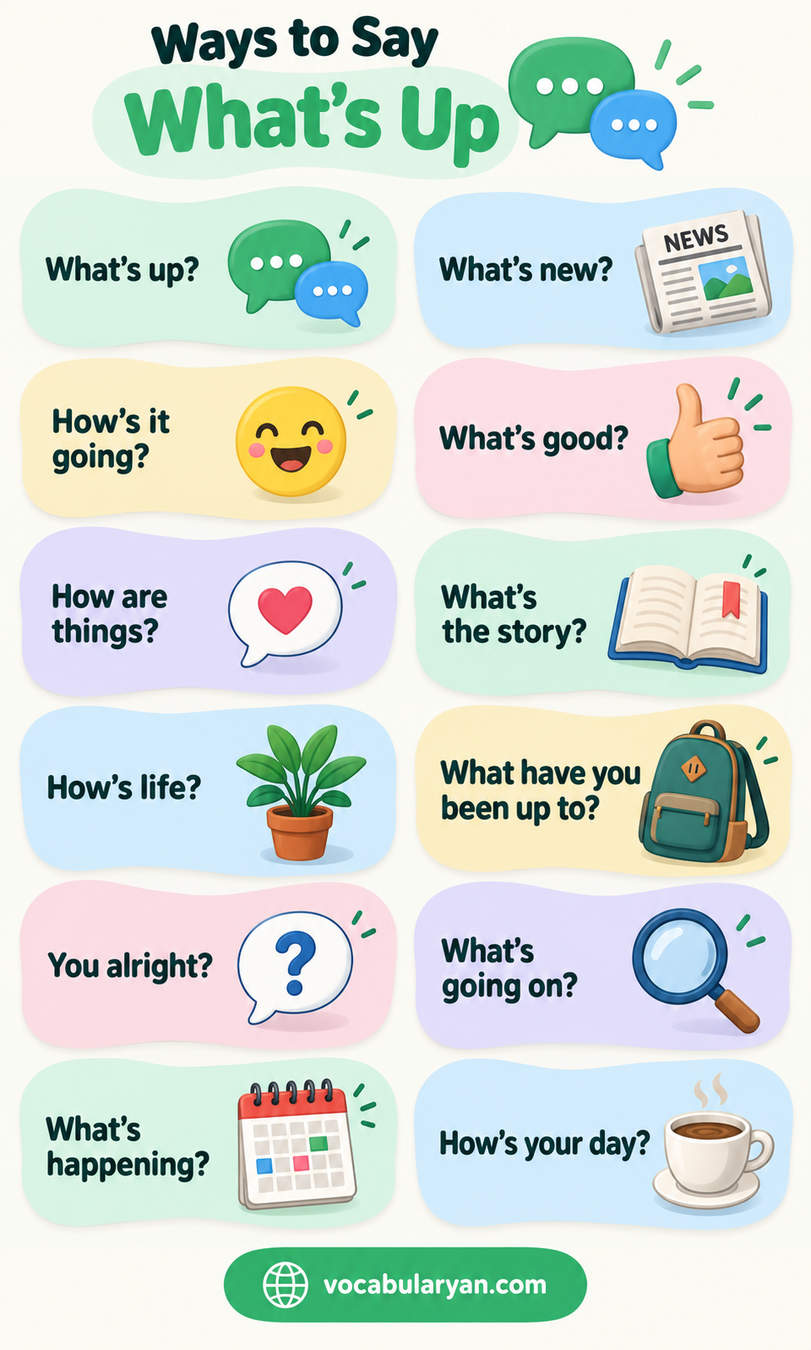
These seven greetings are the most common replacements for "what’s up?", and they fit friends, family, classmates, and colleagues you know well.
What’s up?: the starting form, and it means "hello" rather than "what is happening?". It fits friends and classmates, and it sounds too relaxed for a first meeting with a manager.
- What’s up, Nadia? You’re here early.
- Hey, what’s up? I saw your light on.
- What’s up, man? Long day at the shop?
What’s going on?: the closest match to "what’s up?", and it fits the same people. The reply is "not much" or a short piece of news.
- What’s going on, Sam? Did the plumber come?
- Hi, Ravi, what’s going on with the car?
- What’s going on? Everyone looks so serious.
How’s it going?: a greeting and a question in one, and it works with friends, neighbours, and relaxed colleagues. The reply is "good, you?".
- How’s it going, Mrs Kaur? Is the knee better?
- Morning, Tom, how’s it going?
- How’s it going with the new flat?
What’s new?: an opener that asks for news, so it fits a friend or a cousin you see every week or two.
- What’s new, Ola? Still teaching on Saturdays?
- Hi, Jonah, what’s new with you and the band?
- What’s new? I feel like I’ve missed a lot.
How are things?: softer than "how are you?", and it fits friends, family, and colleagues in speech and in messages. The reply is a short update.
- How are things, Nan? Did the roses survive the frost?
- Hey, Ines, how are things at the clinic?
- How are things? You’ve been quiet since Tuesday.
What’s happening?: casual and friendly, and it is more common in American English than in British English.
- What’s happening, Marcus? You still on for Friday?
- Hey, what’s happening? You left early last night.
- What’s happening over there? I heard shouting.
How’s everything?: the same warmth as "how are things?", and it fits the start of a phone call or a video chat.
- How’s everything, Dad? Is the boiler fixed yet?
- Hi, Yara, how’s everything over in Leeds?
- How’s everything? I owe you three phone calls.
Say "how’s it going?" when you are unsure, because it fits a friend and a colleague and never sounds cold.
Casual Ways to Say What’s Up to a Friend
Casual greetings are for people who know you well, and each one asks for a little news in a relaxed way.
How’s life?: a wide question about everything at once, and it fits a friend you have not spoken to for a few weeks.
- How’s life, Dan? Still at the same company?
- Hey, Amira, how’s life in the city?
- How’s life? You look well.
What are you up to?: a greeting that asks what the person is doing right now, and it fits a friend on the street or on a call.
- What are you up to, Josh? Fancy a coffee?
- Hi, Priya, what are you up to this weekend?
- What are you up to? I’m bored at home.
How’s your day going?: a warm greeting for a friend or a partner in the middle of the day, and the reply is a short update.
- How’s your day going, love? Did the meeting go well?
- Hey, Chris, how’s your day going?
- How’s your day going? Mine started with a flat tyre.
What’s new with you?: "what’s new?" with the person named, and it turns the greeting into a real invitation to talk.
- What’s new with you, Ana? Any word from the university?
- Hi, Grandad, what’s new with you?
- What’s new with you? I want all the news.
Anything exciting going on?: a playful way to ask for news, and it fits a friend who likes to tell stories.
- Anything exciting going on, Leah? You sound happy.
- Hey, Omar, anything exciting going on at work?
- Anything exciting going on? I’ve had the dullest week.
Got any news?: a direct request for news, and it fits a close friend or a family member on a call.
- Got any news, Kwame? How was the interview?
- Hi, Auntie, got any news about the house?
- Got any news? You said you’d tell me on Monday.
How’s things?: the casual spoken form of "how are things?", and it is common in British and Irish English between friends. In writing, "how are things?" is the safer form.
- How’s things, Paddy? Busy at the farm?
- Hey, Lucy, how’s things?
- How’s things? Haven’t seen you at the gym.
Ask "what’s new with you?" when you want a real answer, and ask "what are you up to?" when you want to meet.
Slang Ways to Say What’s Up
Slang greetings belong to close friends your own age, and each one sounds wrong from a stranger, a teacher, or a manager.
Sup?: the shortest form of "what’s up?", said and typed by younger speakers. The reply is "sup" back or "not much".
- Sup, Kian? You skipping practice again?
- Sup? Rough night?
- Yo, sup, save me a seat.
Wassup?: "what’s up?" said fast, and it is friendlier and louder than "sup". It fits a greeting shouted across a room.
- Wassup, Tariq! Where’ve you been?
- Wassup? I got your text.
- Hey, wassup, everyone? Party started without me?
What’s good?: American slang that means "what’s up?", and it fits friends in a group chat or at a game.
- What’s good, Deshawn? You watching the game later?
- What’s good? I’m done with work at five.
- Yo, what’s good, man? Nice trainers.
What’s poppin’?: American slang for "what’s happening?", and it fits close friends and a night out.
- What’s poppin’, Dre? Who’s coming tonight?
- What’s poppin’? You look ready to go.
- Hey, what’s poppin’, girls?
What’s crackin’?: older American slang with the same meaning as "what’s poppin’?", and it sounds a little dated to teenagers.
- What’s crackin’, Eddie? Still driving that van?
- What’s crackin’? I heard the music from the street.
- Hey, what’s crackin’, cousin?
What’s the word?: slang that asks for news, and it fits a friend who knows what is being planned.
- What’s the word, Mia? Are we still going Saturday?
- What’s the word on the new manager?
- Hey, what’s the word? Did they pick a date?
What’s shakin’?: playful American slang from the 1950s, still said as a joke between friends.
- What’s shakin’, Rosa? You look busy.
- What’s shakin’? I brought doughnuts.
- Hey, what’s shakin’, boss?
Keep "sup", "wassup", and "what’s good?" for friends your own age, and use "how’s it going?" with everyone else.
Ways to Say What’s Up Over Text
Text greetings are short, and the question mark and the exclamation mark do the work of your voice.
Hey, what’s up?: the default text greeting between friends, and it fits the first message of the day or the first message after a few days.
- Hey, what’s up? Free tonight?
- Hey, what’s up? Just saw your photos from the lake.
- Hey, what’s up? Did you get home okay?
Wyd?: the text form of "what are you doing?", and it fits close friends and partners only. Spell it out in a message to anyone older.
- Wyd? I’m outside the cinema.
- Wyd tonight? Pizza at mine?
- Hey, wyd? You’ve gone quiet.
What’s up with you?: a text greeting that asks for news, and it fits a friend you have not messaged for a while.
- What’s up with you? Haven’t heard from you since Easter.
- Hi, Zara, what’s up with you these days?
- What’s up with you, stranger?
You up to much?: a British text greeting that asks what the person is doing, and the reply is "not really, you?".
- You up to much this weekend?
- Hey, you up to much? Fancy a walk?
- You up to much tonight, or shall I come round?
How’s your day?: a soft text opener for a friend or a partner, and it fits the middle of a working day.
- How’s your day? Mine has been one long queue.
- Hi, how’s your day so far? Any news from the vet?
- How’s your day? I’m stuck on a delayed train.
Keep a text greeting to three or four words, and let the question mark do the asking.
Ways to Say What’s Up to a Group
A group version of "what’s up" reaches everyone in one line, and it stays casual because the phrase itself is casual.
What’s up, everyone?: the standard casual greeting for a group of friends or classmates, in person or in a group chat.
- What’s up, everyone? Sorry I’m late.
- What’s up, everyone? Who’s driving tonight?
- Hey, what’s up, everyone? Thanks for waiting.
What’s up, guys?: warm and relaxed, and it fits friends of any gender. In a work message it sounds too familiar.
- What’s up, guys? Ready to go?
- What’s up, guys? I brought the snacks.
- Hey, what’s up, guys? Did I miss the start?
How’s everyone doing?: a friendly group greeting that also fits a class, a team, or a family dinner.
- How’s everyone doing? Warm enough in here?
- Hi, all, how’s everyone doing after the long drive?
- How’s everyone doing? Let’s start with the good news.
What’s happening, folks?: a cheerful greeting for a group of friends or neighbours, and "folks" sounds warm in American English.
- What’s happening, folks? Who wants coffee?
- What’s happening, folks? Nice to see so many of you.
- Hey, what’s happening, folks? Room for one more?
How’s it going, all?: a British group greeting for friends, flatmates, or a small team, and it fits a message too.
- How’s it going, all? Pub at eight?
- How’s it going, all? Any news on the van?
- Hey, how’s it going, all? Long time.
Say "what’s up, everyone?" to friends and "how’s everyone doing?" to any group with people you do not know well.
Ways to Say What’s Up to a Friend You Have Not Seen for a While
These greetings ask for the news of the whole time apart, and they fit friends, family, and old colleagues.
What have you been up to?: the standard question after a long absence, and it asks for real news rather than "fine".
- What have you been up to, Aisha? I heard about the wedding.
- Hey, Ravi, what have you been up to since the summer?
- What have you been up to? Tell me everything.
How have you been?: the warm question that follows "long time no see", and the reply is a short update.
- How have you been, Ines? How’s the new school?
- It’s been ages, how have you been?
- How have you been, Uncle Femi? Is the shop still busy?
What’s been going on?: a casual question about the time apart, and it fits a friend you have not messaged for months.
- What’s been going on, Tom? You disappeared.
- Hi, Elena, what’s been going on with you?
- What’s been going on? I want the full story.
What’s the latest?: a question about the newest news, and it fits a friend who was in the middle of something when you last spoke.
- What’s the latest, Sara? Did you get the flat?
- Hey, Pete, what’s the latest on the visa?
- What’s the latest? Any word from the doctor?
Where have you been?: a playful greeting with a small tease in it, and it fits a friend who has been out of touch.
- Where have you been, stranger? I thought you’d emigrated.
- Well, well, where have you been hiding?
- Where have you been? You never answer my messages.
What’s new since I last saw you?: a full question that names the time apart, and it fits a family gathering or a school reunion.
- What’s new since I last saw you, Dev? That was Christmas, wasn’t it?
- Hi, Ruth, what’s new since I last saw you?
- What’s new since I last saw you? You’ve cut your hair.
Ask "what have you been up to?" after months apart, and "what’s the latest?" when you know what the person was waiting for.
Polite Ways to Say What’s Up at Work
Polite forms fit a manager, a client, a customer, or a colleague you do not joke with, and each one goes with a title or a full sentence.
How are you?: the standard polite question at work, and the reply is short and positive: "Very well, thank you, and you?".
- Good morning, Mrs Haddad, how are you?
- How are you, Professor Lindqvist? Your talk was excellent.
- Hello, how are you? The doctor will be with you shortly.
How are you doing?: a little warmer than "how are you?", and it fits a colleague you see every day or a client you have met before.
- How are you doing, Mr Chen? How was the flight?
- Hi, Fatima, how are you doing today?
- How are you doing? I heard the launch went well.
How’s everything going?: a polite question that asks about work rather than health, and it fits a manager checking in with a team.
- How’s everything going with the audit, Dana?
- Hi, Omar, how’s everything going on your side?
- How’s everything going? Any problems with the new system?
Is everything going well?: the most careful form, and it fits a manager, a client, or a senior colleague you speak to rarely.
- Is everything going well with the new office, Ms Brennan?
- Good afternoon, Dr Okafor, is everything going well?
- Is everything going well? Please tell me if you need more time.
Any updates?: a work greeting that asks for progress, and it fits a message or a short call with a colleague.
- Hi, Ravi, any updates on the delivery?
- Any updates from the client since yesterday?
- Morning, team, any updates before we start?
How’s your week going?: a friendly polite question for a colleague on a Wednesday or a Thursday, and the reply is a short report on the week.
- How’s your week going, Maya? Busy one?
- Hi, Leo, how’s your week going so far?
- How’s your week going? Mine has been all meetings.
Hope all is well: not a question but the first line of a work email, and it replaces "what’s up?" in writing to a client or a manager.
- Hi Sara, hope all is well. Could you send me the invoice?
- Dear Mr Petrov, I hope all is well with you and the team.
- Hello Tom, hope all is well. Quick question about Friday.
How’s everything on your end?: a polite question for a colleague in another office or another company, and it fits the start of a call.
- How’s everything on your end, Kemi? Any delays?
- Hi, Mark, how’s everything on your end with the contract?
- How’s everything on your end? We’re ready when you are.
The one greeting to avoid with a manager you met a week ago is "what’s up?", because it puts you on the level of a close friend before the relationship is there.
- What’s up, Ms Brennan? Got a minute? ❌
"What’s up?" sounds too familiar for a senior person, and "how are you?" fits the same moment.
- How are you, Ms Brennan? Do you have a minute? ✅
"Hope all is well" is a written line, and it sounds strange out loud.
- Hope all is well, Dr Okafor. (said at the door) ❌
"Hope all is well" is for email, so in speech the same greeting takes "how are you?".
- Good morning, Dr Okafor, how are you? ✅
The greetings on this page sort into five levels, and the table shows where each one belongs.
| Level | Greetings | Who it fits |
|---|---|---|
| Slang | Sup, wassup, what’s good, what’s poppin’ | Close friends your own age |
| Casual | What’s up, what’s going on, how’s it going, what’s new | Friends, family, relaxed colleagues |
| Neutral | How are things, how’s everything, how’s your day going | Anyone you know by name |
| Formal | How are you, how are you doing, how’s everything going | Managers, clients, older people |
| Very formal | Is everything going well, I hope all is well | Senior people, first emails, customers |
Use "how are you?" at work until a colleague says "what’s up?" to you first.
Regional Ways to Say What’s Up in English
Each English-speaking country keeps a few forms of "what’s up?" of its own, and using one in the right country wins a smile at once.
British Ways to Say What’s Up
Alright?: the everyday British greeting, and it is not a question about health. The reply is "alright?" back, or "yeah, you?".
- Alright, Gaz? Busy shift?
- Alright? Didn’t hear you come in.
- Oh, alright, mate? Coming to the quiz tonight?
You alright?: "alright?" with "you" in front, and it sounds a little softer. It is a greeting, so the reply is "yeah, you?".
- You alright, Claire? You look tired.
- Morning, you alright?
- You alright, mate? Haven’t seen you at training.
How’s tricks?: an old British and Irish greeting that means "how are things?", and it fits friends and older neighbours.
- How’s tricks, Pete? Still working nights?
- Hello, stranger, how’s tricks?
- How’s tricks? Haven’t seen you since the match.
What’s occurring?: a Welsh greeting that means "what’s happening?", now heard across Britain as a joke between friends.
- What’s occurring, Gav? Ready for the trip?
- Alright, what’s occurring?
- What’s occurring, lads? Why’s everyone in the kitchen?
American Ways to Say What’s Up
Howdy: a friendly greeting from the American South and West, short for "how do you do?", and it fits neighbours, shops, and strangers on a trail.
- Howdy, folks, the trail starts just past the gate.
- Howdy, neighbour, that truck of yours sounds rough.
- Howdy! Y’all here for the market?
What’s up, y’all?: "what’s up?" for a group in the American South, and it fits friends and family.
- What’s up, y’all? Dinner’s nearly ready.
- What’s up, y’all? Thanks for coming out.
- Hey, what’s up, y’all? Who wants the last biscuit?
What’s the deal?: American slang that asks what is happening, and it fits a friend who owes you news.
- What’s the deal, Marcus? Are we going or not?
- Hey, what’s the deal with the party? Is it still on?
- What’s the deal? You said you’d call.
How’s it going, man?: "how’s it going?" with "man", the American casual word for a male friend, and it fits close friends only.
- How’s it going, man? Long time.
- Hey, how’s it going, man? Nice car.
- How’s it going, man? You good?
Australian and Irish Ways to Say What’s Up
How are you going?: the Australian form of "how are you?", and it means the same thing. The reply is "good, thanks".
- How are you going, Tash? Beach any good this morning?
- G’day, Bruce, how are you going?
- How are you going? Long drive up from Melbourne?
How’s it going, mate?: the everyday Australian greeting between friends and strangers alike, and "mate" fits men and women.
- How’s it going, mate? Hot one today.
- How’s it going, mate? Is this the queue for the ferry?
- G’day, how’s it going, mate?
What’s the craic?: the Irish "what’s up", said "crack", and it asks what is happening and what the fun is. It fits friends and a friendly pub.
- What’s the craic, Declan? Any word on the job?
- Howya, lads, what’s the craic?
- What’s the craic? Haven’t seen you since the christening.
What’s the story?: an Irish greeting that means "what’s up?", and it fits friends and neighbours.
- What’s the story, Niamh? You look busy.
- Howya, what’s the story?
- What’s the story? Is the match still on?
How’s the form?: the Irish question about how someone is feeling, and it fits friends and family.
- How’s the form, Ciara? Still on the early shifts?
- How’s the form? You’re looking well.
- Hey, Oisin, how’s the form this morning?
Say "alright?" in Britain, "howdy" in the American South, "how are you going?" in Australia, and "what’s the craic?" in Ireland.
Funny Ways to Say What’s Up
Funny greetings are for close friends who know your sense of humour, and most of them rhyme or add a joke name.
What’s cookin’, good lookin’?: an old rhyme said as a joke to a partner or a close friend, and the joke is the compliment.
- What’s cookin’, good lookin’? Something smells great.
- What’s cookin’, good lookin’? Ready to go?
- Hey, what’s cookin’, good lookin’? Long time.
What’s up, buttercup?: a rhyme for a child, a partner, or a friend in a bad mood, and the joke is the sweet name.
- What’s up, buttercup? Somebody needs coffee.
- What’s up, buttercup? Ready for school?
- Hey, what’s up, buttercup? Why the long face?
What’s shakin’, bacon?: another rhyme, and it fits a friend who laughs at silly greetings.
- What’s shakin’, bacon? Breakfast is ready.
- What’s shakin’, bacon? You look like you slept in a hedge.
- Hey, what’s shakin’, bacon? Coming to the game?
What’s the tea?: slang that asks for gossip, and it fits close friends who want the whole story.
- What’s the tea, Jess? Tell me about the date.
- Sit down, what’s the tea?
- What’s the tea? You said you had news.
Sup, troublemaker?: "sup" with a teasing name, and it fits a friend who is always up to something.
- Sup, troublemaker? What did you break this time?
- Sup, troublemaker? Heard you got home at three.
- Hey, sup, troublemaker? Where’s your partner in crime?
How’s life in the fast lane?: a joke greeting for a friend who is always busy, or for a friend who never leaves the sofa.
- How’s life in the fast lane, Ravi? Two jobs now?
- How’s life in the fast lane? Still watching the same show?
- Hey, how’s life in the fast lane, Dr Patel?
Save the funny forms for people who will laugh, because a rhyme said to a stranger reads as a mistake.
When What’s Up Means What’s Wrong
"What’s up?" has a second meaning, and the face and the voice tell you which one you are hearing. With a worried look, it means "what’s wrong?", and the reply is a real answer.
What’s up?: with a frown or a soft voice, it asks what the problem is. The reply is the problem, not "not much".
- What’s up? You’ve gone very quiet.
- Hey, what’s up? You look upset.
- What’s up, Sam? Did something happen at school?
What’s up with you?: stronger than "what’s up?", and it asks why someone is behaving in a strange way. Between friends it sounds concerned, and to a stranger it sounds rude.
- What’s up with you today? You keep sighing.
- What’s up with you? You never miss a match.
- Hey, what’s up with you and Mark? You’re not talking.
What’s wrong?: the direct question, and it fits anyone who looks sad, hurt, or angry.
- What’s wrong, love? Come and sit down.
- What’s wrong? Is it the exam?
- Hey, what’s wrong? You can tell me.
What’s the matter?: the same meaning as "what’s wrong?", and it sounds a little softer and a little older. It fits a child or an older relative.
- What’s the matter, sweetheart? Did you fall?
- What’s the matter? You don’t look well.
- Grandad, what’s the matter? Is it your back?
Is everything okay?: a gentle question when you are not sure there is a problem, and it fits a colleague, a neighbour, or a friend.
- Is everything okay, Fatima? You left the meeting early.
- Hi, is everything okay at home?
- Is everything okay? You seemed upset on the phone.
What’s going on with you?: a question about a change in someone’s mood or behaviour over days or weeks, and it fits a close friend or a family member.
- What’s going on with you? You’ve cancelled three times.
- Hey, what’s going on with you lately?
- What’s going on with you, Ben? Talk to me.
The greeting form and the worried form look the same in writing, so in a text add a word that says which one you mean.
- What’s up? (a text to a friend who just posted a sad message) ❌
On its own, this reads as a greeting, so the friend hears "hello" rather than "what’s wrong?".
- Hey, is everything okay? Saw your message. ✅
Ask "what’s wrong?" when you can see a problem, and "is everything okay?" when you only suspect one.
How Do You Reply When Someone Says What’s Up?
The reply to "what’s up?" is short, because the greeting is not a real question, and the same question goes back at the end.
Not much, you?: the standard reply, and it fits every casual form of "what’s up?". It means "hello" back, and "you?" hands the turn over.
- What’s up, Mo? Not much, you?
- Sup? Not much, you?
- What’s going on? Not much, you? Just heading home.
Nothing much: the same reply without the question back, and it fits when you are about to say more.
- What’s up? Nothing much, just waiting for the bus.
- Hey, what’s up? Nothing much, I was about to call you.
- What’s new? Nothing much, same job, same flat.
Same old, same old: a reply that means nothing has changed, and it fits a friend who asks for news.
- What’s new? Same old, same old. How about you?
- How’s life? Same old, same old, work and sleep.
- What have you been up to? Same old, same old, nothing exciting.
Just chilling: a relaxed reply that means you are resting, and it fits a text or a call with a friend.
- Wyd? Just chilling, you?
- What are you up to? Just chilling at home, come round.
- What’s up? Just chilling after work.
All good, you?: a positive reply that works for "how’s it going?" and "how are things?", and it keeps the greeting short.
- How’s it going? All good, you?
- How are things? All good, thanks, you?
- How’s everything? All good here, how’s the new place?
Not a lot, what about you?: a slightly longer reply, and it fits a friend you have time to talk to.
- What’s up? Not a lot, what about you?
- What’s happening? Not a lot, what about you? Free later?
- What’s going on? Not a lot, what about you? You look busy.
Answer "what’s up?" in three words or fewer, then ask it back, and give a real answer only when the face says "what’s wrong?".
More Everyday English Phrases
- Other Ways to Say Good Evening
- Other Ways to Say How Are You
- Other Ways to Say Good Afternoon
- Other Ways to Say Nice to Meet You
FAQs
"What’s up?" is informal, and it fits friends, family, classmates, and colleagues you joke with. With a manager, a client, or a stranger, the polite forms are "how are you?" and "how are you doing?". In an email to anyone senior, "I hope all is well" is the line that replaces it.
The most common ways to say what’s up are "what’s going on?", "how’s it going?", "what’s new?", "how are things?", and "what’s happening?". The slang forms are "sup", "wassup", "what’s good?", and "what’s poppin’?". The polite forms for work are "how are you doing?" and "how’s everything going?".
Say "how are you?", "how are you doing?", or "how’s everything going?", because each one asks the same thing at a level that fits a manager or a customer. In writing, open with "I hope all is well" and then ask your question. "What’s up?" itself stays with friends.
Answer with "not much, you?", "nothing much", or "all good, you?", because the greeting is not a real question. Keep the reply to three or four words and then ask the same question back. When the person looks worried, "what’s up?" means "what’s wrong?", and then the reply is the real answer.
The difference is level and reply. "What’s up?" is casual and expects "not much", and "how are you?" is polite and expects "fine, thanks, and you?". "How are you?" fits everyone from a friend to a manager, and "what’s up?" fits friends only.
Type "hey, what’s up?", "sup", or "wyd?" to a friend, and "how’s your day?" to a partner or a friend in the middle of the day. The shorter forms fit close friends only, so write "how’s it going?" in full to anyone older or anyone at work. Add a question mark, because a text greeting without one reads as flat.
Yes, when she is a friend or a classmate, because "what’s up?" is a normal greeting between friends of any gender. As a first message to someone you do not know, it sounds lazy, and "hi, how’s your day going?" gives her more to answer. Match the level she uses in her reply.
It means "what’s wrong?", and the reply is a real answer rather than "not much". The same words are a greeting with a smile and a question with a frown, so the face and the voice decide the meaning. In writing, "is everything okay?" says the worried meaning without any doubt.