
"Maybe" is a one-word answer, and a one-word answer leaves the other person waiting. The ways to say maybe in English add what "maybe" leaves out: a reason, a time, or a direction. "Let me check" gives a time, "I doubt it" gives a direction, and "we’ll see" leaves the plan open. The everyday forms come first, because they fit almost any conversation.
Common Ways to Say Maybe in Everyday English
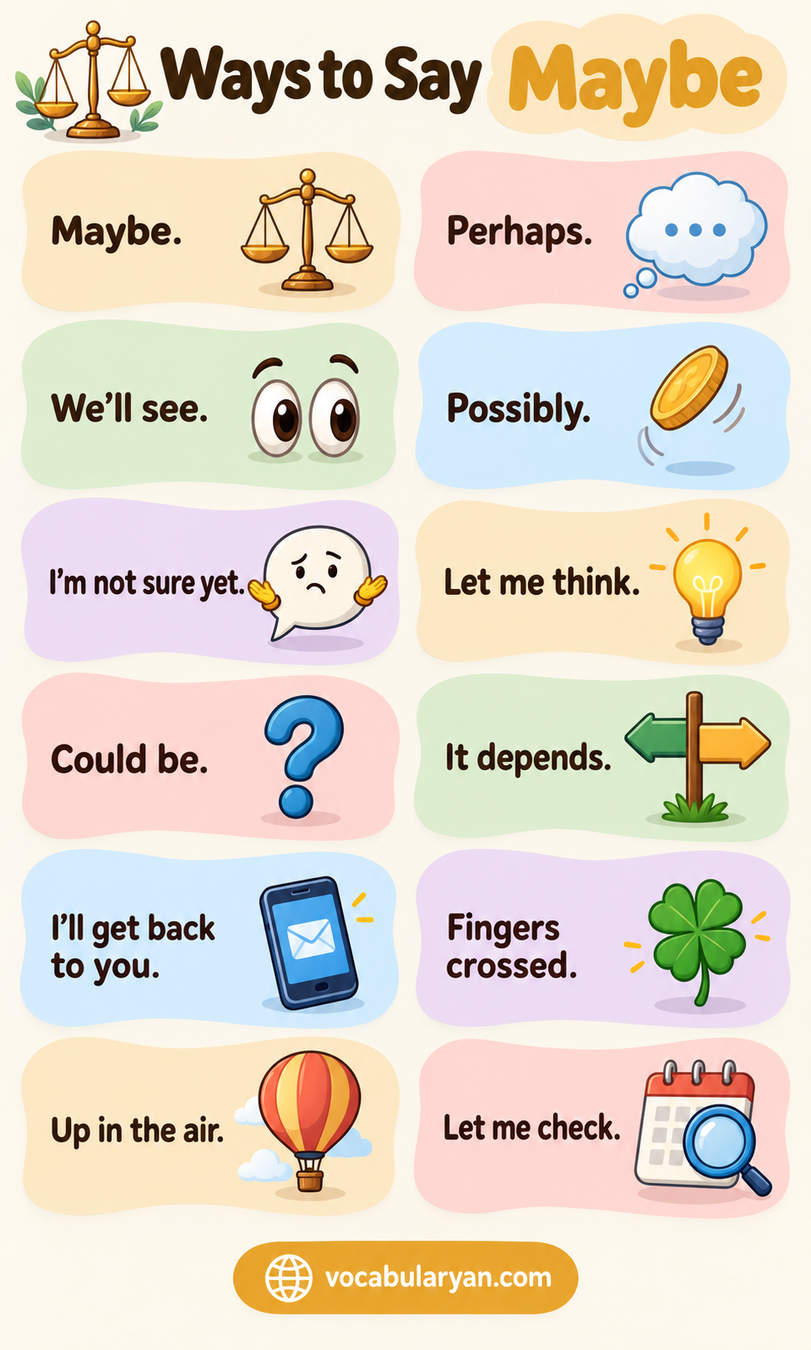
These seven answers fit almost any speaker and any listener, and each one softens a "maybe" in a slightly different way.
Maybe: the plain word, and it works with anyone. On its own it sounds short, so add a reason or a time after it.
- Maybe, if the rain stops before lunch.
- I’ll come to the gym on Saturday, maybe, but don’t wait for me.
- Maybe we should ask the landlord before we paint the wall.
Perhaps: the same meaning as "maybe", but a step more formal, and it is the natural choice in writing and in a meeting. Spoken to a close friend it sounds a little stiff.
- Perhaps we could move the meeting to Thursday afternoon.
- The delay was caused, perhaps, by the storm on the coast.
- Perhaps she has already left for the airport.
Possibly: an adverb that means "it can happen", and it goes at the start of an answer or on its own as a full reply.
- Possibly, but I need to check the train times first.
- We’re possibly moving house in the spring.
- Will the shop be open on Sunday? Possibly, it was last year.
I’m not sure: the most honest maybe, because it says that you do not know yet. It fits friends, family, and colleagues alike.
- I’m not sure whether the dentist takes new patients.
- I’m not sure, let me ask my sister and get back to you.
- Is the bridge open again? I’m not sure, the news said Friday.
It’s possible: a neutral maybe for a fact or a plan, and it says that the plan can happen without a promise.
- It’s possible the parcel went to the neighbour’s house.
- It’s possible, but the last bus leaves at ten.
- Can we finish the report by Monday? It’s possible if Tom helps.
Could be: a short casual maybe for a guess about a fact. The reply to a question about a reason is "could be" plus the guess.
- Could be the battery, the car wouldn’t start yesterday either.
- Is that Maria at the door? Could be, she said she’d drop by.
- Could be worse, at least the roof is dry.
It depends: a maybe with a condition, and the condition follows "on". It fits any level, from a friend to a manager.
- It depends on how late the meeting runs.
- Will you drive or take the train? It depends on the weather.
- It depends, some weekends I work and some I don’t.
Add a reason or a time to every "maybe", because "maybe, I’ll know by tonight" is far kinder than "maybe" alone.
Casual Ways to Say Maybe to Friends
Casual forms are for people who know you well, and each one sounds relaxed, quick, and a little undecided.
I guess: a lazy yes-or-maybe, said when you are not excited but not against the plan either.
- I guess we could try the new pizza place.
- Are you coming to the quiz? I guess, if nobody else drops out.
- I guess I’ll go, but I’m leaving early.
I guess so: a maybe that agrees with a question, and it sounds warmer than "I guess" alone.
- Is Jamie still coming? I guess so, he hasn’t said no.
- I guess so, though I’ve never tried kayaking before.
- Do we need tickets in advance? I guess so, it was busy last time.
Who knows?: a maybe that says the answer is out of your hands, and it fits weather, traffic, and other people’s plans.
- Who knows? The trains have been late all week.
- Will Dan turn up on time? Who knows, he never does.
- Who knows, we might even win this year.
Hard to say: a maybe for a question nobody can answer with confidence, and it fits a friend who asks for a prediction.
- Hard to say, the two teams are very close this season.
- Will the flat be ready by June? Hard to say, the builders keep changing the date.
- Hard to say without seeing the photos first.
Not sure yet: "I’m not sure" with "yet", and "yet" says that an answer is coming.
- Not sure yet, I’m waiting to hear about the shifts.
- Are you going to Lena’s party? Not sure yet, I’ll text you tomorrow.
- Not sure yet, but I’m leaning towards the blue one.
Maybe later: a maybe that pushes the plan to another time, and between friends it means "not right now".
- Maybe later, I’ve still got two chapters to read.
- Want to go for a run? Maybe later, it’s too hot at the moment.
- Maybe later in the week, when the kids are back at school.
Say "not sure yet" when an answer is coming, and "who knows?" when the answer is not yours to give.
Formal Ways to Say Maybe at Work
Formal forms fit a manager, a client, or a report, and they replace "maybe" with a full sentence about what is possible.
It is possible that: the standard formal maybe in a report or a meeting, and a full clause follows it.
- It is possible that the supplier will raise prices in January.
- It is possible that the error came from the old software.
- It is possible that we will need a second interview round.
There is a possibility: a slightly softer form than "it is possible that", used when the chance is real but small.
- There is a possibility of a delay on the northern route.
- There is a possibility that the client will ask for a discount.
- There is a possibility, though a small one, that the venue will cancel.
That may be the case: a polite maybe that half agrees with another person’s opinion in a meeting.
- That may be the case, but the figures say otherwise.
- That may be the case for the London office, not for ours.
- That may be the case, Mr Reyes, and I’d like to check it before we decide.
Potentially: a formal adverb for a plan or a risk that can happen, common in business and science writing.
- The merger is potentially the biggest deal of the year.
- We are potentially looking at a two-week delay.
- Potentially, yes, but the board has not approved it.
I’ll need to confirm: a work maybe that promises an answer after a check, and it sounds responsible rather than vague.
- I’ll need to confirm the dates with the events team.
- I’ll need to confirm, but I believe the room seats forty.
- Can we deliver by Friday? I’ll need to confirm with the warehouse.
That might be an option: a maybe for a suggestion, and it keeps the idea alive without agreeing to it.
- That might be an option if the budget allows.
- Moving the launch to May? That might be an option.
- That might be an option, let’s cost it out first.
"Perhaps" and "possibly" are fine in a formal answer, but a one-word answer to a client still sounds abrupt.
- Can you deliver by the fifteenth? Maybe. ❌
A one-word maybe to a client gives no time and no next step, so the full form promises an answer.
- Can you deliver by the fifteenth? I’ll need to confirm with the warehouse and get back to you by Wednesday. ✅
Five levels run from slang to very formal, and every maybe on this page is one of them.
| Level | Phrases | Who it fits |
|---|---|---|
| Slang | Meh, maybe; it’s a strong maybe; I’m 50/50 | Close friends your own age |
| Casual | I guess, who knows, we’ll see, maybe later | Friends, family, relaxed colleagues |
| Neutral | Maybe, I’m not sure, it depends, possibly | Anyone you know by name |
| Formal | Perhaps, I’ll need to confirm, that may be the case | Managers, clients, strangers, reports |
| Very formal | It is possible that, there is a possibility, conceivably | Written reports, official replies, interviews |
Write "I’ll need to confirm" or "it is possible that" for a client, and keep "maybe" for the tea break.
Ways to Say Maybe in an Email
An email maybe needs a date and a next step, because the reader cannot ask you a follow-up question at once.
Let me check and get back to you: the standard email maybe, and it promises a second email with the answer.
- Let me check and get back to you on the delivery date by the end of the day.
- Thanks for the offer, let me check and get back to you tomorrow.
- Let me check and get back to you, as the schedule is with my manager at the moment.
I will confirm by Friday: a maybe with a deadline, and it lets the reader plan. Change the day to fit.
- I am interested in the workshop and I will confirm by Friday.
- I will confirm by Friday whether the team can attend.
- I cannot say yes today, but I will confirm by Friday.
Tentatively: a formal adverb for a plan that is booked but not final, common in a meeting invitation.
- We have tentatively booked the hall for 12 June.
- I have tentatively accepted the meeting and will confirm on Monday.
- The date is tentatively set for the second week of March.
Subject to: a formal maybe with a condition, and the condition is a noun: approval, availability, the weather.
- The offer stands, subject to approval from the finance team.
- We can host the event, subject to availability of the main hall.
- Delivery is Thursday, subject to the weather on the crossing.
I’ll keep you posted: a friendly email maybe for a colleague, and it promises news when there is news.
- Nothing is decided yet, but I’ll keep you posted.
- I’ll keep you posted on the interview dates as soon as I hear.
- Thanks for asking, I’ll keep you posted over the next few days.
Give every email maybe a day, because "I will confirm by Friday" is a plan and "maybe" is a delay.
Ways to Say Maybe When Replying to an Invitation
A maybe to a host needs warmth first and the doubt second, so the host hears that you want to come.
I’d love to, but let me check: the kindest maybe to an invitation, because the wish comes before the doubt.
- I’d love to, but let me check with Sam about the babysitter.
- I’d love to, but let me check my shifts before I say yes.
- Dinner on Saturday? I’d love to, but let me check the train times.
Can I let you know?: a maybe that asks the host for time, and the reply from the host is "of course".
- Can I let you know by Wednesday? My week is still a bit unsettled.
- I’m not sure about the weekend yet, can I let you know tomorrow?
- Can I let you know closer to the day? Mum’s visiting that week.
I’ll try to make it: a maybe that promises effort, and it fits a friend’s event you want to attend.
- I’ll try to make it, but the meeting runs late on Thursdays.
- I’ll try to make it for the second half at least.
- Thanks for the invite, I’ll try to make it!
Pencil me in: a casual maybe that asks the host to write your name with a pencil, not a pen, because it can be rubbed out.
- Pencil me in for the barbecue and I’ll confirm next week.
- Pencil me in, but don’t order my ticket yet.
- Sure, pencil me in for Friday, I’ll know more by then.
Count me as a maybe: the reply to a group event, and the host adds you to the maybe list.
- Count me as a maybe, the boss hasn’t signed off my leave yet.
- Count me as a maybe for now, I’d love to come.
- Count me as a maybe, I’ll know after the doctor’s appointment.
A bare maybe to a wedding or a formal event leaves the host unable to plan.
- Thank you for the invitation to your wedding. Maybe. ❌
The reply to a formal invitation needs the wish to attend and a date for the final answer.
- Thank you for the invitation to your wedding. I’d love to be there, and I will confirm by 1 May. ✅
Put the wish first and the doubt second, so "I’d love to, but let me check" sounds close to a yes.
Ways to Say Maybe When Replying to a Request
A maybe to a request is a polite way to ask for time, and the best forms say when the real answer will come.
Let me think about it: a fair maybe for a big request, and it means you will give a real answer later.
- Let me think about it over the weekend and I’ll call you Monday.
- That’s a generous offer, let me think about it.
- Let me think about it, moving abroad is a big step.
I’ll see what I can do: a maybe that promises effort, common from a manager, a shop assistant, or a parent.
- I’ll see what I can do about the extra day off.
- The size is out of stock, but I’ll see what I can do.
- I’ll see what I can do, no promises though.
Can I get back to you?: a maybe that asks for time, and it fits a colleague, a client, or a friend.
- Can I get back to you on that after lunch?
- Can I get back to you tomorrow? I need to look at the numbers.
- That sounds interesting, can I get back to you next week?
No promises: a warning that comes before or after a maybe, and it says that the answer is not a yes.
- I’ll ask my brother about the tickets, but no promises.
- No promises, but I’ll try to finish the design by tonight.
- I can look at your essay, no promises on how much I’ll get through.
I’ll have to check: a maybe that names a check as the reason for the delay, and it fits any level.
- I’ll have to check whether the car is free that day.
- I’ll have to check with my wife before I say yes.
- Can you lend me the ladder? I’ll have to check that Dad has finished with it.
Answer a request with "can I get back to you?" plus a time, because a maybe without a time reads as a no.
Ways to Say Maybe That Mean Mostly Yes
These forms are a maybe that is close to yes, and the listener can expect good news.
Probably: the standard soft yes, and it means "more yes than no". It fits speech and writing at any level.
- Probably, I just need to finish this one job first.
- We’ll probably get there before six.
- Is the pool open in October? Probably, it was last year.
Most likely: a little stronger than "probably", and it fits plans and predictions.
- Most likely we’ll take the coast road.
- Is Ana coming? Most likely, she asked what time it starts.
- The results will most likely arrive on Thursday.
I don’t see why not: a relaxed yes with a small door left open, and it fits a friend or a colleague.
- Can I bring my cousin? I don’t see why not.
- I don’t see why not, the room is big enough for ten.
- I don’t see why not, as long as we’re back by dark.
I should be able to: a soft yes for a plan you expect to keep, and it fits work and friends alike.
- I should be able to finish the slides by Friday.
- Can you pick Leo up from school? I should be able to, my meeting ends at three.
- I should be able to come, I’ll confirm tonight.
Say "probably" or "I should be able to" when you expect to say yes, so the other person can start planning.
Ways to Say Maybe That Mean Mostly No
These forms are a maybe that is close to no, and they are kinder than a flat "no" while still saying it.
Probably not: the standard soft no, and it means "more no than yes". Add a reason to keep it friendly.
- Probably not, I’ve got an early start on Sunday.
- Will the shop have it in blue? Probably not, it’s an old model.
- Probably not this month, the car needs new tyres first.
I doubt it: a maybe that expects a no, and it fits a question about a fact or another person’s plan.
- I doubt it, the office closes at five on Fridays.
- Will Grandad come to the concert? I doubt it, he hates loud music.
- I doubt it, but you can always ask.
I wouldn’t count on it: a warning not to plan around a yes, and it fits friends and colleagues.
- I wouldn’t count on it, the boss said no last year too.
- Will the trains run in the snow? I wouldn’t count on it.
- I wouldn’t count on it, she’s been very busy lately.
I’ll think about it: a polite no in most conversations, from a parent to a child or from a buyer to a seller. Only a follow-up call turns it into a real maybe.
- I’ll think about it, but the price is more than I wanted to pay.
- Can I have a puppy? I’ll think about it.
- I’ll think about it and let you know, thanks for the offer.
"I’ll think about it" catches learners out, because it looks like a promise to decide.
- Would you like to buy the extended warranty? I’ll think about it. (learner hears "yes, later") ❌
In a shop or a sales call "I’ll think about it" is a polite no, and the seller hears it that way.
- Would you like to buy the extended warranty? No, thank you, not today. ✅
Use "probably not" with a reason for a soft no, and read "I’ll think about it" as a no unless the person calls back.
Ways to Say Maybe Over Text
Text forms are short, and the spelling and the extra letters stand in for your voice.
Idk, maybe: "I don’t know" in three letters plus "maybe", and it fits close friends only.
- Idk, maybe, what time does it start?
- Idk, maybe Saturday? I’ll check with Jo.
- Idk, maybe, my phone’s about to die, talk later.
Maybe lol: "maybe" with a laugh, and the laugh says you are not sure but you are not against it.
- Are you coming to karaoke? Maybe lol
- Maybe lol, depends how tired I am after work
- Maybe lol, I said that last time too
Mayyybe: "maybe" with extra letters, and the longer the word, the more playful the doubt.
- Mayyybe, if you’re buying the coffee
- Movie night at mine? Mayyybe 😏
- Mayyybe, ask me again after my exam
Depends: "it depends" with the first word dropped, and the condition comes in the same message.
- Depends what time, I’ve got football till seven
- Depends on the weather tbh
- Depends, who else is going?
Keep a text maybe to one or two words, and put the condition in the same message so nobody has to ask.
Ways to Say Maybe to a Group
A group maybe keeps a plan open for everyone, and it fits a chat, a team meeting, or a family dinner.
Let’s play it by ear: a maybe for a plan that will be decided on the day, and it fits friends and relaxed teams.
- Let’s play it by ear, the forecast keeps changing.
- We’ll play it by ear on Saturday and see who’s free.
- Let’s play it by ear, if the first half is boring we’ll leave.
Let’s keep our options open: a maybe that refuses to choose yet, and it fits a work team or a family trip.
- Let’s keep our options open until we hear from the hotel.
- Let’s keep our options open, Italy or Greece both look good.
- Let’s keep our options open on the venue for now.
We’ll see how it goes: a maybe about a plan that has already started, and the group decides as it happens.
- Let’s start with one class a week and we’ll see how it goes.
- We’ll see how it goes, if the sales pick up we’ll hire again.
- We’ll see how it goes with the new babysitter.
We’ll decide on the day: a maybe that names the day as the moment of decision, and it fits any group.
- We’ll decide on the day whether to walk or drive.
- Beach or museum? We’ll decide on the day, it depends on the sky.
- We’ll decide on the day, no need to book anything.
Write "let’s play it by ear" for friends and "let’s keep our options open" for a team, and name the day of the decision.
Regional Ways to Say Maybe in English
English-speaking countries each keep a few maybes of their own, and using one in the right country sounds natural.
British Ways to Say Maybe
Might do: the British short answer to a "will you" question, with "do" standing in for the verb. It sounds relaxed and undecided.
- Are you going to the match? Might do, if I can get a ticket.
- Might do, I’ll see how I feel after work.
- Will you paint the fence this weekend? Might do, if it stays dry.
Could do: a British maybe that agrees a plan is possible without promising it, and it fits friends and family.
- Could do, but the pub will be packed on a Friday.
- Shall we walk instead? Could do, it’s only twenty minutes.
- Could do, though I’d rather leave it till Sunday.
We’ll have to see: a British parent’s maybe, and every child knows it means "probably not, but I won’t say so".
- Can we get ice cream after? We’ll have to see how you behave at the dentist.
- We’ll have to see, the weather’s not looking great.
- We’ll have to see what your dad says.
American Ways to Say Maybe
Yeah, maybe: the everyday American maybe, and the "yeah" softens it without turning it into a yes.
- Yeah, maybe, let me see how the week goes.
- Want to grab lunch later? Yeah, maybe, I’ve got a call at noon.
- Yeah, maybe next time, I’m wiped out tonight.
It’s up in the air: an American maybe for a plan with no decision yet, and it fits work and friends.
- The move is still up in the air, we’re waiting on the loan.
- Is the trip happening? It’s up in the air, half the group can’t get time off.
- The launch date is up in the air until the tests come back.
Australian and Irish Ways to Say Maybe
Yeah, nah, maybe: the Australian answer that goes yes, no, and maybe in three words, and it means "I’m really not sure".
- Coming to the beach? Yeah, nah, maybe, I’ve got work in the arvo.
- Yeah, nah, maybe, ask me after lunch.
- Yeah, nah, maybe, depends if my mate needs the car.
I’ll see how I go: the Australian "I’ll see how I feel", used about energy, money, or time.
- I’ll see how I go, it’s been a long week.
- Are you doing the fun run? I’ll see how I go with the knee.
- I’ll see how I go, might be too tired by then.
Sure, we’ll see: the Irish maybe, with "sure" as a soft opener rather than a yes.
- Sure, we’ll see, the weather might turn.
- Are you going to the wedding? Sure, we’ll see, it’s a long way to Galway.
- Sure, we’ll see what happens, no point planning too far ahead.
Say "might do" in Britain, "yeah, maybe" in America, "yeah, nah, maybe" in Australia, and "sure, we’ll see" in Ireland.
Slang Ways to Say Maybe
Slang forms belong to close friends your own age, and each one puts a number or a mood on the doubt.
It’s a strong maybe: a joke on the weakness of "maybe", and it means "closer to yes than you’d think".
- Will you come to the reunion? It’s a strong maybe.
- It’s a strong maybe, I’ve already looked at the flights.
- It’s a strong maybe, ask me again on payday.
I’m 50/50: a maybe with a number, said "fifty fifty", and it means the yes and the no are equal.
- I’m 50/50 on the camping trip, the tent leaks.
- Are you taking the job? I’m 50/50, the money’s good but the commute is awful.
- I’m 50/50, talk me into it.
Iffy: an adjective for a plan or a chance that is not certain, and it fits speech and texts between friends.
- Saturday’s a bit iffy, my parents might visit.
- The weather looks iffy for the picnic.
- Whether he turns up is iffy at best.
Meh, maybe: "meh" is a sound of no interest, so "meh, maybe" is a maybe with a shrug.
- Bowling again? Meh, maybe.
- Meh, maybe, I’m not that bothered either way.
- Meh, maybe if there’s nothing better on.
Keep "I’m 50/50" and "meh, maybe" for friends, and never send either one to a client.
Funny Ways to Say Maybe
Funny forms are for people who laugh with you, and each one makes a joke of not deciding.
Ask me again later: the answer from a toy fortune ball, said to a friend who wants a decision you refuse to give.
- Will you help me move on Sunday? Ask me again later.
- Ask me again later, after I’ve had a coffee.
- Ask me again later, my brain has closed for the day.
Maybe, maybe not: a maybe that says no to both answers, and it is said with a grin.
- Are you coming to the party? Maybe, maybe not, you’ll have to wait and see.
- Maybe, maybe not, I like to keep you guessing.
- Did you eat the last biscuit? Maybe, maybe not.
In another life: a joke maybe that means no, because the yes belongs to a different version of you.
- Fancy running a marathon with me? In another life.
- In another life I’d say yes, in this one I have three kids and a mortgage.
- Would you move to a farm? In another life, maybe.
Let me check with my sofa: a joke maybe for an evening invitation, because the sofa always says stay home.
- Drinks tonight? Let me check with my sofa first.
- Let me check with my sofa, it has strong opinions on Tuesdays.
- Let me check with my sofa and get back to you, it’s a close vote.
Save the funny maybes for a friend who will laugh, because a joke answer to a real invitation from a colleague reads as a refusal.
How Do You Turn a Maybe Into a Decision?
A maybe from another person needs a gentle push, and each of these lines asks for a yes or a no without pressure.
Let me know by Friday: a deadline for the decision, and it fits friends, colleagues, and hosts.
- No pressure, but let me know by Friday so I can book the table.
- Let me know by Friday, the tickets go up in price after that.
- Think it over and let me know by Friday.
Is that a yes or a no?: a direct request for an answer, said with a smile to a friend who has said "maybe" three times.
- You keep saying maybe, is that a yes or a no?
- Is that a yes or a no? I need to tell the driver.
- Come on, is that a yes or a no?
Shall I put you down as a maybe?: a host’s question, and it turns a vague answer into a place on the list.
- Shall I put you down as a maybe for the dinner on the twelfth?
- No problem if you’re not sure, shall I put you down as a maybe?
- Shall I put you down as a maybe and check again next week?
What would make it a yes?: a question that asks for the condition behind the maybe, and it fits work and friends.
- You said maybe, what would make it a yes?
- What would make it a yes? Is it the date or the cost?
- What would make it a yes for you? We can change the plan.
Give the other person a day, then ask "is that a yes or a no?", because a maybe left alone turns into a no.
More Everyday English Phrases
FAQs
The three replacements that fit almost every moment are "I’m not sure", "it depends", and "let me check and get back to you". "Perhaps" and "possibly" are the formal single words, "we’ll see" and "I guess" are the casual ones, and "probably" or "probably not" tell the listener which way you lean. Pick the one that matches the person and add a reason or a time.
"Perhaps" is the formal single word, and "it is possible that", "there is a possibility", and "I’ll need to confirm" are the formal full sentences. In a report, "potentially" and "tentatively" fit a plan that is not final. Each of these is more polite than "maybe" because it explains what is not yet known.
Put the wish before the doubt: "I’d love to, but let me check" sounds kind, while "maybe" alone sounds cold. To a request, "I’ll see what I can do" and "can I get back to you?" both sound warm, because they promise effort or an answer. The nicest maybe always names when the real answer will come.
"It’s a strong maybe", "I’m 50/50", "meh, maybe", and "iffy" are the slang forms, and in texts "idk, maybe" and "maybe lol" are the most common. All of them belong to friends your own age. With a manager or a stranger, "I’m not sure" is the safe choice.
"Let me check and get back to you" is the best work answer, because it promises a reply. "I’ll need to confirm", "that might be an option", and "I will confirm by Friday" also fit, and each one gives a next step or a date. A bare "maybe" to a client or a manager sounds as if you have not thought about the question.
"Maybe" is one word when it means "perhaps", as in "maybe she’s late". "May be" is two words when it is the verb "may" plus "be", as in "she may be late". The test is to replace the word with "perhaps", and if the sentence still works, write one word.
No, because "maybe" is a spoken word and it sounds casual on the page. In an essay, write "perhaps", "possibly", or "it is possible that", and in a science report write "potentially" or "there is a possibility that". Each one says the same thing at a written level.
Name the reason or the time instead of the doubt: "it depends on the weather", "I’ll know by Friday", "let me check with Sam". A soft yes is "probably" or "I should be able to", and a soft no is "I doubt it" or "probably not". The word "maybe" disappears and the listener learns more.