
"I hope so" answers a yes-or-no question about something that has not happened yet, and it says you want the answer to be yes. The ways to say I hope so in English change with two facts: how sure you are, and who asked the question. "Fingers crossed" is for a friend, "I trust it will" is for a client, and the everyday replies come first.
Common Ways to Say I Hope So in Everyday English
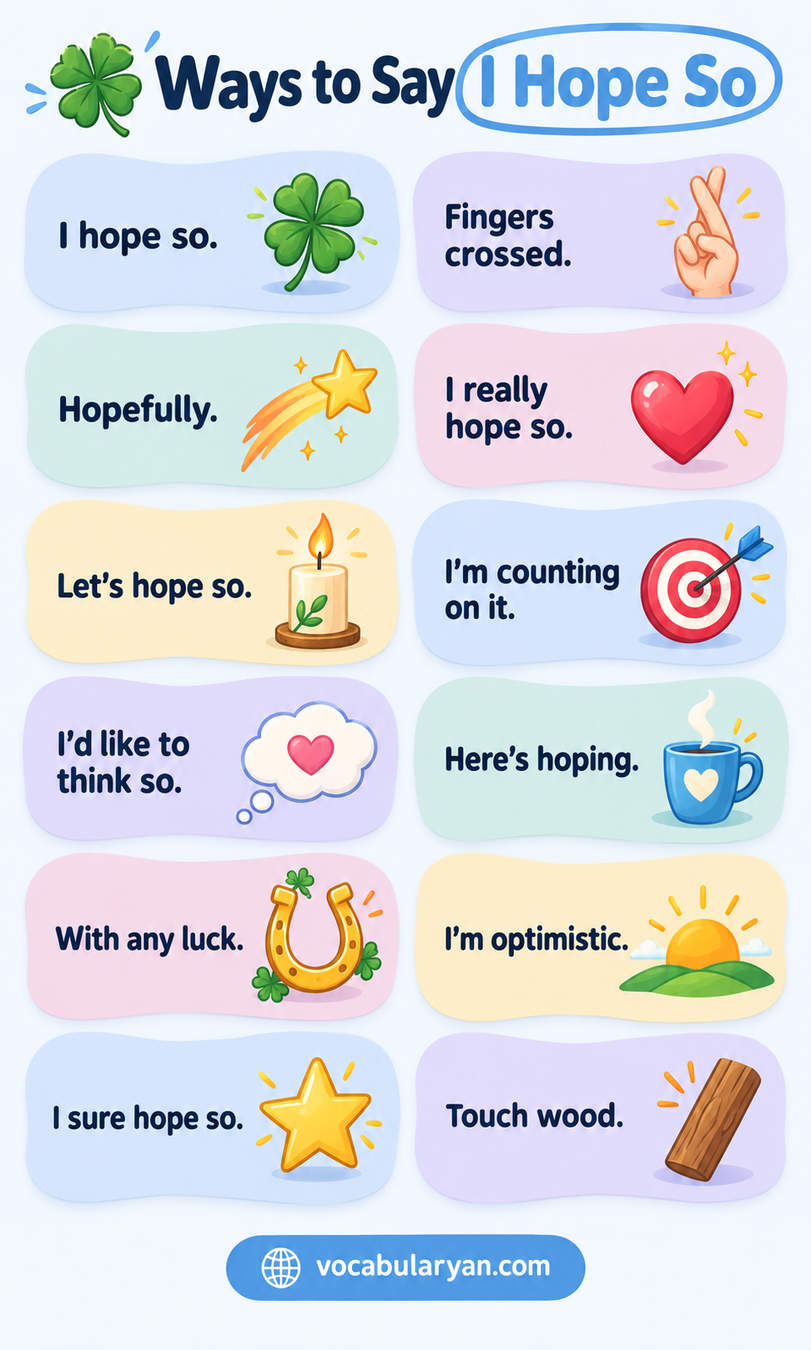
These six replies fit a neighbour, a colleague, or a friend, and each one says yes is the answer you want.
I really hope so: the plain reply with one word of feeling added, and it fits anyone at any level. "Really" says the result is one you care about.
- Will the doctor have the results today? I really hope so, I’ve been waiting all week.
- I really hope so, because the tickets cost a fortune.
- Is your brother coming for Christmas? I really hope so, we haven’t seen him since March.
I certainly hope so: a firmer form, and it says that no other answer would be acceptable. It fits work and family alike.
- Will the boiler be fixed before the weekend? I certainly hope so, the house is freezing.
- I certainly hope so, we’ve paid for the full course.
- Is the manager going to apologise? I certainly hope so, after what she said.
Let’s hope so: a reply that puts you and the asker on the same side, because "let’s" means both of you. The level is neutral, so it fits a colleague as well as a friend.
- Will the trains run on Monday? Let’s hope so, or I’m walking to work.
- Let’s hope so, Grandad, the garden needs the rain.
- Is this the last form we have to fill in? Let’s hope so.
Hopefully: a one-word reply that means "I hope so", and it is the most common of the short forms. It works in speech, in a text, and in a message to a colleague.
- Are they going to accept the offer? Hopefully, we’ll know by Thursday.
- Hopefully, yes, the mechanic said it was a small job.
- Will you be home before the kids go to bed? Hopefully, the meeting should end at six.
I hope that’s true: the reply when someone tells you good news you cannot check yet. It answers a statement as well as a question.
- They say the new road will cut the journey in half. I hope that’s true, I spend an hour in traffic every day.
- I hope that’s true, because the last three forecasts were wrong.
- Amir thinks the flat is still available. I hope that’s true, it’s the only one we can afford.
That’s what I’m hoping for: a longer reply, and it fits a question about a result you have worked towards.
- Do you think you’ll get the promotion this year? That’s what I’m hoping for.
- That’s what I’m hoping for, a full house on opening night.
- Will the seeds come up before June? That’s what I’m hoping for, I planted them early.
Say "hopefully" when you want one word, and "let’s hope so" when you want the other person on your side.
Casual Ways to Say I Hope So to Friends
Casual replies drop the "I", add a gesture or a picture, and sound relaxed between people who know each other well.
Hope so: "I hope so" without the "I", and it is the standard spoken form between friends and family. In a message it fits with an exclamation mark.
- Is Dan bringing his guitar tonight? Hope so, or it’ll be a quiet party.
- Hope so, mate, I’ve got nothing else planned.
- Will the café still be open? Hope so, I need a coffee.
Fingers crossed: a reply that names the gesture for luck, and it fits a friend, a family member, or a relaxed colleague. It goes with a question about a result you cannot control.
- Are you going to pass your driving test tomorrow? Fingers crossed!
- Fingers crossed, the landlord said he’d call today.
- Will the parcel arrive before Friday? Fingers crossed, the tracking says it’s on its way.
Here’s hoping: a cheerful reply, and it fits a friend at the start of something new. It sounds like a small toast.
- Do you think the new coach will change anything? Here’s hoping.
- Here’s hoping, this is the third flat we’ve looked at.
- Will the weather hold for the barbecue? Here’s hoping, I’ve bought forty sausages.
That’s the hope: a short reply for a plan that is not fixed yet, and it fits friends and family in speech.
- So you’ll both be in London by the summer? That’s the hope.
- That’s the hope, if the bank agrees to the loan.
- Are you going to run the whole race this time? That’s the hope, my knee feels fine.
Hoping for the best: a reply for a result that is out of your hands now, and it sounds calm rather than worried.
- Did the interview go well? Hoping for the best, they said they’d call by Friday.
- Hoping for the best, the vet is looking at her now.
- Will the car pass its inspection? Hoping for the best, it’s been making a strange noise.
Drop the "I" with friends, and say "fingers crossed" when the result is out of your hands.
Formal Ways to Say I Hope So at Work
Formal replies to a client, a manager, or a customer swap "hope" for "trust", "expect", or "confident", because at work a plain hope sounds weak.
I trust it will: a polite reply that says you expect yes, and it fits a client or a senior colleague in a meeting or an email.
- Will the delivery reach us before the launch? I trust it will, the supplier confirmed the date this morning.
- I trust it will, Ms Okonkwo, the team has reviewed every figure.
- Is the contract going to be signed this week? I trust it will.
I expect so: a calm reply that says yes is the answer you expect, and it fits a manager who wants a straight answer rather than a feeling.
- Will the audit be finished by the end of the month? I expect so, we’re already on the final section.
- I expect so, the board has approved the budget.
- Are the new laptops arriving on Tuesday? I expect so, the order was placed two weeks ago.
We are hopeful that it will: the formal form of "I hope so" for a company reply, and it fits a customer, a partner, or a press question.
- Will the store reopen before the holidays? We are hopeful that it will, the repairs are almost complete.
- We are hopeful that it will, and we’ll update every customer by email.
- Is the merger going ahead in the spring? We are hopeful that it will.
I’m optimistic about that: a reply that names your confidence without promising, and it fits a project meeting or an interview.
- Do you think the team can deliver by March? I’m optimistic about that, we’ve hit every deadline so far.
- I’m optimistic about that, sales have grown for three quarters.
- Will the new hire settle in quickly? I’m optimistic about that, she’s already asking the right questions.
I believe that will be the case: the most formal reply on the page, and it fits a legal, financial, or official conversation.
- Will the funding cover the whole year? I believe that will be the case, based on the current figures.
- I believe that will be the case, though the final decision rests with the committee.
- Is the policy going to apply to part-time staff too? I believe that will be the case.
That is our expectation: a company reply for a client or a journalist, and it says yes is the plan without giving a promise.
- Will the software update be free for existing users? That is our expectation.
- That is our expectation, and we will confirm the date in writing.
- Are you going to keep the office in Leeds? That is our expectation for the coming year.
"Fingers crossed" catches out learners at work, because it sounds relaxed to a client who wants to hear a plan.
- Will the order be ready by Friday? Fingers crossed! (to a client) ❌
A client hears "fingers crossed" as luck rather than work, so the formal reply names what you expect and why.
- Will the order be ready by Friday? I trust it will, the parts arrived this morning. ✅
A hopeful reply is spoken at one of five levels, and the table sorts them.
| Level | Replies (7) | Who it fits (11) |
|---|---|---|
| Slang | God I hope so, manifesting, praying on it (41) | Close friends your own age (26) |
| Casual | Hope so, fingers crossed, here’s hoping (39) | Friends, family, relaxed colleagues (35) |
| Neutral | Hopefully, let’s hope so, I really hope so (42) | Anyone you know by name (23) |
| Formal | I trust it will, I expect so, I’m optimistic about that (55) | Managers, clients, customers (28) |
| Very formal | I believe that will be the case, we are hopeful that it will (60) | Boards, official letters, press questions (41) |
Use "I trust it will" or "I expect so" with a client, and keep "fingers crossed" for the people you eat lunch with.
Ways to Say I Hope So in an Email
An email reply needs a full sentence, because "hope so" alone looks abrupt on a screen and gives the reader nothing to act on.
I hope that will be the case: the standard written form, and it fits a colleague or a client you already know. It answers a question from the previous email.
- You asked whether the venue can hold 200 guests. I hope that will be the case, and I’ll confirm with the manager today.
- I hope that will be the case, though the printer has not sent a final date yet.
- I hope that will be the case for the second shipment as well.
I very much hope so: a warm written reply for a colleague or a contact you like, and "very much" adds feeling without losing politeness.
- Will you be at the conference in Lisbon? I very much hope so, and I’d love to catch up.
- I very much hope so, the last workshop was the best of the year.
- I very much hope so, and I’ll let you know as soon as my travel is approved.
I look forward to a positive outcome: a formal closing line for a client or an application, and it says you hope for yes without asking again.
- Thank you for considering my application, and I look forward to a positive outcome.
- I look forward to a positive outcome and to working with your team.
- We have sent all the documents you requested, and I look forward to a positive outcome.
I am hopeful that we can: a written reply for a plan that needs the reader’s agreement, and it fits a partner, a supplier, or a landlord.
- I am hopeful that we can agree the new dates by the end of the week.
- I am hopeful that we can keep the same price for a second year.
- I am hopeful that we can find a slot that suits both teams.
We remain optimistic: a company line for an update email, and it fits a delay, a bid, or a project that is still open.
- We remain optimistic that the site will open in September as planned.
- Despite the weather, we remain optimistic about the harvest.
- We remain optimistic, and we will share the next update on Monday.
Write "I hope that will be the case" to a colleague, and "we remain optimistic" when the reply speaks for a company.
Ways to Say I Hope So When You Feel Confident
These replies say you expect yes as well as want it, and each one fits a result you have worked for or have evidence for.
I’m counting on it: a reply that says you need the result and expect it, and it fits a plan that other people depend on.
- Will the money be in the account by the first? I’m counting on it, the rent is due that day.
- I’m counting on it, I’ve already told the kids we’re going.
- Is Sam going to drive us to the airport? I’m counting on it, he promised twice.
I’m sure it will: a reply that leaves almost no doubt, and it fits a friend who needs reassurance.
- Will the cake rise this time? I’m sure it will, you followed the recipe exactly.
- I’m sure it will, the shop said the part was in stock.
- Do you think the play will sell out? I’m sure it will, the reviews were wonderful.
I have a good feeling about it: a reply that names a feeling rather than a fact, and it fits a friend or a relaxed colleague before a result comes in.
- Do you think you got the job? I have a good feeling about it, the interview lasted an hour.
- I have a good feeling about it, the buyer asked to see the garden twice.
- Will the team win on Saturday? I have a good feeling about it.
It looks promising: a reply about the evidence, and it fits a project, a test, or a search that is going well so far.
- Is the new treatment working? It looks promising, the swelling has gone down.
- It looks promising, three of the five investors said yes.
- Any luck with the flat search? It looks promising, we see two more tomorrow.
It’s looking good: the casual form of "it looks promising", and it fits friends and family talking about a plan in progress.
- Will the extension be finished by Easter? It’s looking good, the roof went on yesterday.
- It’s looking good, the doctor was pleased with the scan.
- Are the tomatoes going to ripen this year? It’s looking good, they’re already turning red.
Say "I’m counting on it" when other people depend on the result, and "it looks promising" when the evidence is on your side.
Ways to Say I Hope So When You Feel Unsure
These replies say you want yes but do not expect it, and each one leaves room for a no.
I’d like to think so: a soft reply that says yes is the answer you want, and it fits a question about a person’s behaviour or a fair result.
- Will they give you your deposit back? I’d like to think so, the flat was spotless.
- I’d like to think so, but the last owner never returned a single call.
- Do you think the council will listen this time? I’d like to think so.
We’ll see: a reply that gives no answer at all, and it fits a question you do not want to promise on. On its own it sounds cool, so it goes with "but I hope so".
- Are you going to the reunion? We’ll see, but I hope so.
- We’ll see, the doctor wants one more test first.
- Will the shop stay open after Christmas? We’ll see, it depends on December.
I’m not sure, but I hope so: an honest reply for a friend or a colleague, and it fits a result you have no control over.
- Is the flight still on time? I’m not sure, but I hope so, the board hasn’t changed.
- I’m not sure, but I hope so, she hasn’t replied to my message yet.
- Will there be enough chairs for everyone? I’m not sure, but I hope so.
There’s a chance: a reply that puts the odds low, and it fits a result that would be a pleasant surprise.
- Do you think the shop still has the blue one? There’s a chance, they had two last week.
- There’s a chance, the coach said he’d look at the tape again.
- Will we get tickets for the final? There’s a chance, if the extra seats go on sale.
That would be nice: a reply that names the result as pleasant without saying you expect it, and it fits friends, family, and small hopes.
- Do you think the neighbours will invite us again? That would be nice.
- That would be nice, the last holiday together was eight years ago.
- Will the new manager give you the Friday off? That would be nice, I haven’t asked her yet.
"I think so" looks like a softer "I hope so", and it means something different.
- Will your sister get the job she wants? I think so, she’d be so happy. (you want it, you have no evidence) ❌
"I think so" says the answer is "probably" yes in your judgement, so when you have a wish and no evidence the reply is "I hope so". A page on ways to say I think so covers that reply on its own.
- Will your sister get the job she wants? I hope so, she’d be so happy. ✅
Use "I’d like to think so" for a fair result you cannot promise, and add "but I hope so" after "we’ll see" so it does not sound cold.
Ways to Say I Hope So About Someone Else’s News
When the question is about another person’s result, the reply names that person, and it sounds like support rather than a private wish.
I hope so, for your sake: a reply that puts the other person first, and it fits a friend or a colleague whose result counts more for them than for you.
- Do you think the landlord will let me keep the cat? I hope so, for your sake, you’d hate to move again.
- I hope so, for your sake, that commute is killing you.
- Will the bank approve my loan? I hope so, for your sake, you’ve worked so hard on the plan.
I hope it works out for you: a warm reply for a plan that is still open, and it fits a friend leaving a job, a city, or a relationship.
- I’ve applied for the transfer to Madrid. I hope it works out for you, you’ve wanted that for years.
- I hope it works out for you, and call me the moment you hear.
- We’re trying to buy the house next door. I hope it works out for you, it would be perfect for the twins.
I’m rooting for you: a reply that says you are on the person’s side, and it fits a friend before a test, a match, or an interview. It is American in origin and common everywhere now.
- I find out about the scholarship on Friday. I’m rooting for you, Ana.
- I’m rooting for you, and so is the whole office.
- My audition is at ten. I’m rooting for you, break a leg.
I really hope you get it: a reply for a job, a place, a house, or a prize that someone has asked for, and it names the wish plainly.
- I’ve put in for the deputy head role. I really hope you get it, the school would be lucky.
- I really hope you get it, nobody deserves that flat more than you.
- Do you think I have a chance at the grant? I really hope you get it, your proposal was brilliant.
Let’s hope it goes your way: a reply for a decision that someone else will make, and it fits a colleague waiting for a verdict, a vote, or a review.
- The panel meets on Tuesday. Let’s hope it goes your way.
- Let’s hope it goes your way, you’ve answered every question they had.
- The neighbours are voting on the fence tonight. Let’s hope it goes your way, Marco.
Name the person in the reply, because "I hope so" on its own can sound as if the result counts only for you.
Ways to Say I Hope So About Your Own Plans
When the question is about your own plan, the reply says what you intend as well as what you hope, and it fits speech and messages.
That’s the plan: a reply that says yes is the intention, and it fits a friend or a colleague asking about a date or a goal.
- Are you still moving in September? That’s the plan, if the sale goes through.
- That’s the plan, I’ve booked the van already.
- Will you finish the course this year? That’s the plan, I have two modules left.
If all goes well: a reply that says yes with one condition, and it fits a plan that depends on weather, money, or other people.
- Will the roof be done before winter? If all goes well, the builder starts on Monday.
- If all goes well, we’ll open the café in May.
- Are you going to be back for the wedding? If all goes well, my visa should come through next week.
With any luck: a reply that names luck as the missing piece, and it fits friends and family talking about travel, tickets, or the weather.
- Will you catch the early train? With any luck, if the taxi turns up on time.
- With any luck, the shop will still have my size.
- Are you going to see the northern lights? With any luck, the sky is meant to be clear on Thursday.
That’s the idea: a reply that says yes is the aim, and it fits a plan that is still being worked out.
- So you’ll work from home three days a week? That’s the idea, once the new contract is signed.
- That’s the idea, we’ll see how the first month goes.
- Are you going to sell the old car and keep the bike? That’s the idea.
I’m hoping to: a reply that answers a question about your own action, and it fits a friend, a teacher, or a colleague.
- Are you going to apply for the course? I’m hoping to, the deadline is next Friday.
- I’m hoping to, if the boss agrees to the time off.
- Will you visit your grandmother this summer? I’m hoping to, I haven’t seen her since the spring.
"I hope so" sounds weak when the plan is yours and someone is depending on you.
- Will the report be on my desk by nine? I hope so. (to your manager) ❌
A manager hears "I hope so" as "maybe", so the reply for your own work names the plan and any condition.
- Will the report be on my desk by nine? That’s the plan, I’m on the final section now. ✅
Say "that’s the plan" for a goal you control, and "if all goes well" when one condition remains between you and yes.
Ways to Say I Hope So in a Text
Text replies are two or three words, and punctuation and repeated letters replace the sound of your voice.
Hope so!: the standard text reply between friends, and the exclamation mark makes it warm rather than flat.
- Are we still on for Saturday? Hope so! I’ve cleared the whole day.
- Hope so! The bus is due in five.
- Will the pub have the match on? Hope so! Otherwise we’ll go to Jack’s.
Hope so too: the reply when the other person has already said "I hope so", and it fits a partner, a friend, or a sibling.
- I hope the storm misses us. Hope so too, the tent isn’t great in the wind.
- Hope so too, I can’t do another week of this.
- Hope she says yes! Hope so too, I’ll let you know tonight.
Praying: a one-word text reply that means "I’m hoping hard", and it fits close friends. It is not always about religion.
- Do you think the exam results are good? Praying.
- Praying, the letter comes tomorrow.
- Will the car start in this cold? Praying, I have to be at work by seven.
Pls yes: text slang for "please let the answer be yes", and it fits friends your own age in a group chat.
- Is the concert still on tonight? Pls yes, I’ve been waiting all year.
- Pls yes, I need this week to be over.
- Did the shop get the trainers back in? Pls yes, size nine.
Crossing everything: "fingers crossed" in a stronger form, and it fits a friend waiting for a big result.
- I hear about the visa on Monday. Crossing everything for you.
- Crossing everything, the scan is at two.
- Do you think they’ll pick our design? Crossing everything!
Keep a text reply short, and let "hope so!" or "crossing everything" match how much you want the result.
Ways to Say I Hope So to a Group
A group reply speaks for everyone in the room, so "I" becomes "we" or "let’s", and the level matches the meeting or the chat.
We’re all hoping so: a reply that answers for a team, a class, or a family, and it fits a question from an outsider.
- Will the school trip go ahead after all? We’re all hoping so, the kids have talked of nothing else.
- We’re all hoping so, the team has put six months into this launch.
- Are you going to get the funding for another year? We’re all hoping so.
Let’s all hope so: a reply that asks the whole group to want the same result, and it fits a meeting or a group chat.
- Will the new schedule mean fewer weekend shifts? Let’s all hope so.
- Let’s all hope so, nobody wants another winter in that office.
- Do you think the festival will come back next year? Let’s all hope so, it was the best weekend of the summer.
We’re counting on it: the group form of "I’m counting on it", and it fits a team that has planned around a result.
- Will the venue be ready for the wedding on the twelfth? We’re counting on it, the invitations went out in May.
- We’re counting on it, the whole tour depends on that first show.
- Is the bridge going to reopen before the school term? We’re counting on it.
Fingers crossed, everyone: the casual group reply for friends, family, or a relaxed team waiting on the same news.
- The results go up at noon. Fingers crossed, everyone.
- Fingers crossed, everyone, the judges are coming back in.
- Will the rain stop for the parade? Fingers crossed, everyone, the floats are already lined up.
Write "we’re all hoping so" for a team and "fingers crossed, everyone" for friends, and let "we" replace "I" whenever the hope is shared.
Regional Ways to Say I Hope So in English
Each English-speaking country adds a reply of its own, and the right one in the right place sounds natural at once.
British Ways to Say I Hope So
Touch wood: a British reply for a hope about bad luck staying away, said while touching a wooden table or door. It answers a question about health, weather, or a machine that has been fine so far.
- Will the car get you to Scotland? Touch wood, it hasn’t let me down yet.
- Touch wood, nobody in the house has had the flu this year.
- Is the boiler going to last another winter? Touch wood.
I should hope so: a British reply that says yes is the only acceptable answer, and it fits a question about a duty someone owes you. It can sound sharp, so keep it for people who know you.
- Will they refund the full amount? I should hope so, the shoes fell apart in a week.
- I should hope so, after we waited two hours for a table.
- Is the plumber coming back to fix the leak? I should hope so, we’ve paid him already.
American Ways to Say I Hope So
Knock on wood: the American form of "touch wood", said while knocking on a table, and it fits a hope that good luck continues.
- Will the flight leave on time? Knock on wood, the app says no delays.
- Knock on wood, the baby has slept through three nights in a row.
- Is the old truck going to pass inspection? Knock on wood.
I sure hope so: the American form of "I certainly hope so", and it fits friends, family, and neighbours in everyday speech.
- Are the Cubs going to win tonight? I sure hope so, I bought tickets for the whole family.
- I sure hope so, this heat has to break at some point.
- Will the diner be open on the holiday? I sure hope so, Dad wants pancakes.
Australian and Irish Ways to Say I Hope So
Hope so, mate: the Australian form of "hope so", and it fits friends, neighbours, and the person next to you at the bus stop.
- Will the surf be up this weekend? Hope so, mate, I’ve got Saturday off.
- Hope so, mate, the fire ban lifts on Friday.
- Is the footy on at the pub tonight? Hope so, mate.
She’ll be right: an Australian reply that says the result will be fine, and it is more confident than "I hope so". It fits any small worry between friends.
- Will the ute make it up that track? She’ll be right, it’s done worse.
- She’ll be right, the storm will pass before the barbecue.
- Do you think the tent will hold in this wind? She’ll be right, mate.
Please God: an Irish reply that means "I hope so", and it is common in everyday speech whether or not the speaker is religious.
- Will the weather hold for the wedding? Please God, the tent is only small.
- Please God, the results will be in by Friday.
- Is your father home from hospital soon? Please God, the doctor said next week.
I’d hope so: an Irish and British reply with "would", and it fits a question about a fair or expected result. It sounds softer than "I should hope so".
- Will the council fix the road before winter? I’d hope so, they’ve had the money since May.
- I’d hope so, we’ve been on the waiting list for a year.
- Is the bus going to turn up this time? I’d hope so, Niamh, we’ve been here twenty minutes.
Say "touch wood" in Britain, "knock on wood" in the United States, "she’ll be right" in Australia, and "please God" in Ireland, and use "hopefully" everywhere else.
Slang Ways to Say I Hope So
Slang replies are for close friends your own age, and each one adds feeling to a plain "hope so".
God, I hope so: a strong casual reply, and it fits a friend when you want the result badly. It is not about religion, and it sounds too strong for a manager.
- Do you think the exam is going to be easier this year? God, I hope so, I failed the last one.
- God, I hope so, I can’t afford another repair.
- Will the heating be back on tonight? God, I hope so, the flat is like a fridge.
Manifesting: a one-word reply from social media that means "I’m hoping so hard it might come true", and it fits a group chat between young friends.
- Are we getting tickets for the tour? Manifesting.
- Manifesting, the shop said they’d restock on Friday.
- Do you think he’ll text back tonight? Manifesting for you.
Praying on it: a casual reply that means "hoping hard", common in American speech among younger speakers.
- Are you going to get the apartment? Praying on it, I hear back Monday.
- Praying on it, the game needs to go our way.
- Will your mom let you go to the festival? Praying on it.
Keep "manifesting" and "praying on it" for friends your own age, and use "hopefully" with everyone else.
Funny Ways to Say I Hope So
Funny replies are for friends who know your humour, and each one makes the hope bigger than the question needs.
From your lips to God’s ears: an old joke reply that means "I hope what you just said comes true", and it fits a friend or a relative who has just made a hopeful prediction.
- I bet you’ll get the job by Friday. From your lips to God’s ears.
- From your lips to God’s ears, Auntie, I could use the money.
- This is the year the team wins something. From your lips to God’s ears.
I’m crossing everything I’ve got: "fingers crossed" taken to the extreme, and it fits a friend waiting for a result with you.
- Will the van start in the morning? I’m crossing everything I’ve got.
- I’m crossing everything I’ve got, and so should you.
- Do you think the landlord will say yes to the party? I’m crossing everything I’ve got, including my eyes.
If there’s any justice in the world: a mock-serious reply for a result that someone deserves, and it fits friends and family.
- Will Raj finally get promoted this year? If there’s any justice in the world.
- If there’s any justice in the world, that café will win the award.
- Do you think the referee will get sacked? If there’s any justice in the world, yes.
Hope springs eternal: an old line of poetry used as a joke reply, and it fits a hope that has failed before.
- Do you think the printer will work today? Hope springs eternal.
- Hope springs eternal, this is the fourth diet since January.
- Will your brother turn up on time for once? Hope springs eternal.
Save the funny replies for people who will laugh, because a joke about hope sounds like a shrug to a stranger.
How Do You Reply When Someone Says I Hope So?
"I hope so" is not a question, so the reply agrees with the hope, adds a reason to believe, or gently lowers the expectation.
Me too or so do I: the standard reply when you want the same result, and it fits every level.
- I hope the rain stops before the picnic. Me too, I’ve made three salads.
- I hope so. So do I, we’ve waited long enough.
- Hopefully! Same here, I’ll bring the umbrella just in case.
I’m sure it will: the reply that gives reassurance, and it fits a friend or a colleague who sounds worried.
- I hope the interview goes well. I’m sure it will, you know the company inside out.
- I hope so. I’m sure it will, the doctor sounded confident.
- Fingers crossed the flight isn’t delayed. I’m sure it will be fine, the weather is perfect.
Let’s see: the reply that keeps the door open without promising, and it fits a colleague or a family member when the result is uncertain.
- I hope we win the contract. Let’s see, we did everything we could.
- I hope so. Let’s see what the letter says.
- Hopefully the car passes. Let’s see, the mechanic is looking at it now.
We’ll get it done: the reply to "I hope so" about your own work, and it turns a hope into a promise.
- I hope the slides are ready by nine. We’ll get it done, I’m finishing the last one now.
- I hope so. We’ll get it done, don’t worry.
- I hope the garden’s tidy before Mum arrives. We’ll get it done if you take the front and I take the back.
It will: the shortest reply, and it fits a friend who needs to hear yes.
- I hope this works. It will.
- I hope so. It will, trust me.
- I hope the results are good. It will be fine, whatever they say.
"Thank you" catches out learners, because "I hope so" is not a compliment.
- I hope so. Thank you. ❌
"Thank you" fits "I hope you get the job", because that hope is a gift to you. "I hope so" is a shared wish, so the reply is "me too" or "so do I".
- I hope so. Me too, let’s find out tomorrow. ✅
Reply "me too" when you share the hope, "I’m sure it will" when the other person needs comfort, and "we’ll get it done" when the job is yours.
More Everyday English Phrases
FAQs
The nearest replies are "hopefully", "let’s hope so", and "fingers crossed", and each one answers a yes-or-no question about the future. "I really hope so" and "I certainly hope so" make the hope stronger, and "we’ll see, but I hope so" makes it softer. Choose by who asked and by how sure you are.
The difference is position: "I hope" starts a sentence and needs a clause after it ("I hope the train is on time"), while "I hope so" is a full reply on its own. "So" replaces the whole idea in the question, so nothing follows it. "I hope" without "so" at the end of a reply is a mistake.
Professionally, the reply swaps "hope" for a word that names expectation: "I trust it will", "I expect so", "I’m optimistic about that", or "we are hopeful that it will". In writing, "I hope that will be the case" and "we remain optimistic" fit a client email. "Fingers crossed" and "hope so" are for friends and sound too relaxed to a customer.
Yes, as a one-word reply "hopefully" means exactly "I hope so", and it is correct in speech and in messages. The one difference is level: "hopefully" sounds a little quicker and lighter, so in a formal letter "I hope that will be the case" is the better form. Both replies answer a yes-or-no question about the future.
Respond with agreement or comfort: "me too", "same", "so do I", or "I’m sure it will". A hopeful reply back, such as "fingers crossed" or "hope so too", also works between friends. "Thank you" is wrong, because "I hope so" is a shared wish and not a compliment.
Say "me too" or "so do I" when you share the hope, and "I’m sure it will" or "it will" when the person sounds worried. When the job is yours, "we’ll get it done" turns the hope into a promise. When you doubt the result, "let’s see" keeps the door open without a promise.
Respond with a reason the result will come, because "I should hope so" says that yes is the only acceptable answer. "It will, the plumber is coming at nine" or "don’t worry, it’s all arranged" both work. A joke reply such as "no promises" fits a friend but sounds rude to a customer.
Yes, when the result is outside your control, such as the weather, a supplier, or another team. When the result is your own work, "I hope so" sounds weak, and a manager hears it as "maybe". Answer with "that’s the plan", "it will be", or "I expect so" and add the reason.