
"Take care" is a farewell and a wish in one: it means "goodbye, and look after yourself". What happens next for the person decides the stronger wish. The ways to say take care in English split by situation: "stay safe" for a night out, "get well soon" for someone ill, "safe travels" at the airport. The everyday farewells come first.
Other Ways to Say Take Care in Everyday English
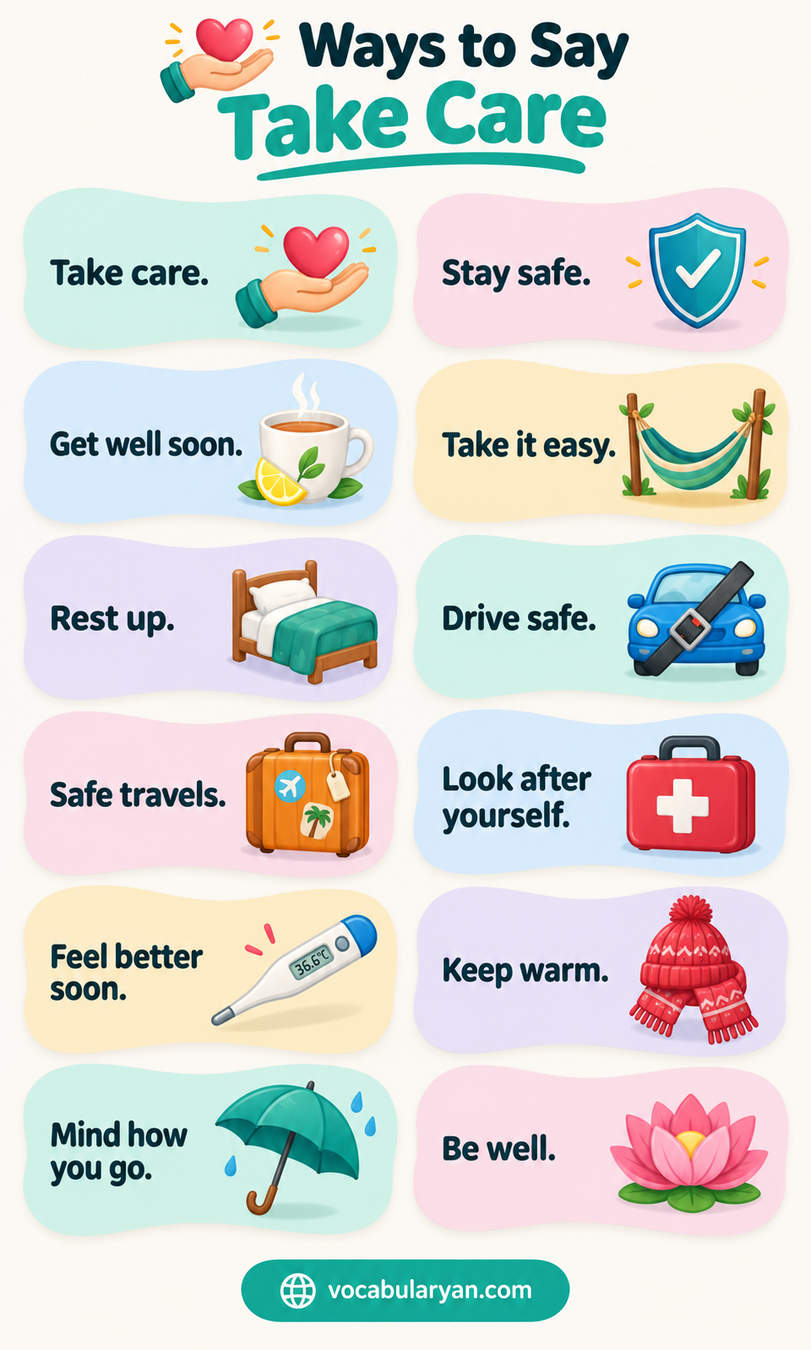
These six farewells fit almost anyone, from a neighbour to a colleague, and each one adds a wish for the person’s health or safety.
Take care of yourself: the full form of "take care", and it fits friends, family, and colleagues at the end of a talk or a visit. It sounds warm at every level.
- Take care of yourself, Nadia, and call me when you get back.
- It was lovely to see you both, take care of yourselves.
- Take care of yourself this week, Mr Lewis, and try to rest that knee.
Look after yourself: the same wish in different words, and it is more common in British English. It fits a friend who has looked tired or stressed.
- Look after yourself, Sam, you’ve been working too hard.
- Bye, Grandad, look after yourself and keep taking the tablets.
- Look after yourself out there, the roads are icy tonight.
Stay safe: a farewell for someone going out, driving, or living somewhere with bad weather or trouble. It fits friends and strangers alike, and it is neutral.
- Stay safe, Aisha, text me when you get home.
- Thanks for the lift, stay safe on the motorway.
- Stay safe, everyone, the storm is due at six.
Be safe: a shorter form of "stay safe", more common in American English, and it fits a parent or a friend at the door.
- Be safe, sweetheart, and don’t stay out too late.
- Have fun at the festival, and be safe.
- Be safe driving back, Marco, it’s dark already.
Be well: a calm farewell that wishes good health, and it fits a colleague, a client, or an older friend. It is a little more formal than "take care".
- Be well, Ruth, and thank you for everything this year.
- I’ll see you at the next meeting, be well.
- Be well, my friend, and write when you can.
Have a good one: a relaxed American farewell that means "have a good day", and it fits a shop, a colleague, or a neighbour.
- Thanks for your help today, have a good one.
- Have a good one, Priya, and don’t work through lunch.
- Right, I’m off, have a good one, everybody.
Say "take care of yourself" when you are unsure, because it fits every person and every level.
Casual Ways to Say Take Care to Friends
Casual farewells are for people who know you well, and each one sounds relaxed, short, and a little playful.
Take it easy: a casual farewell that means "relax and don’t work too hard". It fits friends, classmates, and colleagues you joke with, and the reply is "you too".
- Take it easy, Ben, and enjoy the weekend.
- Right, I’ve got to run, take it easy.
- Take it easy, mate, don’t let the boss get to you.
Catch you later: a quick goodbye between friends that means "see you soon". It sounds too relaxed for a manager or a customer.
- Catch you later, Dan, I’ll bring the tickets.
- Okay, catch you later, I need to get this bus.
- Catch you later, guys, save me a seat.
Don’t be a stranger: a warm farewell that asks the person to stay in touch, and it fits a friend or a relative you see a few times a year.
- Lovely to see you, Priya, don’t be a stranger.
- Don’t be a stranger, come round for dinner any time.
- Safe trip home, and don’t be a stranger, okay?
Later: the shortest casual goodbye, and it fits close friends of your own age in speech and in texts.
- Later, Chris, I’ll message you tonight.
- Okay, cool, later.
- Later, everyone, thanks for the game.
Peace: American slang for goodbye between close friends, and it sounds odd from anyone in a suit.
- Peace, Marcus, see you at practice.
- I’m heading out, peace.
- Peace, guys, drive safe.
Hit me up: casual American slang that means "contact me", and it goes at the end of a talk between friends.
- Hit me up if you’re free on Saturday.
- Take care, and hit me up when you land.
- Hit me up later, I want to hear how it went.
Stay cool: a playful farewell for a friend, and it is more common in American English than in British English.
- Stay cool, Leo, see you in September.
- Thanks for coming, stay cool, everyone.
- Stay cool, and don’t forget to water my plants.
Keep "later", "peace", and "hit me up" for friends your own age, and say "take care" to everyone else.
Formal Ways to Say Take Care at Work
Formal farewells fit a manager, a client, or a colleague you do not know well, and they pair with a name or a full sentence.
All the best: the standard formal farewell that wishes the person success, and it fits a client, a colleague leaving a job, or the end of a meeting.
- All the best with the new role, Ms Adams.
- It was a pleasure working with you, all the best.
- All the best, Dr Okafor, and thank you for your time.
I wish you well: a very polite farewell for a senior person, a colleague who is leaving, or anyone facing a change.
- I wish you well in your retirement, Professor Grant.
- Thank you for the interview, and I wish you well with the search.
- I wish you well, Mrs Novak, please give my regards to your team.
Keep well: a formal and warm farewell, more common in British English, and it fits an older colleague, a client, or a letter.
- Keep well, Mr Chen, and we will speak again in the spring.
- Thank you for coming in today, keep well.
- Keep well, Ms Kaur, and please call if anything changes.
Best wishes: a polite farewell in speech and a standard closing line in writing, and it fits every work relationship.
- Best wishes for the launch next week, Fatima.
- Please pass on my best wishes to your family.
- Best wishes, and thank you again for the invitation.
Until next time: a polite farewell for someone you expect to see again, and it fits a client, a host, or a regular customer.
- Until next time, Mr Petrov, safe journey home.
- Thank you for a wonderful evening, until next time.
- Until next time, and good luck with the exams.
The one farewell to avoid with a client is "peace out", because it belongs to close friends and sounds like a joke in an office.
- Peace out, Ms Adams, thanks for the meeting. ❌
"Peace out" is slang for goodbye between friends, and "all the best" fits the same moment at work.
- All the best, Ms Adams, thanks for the meeting. ✅
Care wishes run across five levels, and the table sorts the ones on this page.
| Level | Farewells | Who it fits |
|---|---|---|
| Slang | Peace, later, hit me up | Close friends your own age |
| Casual | Take it easy, catch you later, stay safe | Friends, family, relaxed colleagues |
| Neutral | Take care, take care of yourself, look after yourself | Anyone you know by name |
| Formal | All the best, keep well, be well | Managers, clients, older people |
| Very formal | I wish you well, until we meet again | Speeches, ceremonies, farewell letters |
Say "all the best" or "keep well" to a client, and keep "take it easy" for the colleagues you have lunch with.
Ways to Say Take Care in an Email
An email farewell is called a sign-off, and it goes on its own line before your name. The words change with the reader.
Take care,: the standard warm sign-off for a colleague, a client you know, or a friend. It is a step warmer than "best regards" and never sounds too casual.
- Thanks again for the update. Take care, Ana
- Let me know if Thursday works. Take care, Omar
- Have a lovely weekend. Take care, Lena
All the best,: a polite sign-off for anyone, and it fits a first email as well as a hundredth.
- I look forward to hearing from you. All the best, Mark
- Thank you for your patience with this. All the best, Sofia
- Please find the report attached. All the best, Ravi
Best wishes,: a neutral sign-off that fits a client, a teacher, or a colleague in another office.
- I hope the move goes well. Best wishes, Tom
- Thanks for your help with the booking. Best wishes, Kemi
- Speak soon. Best wishes, Dana
Look after yourself,: a warm sign-off for a friend or a colleague who is ill, stressed, or going through a hard time.
- I’m sorry to hear about your dad. Look after yourself, Joel
- Don’t reply to this until you’re better. Look after yourself, Maya
- Sending love from all of us. Look after yourself, Claire
Stay safe,: a sign-off for a reader who is travelling, working outdoors, or living through bad weather.
- Thanks for the photos from the site. Stay safe, Ella
- Hope the storm passes quickly. Stay safe, Raj
- Speak when you’re back from the trip. Stay safe, Nina
Wishing you well,: a formal sign-off for a farewell email, a reference, or a message to someone who is leaving.
- It has been a pleasure to work with you. Wishing you well, Charles
- Good luck in the new job. Wishing you well, Helen
- Thank you for ten years with the company. Wishing you well, the team
"Be careful" looks like a sign-off, and it is not one, because it sounds like a warning.
- Thanks for the draft. Be careful, Sara ❌
"Be careful" is said to someone about to do something risky, so as a sign-off it reads as if the draft is dangerous. "Take care" is the farewell.
- Thanks for the draft. Take care, Sara ✅
Write "take care" for a colleague you know and "all the best" for anyone you have written to once or never.
Ways to Say Take Care in a Text
Text farewells are short, and they name what the person is about to do: go home, sleep, work, or go out in the cold.
Text me when you’re home: a caring farewell for a friend or a partner leaving at night, and it asks for one short message later.
- Text me when you’re home, okay? It’s late.
- Great night, text me when you’re home.
- Text me when you’re home, the buses are a mess tonight.
Get home safe: the standard text for someone on their way back, and it fits friends, family, and colleagues after an evening out.
- Get home safe, Tom, thanks for coming.
- Bye! Get home safe.
- Get home safe, and don’t forget your umbrella.
Rest up: a short farewell for someone who is tired or unwell, and it means "get plenty of rest".
- Rest up, you’ve got a big day tomorrow.
- Sorry you’re feeling rough, rest up.
- Rest up this weekend, we’ll catch up next week.
Sleep well: the farewell for a late-night chat, and it fits a friend, a partner, or a child.
- Night, sleep well.
- Sleep well, Jess, and good luck tomorrow.
- Talk in the morning, sleep well.
Don’t work too hard: a friendly farewell for someone busy at work or with exams, and it has a small tease in it.
- Good luck with the report, don’t work too hard.
- Don’t work too hard, the essay can wait till Monday.
- Enjoy the night shift, don’t work too hard.
Stay warm: a winter farewell for anyone outside in the cold, from a partner to a delivery driver.
- Stay warm, it’s minus five out there.
- Bye, Mum, stay warm and put the heating on.
- Stay warm at the match, take a flask.
Keep a text farewell to three or four words, and name what the person is about to do.
Ways to Say Take Care as a Farewell Wish
A farewell wish names the rest of the person’s day, week, or weekend, and it fits every level from a shop to an office.
Have a great day: the standard daytime farewell wish, and it fits a customer, a colleague, or a stranger at a counter.
- Thanks for shopping with us, have a great day.
- Have a great day, Mrs Ali, see you next week.
- Bye, Dad, have a great day at work.
Enjoy the rest of your day: a polite version for the afternoon, and it fits a call, a clinic, or a shop.
- Your appointment is confirmed, enjoy the rest of your day.
- Thanks for calling, enjoy the rest of your day.
- Enjoy the rest of your day, sir, and thank you for waiting.
Have a good weekend: the Friday farewell in every office, and it fits managers and friends alike.
- Have a good weekend, everyone, see you Monday.
- Thanks for your help this week, have a good weekend.
- Have a good weekend, Kwame, any plans?
Keep in touch: a farewell for someone moving away or leaving a job, and it asks for messages or calls later.
- Good luck in Canada, keep in touch.
- Keep in touch, Elena, you have my number.
- It was great working together, keep in touch.
See you soon: a warm farewell for someone you expect to see within days or weeks.
- See you soon, Anna, thanks for lunch.
- Safe drive, see you soon.
- See you soon, I’ll bring the photos next time.
Bye for now: a friendly goodbye that promises another talk, and it fits calls, messages, and visits.
- Bye for now, I’ll call again on Sunday.
- Bye for now, Lucy, give my love to the kids.
- Okay, bye for now, and thanks for the advice.
Say "have a great day" before noon and "enjoy the rest of your day" after it, and add "keep in touch" for anyone moving away.
Ways to Say Take Care to Someone Who Is Ill
A farewell to someone who is ill wishes them health, and the choice depends on whether the illness is short or long.
Get well soon: the standard wish for a cold, a flu, or an injury that will pass within weeks, and it fits cards, texts, and speech.
- Get well soon, Sofia, the office is quiet without you.
- Sorry to hear about your ankle, get well soon.
- Get well soon, Grandma, we’ll visit on Saturday.
Feel better soon: softer than "get well soon", and it fits a friend with a headache, a cold, or a bad day.
- Feel better soon, I’ll drop some soup round.
- Go to bed early and feel better soon.
- Feel better soon, Liam, don’t come in tomorrow.
Get some rest: an instruction to stop working and sleep, used as a farewell, and it fits family, friends, and colleagues.
- Get some rest, the emails can wait.
- You sound exhausted, get some rest.
- Get some rest, Ravi, and see the doctor if the cough gets worse.
Hope you feel better: a gentle wish for someone with a short illness, and it fits a text or a card.
- Hope you feel better by the weekend.
- Hope you feel better, let me know if you need anything from the shop.
- Sorry you’re poorly, hope you feel better soon.
Take it slow: a farewell for someone getting better after an illness or an operation, and it warns them not to rush.
- Take it slow this week, the doctor said no lifting.
- Welcome back, but take it slow, okay?
- Take it slow, Dad, the garden can wait till next month.
Don’t rush back: a farewell from a colleague or a manager that gives permission to stay off work until the person is well.
- Don’t rush back, we’ve got the project covered.
- Rest properly and don’t rush back.
- Don’t rush back, Maya, your health comes first.
"Get well soon" fits an illness that will end, and it sounds wrong for one that will not.
- Get well soon, Mr Lewis. (to a friend with a lifelong condition) ❌
"Get well soon" promises a full recovery, so for a long-term illness the farewell names your care instead.
- Thinking of you, Mr Lewis, and I’m here whenever you need me. ✅
Say "get well soon" for a cold or a broken arm, and "thinking of you" for anything longer.
Ways to Say Take Care to Someone Travelling
A travel farewell wishes a safe journey, and it changes with how the person is travelling: by car, by plane, or on foot.
Safe travels: the standard travel farewell at every level, and it fits a colleague flying to a conference or a friend going backpacking.
- Safe travels, Fatima, send us a photo from Lisbon.
- Thank you for visiting, safe travels.
- Safe travels, and let us know when you arrive.
Have a safe trip: a warm and polite farewell for any journey, and it fits a client, a neighbour, or a parent.
- Have a safe trip, Mr Diaz, we’ll see you next quarter.
- Have a safe trip, and enjoy the wedding.
- Bye, love, have a safe trip and call from the hotel.
Drive safe: the farewell for someone leaving by car, and it is casual in American English. The full form "drive safely" fits a formal setting.
- Drive safe, Tom, the fog is thick tonight.
- Thanks for dinner, drive safe.
- Drive safe, and text me when you’re back.
Travel safe: a short form of "safe travels", and it fits texts and quick goodbyes at a station.
- Travel safe, Ana, see you in two weeks.
- Bye, travel safe and don’t lose your passport.
- Travel safe, I’ll pick you up on Sunday.
Have a good flight: the farewell at an airport or in a text before a flight, and it fits every level.
- Have a good flight, Kemi, sleep if you can.
- Thanks for coming all this way, have a good flight.
- Have a good flight, and enjoy the film selection.
Let me know when you land: a caring farewell for a friend or a relative flying, and it asks for one message on arrival.
- Let me know when you land, Mum, even if it’s late.
- Have a great trip, let me know when you land.
- Let me know when you land, and say hi to your brother.
Say "safe travels" to anyone leaving on a trip, "drive safe" to a friend at the car, and "have a good flight" at the airport.
Ways to Say Take Care to a Friend in a Hard Time
A farewell to a friend in a hard time offers support, and each one says that you are still there after the goodbye.
Hang in there: a farewell that means "stay strong, this will pass", and it fits a friend with exams, a hard job, or a family problem.
- Hang in there, Sam, the exams are over in a week.
- I know it’s tough right now, hang in there.
- Hang in there, and call me any time you need to talk.
I’m here if you need me: the farewell that promises support later, and it fits close friends and family.
- Take care, and I’m here if you need me.
- I’m here if you need me, day or night.
- Look after yourself, I’m here if you need me, okay?
Be kind to yourself: a gentle farewell for a friend who blames themselves, and it means "don’t be too hard on yourself".
- Be kind to yourself this week, you did everything you could.
- Be kind to yourself, Jess, one bad interview doesn’t matter.
- Get some sleep and be kind to yourself.
Thinking of you: a farewell for someone grieving or seriously ill, and it fits a card, a text, or a quiet goodbye.
- Thinking of you and your family, Ruth.
- Thinking of you today, let me know if you want company.
- Bye, Grandad, thinking of you always.
Stay strong: a farewell for someone in the middle of a long problem, and it fits a friend, a teammate, or a colleague.
- Stay strong, Marco, the treatment is nearly over.
- Stay strong, we’re all behind you.
- Take care and stay strong, I’ll see you next week.
Take all the time you need: a farewell from a friend or a manager that removes any pressure to hurry back.
- Take all the time you need, the team will cover your shifts.
- Don’t worry about the group project, take all the time you need.
- Take all the time you need, Nina, we’ll be here when you’re ready.
Say "I’m here if you need me" to a close friend, and "thinking of you" to anyone grieving.
Regional Ways to Say Take Care in English
English-speaking countries each keep a few farewells of their own, and each one sounds natural in its home country and a little odd outside it.
British Ways to Say Take Care
Mind how you go: the classic British farewell that means "be careful on your way", and it fits friends, neighbours, and older people.
- Mind how you go, Pete, the pavement’s icy.
- Cheers for the lift, mind how you go.
- Mind how you go, love, see you tomorrow.
Ta-ra: a northern English goodbye, said between friends and family and in shops.
- Ta-ra, Claire, see you at the weekend.
- Ta-ra, love, thanks for the tea.
- Right, ta-ra, I’m off to the shops.
Cheers: in British English, a goodbye and a thank-you in one word, and it fits friends, taxi drivers, and shop staff.
- Cheers, Dave, see you Friday.
- Cheers, mate, take care.
- That’s everything, cheers, bye.
American Ways to Say Take Care
Be good: a friendly American farewell that means "behave and look after yourself", and it fits family and old friends.
- Be good, kids, listen to your grandmother.
- Be good, Jay, see you at Thanksgiving.
- Alright, be good, I’ll call you Sunday.
Y’all take care now: the Southern American farewell for a group or a family, and it sounds warm from a host or a shopkeeper.
- Y’all take care now, and come back soon.
- Thanks for stopping by, y’all take care now.
- Y’all take care now, drive safe.
Stay safe out there: an American farewell for someone going out into bad weather, a busy city, or a hard job.
- Stay safe out there, officer.
- Big storm tonight, stay safe out there.
- Stay safe out there, and text me when you’re done.
Australian and Irish Ways to Say Take Care
Hooroo: an old Australian goodbye, still said by older speakers and in the countryside.
- Hooroo, Mel, see you at the beach.
- Hooroo, mate, thanks for the barbie.
- Right, hooroo, I’m off.
Take it easy, mate: the everyday Australian farewell, and "mate" makes it friendly for a stranger as well as a friend.
- Take it easy, mate, catch you next week.
- Thanks for the help, take it easy, mate.
- Take it easy, mate, and say g’day to Liam.
Mind yourself: the Irish form of "take care", and it fits friends, family, and neighbours of every age.
- Mind yourself, Niamh, the roads are bad tonight.
- Bye, Paddy, mind yourself.
- Mind yourself now, and give my love to your mother.
Safe home: the Irish farewell for someone leaving your house or a pub, and it means "get home safely".
- Safe home, Sean, thanks for coming.
- Safe home, lads, see you at the match.
- Night, safe home, text me when you’re in.
Say "mind how you go" in Britain, "y’all take care now" in the American South, "take it easy, mate" in Australia, and "mind yourself" in Ireland.
Funny Ways to Say Take Care
Funny farewells are for close friends who know your sense of humour, and each one plays on the idea of staying out of danger.
Don’t do anything I wouldn’t do: a joke farewell that means "behave", and it fits a friend going to a party or on holiday.
- Have fun in Ibiza, don’t do anything I wouldn’t do.
- Don’t do anything I wouldn’t do, and that leaves you plenty.
- Enjoy the stag do, don’t do anything I wouldn’t do.
Stay out of trouble: a teasing farewell for a friend, a teenager, or a colleague known for jokes.
- See you Monday, stay out of trouble.
- Stay out of trouble, Chris, I’m not bailing you out again.
- Bye, boys, stay out of trouble this weekend.
Get home in one piece: a joke farewell for a friend leaving a party, and it fits people who laugh at jokes about themselves.
- Get home in one piece, Dan, no more karaoke.
- Right, get home in one piece, and I’ll see you at brunch.
- Get home in one piece, you two, the taxi’s outside.
Smell you later: a silly goodbye between children and old friends, and it is a joke on "see you later".
- Smell you later, Leo, don’t forget your PE kit.
- Okay, smell you later!
- Smell you later, I’m off to the gym.
Don’t let the bedbugs bite: a playful bedtime farewell for a child or a partner, and it follows "good night" and "sleep tight".
- Night, sleep tight, don’t let the bedbugs bite.
- Off to bed, love, don’t let the bedbugs bite.
- Sleep well, and don’t let the bedbugs bite!
Save the funny farewells for people who will laugh, because a joke goodbye to a stranger or a client reads as a mistake.
How Do You Reply When Someone Says Take Care?
The reply to "take care" returns the wish, and a farewell that names a journey or an illness gets a thank-you.
Take care and take it easy: reply with "you too" or the same farewell back.
- Take care! You too, see you tomorrow.
- Take it easy. You too, mate.
- Take care of yourself. I will, and you.
Stay safe and get home safe: reply with "I will" and a thank-you, then return the wish if the other person is leaving too.
- Stay safe out there. I will, thanks.
- Get home safe. Will do, thanks for tonight.
- Drive safe. Thanks, I’ll text you when I’m back.
Get well soon and feel better: the reply is a thank-you, with a short update if you want one.
- Get well soon! Thank you, I’m already feeling a bit better.
- Feel better soon. Thanks, I just need a day in bed.
- Rest up. I will, thanks for covering for me.
Safe travels and have a good flight: reply with a thank-you and a promise to message.
- Safe travels! Thanks, I’ll send a photo when I land.
- Have a good flight. Thank you, see you in two weeks.
- Let me know when you land. I will, bye!
Hang in there and thinking of you: the reply thanks the person for the support.
- Hang in there. Thanks, that means a lot.
- Thinking of you. Thank you, it helps to know you’re there.
- I’m here if you need me. I know, thank you.
All the best and keep well: the reply returns the same formal wish.
- All the best, Ms Adams. And to you, Mr Chen.
- Keep well. You too, and thank you for your time.
- I wish you well. Thank you, and the same to you.
Reply to "take care" with "you too", and reply to any wish about a trip or an illness with "thank you" first.
More Everyday English Phrases
- Other Ways to Say Good Night
- Other Ways to Say See You Later
- Other Ways to Say Goodbye
- Other Ways to Say Sweet Dreams
FAQs
The most common way to say take care is "take care" itself, followed by "take care of yourself" and "stay safe". "Take care" fits every person and every level, so it is the one to use when you are unsure. "Look after yourself" is the most common British form, and "be safe" is the most common American one.
Yes, "take care" is polite enough for a manager, a client, or a colleague, and it is a standard email sign-off in every English-speaking office. In a very formal setting, such as a speech or a farewell letter, "all the best", "keep well", or "I wish you well" sound more polished. "Take it easy", "later", and "peace" are the forms to avoid at work.
Yes, "take care" is one of the most natural farewells between coworkers, in speech and in email. It sounds warm without sounding personal, so it fits a colleague you have known for years and one you met last week. Add a first name, "take care, Sam", to make it warmer.
No, the two farewells overlap but do not mean the same thing. "Take care" is a general wish for the person’s health and happiness, and it fits any goodbye. "Be safe" is a wish about danger, so it fits someone about to drive, travel, or go out at night, and it sounds odd at the end of a normal office chat.
You say "take care" at the end of a conversation, a visit, a call, or an email, never at the start. It fits a person you will not see for a while, a person who is ill, or a person about to travel. After a short chat with a colleague you see every day, "see you tomorrow" is more natural.
Name what the person is about to do, because a farewell that fits the moment sounds kinder than a general one. "Get home safe" for a friend leaving at night, "safe travels" before a trip, "get well soon" for a cold, and "hang in there" during a hard week each sound warmer than "take care" alone. Adding the person’s name makes any of them nicer still.
Use "look after yourself" with a friend, a relative, or a colleague who has been tired, unwell, or stressed, because it is a real request as well as a farewell. It is more common in British English than in American English, where "take care of yourself" fills the same role. It sounds too personal for a client or a stranger, so keep it for people you know.