
"Take your time" is an order in form and a kindness in meaning, because it says that no clock is running. The ways to say take your time in English change with the listener: "no rush" for a friend, "whenever you get a chance" for a colleague, "there’s no hurry" for a customer at the counter. Said with a smile it removes pressure, and said with a sigh it means the opposite, so the everyday phrases come first.
Common Ways to Say Take Your Time in Everyday English
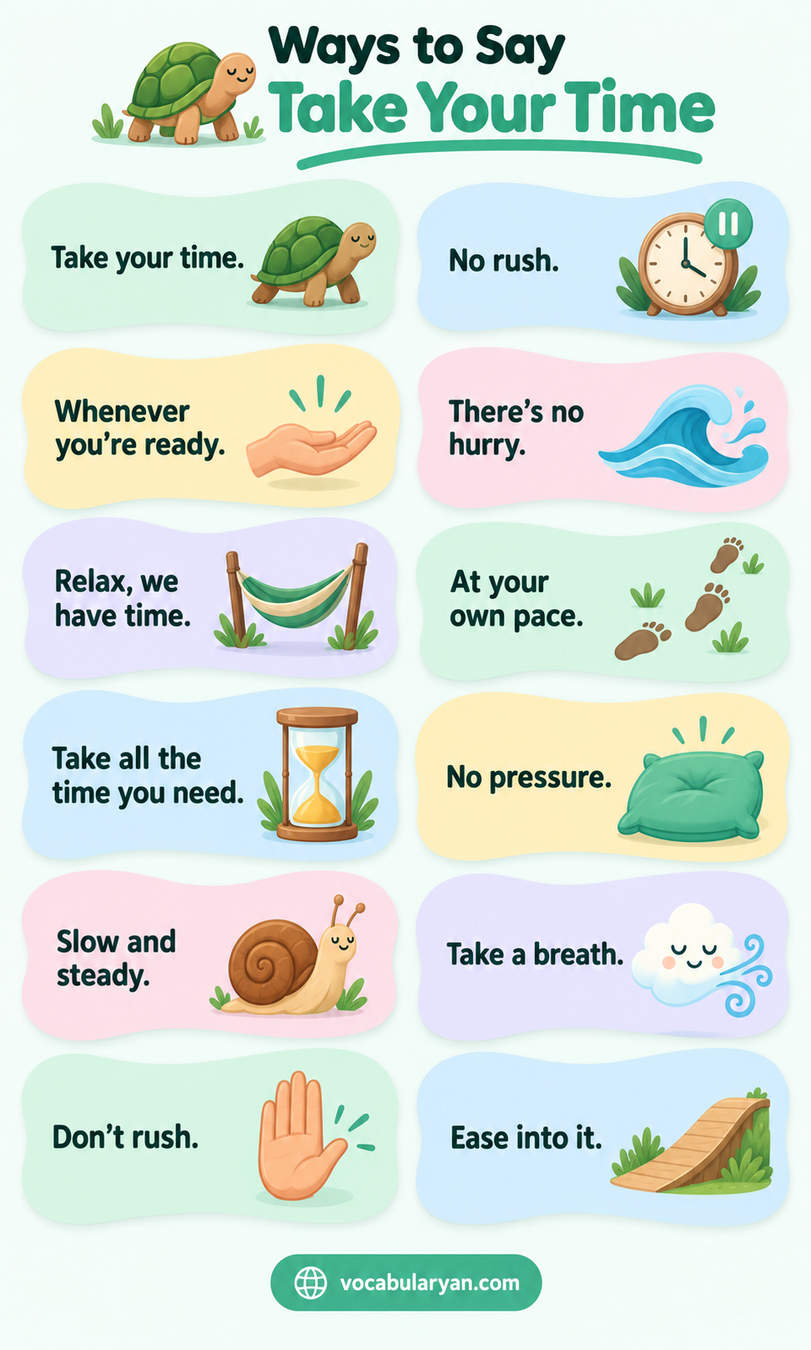
These six phrases fit almost anyone, and each one says that the listener is free to go slowly.
No rush: the most common short form, and it fits friends, family, shop staff, and colleagues you know. It works as a full reply on its own.
- No rush, I’ll be reading in the car.
- Send it whenever, no rush.
- No rush on the forms, Mrs Bello, the desk is open all afternoon.
No hurry: the same meaning as "no rush", a touch softer and a little more common in American speech.
- No hurry, the film doesn’t start until eight.
- Finish your tea first, there’s no hurry.
- No hurry at all, we can order when your sister gets here.
Take all the time you need: warm and full, so it fits someone under pressure or someone upset. It sounds kind rather than casual.
- Take all the time you need, the room is yours until noon.
- Don’t apologise, take all the time you need to read it through.
- Take all the time you need, Dan, the decision can wait.
There’s no rush: "no rush" with "there is" in front, and it fits speech and messages at every level except very formal.
- There’s no rush, the bus comes every ten minutes.
- I know you’re busy, so there’s no rush on the photos.
- There’s no rush, we’ve booked the table for the whole evening.
Whenever you’re ready: the polite way to hand the next move to the other person, and it fits a waiter, a teacher, a driver, or a friend at the door.
- Whenever you’re ready, we can start the tour.
- The taxi’s outside, so come down whenever you’re ready.
- Whenever you’re ready, Mr Cole, the doctor will see you in room four.
No need to rush: a gentle full sentence, and it fits a colleague, a neighbour, or a family member who is hurrying without reason.
- No need to rush, the meeting moved to three.
- There’s no need to rush back, I’ll lock up.
- No need to rush, Grandad, the taxi driver said he’d wait.
Say "no rush" when the moment is relaxed and "take all the time you need" when the other person is under strain.
Casual Ways to Say Take Your Time to Friends
Casual forms are short, relaxed, and a little playful, and they fit people who know you well.
Don’t rush: the plain imperative, and between friends it sounds caring rather than bossy.
- Don’t rush, I’m still parking.
- Don’t rush the last bit, you’ll only have to redo it.
- Eat first, don’t rush, the game’s on record.
No stress: young and relaxed, and it removes pressure from a favour or a late reply. Keep it out of formal writing.
- No stress, bring the book back whenever.
- No stress if you can’t make it tonight.
- Pay me back next week, no stress.
Take it slow: a friend’s advice for a job, a hill, a recovery, or a new relationship, and it means "go step by step".
- Take it slow on the ice, it’s worse than it looks.
- The doctor said to take it slow for a fortnight.
- Take it slow with the new job, nobody expects miracles in week one.
Take it easy: relaxed and warm, and it means "don’t push yourself" as well as "don’t hurry". The page on "take it easy" covers that phrase in full.
- Take it easy, you’ve been on your feet since six.
- Take it easy with the spice, the kids are eating too.
- Sit down and take it easy, I’ll do the dishes.
All good, whenever: two casual words in a row, and they fit a text or a quick reply when a friend apologises for being slow.
- All good, whenever you get round to it.
- Sorry I’m late with the money. All good, whenever works.
- All good, whenever, the offer’s still open.
Keep "no stress" and "all good, whenever" for friends your own age, and say "no rush" with everyone else.
Formal Ways to Say Take Your Time at Work
Formal forms fit a manager, a client, an interview, or a document, and most of them use "please" or "convenience".
Please take your time: the original phrase with "please" in front, and the word "please" is what makes it safe with a senior person.
- Please take your time with the contract, we have until Friday.
- Please take your time, Ms Ortiz, there is no need to answer today.
- Please take your time over the figures and call me with any questions.
At your convenience: the standard formal form in writing, and it means "at a time that suits you". In speech it sounds stiff.
- Please review the draft at your convenience.
- The samples can be collected at your convenience from reception.
- Sign and return the form at your convenience.
At your leisure: a step more formal than "at your convenience", and it fits a document that needs no reply by a fixed date.
- The full report is attached for you to read at your leisure.
- Browse the catalogue at your leisure, Mr Hale.
- The recording is available at your leisure on the shared drive.
There’s no deadline on this: direct and polite, and it removes the one question a busy colleague always asks.
- There’s no deadline on this, so fit it around the audit.
- Just to be plain, there’s no deadline on this request.
- There’s no deadline on this, but a rough date would help my planning.
Take the time you need: shorter than "take all the time you need", and it reads well in a formal message to a colleague or a client.
- Take the time you need to check the numbers.
- Take the time you need, and we will meet when you are ready.
- Please take the time you need before you sign anything.
Please proceed at a pace that suits you: the most formal form on the page, and it fits a letter, a training pack, or a message to a new client.
- Please proceed at a pace that suits you, the course stays open for a year.
- Please proceed at a pace that suits you, and contact us with any concerns.
- There is no fixed timetable, so please proceed at a pace that suits you.
"At your earliest convenience" looks like a polite cousin of "at your convenience", and the two mean the opposite of each other.
- No rush, please reply at your earliest convenience. ❌
"At your earliest convenience" means "as soon as you can", so it fights the "no rush" in front of it.
- No rush, please reply at your convenience. ✅
Each phrase on the page fits one of the five levels in the table.
| Level | Phrases | Who it fits |
|---|---|---|
| Slang | No stress, all good whenever, no dramas | Friends your own age |
| Casual | No rush, don’t rush, take it slow | Friends, family, relaxed colleagues |
| Neutral | Take all the time you need, whenever you’re ready | Anyone you know by name |
| Formal | Please take your time, there’s no deadline on this, at your convenience | Managers, clients, strangers |
| Very formal | At your leisure, please proceed at a pace that suits you | Letters, documents, senior clients |
Write "at your convenience" in a formal message and say "please take your time" out loud, because the written form sounds stiff in speech.
Ways to Say Take Your Time in an Email
An email version of "take your time" names the task and removes the deadline in the same line, so the reader knows what can wait.
No rush on this: the standard work email form, and "on this" ties the phrase to the task in the message.
- No rush on this, but could you check the totals in column C?
- No rush on this, I only need it before the board meeting next month.
- Attaching the draft, no rush on this at all.
Whenever you get a chance: a soft request that fits a colleague or a client you know, and it means "when you have a free moment".
- Whenever you get a chance, could you send me the login?
- Have a look at the slides whenever you get a chance.
- Whenever you get a chance, I’d love your thoughts on the new logo.
When you have a moment: a step more polite than "whenever you get a chance", and it fits a manager or someone senior.
- When you have a moment, could you approve the leave request?
- I’d like your view on the budget when you have a moment.
- When you have a moment, please glance at the new policy wording.
This isn’t urgent: a plain fact at the top of an email, and it stops the reader dropping other work.
- This isn’t urgent, so feel free to leave it until after your trip.
- Quick one, and this isn’t urgent: do we still have the old logo files?
- This isn’t urgent, but I’d like to close it before the end of the quarter.
Feel free to review at your leisure: the formal email form for a document with no fixed return date.
- Feel free to review at your leisure, and I’ll follow up next month.
- Attached is the proposal, so feel free to review at your leisure.
- Feel free to review at your leisure, there is no action needed on your side.
Open a low-priority email with "no rush on this" or "this isn’t urgent", and end it with the date you do need.
Ways to Say Take Your Time to a Customer or Client
A customer hears these phrases from staff who want them to feel comfortable, and each one comes with a smile.
There’s no hurry: the standard line at a counter, a table, or a fitting room, and it sounds kind from a waiter or a shop assistant.
- There’s no hurry, I’ll come back for your order in a few minutes.
- There’s no hurry, madam, try both pairs on.
- The shop’s quiet, so there’s no hurry at all.
Take your time, I’m happy to wait: "take your time" with a reason after it, and the reason is what makes it warm.
- Take your time, I’m happy to wait while you find the card.
- Take your time, I’m happy to wait, the queue’s gone.
- Take your time, I’m happy to wait if you’d like to read the terms first.
No rush at all: "no rush" with "at all" added, and the extra words make the message stronger.
- No rush at all, the changing rooms are open until seven.
- No rush at all, sir, I’ll be at the desk when you’re ready.
- No rush at all, have a look round and call me over.
Have a look and let me know: the shop form of "whenever you’re ready", and it hands the next step to the customer.
- Have a look and let me know if you need another size.
- Have a look and let me know which colour you prefer.
- Have a look and let me know, I’m just over by the till.
Say "there’s no hurry" to a customer, and add "I’m happy to wait" so the phrase sounds like service rather than instruction.
Ways to Say Take Your Time to a Colleague on a Task
A colleague working on a shared task needs to know the pace is theirs, and these phrases say so without a deadline.
Go at your own pace: the standard form for a person learning a task or working through a long list, and it means "at the speed that suits you".
- Go at your own pace, the training modules stay open all year.
- Go at your own pace with the data entry, accuracy beats speed here.
- There’s no target this week, so go at your own pace.
No pressure: short and friendly, and it fits a colleague you have just asked for a favour.
- No pressure, but could you glance at my slides before Monday?
- No pressure on the report, the client pushed the date back.
- I’d love your feedback, no pressure though.
Get to it when you can: casual and practical, and it fits a task that can wait behind the other work on someone’s desk.
- Get to it when you can, the printer’s been jamming all week.
- Get to it when you can, it’s a five-minute job.
- The archive request can wait, so get to it when you can.
There’s no rush on my end: a way of saying that your side of the work is not waiting, and it fits a colleague who fears holding you up.
- There’s no rush on my end, I’m still waiting on the supplier.
- There’s no rush on my end, so take the weekend.
- There’s no rush on my end, the design stage comes after yours anyway.
Tell a colleague "go at your own pace" for a long task and "no pressure" for a small favour.
Ways to Say Take Your Time to a Child
A child hears "take your time" from a parent or a teacher who wants care rather than speed, and the phrases are short and soft.
Slowly does it: a British parent’s line for a careful job, from pouring milk to walking down stairs.
- Slowly does it, hold the cup with both hands.
- Slowly does it on the steps, they’re wet.
- Slowly does it, Leo, the glue needs a minute.
One step at a time: a phrase for a task that looks too big to a child, and it means "do the first part, then the next".
- One step at a time, start with the sleeves.
- One step at a time, first the shoes, then the coat.
- Don’t look at the whole puzzle, one step at a time.
No hurry, sweetheart: "no hurry" with a pet name, and it fits a parent or grandparent with a child who is anxious about being slow.
- No hurry, sweetheart, the bus isn’t here yet.
- No hurry, sweetheart, read it again if you like.
- No hurry, sweetheart, Daddy can wait for his tea.
We’ve got plenty of time: a fact about the clock, said to a child who is rushing or panicking.
- We’ve got plenty of time, the party starts at three.
- Don’t run, we’ve got plenty of time before the train.
- We’ve got plenty of time, so let’s tie those laces properly.
Say "slowly does it" when a child is doing something with their hands, and "we’ve got plenty of time" when a child is rushing to leave.
Ways to Say Take Your Time to a Student or Learner
A learner working on a test, a speech, or a new skill needs permission to be slow, and a teacher gives it with these phrases.
Take a moment: the teacher’s form of "take your time", and it fits a pause before an answer in class.
- Take a moment before you answer, there’s no bell.
- Take a moment and read the question twice.
- Take a moment, Yusuf, then try the sentence again.
Think it through: an instruction to work slowly and carefully, and it fits a maths problem or an essay plan.
- Think it through before you write the first line.
- Think it through, what happens to the number when you divide?
- Don’t guess, think it through and show your working.
There’s no time limit: a fact about the task, and it removes exam fear from a practice exercise.
- There’s no time limit, so check every answer.
- There’s no time limit on the speaking practice today.
- Relax, there’s no time limit for the reading task.
Pace yourself: advice for a long test or a long course, and it means "spread your energy over the whole task".
- Pace yourself, the exam is three hours long.
- Pace yourself with the vocabulary, ten words a day is enough.
- You’ve got six chapters, so pace yourself.
Tell a learner to "take a moment" before an answer and to "pace yourself" across a long piece of work.
Ways to Say Take Your Time to Someone Nervous or Upset
Someone nervous or in tears needs to hear that nobody is waiting, and these phrases say that in a calm voice.
Take a deep breath: the first line for someone in a panic, and it gives them an action instead of a demand.
- Take a deep breath, the interview doesn’t start for twenty minutes.
- Take a deep breath, then tell me from the beginning.
- It’s okay, take a deep breath, nobody’s angry.
Take a minute: a short, kind permission to pause, and it fits a friend, a colleague, or a stranger at a bad moment.
- Take a minute, I’ll get you some water.
- Take a minute if you need to, we’ll wait outside.
- Take a minute, there’s no need to speak yet.
Whenever you feel ready: softer than "whenever you’re ready", because "feel" makes it about the person and not the task.
- Whenever you feel ready, we can talk about what happened.
- Whenever you feel ready, come back in and join us.
- There’s no pressure, whenever you feel ready.
I’m here when you’re ready: a promise as well as a permission, and it fits a close friend or a family member.
- I’m here when you’re ready, no matter how long it takes.
- I’m here when you’re ready to talk about the results.
- Take the weekend, I’m here when you’re ready.
Say "take a deep breath" to someone in a panic and "I’m here when you’re ready" to someone in tears.
Ways to Say Take Your Time to Someone Deciding
A person facing a choice hears these phrases from someone who wants a good decision rather than a fast one.
Sleep on it: advice to decide tomorrow, and it fits a big purchase, a job offer, or a family plan.
- Sleep on it and call me in the morning.
- Sleep on it, the offer’s open until Friday.
- Don’t sign tonight, sleep on it first.
Think it over: a request to consider a choice slowly, and it fits a friend, a client, or a family member.
- Think it over and let me know next week.
- Think it over, there’s no right answer here.
- Think it over with your partner before you say yes.
No pressure to decide today: a full sentence that removes the deadline from a choice, and it fits a salesperson or a manager.
- No pressure to decide today, the price holds until the end of the month.
- No pressure to decide today, take the brochure home.
- No pressure to decide today, Maria, we can talk again on Monday.
Let me know when you’ve decided: the polite way to ask for an answer without asking for it now.
- Let me know when you’ve decided, and I’ll book the dates.
- Let me know when you’ve decided about the flat.
- No rush, just let me know when you’ve decided.
Say "sleep on it" for a decision that can wait a night, and "no pressure to decide today" for one that can wait longer.
Ways to Say Take Your Time on the Phone
On a call the other person cannot see you wait, so the phrase has to say that you are still there.
No rush, I’ll hold: the line for a caller who needs to find a number, a card, or a document.
- No rush, I’ll hold while you find the reference number.
- No rush, I’ll hold, go and check the boiler.
- Sure, no rush, I’ll hold.
Take your time, I’ll wait: the same meaning with the full phrase, and it fits a friend or a customer on the line.
- Take your time, I’ll wait, the kettle’s on here.
- Take your time, I’ll wait for you to read it out.
- Take your time, I’ll wait, I’m not going anywhere.
Call me back when you get a chance: the phrase for ending a call so the other person can finish something first.
- Call me back when you get a chance, it’s nothing urgent.
- You sound busy, so call me back when you get a chance.
- Call me back when you get a chance, I’m home all evening.
Say "I’ll hold" so the caller knows you are still on the line, because silence on a phone sounds like a lost connection.
Ways to Say Take Your Time in a Text
A text version is short, and an exclamation mark or a kiss changes the feeling of the same two words.
No rush!: the default text form between friends, and the exclamation mark makes it cheerful.
- No rush! I’m still at the gym.
- No rush! Reply whenever.
- Saw your message, no rush!
Whenever you’re free: a text that asks for a call or a chat with no fixed time.
- Ring me whenever you’re free.
- Whenever you’re free, fancy a coffee this week?
- Can you send the photos whenever you’re free?
No hurry, reply when you can: a full text for a friend who apologises for slow replies.
- No hurry, reply when you can, I know it’s exam week.
- No hurry, reply when you can, just wanted to say hi.
- No hurry, reply when you can about Saturday.
Take your time x: the British text form with a kiss, and it fits a partner, a close friend, or a family member.
- Take your time x, I’ll keep the dinner warm.
- Take your time x, no need to reply tonight.
- Get some sleep first, take your time x.
Keep a text to "no rush!" or "whenever you’re free", and add the kiss only for someone who sends one back.
Ways to Say Take Your Time to a Group
A group version names everyone at once, and it fits a class, a team, or a room full of guests.
No rush, everyone: the plain form for a room, and it fits a meeting, a workshop, or a dinner table.
- No rush, everyone, the next session starts at eleven.
- No rush, everyone, finish your coffee.
- No rush, everyone, the forms can go in the box by Friday.
Take your time, everybody: the full phrase with "everybody", and it fits a teacher or a tour leader.
- Take your time, everybody, the bus leaves at four.
- Take your time, everybody, there are three more rooms to see.
- Take your time, everybody, this is the hard part of the test.
Everyone can go at their own pace: the form for a group where people work at different speeds, and it fits a class or a training day.
- Everyone can go at their own pace, the worksheets are on the table.
- Everyone can go at their own pace today, there’s no group deadline.
- Everyone can go at their own pace, and I’ll come round to each desk.
Say "no rush, everyone" to a room, and "everyone can go at their own pace" when the group is working on separate tasks.
Regional Ways to Say Take Your Time in English
Each English-speaking country keeps a few forms of its own, and the right one wins a smile from a local.
British Ways to Say Take Your Time
No rush, mate: "no rush" with the friendly British "mate", and it fits a friend or any man you speak to casually.
- No rush, mate, the pub’s open till late.
- No rush, mate, I’ll grab a paper while you sort it.
- Cheers, no rush, mate, next week’s fine.
All in good time: an old saying that means "it will happen when it should", said to someone impatient or someone rushing.
- All in good time, the results come out on Thursday.
- All in good time, love, let the cake cool first.
- You’ll get your turn, all in good time.
Whenever you like: the British casual form of "at your convenience", and it fits a neighbour, a colleague, or a guest.
- Pop round whenever you like, the door’s open.
- Drop the keys back whenever you like.
- Whenever you like, there’s no hurry on the ladder.
American Ways to Say Take Your Time
Whenever you get around to it: an American casual form for a task with no deadline, and "get around to" means "find the time for".
- Fix the fence whenever you get around to it.
- Whenever you get around to it, the recipe’s on the fridge.
- The garage can wait, do it whenever you get around to it.
No sweat: American slang that means "no problem, no pressure", and it fits close friends and casual colleagues.
- No sweat, bring the drill back next week.
- No sweat, I’ll cover the desk till you’re done.
- Running late? No sweat, we’ll order for you.
Australian and Irish Ways to Say Take Your Time
No worries: the Australian all-purpose phrase, and as a version of "take your time" it means "there’s no problem with waiting".
- No worries, mate, finish your call.
- No worries, drop it round whenever.
- Late again? No worries, we saved you a chair.
No dramas: casual Australian slang with the same meaning as "no worries", used between friends and easygoing colleagues.
- No dramas, the boat doesn’t leave till ten.
- No dramas, send it Monday.
- Lost the receipt? No dramas, I’ve got a copy.
Sure there’s no rush: the Irish form, where "sure" at the start means "of course" and softens the whole line.
- Sure there’s no rush, the match isn’t on till eight.
- Sure there’s no rush, have another cup first.
- Sure there’s no rush, it’ll keep till the morning.
Say "no rush, mate" in Britain, "no sweat" in America, "no worries" in Australia, and "sure there’s no rush" in Ireland.
Funny Ways to Say Take Your Time
A funny version exaggerates the wait, and it fits friends who know you are joking. The same lines, said flat, become sarcasm.
Take your sweet time: a teasing form, and "sweet" makes it a joke about slowness. From a stranger it sounds rude.
- Take your sweet time, the ice cream’s only melting.
- Oh, take your sweet time, the rest of us love standing in the rain.
- Take your sweet time, mate, I’ve brought a book.
I’ve got all day: a joke about the wait, and it fits a friend who is being slow at the mirror or the menu.
- I’ve got all day, choose whichever cake you like.
- Try the other jacket too, I’ve got all day.
- I’ve got all day, and the dog does too.
We’ve got all the time in the world: a warm exaggeration, and it fits a partner or a parent rather than a colleague.
- We’ve got all the time in the world, so read me the whole letter.
- Slow down, we’ve got all the time in the world tonight.
- We’ve got all the time in the world, the plane’s tomorrow.
Rome wasn’t built in a day: an old saying that means "big work takes time", and it fits a friend who is frustrated by slow progress.
- Rome wasn’t built in a day, and neither is a garden shed.
- Ten pages in a week is fine, Rome wasn’t built in a day.
- Rome wasn’t built in a day, so stop checking the paint every hour.
Slow and steady wins the race: the moral of an old fable, and it fits a learner, a runner, or a child who wants to rush.
- Slow and steady wins the race, keep the same speed to the end.
- Slow and steady wins the race, one chapter a night is plenty.
- Don’t skip the revision, slow and steady wins the race.
"Take your time" turns into its opposite when it comes after a long wait, with stress on "time" and no smile.
- (after ten minutes at the till) Oh, no, take your time. ❌
Said flat after a wait, the line means "hurry up" and sounds rude to everyone who hears it.
- (after ten minutes at the till) No rush, I’m not in a hurry. ✅
Save the funny forms for friends, and keep a smile on "take your time" whenever a stranger is being slow.
How Do You Reply When Someone Says Take Your Time?
The reply thanks the speaker and, at work, names a rough date, because "take your time" never cancels the task itself.
Thanks, I appreciate it: the standard warm reply at every level, and it fits a friend, a colleague, or a customer.
- Take your time with the report. Thanks, I appreciate it.
- No rush on the deposit. Thanks, I appreciate it, I get paid Friday.
- There’s no hurry. Thanks, I appreciate it, I’ll just be a minute.
Thanks, I won’t be long: the reply that promises speed anyway, and it fits a shop, a queue, or a phone call.
- Take your time. Thanks, I won’t be long, I just need my glasses.
- No rush, I’ll hold. Thanks, I won’t be long.
- Whenever you’re ready. Thanks, I won’t be long, two more questions.
I’ll have it to you by Friday: the work reply, and it turns "no deadline" into a date the other person can plan around.
- No rush on this. I’ll have it to you by Friday anyway.
- Take the time you need. Thank you, I’ll have it to you by Friday at the latest.
- There’s no deadline on this. Understood, I’ll have it to you by Friday.
Just a minute: the reply for a short pause, and it fits a friend at the door or a customer at the counter.
- Take your time. Just a minute, I’m looking for the ticket.
- No hurry. Just a minute, I’ll grab my coat.
- Whenever you’re ready. Just a minute, nearly done.
Reply with thanks, and at work add a date, so "take your time" ends with a plan instead of silence.
More Everyday English Phrases
- Other Ways to Say Hurry Up
- Other Ways to Say Calm Down
- Other Ways to Say Stop It
- Other Ways to Say Take It Easy
FAQs
No, "take your time" is polite when it comes with a smile or a "please", because it removes pressure from the other person. It becomes rude in one case: when it comes after a long wait, in a flat voice, with stress on "time". At that moment it means "hurry up", so a stranger being slow gets "no rush" instead.
Yes, "please take your time" and "no rush on this" both fit a work email, and "at your convenience" fits a formal one. Add the date you do need at the end of the message, because "take your time" alone leaves the task with no end. Avoid "at your earliest convenience" here, because it asks for speed.
The most formal form is "please proceed at a pace that suits you", with "at your leisure" and "at your convenience" close behind. All three belong in writing: a letter, a contract cover note, or a message to a senior client. Out loud they sound stiff, so "please take your time" is the spoken formal choice.
"No stress" and "no dramas" are the most casual forms, and both belong to friends of your own age. "No rush" is casual too, but it fits a wider range of people, from a neighbour to a colleague. Keep "no stress" and "no dramas" out of any message a manager or a customer will read.
Yes, "take your time" is a complete sentence, because it is an imperative, and the person addressed is understood as "you". "Take" is the verb, "your time" is the object, and the sentence needs nothing else. The same is true of "don’t rush" and "pace yourself".
"Take your time" means "there is no need to hurry", and the speaker is giving the listener permission to go slowly. The literal words say "use as much of your time as you want". With a smile it is kind, and with a sigh after a wait it means the opposite.
Yes, and with a friend the shorter forms sound more natural: "no rush", "don’t rush", "no stress", or "all good, whenever". "Take your time" itself fits a friend too, in speech or a text with an exclamation mark or a kiss. The full phrase sounds a little serious between friends, so keep it for a moment that needs care, such as a friend who is upset.
Put "please" in front of it, or replace it with "whenever you’re ready", "when you have a moment", or "there’s no hurry". Each of those fits a customer, a colleague, or someone senior. The politest forms give a reason as well, such as "take your time, I’m happy to wait".