
"Take it easy" is used with three separate meanings, and the person in front of you decides which one you mean. At the door it is a goodbye, to a tired friend it is advice to rest, and with "on" after it ("take it easy on him") it asks someone to be gentle. The ways to say "take it easy" in English split along the same three lines, and the everyday set covers all three at once.
Other Ways to Say Take It Easy in Everyday English
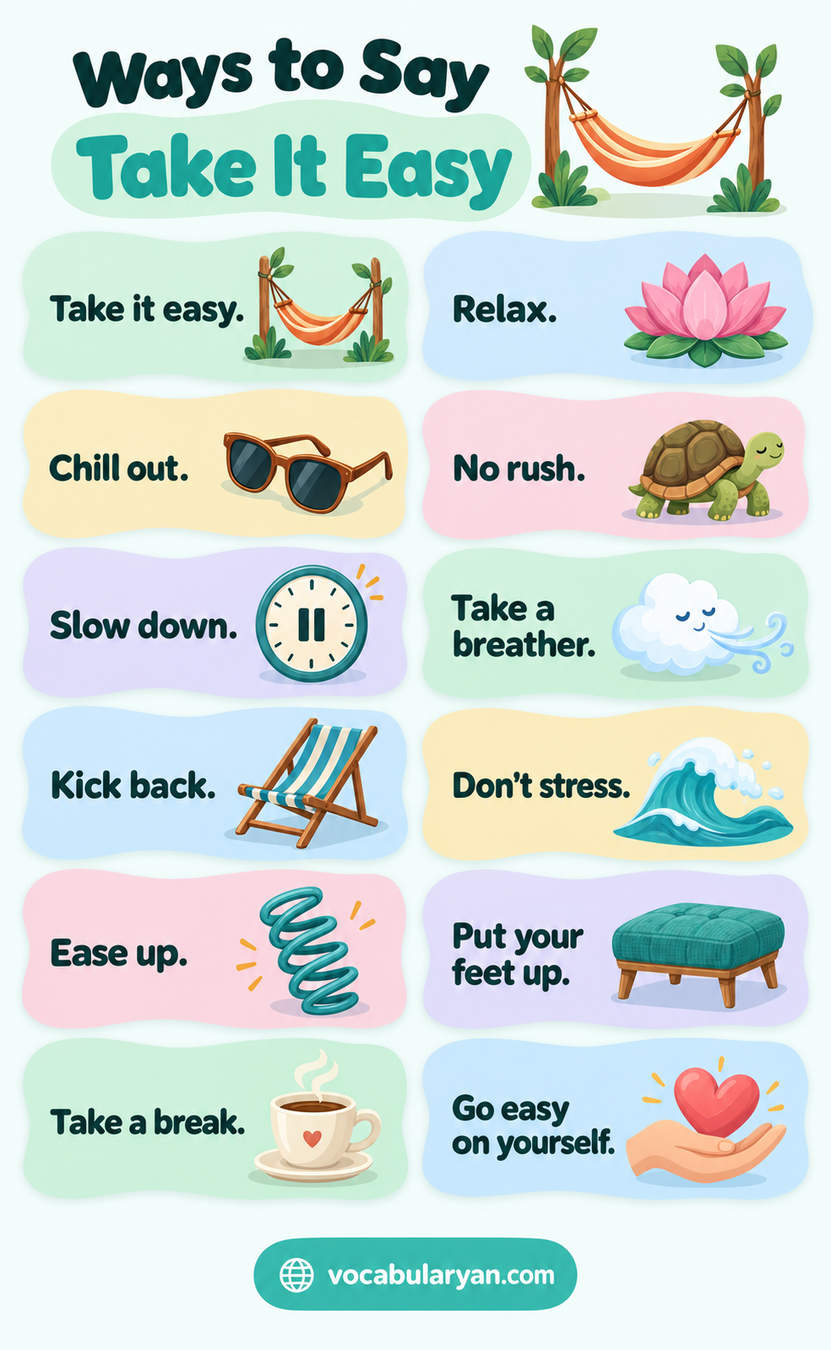
These five phrases cover the three meanings of "take it easy" with people you know well and people you have just met.
Relax: the plainest advice to rest or to stop worrying, and it fits family, friends, and colleagues. Said sharply to someone angry it makes the anger worse, so keep the voice soft.
- Relax, the train doesn’t leave for another forty minutes.
- You’ve been on your feet since six, sit down and relax for a bit.
- I’m going to relax in the garden with a book this afternoon.
Slow down: advice to a person doing too much too fast, in work, in sport, or in speech. It is neutral, so it works with a child, a colleague, or a parent.
- Slow down, Ravi, nobody is marking you on speed.
- The doctor told my dad to slow down after the operation.
- You’re talking so fast I can’t follow, slow down a little.
Take a break: a suggestion to stop for a short time, and the most common form in an office or a classroom.
- Let’s take a break and come back to the budget at three.
- Take a break, Mia, you’ve been staring at that screen for hours.
- I need to take a break from the news for a week.
Don’t overdo it: a warning to a person who will push too hard, and it is the most common form said to someone returning from illness or starting a new sport.
- Have fun at the gym, but don’t overdo it on your first day back.
- Grandma, don’t overdo it with the garden this weekend.
- The physio said I can run again, as long as I don’t overdo it.
Go easy: the gentle meaning of "take it easy", said with "on" plus a person or a thing. It is casual and warm in speech and in messages.
- Go easy on the chilli, the kids are eating too.
- Go easy on Tom in the meeting, he’s had a rough week.
- I’m going to go easy on the coffee this month.
Say "relax" for worry, "slow down" for speed, "don’t overdo it" for effort, and "go easy on" when you want someone to be gentle.
Ways to Say Take It Easy as a Goodbye to Friends
As a goodbye, "take it easy" means little more than "bye", and these phrases are the friends-only forms with the same warmth.
Have a good one: a casual American goodbye that means "have a good day" or "have a good night", and the reply is "you too".
- Right, I’m off, have a good one!
- Thanks for the lift, mate, have a good one.
- Have a good one, and text me when you land.
Catch you later: a goodbye that promises another meeting without naming a time, and it fits friends, classmates, and teammates.
- I’ve got to run to class, catch you later.
- Catch you later, Jess, say hi to your mum.
- Cool, catch you later at the game.
Be good: a fond goodbye from an older friend, a parent, or an aunt, and there is a small joke in it, because it hints that you will not be good.
- Be good, and don’t stay out all night.
- See you Sunday, Nan. Be good!
- Be good, you two, I’ll be back at ten.
Don’t work too hard: a goodbye for a friend or a colleague who is going back to work, and it is a wish rather than an order.
- I’ll leave you to it, don’t work too hard.
- Don’t work too hard, it’s Friday!
- See you at six, and don’t work too hard this afternoon.
Close a chat with a friend on "have a good one" or "catch you later", and keep "be good" for people who laugh at the joke in it.
Ways to Say Take It Easy as a Goodbye at Work
At work the goodbye names the evening or the weekend, and it sounds polite to a manager and warm to a colleague at the same time.
Have a good evening: the standard office goodbye at the end of the day, and it works with anyone from the receptionist to the director.
- Have a good evening, Ms Adeyemi, see you tomorrow.
- I’m off now, have a good evening, everyone.
- Have a good evening, and thanks again for covering the call.
Enjoy your weekend: the Friday form, and it fits a message, a call, or the lift on the way out.
- That’s me done, enjoy your weekend!
- Enjoy your weekend, Priya, you’ve earned it.
- Thanks for the update, enjoy your weekend.
Don’t stay too late: the goodbye to a colleague who is still at a desk when you leave, and it means "take it easy" without the slang.
- I’m heading off, don’t stay too late.
- Don’t stay too late, Omar, the report isn’t due until Thursday.
- Night, Lena, don’t stay too late on that deck.
Get some rest: a goodbye to a colleague who looks tired, and it fits the end of a late shift or a long trip.
- You flew in this morning, get some rest and we’ll talk on Monday.
- Get some rest, Ana, the site can wait.
- Thanks for staying, now get some rest.
Leave a colleague with "have a good evening" on a weekday and "enjoy your weekend" on a Friday, and keep "have a good one" for the people you joke with.
Ways to Say Take It Easy to Someone Stressed or Overworked
Here "take it easy" is advice, and each phrase names a way to stop, breathe, or slow down without sounding like a lecture.
Take a breather: a short stop to breathe and rest, and it fits sport, work, and study with anyone you speak to by first name.
- Take a breather, we’ll finish the boxes after lunch.
- I told the kids to take a breather before the second half.
- Can we take a breather? I’ve been reading contracts since eight.
Pace yourself: advice for a long task, a long run, or a long night, and it means "spread your energy out".
- The exam is three hours, so pace yourself.
- Pace yourself, Nadia, the project runs until June.
- I always tell new drivers to pace yourself on a long trip.
Give yourself a break: said to a person who is hard on themselves, and it asks them to stop the self-blame as well as the work.
- You’ve done more this week than anyone, give yourself a break.
- Give yourself a break, one bad grade won’t end your degree.
- I keep telling my sister to give yourself a break, and she never listens.
Don’t sweat it: casual American advice that means "don’t worry about it", and it fits friends and relaxed colleagues.
- Don’t sweat it, the client loved the first draft.
- You forgot my birthday? Don’t sweat it, we’ll go out next week.
- Don’t sweat it, Jay, I’ll fix the link before anyone notices.
You’ve done enough for today: a kind way to send someone home, and it fits a manager, a partner, or a friend.
- Close the laptop, you’ve done enough for today.
- You’ve done enough for today, Ruth, the rest can wait.
- Honestly, you’ve done enough for today, go and eat something.
One step at a time: advice for a person facing a big task, and it says that the whole task does not need to be done today.
- Just get through the interview, one step at a time.
- One step at a time, first the passport, then the flights.
- She’s learning to walk again, one step at a time.
Say "take a breather" for a short stop, "pace yourself" for a long job, and "give yourself a break" to a person who blames themselves.
Ways to Say Take It Easy to Someone Ill or Recovering
For a person who is unwell, the phrase is a wish for rest, and these forms fit a card, a text, or a visit.
Rest up: the most common advice to someone with a cold, a flu, or an injury, and it fits speech and messages.
- Rest up, and don’t come in until the fever is gone.
- I hope you rest up over the weekend, Tom.
- Rest up, mate, the team can manage without you for a week.
Take it slow: advice for the first days back after illness or surgery, and it means "do less than you want to".
- The nurse said to take it slow for the first fortnight.
- Take it slow on the stairs, your knee is still healing.
- I’m back at work, but I’m going to take it slow this week.
Don’t rush it: said to a person who wants to be better before the body is ready, and it fits a parent, a coach, or a doctor.
- Don’t rush it, a sprained ankle needs three weeks.
- I know you miss football, but don’t rush it.
- Don’t rush it, Grandad, the doctor said two more days in bed.
Look after yourself: a warm goodbye to a person who is unwell, and it fits a card, a call, or a visit. It also works as a plain farewell to anyone, and the page on ways to say take care covers that use.
- Look after yourself, and call me if you need anything.
- Look after yourself, Mrs Kaur, we’ll see you when you’re stronger.
- Right, I’ll let you sleep, look after yourself.
Feel better soon: the wish written in a card or a message to someone ill, and it is the standard form for a colleague.
- Feel better soon, Ana, the office isn’t the same without you.
- Sending soup and a hug, feel better soon!
- I hope you feel better soon, don’t reply to this.
The reply to advice sounds different from the reply to a goodbye, and the two get mixed up at a sickbed.
- Rest up, the doctor said a full week in bed. (reply) You too! ❌
"Rest up" is advice, not a goodbye, so "you too" makes no sense unless the other person is ill as well, and the reply agrees with the advice.
- Rest up, the doctor said a full week in bed. (reply) I will, thanks for coming. ✅
Write "rest up" or "feel better soon" to a colleague, and say "don’t rush it" to a friend who wants to be back on the pitch too early.
Ways to Say Take It Easy to Someone Angry
To an angry person the phrase asks for gentleness, and the softest forms name a breath, a pause, or the person being shouted at.
Easy: the one-word form of "take it easy", said quietly to stop a person who is about to shout or to lift too much. It fits friends and family, and it sounds bossy to a stranger.
- Easy, Ben, he didn’t mean it like that.
- Easy, that box has glass in it.
- Easy, easy, let him finish his sentence.
Go easy on him: a request to be gentle with a person who is getting the anger, and the "him" changes to "her", "them", "me", or a name.
- Go easy on him, he’s only been here a week.
- Can you go easy on her tonight? She’s had bad news.
- Go easy on me, I haven’t played since school.
Ease up: advice to reduce pressure or criticism, and it takes "on" plus a person, in the same way as "go easy".
- Ease up on the new guy, he’s learning.
- Okay, I’ll ease up on the questions until she’s ready.
- Ease up, Dad, it was one scratch on the car.
Keep your cool: advice to stay in control during an argument, and it fits work and sport.
- Keep your cool in the meeting, whatever he says.
- The referee told both captains to keep your cool.
- I managed to keep your cool with the landlord, just about.
Take a deep breath: a gentle instruction that gives an angry or panicked person something to do with the next three seconds.
- Take a deep breath, and then tell me what happened.
- Take a deep breath, Sara, the flight isn’t for two hours.
- I had to take a deep breath before I opened the letter.
Cool it: a short casual order to stop arguing, and it fits friends and teammates. It sounds rude from a stranger, so keep it for people who know you.
- Cool it, you two, the neighbours can hear.
- Cool it, Josh, it’s only a game.
- Okay, I’ll cool it, but he started it.
One trap catches out even native speakers, because the wrong voice turns advice into an insult.
- Would you just relax! (shouted at an angry person) ❌
"Relax" shouted at an angry person sounds like an order and makes the anger worse, so the gentle form names a breath instead.
- Let’s both take a deep breath for a second. ✅
Say "go easy on him" for the person being shouted at and "take a deep breath" for the person shouting, and save "cool it" for close friends.
Ways to Say Take It Easy in a Text
A text form of "take it easy" is two or three words, and an exclamation mark or an emoji replaces the warmth of your voice.
Chill: the shortest advice to relax or to stop worrying, and it fits friends in a message or a group chat.
- Chill, I’m five minutes away.
- Chill, the tickets are in my bag.
- Told him to chill and he sent me a thumbs up.
Don’t stress: the text form of "don’t worry", and it fits a friend or a sibling who is panicking about an exam or a date.
- Don’t stress, you know this stuff better than anyone.
- Don’t stress about the deposit, I’ll cover it till Friday.
- Don’t stress, she’s just late, not lost.
No worries: a reply that means "it’s fine", and also a way to tell a friend to stop apologising. It is Australian in origin and common in every English-speaking country now.
- No worries, I’ll grab the milk on my way.
- Sorry I missed your call! No worries, call me back when you’re free.
- No worries, mate, see you Sunday.
Keep a text to "chill", "don’t stress", or "no worries", and add an exclamation mark so the short form reads as warm.
Ways to Say Take It Easy in an Email
In an email the phrase becomes a full sentence with "I hope" or "please", because a bare "take it easy" reads as slang on a screen.
I hope you get some rest: the closing line for a colleague who is ill or exhausted, and it fits a first-name relationship.
- I hope you get some rest over the weekend, the report can wait.
- Thanks for pushing this through, I hope you get some rest tonight.
- I hope you get some rest, and please don’t reply until you’re back.
Enjoy the break: the line before a holiday, and it fits a colleague, a client, or a manager.
- Enjoy the break, and we’ll pick this up in the new year.
- Enjoy the break, Sam, you’ve more than earned it.
- Speak in September, enjoy the break!
No rush on this: the email form of "take it easy", and it says that the task can wait.
- No rush on this, any time before Friday is fine.
- Attached is the draft, no rush on this at all.
- No rush on this, I know you’re covering two teams this week.
Take your time: the polite line that removes pressure from a request, and it fits colleagues, clients, and students.
- Take your time with the feedback, the deadline is soft.
- Take your time, there’s no need to answer today.
- Please take your time reading the contract before you sign.
Please rest and recover: the formal line to a colleague on sick leave, and it fits a message from HR or a manager.
- Please rest and recover, your work is covered until you return.
- Please rest and recover, and let us know if there is anything you need.
- We were sorry to hear the news, please rest and recover fully before coming back.
The most common email mistake is to paste the spoken goodbye into a message to a manager.
- Thanks for the feedback, take it easy! (email to a director) ❌
"Take it easy" is a spoken goodbye between equals, so in an email to a senior person the same warmth goes into a wish.
- Thanks for the feedback, I hope you have a restful weekend. ✅
End an email with "no rush on this" when you are giving work, and "I hope you get some rest" when the reader is tired.
Formal Ways to Say Take It Easy
Formal forms fit a manager, a client, a patient, or an older relative, and each one is a full sentence with "please" or "I hope".
Please take the time you need: the standard formal line to a colleague after a loss, an illness, or a family problem.
- Please take the time you need, the team will manage.
- Please take the time you need, and we will speak when you are ready.
- Our thoughts are with you, please take the time you need.
There is no hurry: the formal form of "no rush", and it fits a client, a guest, or a patient.
- There is no hurry, Mrs Novak, the form can be returned next week.
- There is no hurry, please finish your coffee first.
- There is no hurry on the signature, take it home and read it.
Do look after yourself: a warm formal line to an older person or a client who has been unwell, common in British English.
- Do look after yourself, Professor Grant, and thank you for the lecture.
- It was lovely to see you, do look after yourself.
- Do look after yourself, the garden can wait until spring.
Please do not overexert yourself: the most formal advice to rest, and it fits a doctor’s letter or a message to a senior colleague after surgery.
- Please do not overexert yourself during the first two weeks at home.
- We are delighted you are back, but please do not overexert yourself.
- Please do not overexert yourself, a short walk each day is enough.
The level of each phrase decides who can hear it without surprise.
| Level | Phrases | Who it fits |
|---|---|---|
| Slang | Chill, no stress, cool your jets, chillax | Close friends your own age |
| Casual | Take it easy, don’t sweat it, have a good one, no worries | Friends, family, relaxed colleagues |
| Neutral | Relax, take a break, get some rest, slow down | Anyone you know by name |
| Formal | I hope you have a restful weekend, please take the time you need | Managers, clients, older relatives |
| Very formal | Please do not overexert yourself, there is no hurry | Doctors’ letters, senior people, guests |
Write "please take the time you need" to a colleague in a hard week, and "there is no hurry" to a client or a guest.
Ways to Say Take It Easy to a Group
A group form adds "everyone", "all", "team", or "you two" to the phrase, and the level matches the room.
Take it easy, everyone: the casual goodbye or the advice at the end of a meeting, a class, or a shift, and it fits a leader who knows the group well.
- Right, that’s a wrap, take it easy, everyone.
- Take it easy, everyone, the heat is going to be brutal today.
- Thanks for coming, take it easy, everyone, and see you next week.
Have a good weekend, all: the Friday goodbye in an office message or a meeting, and it fits any level.
- That’s everything from me, have a good weekend, all.
- Have a good weekend, all, and thanks for a strong sprint.
- Have a good weekend, all, no emails until Monday please.
Get some rest, team: the manager’s goodbye after a long day or a late launch, and it sounds warm and grateful.
- Great work tonight, get some rest, team.
- Get some rest, team, we start again at ten, not eight.
- The site is live, get some rest, team, you’ve earned it.
Don’t burn yourselves out: advice to a group of students or a team under pressure, and it fits a teacher, a coach, or a lead.
- The exam is a month away, don’t burn yourselves out in week one.
- Don’t burn yourselves out, the season is long.
- I want the report done, but don’t burn yourselves out over it.
Say "have a good weekend, all" to a work group and "get some rest, team" after a hard day, and keep "take it easy, everyone" for a team that laughs with you.
Regional Ways to Say Take It Easy in English
Each English-speaking country keeps a form of its own, and most of them are goodbyes with a wish for safety or calm inside them.
British Ways to Say Take It Easy
Take it steady: the British goodbye and advice in one, said to a person leaving or a person recovering, and it means "don’t rush".
- Take it steady on the roads, it’s icy tonight.
- See you Monday, take it steady.
- The doctor said to take it steady for a month.
Mind how you go: a warm British goodbye to a person leaving on foot or by car, and it means "be careful on the way".
- Night, love, mind how you go.
- Mind how you go, the pavement is wet.
- Cheers for the help, mind how you go.
Steady on: a British way to stop a person who is going too far in speech or action, and it fits friends and colleagues.
- Steady on, that’s a bit harsh.
- Steady on, mate, leave some cake for the rest of us.
- Steady on, he was only asking a question.
American Ways to Say Take It Easy
You take it easy now: the Southern American goodbye, said with "you" and "now" for extra warmth, and it fits shops, neighbours, and older relatives.
- You take it easy now, and give my best to your mama.
- Thanks for stopping by, you take it easy now.
- You take it easy now, ma’am, y’all drive safe.
Hang loose: relaxed American advice that means "stay calm and easygoing", and it comes from Hawaiian surf culture.
- Hang loose, the results aren’t in until Friday.
- Just hang loose and let the tour guide sort it out.
- Hang loose, man, we’ll get there when we get there.
Australian and Irish Ways to Say Take It Easy
She’ll be right: the Australian form of "don’t worry", and it means that a problem will fix itself.
- The car’s making a noise. She’ll be right, it always does that.
- She’ll be right, mate, the rain will stop by lunch.
- Missed the ferry? She’ll be right, there’s another at four.
Take it handy: the Irish goodbye and advice in one, and it means "go slowly and carefully".
- Take it handy on the way home, the roads are flooded.
- Right, I’m off, take it handy.
- Take it handy, Sean, you’ve only just got out of hospital.
Mind yourself: the Irish goodbye to a person you care about, and it means "look after yourself".
- Mind yourself, love, and ring me when you get in.
- Mind yourself on those steps.
- Good luck in Dublin, mind yourself.
Match the country: "take it steady" for a British friend, "you take it easy now" for the American South, "she’ll be right" for Australia, "take it handy" for Ireland.
Slang Ways to Say Take It Easy
Slang forms are for friends your own age, and most of them ask a person to relax or to calm down in a playful voice.
Chillax: "chill" and "relax" in one word, and it is a joke as much as advice, so it fits close friends only.
- Chillax, the pizza will be here in ten.
- I told her to chillax and she threw a cushion at me.
- Chillax, bro, nobody saw you fall.
No stress: the slang form of "no worries", and it fits a text or a chat when a friend apologises or panics.
- Running late? No stress, I’ll get us a table.
- No stress, I’ll send you the notes tonight.
- No stress, man, it’s your round next time.
Cool your jets: playful American slang that means "calm down and wait", said to a person who is impatient or excited.
- Cool your jets, the shop doesn’t open until nine.
- Cool your jets, Ali, she said she’d call, not that she’d marry you.
- Okay, cool your jets, I’m getting the keys.
Take a chill pill: a joke instruction to calm down, said between teenagers and friends, and it sounds rude to anyone older.
- Take a chill pill, it’s only a video game.
- Someone needs to take a chill pill before the party.
- Take a chill pill, Dan, the bus is always late.
Keep your shirt on: American slang that means "don’t get angry, wait", and it fits friends and family.
- Keep your shirt on, I’m coming!
- Keep your shirt on, the food will be out in a minute.
- Okay, okay, keep your shirt on, I’ll move the car.
Keep "chillax", "cool your jets", and "take a chill pill" for friends who will laugh, and say "relax" to everyone else.
Funny Ways to Say Take It Easy
A funny form makes a small joke out of the goodbye or the advice, and each one belongs with a person who knows your sense of humour.
Don’t do anything I wouldn’t do: a goodbye joke to a friend going out for the evening, and the joke is that the speaker would do plenty.
- Have fun tonight, don’t do anything I wouldn’t do.
- Don’t do anything I wouldn’t do, which leaves you a lot of options.
- See you at the airport, don’t do anything I wouldn’t do.
Easy, tiger: a teasing way to slow down a person who is too excited, too fast, or too flirty.
- Easy, tiger, it’s only the first date.
- Easy, tiger, leave some chips for me.
- Easy, tiger, the car isn’t even paid for yet.
Hold your horses: an old phrase that means "wait and calm down", and it is funny now because of the picture of horses in it.
- Hold your horses, I haven’t finished the story.
- Hold your horses, the paint needs to dry first.
- Hold your horses, Dad, we’ll open the presents after dinner.
Try not to burn the place down: a goodbye joke to a friend or a teenager left in charge of a house or an office.
- I’m off for the weekend, try not to burn the place down.
- Try not to burn the place down, there’s pasta in the fridge.
- You’re in charge of the shop, try not to burn the place down.
Save the funny forms for friends who tease you back, because "easy, tiger" to a manager is a mistake you will hear about.
How Do You Reply When Someone Says Take It Easy?
The reply depends on which of the three meanings you heard: a goodbye gets a goodbye back, advice gets a promise, and a request to be gentle gets an agreement.
Take it easy as a goodbye: the reply is "you too", "will do", or the same words back.
- Take it easy, Sam. You too, see you Monday.
- Have a good one! Will do, cheers.
- Catch you later. Later, drive safe.
Take it easy as advice: the reply promises to rest, and it thanks the speaker if the advice is kind.
- Take it easy this weekend, you look shattered. I will, I’m sleeping until noon.
- Rest up, okay? I’ll try, thanks for checking on me.
- Don’t overdo it at the gym. I won’t, twenty minutes and I’m done.
Take it easy on someone: the reply agrees, or explains why the pressure was there.
- Go easy on him, it’s his first week. Fair enough, I’ll go through it again with him.
- Ease up on the questions. Okay, okay, I’ll wait until she’s ready.
- Take it easy on me, I’m new to this. No problem, we’ll start with the basics.
Take it easy as a request to calm down: the reply admits the heat or pushes back gently.
- Easy, Ben. Sorry, that came out louder than I meant.
- Keep your cool. I’m fine, I just need a minute.
- Cool it, you two. He started it, but okay.
Answer a goodbye with "you too", answer advice with "I will", and answer "go easy on him" with "fair enough".
More Everyday English Phrases
- Other Ways to Say Have a Nice Day
- Other Ways to Say Sweet Dreams
- Other Ways to Say Good Night
- Other Ways to Say Take Care
- Other Ways to Say Calm Down
FAQs
The count changes with the meaning, because "take it easy" works as a goodbye, as advice, and as a request to be gentle, and each meaning has its own set of phrases. This page covers more than sixty across the three, and the core ones are "relax", "have a good one", "rest up", and "go easy on". Most new forms are slang, and they arrive and disappear within a few years.
The professional form is a wish or a request in a full sentence: "I hope you have a restful weekend", "please take the time you need", or "no rush on this". A bare "take it easy" reads as slang in an email to a manager or a client, so the same warmth goes into "I hope" or "please". In speech at work, "have a good evening" and "enjoy your weekend" do the same work as the casual goodbye.
Yes, between friends, family, and colleagues who use first names, "take it easy" is a normal goodbye with no advice in it. It sounds too relaxed to a manager you have just met, a client, or an older stranger, so those people get "have a good evening" or "goodbye". The page on ways to say goodbye covers the full set of farewells.
Reply with "you too" or "will do" when it is a goodbye, and with "I will" or "I’ll try" when it is advice to rest. If someone says "take it easy on him", the reply is "fair enough" or "okay", because the phrase is a request rather than a farewell. Three words are enough for any of the three.
"Rest up", "feel better soon", and "don’t rush it" are the three most common forms for a person who is ill or recovering. "Rest up" fits a message or a visit, "feel better soon" fits a card, and "don’t rush it" fits a friend who wants to return to work or sport too early. In a formal message, "please rest and recover" is the same wish.
No, "take it easy" is friendly in almost every setting, and it becomes rude only when it is said sharply to an angry person, because then it sounds like "stop being silly". To someone upset, the gentle forms are "take a deep breath" and "let’s take a minute". To a senior person, the risk is not rudeness but over-familiarity, and the formal forms fix that.
"Take it easy" first meant "do things without effort", and by the early twentieth century it was common American advice to relax. The goodbye meaning grew out of the advice, in the same way "take care" grew from "take care of yourself". The "on" form ("take it easy on him") keeps the oldest meaning, because it asks for less force.
"Chill", "don’t sweat it", "no worries", and "have a good one" are the four casual forms a friend hears most. The first three answer stress or an apology, and the last one is a goodbye. "Chillax" and "cool your jets" are the same advice in a joke, so they fit close friends only.