
"Welcome" is said to a person at the moment they arrive, and it always names a place or a group: a home, a team, a shop, a class. That is the difference from "you’re welcome", the reply to "thank you", which has its own page. The ways to say welcome on this page change with the person at the door, and the everyday forms come first.
Different Ways to Say Welcome in English
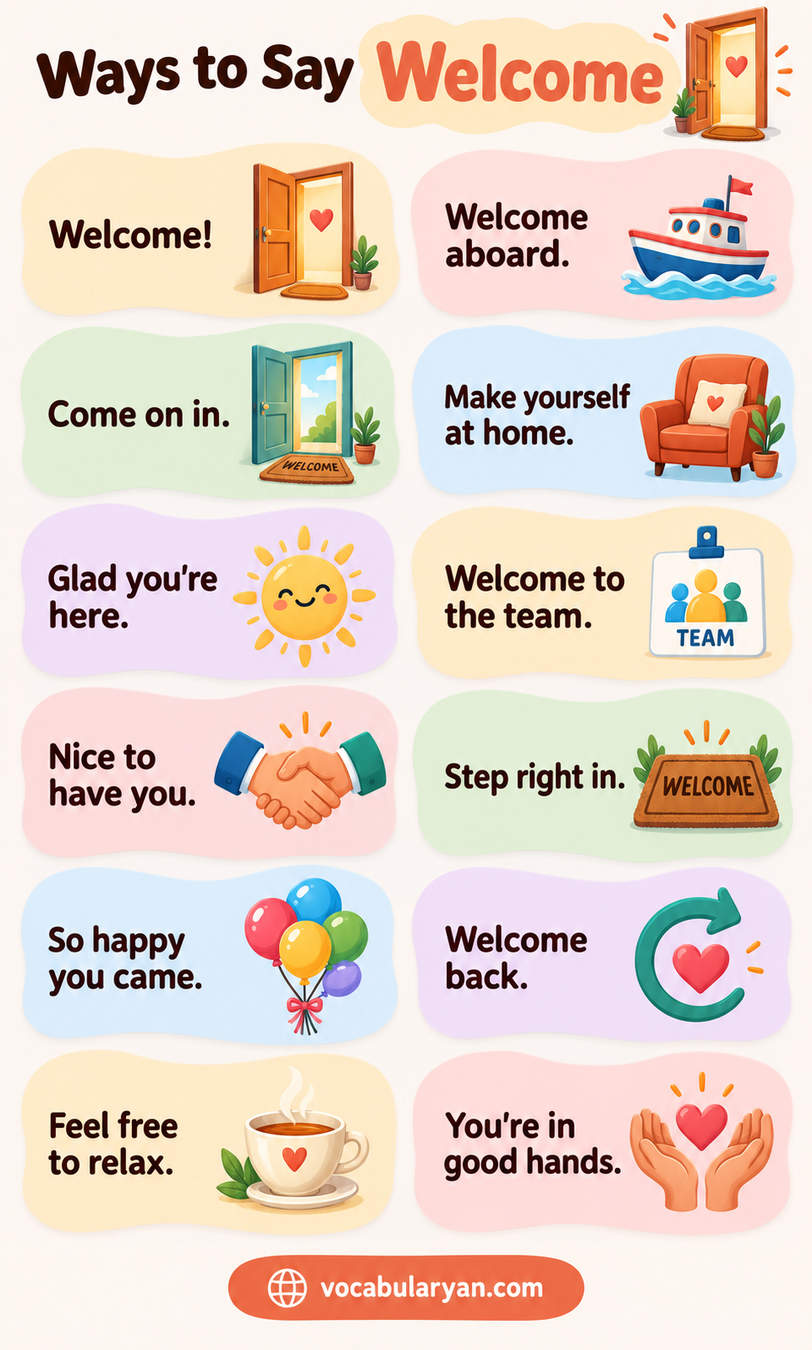
These greetings fit almost every arrival, from a friend at the door to a visitor at a front desk, and each one is short.
Welcome: the one-word greeting for anyone who arrives, and it works at every level. Add a place after "to" and the greeting becomes more personal.
- Welcome, come in out of the wind.
- Welcome, Mr Osei, we have your room ready.
- Welcome to Leeds, did you find the office without trouble?
Come on in: the casual welcome said as you open the door, and it means "enter, you are wanted here". It fits friends, neighbours, and relaxed customers.
- Come on in, Priya, the coffee’s just made.
- Come on in! Don’t worry about your shoes.
- Hi, Marco, come on in and take a seat by the fire.
Glad you’re here: a warm greeting for someone you were hoping to see, and it fits a friend, a new colleague, or a guest at a party.
- Glad you’re here, Sam, we need your help with the quiz.
- So glad you’re here at last, the traffic must have been terrible.
- Glad you’re here, everyone, let’s get started.
Make yourself at home: the line that follows "welcome" once a guest is inside, and it means "relax, sit where you like, and take what you need".
- Come in, make yourself at home, I’ll be down in a minute.
- Make yourself at home, the towels are in the cupboard by the bath.
- Welcome, Aisha, make yourself at home while I put the kettle on.
Say "welcome" first, then "come on in" or "make yourself at home", because the second line is the one that puts a guest at ease.
Ways to Say Welcome to a Guest at Home
A welcome at the front door names the guest, opens the door wide, and says where the guest goes next.
Come in, come in: the doubled form, said with a smile when a guest is cold, wet, or shy about entering.
- Come in, come in, you must be frozen.
- Come in, come in, everyone’s dying to meet you.
- Oh, hello, Ruth, come in, come in, mind the dog.
We’ve been looking forward to your visit: a warm line for a guest who travelled to see you, and it fits family, old friends, and a partner’s relatives.
- We’ve been looking forward to your visit since Christmas.
- Welcome, Tomas, we’ve been looking forward to your visit all month.
- We’ve been looking forward to your visit, the kids have made a sign.
Make yourself comfortable: the polite form of "make yourself at home", and it fits a guest you know less well.
- Make yourself comfortable, I’ll bring the tea through.
- Please make yourself comfortable, Mrs Novak, dinner will be twenty minutes.
- Sit anywhere, make yourself comfortable, the cushions are for using.
Let me take your coat: a welcome and an offer in one, said at the door before the guest takes a seat.
- Welcome! Let me take your coat, it’s soaking.
- Let me take your coat, Mr Chen, and please go through to the lounge.
- Hi, Dana, let me take your coat and your bag.
You’re always welcome here: a line for a close friend or relative that means "come any time, no invitation needed".
- You’re always welcome here, Ben, you know that.
- Don’t wait for a birthday, you’re always welcome here.
- You’re always welcome here, and so are the children.
Open the door with "come in, come in", then take the coat, because a guest relaxes when the host gives the next step.
Ways to Say Welcome to a New Colleague or Employee
A welcome at work names the team or the company, and it goes with an offer of help on the first day.
Welcome to the team: the standard first-day greeting from a manager or a colleague, spoken or written, at every level of the company.
- Welcome to the team, Fatima, your desk is by the window.
- Welcome to the team! Ask me anything, however small.
- Hi, Raj, welcome to the team, I’ll show you where the kitchen is.
Welcome aboard: the greeting for someone who joins a company, a crew, or a project, and it comes from ships. It sounds friendly and a little formal at the same time.
- Welcome aboard, Mr Petrov, your badge is ready at reception.
- Welcome aboard! Your first meeting is at ten.
- The whole department says welcome aboard, Lucy.
We’re glad to have you with us: a neutral welcome from a manager on the first day, and it fits a speech, an email, or a handshake.
- We’re glad to have you with us, Ana, the project needed your experience.
- We’re glad to have you with us, and your mentor will meet you at nine.
- From the whole office, we’re glad to have you with us.
It’s great to have you on board: warmer than "welcome aboard", and it fits a colleague who joins your own team.
- It’s great to have you on board, Jess, we start with the client call.
- Honestly, it’s great to have you on board at last.
- It’s great to have you on board, and the team lunch is on Friday.
Let me show you around: the offer that follows a welcome on the first day, and it turns the greeting into an action.
- Welcome to Northfield, let me show you around before the meeting.
- Let me show you around, the printer is the one thing everyone gets lost looking for.
- Welcome aboard, Priya, let me show you around the floor.
Say "welcome to the team" first and "let me show you around" second, because a new colleague needs a greeting and a tour in the same minute.
Ways to Say Welcome to a New Team Member in an Email
An email welcome names the person, names the team, and ends with the one thing the new member does next.
Welcome to the team, Sara: the opening line of a welcome email, with the name after a comma, and it works from a manager or a colleague.
- Welcome to the team, Sara, we’re all pleased you accepted the offer.
- Welcome to the team, Sara! Your login details are in a separate email.
- Welcome to the team, Sara, and thank you for starting a week early.
We’re delighted to have you join us: a formal welcome for the first line of an email from a manager or a director.
- We’re delighted to have you join us as our new finance lead.
- Dear Mr Chen, we’re delighted to have you join us from Monday.
- We’re delighted to have you join us, and the team is ready to support you.
Please join me in welcoming Sara: the line for an email to the whole team that introduces the new member, and it comes before the person’s role.
- Please join me in welcoming Sara, who starts as our new designer today.
- Hi all, please join me in welcoming Sara to the sales team.
- Please join me in welcoming Sara, she has joined us from the Manchester office.
A warm welcome to Sara: the short group form, common in team messages and on the first line of an announcement.
- A warm welcome to Sara, our new project manager.
- Hi everyone, a warm welcome to Sara, who joined us this morning.
- A warm welcome to Sara from the whole marketing team.
Please don’t hesitate to ask: the closing line of a welcome email, and it says that questions are wanted.
- Please don’t hesitate to ask if anything is unclear in the handbook.
- Welcome aboard, and please don’t hesitate to ask me for anything.
- The team is friendly, so please don’t hesitate to ask whoever is nearest.
"Welcome" is a greeting, and "welcomed" is the past form of the verb, so the two do not swap in the first line.
- Welcomed to the team, Sara! ❌
The greeting is the bare word "welcome", and "welcomed" needs "was" or "will be" in front of it: "you will be welcomed".
- Welcome to the team, Sara! ✅
Open a welcome email with the person’s name, name the team in the first line, and close with "please don’t hesitate to ask".
Ways to Say Welcome to a Customer in a Shop or Hotel
A customer welcome names the business and offers help in the same breath, and the level is polite and neutral.
Welcome to Rivera’s: the greeting at the door of a shop, café, or restaurant, with the name of the business after "to".
- Welcome to Rivera’s, table for two?
- Welcome to Rivera’s, let me know if you need any sizes.
- Good evening, welcome to Rivera’s, do you have a booking?
Welcome, how can I help you today?: the front-desk greeting in a shop or a bank, and the question turns the welcome into service.
- Welcome, how can I help you today?
- Good morning, welcome, how can I help you today? Are you collecting an order?
- Welcome, how can I help you today? The sale rail is at the back.
Welcome to the Grand Hotel: the reception greeting on arrival, followed by the guest’s name and the words "we have your reservation".
- Welcome to the Grand Hotel, Mrs Ali, we have your reservation for three nights.
- Welcome to the Grand Hotel, may I take your passport for a moment?
- Good afternoon, welcome to the Grand Hotel, the lift is on your left.
We hope you enjoy your stay: the line that ends a hotel check-in, and it fits a receptionist or a host.
- Here is your room card, we hope you enjoy your stay.
- We hope you enjoy your stay, Mr Lewis, breakfast is from seven.
- Welcome to Bath, we hope you enjoy your stay with us.
Name the business after "welcome to", then ask "how can I help you today?", because a customer wants a greeting and an offer in one line.
Ways to Say Welcome to a New Student or Class
A classroom welcome comes from the teacher on the first day, and it names the class, the course, or the school.
Welcome to the class: the first-day greeting from a teacher, spoken to the whole room or to one student who joins later in the year.
- Welcome to the class, everyone, my name is Ms Grant.
- Welcome to the class, Yusuf, there’s a seat next to Mia.
- Good morning, welcome to the class, please take a handout as you come in.
Let’s give a warm welcome to our new classmate: the teacher’s line that asks the class to greet a new student, and the class claps or says hello.
- Let’s give a warm welcome to our new classmate, Hana, who has moved here from Osaka.
- Let’s give a warm welcome to our new classmate, and Ben, please share your book today.
- Everyone, let’s give a warm welcome to our new classmate.
We’re happy to have you in our school: a formal welcome from a head teacher or a tutor to a new student and the parents.
- We’re happy to have you in our school, Daniel, and your form tutor is Mr Ali.
- We’re happy to have you in our school, Mrs Novak, the office will send the timetable tonight.
- On behalf of all the staff, we’re happy to have you in our school.
Greet a new student by name in front of the class, because a name in the first minute makes the rest of the day easier.
Ways to Say Welcome to an Audience at an Event
An event welcome names the occasion and the people in the room, and it comes at the very start of a speech.
Good evening and welcome: the opening line of a host or a speaker, with the time of day before "welcome".
- Good evening and welcome to the spring concert.
- Good evening and welcome, everyone, please take your seats.
- Good evening and welcome to the fortieth annual dinner.
Thank you all for being here: the line that follows the greeting, and it thanks the audience for their time.
- Thank you all for being here on a Saturday morning.
- Welcome, and thank you all for being here to support the school.
- Thank you all for being here, I know many of you travelled a long way.
On behalf of the committee, I would like to welcome you: the most formal event opening, and "on behalf of" names the group that the speaker represents.
- On behalf of the committee, I would like to welcome you to this year’s awards.
- On behalf of the committee, I would like to welcome you and thank our sponsors.
- On behalf of the committee, I would like to welcome you to Riverside Hall.
Please give a warm welcome to: the line that introduces a speaker or a performer, and the audience claps at the name.
- Please give a warm welcome to our first speaker, Dr Amara Okafor.
- Ladies and gentlemen, please give a warm welcome to the school choir.
- Please give a warm welcome to tonight’s host, Sam Reyes.
Open a speech with "good evening and welcome", thank the room, and keep the whole welcome to three sentences before the first real line.
Ways to Say Welcome to a New Member of a Group or Club
A group welcome names the club, the team, or the online community, and it comes from the whole group rather than one person.
Welcome to the group: the standard greeting for a new member of a club, a choir, a chat, or a forum.
- Welcome to the group, Maya, we meet on Thursdays at seven.
- Welcome to the group! Say hi and tell us what you’re reading.
- Hi, Dev, welcome to the group, the rules are pinned at the top.
Welcome to the club: the greeting for a new member of a real club, and, as a joke, for someone who has just had the same bad luck as you.
- Welcome to the club, Ali, your membership card is in the post.
- Welcome to the club, the first training session is free.
- You missed the train too? Welcome to the club.
Feel free to introduce yourself: the invitation that follows a group welcome, and it gives the new member a first action.
- Welcome to the group, and feel free to introduce yourself when you’re ready.
- Feel free to introduce yourself to the others at the break.
- Feel free to introduce yourself in the chat, nobody bites.
You’re one of us now: a fond, slightly playful greeting once a new member has done the first task with the group.
- You’re one of us now, Jack, you’ve survived the first rehearsal.
- Three hikes in, you’re one of us now.
- You’re one of us now, so bring biscuits next time.
Write "welcome to the group" and "feel free to introduce yourself" together, because a new member needs both a greeting and a first step.
Ways to Say Welcome Back After Time Away
A welcome for someone who returns names the time apart, and it fits a colleague after leave, a friend after a trip, or a customer who comes back.
Welcome back: the standard greeting for anyone who returns to a place you share, at every level.
- Welcome back, Nadia, how was the honeymoon?
- Welcome back, class, I hope you all rested.
- Welcome back, Mr Chen, your usual room is ready.
Welcome home: the greeting for someone who returns to their own house, town, or country, and it sounds warm and personal.
- Welcome home, love, the fridge is full.
- Welcome home! We missed you every single day.
- Welcome home, Grandad, the garden survived without you.
Look who’s back: a playful welcome for a friend or colleague who returns, said to the room as much as to the person.
- Look who’s back! How was Japan?
- Look who’s back from the dead, you look well.
- Well, look who’s back, the tan suits you.
Long time no see: the greeting for a friend you have not seen for months, and it belongs to the hello page in full. Here it opens a welcome for a returning friend before "come in".
- Long time no see, Aisha, come in, come in.
- Long time no see! Welcome back to the club.
- Well, long time no see, sit down and tell me everything.
Say "welcome back" to a colleague and "welcome home" to family, and add "we missed you" only to people who know you well.
Ways to Say Welcome in a Text
A text welcome is short, and an exclamation mark or a name replaces a smile.
Welcome!: the one-word text, common in a group chat when a new number joins.
- Welcome! Great to have you in the chat.
- Welcome! Mute this group at your peril.
- Welcome! Say hi, everyone, Dana just joined.
So glad you’re here!: a warm text for a friend who has just arrived in town or at an event you organised.
- So glad you’re here! I’m by the main door.
- So glad you’re here! Come find us at the back table.
- So glad you’re here! Text me when you’re through security.
You made it!: the text for a friend who arrives after a long journey or a hard week, and it fits a group chat too.
- You made it! Welcome to Lisbon, sleep first, then call.
- You made it! The door’s unlocked, come straight up.
- You made it! First day done, welcome to the team.
Keep a text welcome to four words, add the name, and let the exclamation mark carry the warmth.
Ways to Say Welcome in a Card or on a Sign
A written welcome on a card, a banner, or a door sign uses the fewest words, and it names the reader or the place.
Welcome home!: the words on a banner at the airport or the front door for someone who returns after months away.
- Welcome home! We love you.
- Welcome home! Sixty days was sixty too many.
- Welcome home, Dad, the dog cried the whole time.
Welcome to our neighbourhood: the line on a card left for new neighbours, with a name and a phone number underneath.
- Welcome to our neighbourhood, we’re at number twelve if you need anything.
- Welcome to our neighbourhood! Bins go out on Tuesday nights.
- Welcome to our neighbourhood, the bakery on the corner opens at seven.
Welcome to the family: the card line for a new son-in-law, a daughter-in-law, an adopted child, or a new pet, and it sounds warm and permanent.
- Welcome to the family, Marco, you’re stuck with us now.
- Welcome to the family, little one.
- Welcome to the family, we’re so happy Ana chose you.
Welcome to the world: the words on a card for a new baby, sent to the parents.
- Welcome to the world, baby Zara.
- Welcome to the world, little Theo, your parents are wonderful.
- Welcome to the world! Congratulations to you both.
Put the reader’s name on a card and the place on a sign, and keep the welcome under six words.
Formal Ways to Say Welcome
A formal welcome speaks for a group, uses a title and surname, and goes with "on behalf of" or "we are honoured".
We’re pleased to welcome you: the standard formal greeting for a visitor, a client, or a new senior colleague, spoken or written.
- We’re pleased to welcome you to the head office, Mr Diaz.
- We’re pleased to welcome you as our new head of research.
- On behalf of the board, we’re pleased to welcome you, Dr Okafor.
It’s an honour to have you here: a very formal welcome for a guest of honour, a senior official, or a famous speaker.
- It’s an honour to have you here, Ambassador.
- It’s an honour to have you here, Professor Grant, please take the seat at the front.
- It’s an honour to have you here at our small school.
Thank you for joining us: a polite welcome for a meeting, a webinar, or a formal dinner, and the reply is "thank you for having me".
- Thank you for joining us today, we’ll begin with the agenda.
- Thank you for joining us, Mrs Novak, the others are on the line.
- Thank you for joining us for the annual review.
We are honoured by your presence: the highest level of welcome, kept for ceremonies, royalty, and heads of state.
- We are honoured by your presence, Your Excellency.
- We are honoured by your presence at this year’s graduation.
- The whole town says we are honoured by your presence today.
You are most welcome: a very polite arrival greeting, common in South Asian and Irish English, and it means "you are very welcome here". Outside those places it is heard as a reply to "thank you".
- You are most welcome in our home, Mr Rahman.
- You are most welcome, please sit and eat with us.
- You are most welcome to our village, the whole family is here to greet you.
The one mistake at the door is "you’re welcome", because that is the reply to "thank you" and not a greeting.
- You’re welcome, Mr Chen, please come in. ❌
"You’re welcome" answers thanks, so an arriving guest hears an answer to a question they never asked, and the greeting is the bare "welcome".
- Welcome, Mr Chen, please come in. ✅
Every welcome on this page belongs to one of five levels.
| Level | Welcomes | Who it fits |
|---|---|---|
| Slang | Welcome to the chaos, look who’s back, you’re one of us now | Close friends, teammates you joke with |
| Casual | Come on in, make yourself at home, glad you’re here | Friends, family, neighbours |
| Neutral | Welcome, welcome to the team, good to have you here | Colleagues, customers, new members |
| Formal | We’re pleased to welcome you, thank you for joining us | Clients, senior colleagues, audiences |
| Very formal | It’s an honour to have you here, we are honoured by your presence | Guests of honour, ceremonies, officials |
Use "we’re pleased to welcome you" with a title and surname, and save "we are honoured by your presence" for a ceremony.
Casual Ways to Say Welcome
A casual welcome is for friends, family, and neighbours, and each one sounds quick, warm, and a little playful.
Get in here: a warm, bossy welcome for a close friend or a relative, said with open arms.
- Get in here, you, it’s been months.
- Get in here and give me a hug.
- Get in here, the pizza’s getting cold.
Help yourself: the casual welcome to food and drink, and it means "take what you want without asking".
- Come in, help yourself, the snacks are on the table.
- Help yourself to a drink from the fridge.
- Welcome, everyone, help yourself, there’s plenty.
Good to see you: the everyday welcome for a friend at the door or at a table, and it fits any age.
- Good to see you, Ravi, come on through.
- Hey, good to see you, sit down.
- Good to see you both, welcome to the new place.
"You’re welcome to" plus a verb gives permission, and the "you’re" and the "to" both stay.
- Welcome to join us for dinner at seven. ❌
Without "you’re", "welcome to" needs a place, not a verb, so "welcome to join" is not English.
- You’re welcome to join us for dinner at seven. ✅
Keep "get in here" and "help yourself" for people who have been to your home before, and use "good to see you" with everyone else.
Regional Ways to Say Welcome
English-speaking countries each keep a welcome of their own, and using the local one at the door earns a smile at once.
British Ways to Say Welcome
Come through: the British welcome that moves a guest from the hall to the living room or the kitchen.
- Welcome, come through, the kettle’s on.
- Come through to the garden, everyone’s out the back.
- Hiya, come through, mind the bikes.
Get yourself in: a friendly northern British welcome for a guest who is cold or wet.
- Get yourself in, it’s bitter out there.
- Get yourself in, love, and I’ll put the fire on.
- Oh, get yourself in, you’re soaked.
American Ways to Say Welcome
Welcome in: the newer American shop greeting, said by staff as a customer steps through the door.
- Welcome in! Let me know if you need help finding anything.
- Welcome in, the fitting rooms are on your right.
- Hi there, welcome in, we’ve got a sale on shoes today.
Come on in, y’all: the Southern American welcome for a group, with "y’all" for "you all".
- Come on in, y’all, supper’s nearly ready.
- Come on in, y’all, and get out of that heat.
- Welcome, come on in, y’all, there’s sweet tea on the porch.
Australian and Irish Ways to Say Welcome
G’day, come in: the Australian door greeting, with "g’day" for hello and "come in" for the welcome.
- G’day, come in, mate, the beer’s cold.
- G’day, come in, you found the place then?
- G’day, come in, the kids are in the pool.
Céad míle fáilte: the Irish welcome that means "a hundred thousand welcomes", said "kayd mee-la fawl-cha" and printed on signs across Ireland.
- Céad míle fáilte, welcome to Galway.
- The sign over the pub door said céad míle fáilte.
- Céad míle fáilte, come in and warm yourself.
You’re very welcome: in Ireland this is the arrival greeting, and it means "we are glad you came". The same words mean "no problem" after thanks everywhere else.
- You’re very welcome, come in, sit by the fire.
- You’re very welcome to Cork, is this your first time?
- You’re very welcome, the two of you, the dinner’s nearly on the table.
Use "come through" in Britain, "welcome in" in an American shop, and "you’re very welcome" at an Irish door, and use "welcome" everywhere else.
Funny Ways to Say Welcome
A funny welcome is for friends who know your humour, and each one jokes about the host, the house, or the guest.
Welcome to the chaos: a joke welcome to a busy home with children, pets, or a half-finished kitchen.
- Welcome to the chaos, mind the toys on the stairs.
- Welcome to the chaos, we’ve got three dogs and no sofa.
- Come in, welcome to the chaos, the twins are teething.
Look who finally made it: a teasing welcome for a friend who arrives late, said with a grin.
- Look who finally made it, we ate your share.
- Well, look who finally made it, only an hour late.
- Look who finally made it! Did you walk from London?
Come in before we eat everything: a joke welcome that says "you are late and the food is going".
- Come in before we eat everything, the lasagne’s half gone.
- Come in before we eat everything, Tom’s on his third plate.
- Quick, come in before we eat everything!
Save the joke welcomes for guests who will laugh, because a stranger hears "welcome to the chaos" as a real warning.
How Do You Reply When Someone Says Welcome?
A welcome asks for thanks, so the reply is "thank you" plus a short line about being glad to be there, and a "welcome back" gets "it’s good to be back".
Welcome and welcome to the team: the reply thanks the speaker and adds one line about being pleased.
- Welcome to the team. Thank you, I’m really pleased to be here.
- Welcome to our home. Thank you for having me, what a lovely house.
- Welcome aboard. Thanks, I’ve been looking forward to this.
Come on in and make yourself at home: the reply is short and casual, and it needs no "thank you" in full.
- Come on in. Cheers, is it okay to leave my shoes here?
- Make yourself at home. Thanks, I will.
- Grab a seat. Great, thanks.
Welcome back and welcome home: the reply agrees that it is good to be back, and it says a word about the time away.
- Welcome back. Thanks, it’s good to be back, the trip was long.
- Welcome home. It’s so good to be home, I missed this kitchen.
- Look who’s back. Yes, I’m back, and I brought cake.
Thank you for joining us: the formal reply returns the thanks, and "thank you for having me" is the standard form.
- Thank you for joining us. Thank you for having me.
- We’re pleased to welcome you. Thank you, it’s a pleasure to be here.
- It’s an honour to have you here. The honour is mine.
Welcome to the group: the reply says thanks and gives a first line about yourself.
- Welcome to the group. Thanks! I’m Maya, I’ve been running for about a year.
- Welcome to the chat. Hi all, thanks for adding me.
- Welcome to the club. Thanks, when is the next session?
Answer a welcome with "thank you" and one more sentence, and answer "welcome back" with "it’s good to be back".
More Everyday English Phrases
- Other Ways to Say Nice to Meet You
- Other Ways to Say How Are You
- Other Ways to Say What’s Up
- Other Ways to Say Good Evening
FAQs
The forms that fit most arrivals are "welcome to…" plus a place, "come on in", "glad you’re here", and "make yourself at home". At work the forms are "welcome to the team", "welcome aboard", and "we’re pleased to welcome you". For someone who returns, the forms are "welcome back" and "welcome home". Each one changes with the person at the door and with how well you know them.
No, because "welcome" greets a person who arrives, and "you’re welcome" answers a person who says "thank you". "Welcome to the team" is said on a first day, and "you’re welcome" is said after "thanks for the lift". The two swap in Ireland only, where "you’re very welcome" is a greeting at the door. The reply to "thank you" has its own page.
Use "we’re pleased to welcome you", "welcome to the team", or "thank you for joining us", with the person’s title and surname on a first meeting. In an email, put the name in the first line and end with "please don’t hesitate to ask". In a speech, open with "on behalf of" and the name of the group you represent.
Say "come on in", "make yourself at home", "we’ve been looking forward to your visit", or "let me take your coat". Each one is said at the door, and each one gives the guest a next step. A guest relaxes faster after "make yourself at home" than after "welcome" alone.
Say "thank you" and add one short line: "thank you, I’m glad to be here" or "thanks for having me". After "welcome back" the reply is "it’s good to be back", and after "thank you for joining us" the reply is "thank you for having me". A long reply is not needed.
Yes, when it is said to a person who arrives, "welcome" is a greeting, and it goes with a place: "welcome to Leeds", "welcome to the class". It is not a greeting when it is said alone as a reply to "thank you", and in that position the full form "you’re welcome" is needed outside Ireland.
Say "welcome" as the greeting, because the greeting is the bare word, as in "welcome to the team". "Welcomed" is the past form of the verb, and it needs "was" or "will be" in front of it: "she was welcomed by the whole office". "Welcomed to the team, Sara" is a mistake in the first line of an email.
Say "welcome aboard", "it’s great to have you on board", "we’re glad to have you with us", or "we’re excited to have you on the team". In an email to the whole group, "please join me in welcoming Sara" or "a warm welcome to Sara" fits. Add "let me show you around" or "please don’t hesitate to ask" so the greeting ends with an offer of help.