
"I don’t think so" is used in two ways. Said flat, it is a soft no with room for doubt. With stress on "think", it is a firm refusal: "I don’t THINK so!" to a friend who wants your car. The other ways to say I don’t think so split along the same line, from a gentle "I doubt it" to a hard "not a chance". The soft forms come first.
Common Ways to Say I Don’t Think So in Everyday English
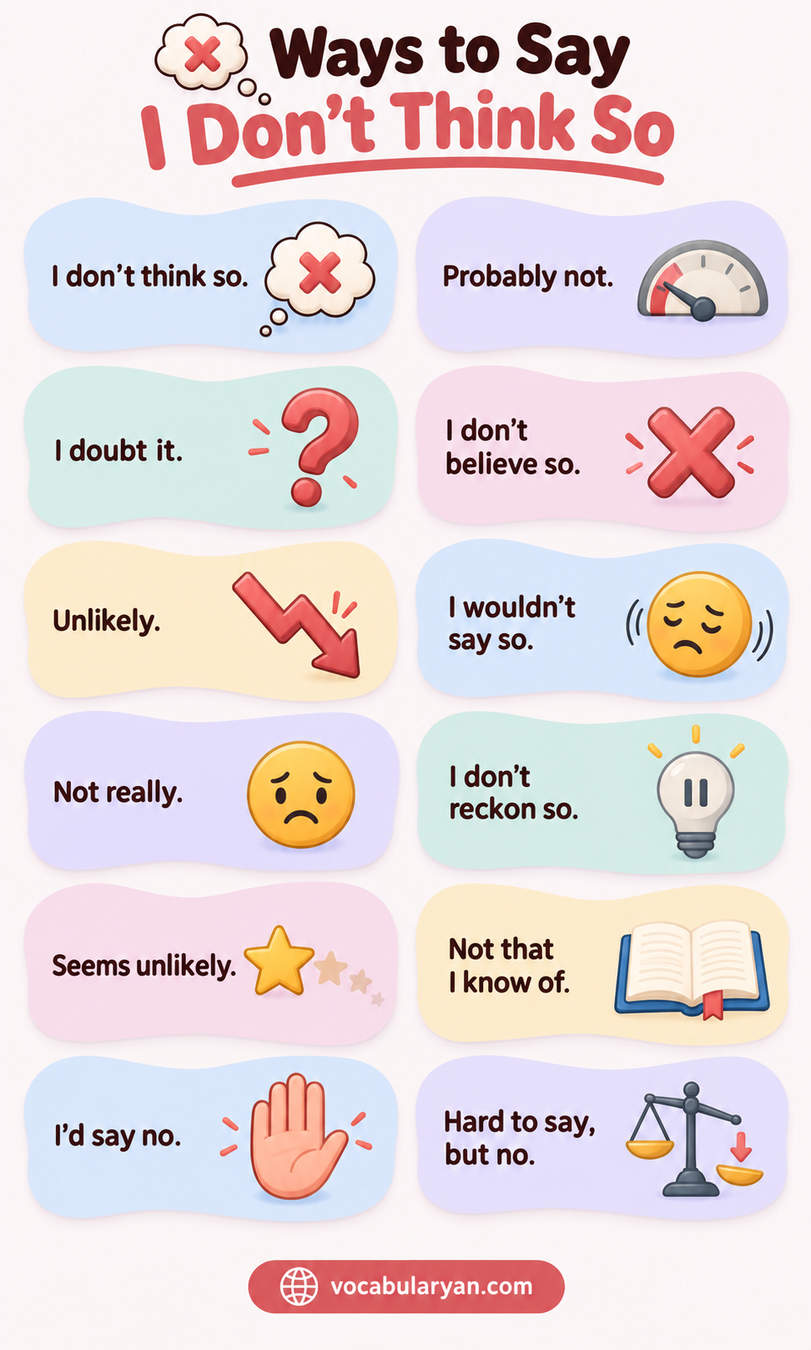
These five phrases are the everyday soft forms, and each one fits a neighbour, a colleague, or a family member without sounding cold.
I doubt it: the most common reply when you expect the answer to be no but cannot be certain. It fits a question about the weather, a delay, or a plan, and it goes with a short reason.
- Will Dad be home before seven? I doubt it, he said the meeting runs late.
- I doubt it, the bakery closes at four on Saturdays.
- Is there still a seat on the two o’clock coach? I doubt it, but I’ll ask at the desk.
I don’t believe so: a calm, neutral form that works with anyone, at home or at work. It means you are fairly sure the answer is no.
- Has the parcel arrived yet? I don’t believe so, the hall table is empty.
- I don’t believe so, but let me check the calendar to be sure.
- Did anyone from the school ring today? I don’t believe so, love.
Not really: a soft no that fits a question about your feelings, your plans, or your knowledge. It never means "yes, a little".
- Do you fancy pizza again tonight? Not really, we had it twice this week.
- Not really, I only know the first verse of that song.
- Are you worried about the test? Not really, I revised most of the chapters.
I’m not sure about that: a polite way to say that you doubt what someone just said, without calling the person wrong. The reply is a reason or a question.
- I’m not sure about that, the sign said the museum shuts on Mondays.
- He says the flat comes with parking, but I’m not sure about that.
- I’m not sure about that, Grandad, the shop moved to the high street years ago.
Not as far as I know: a form for a fact that you have not heard about, so the doubt is about your knowledge, not the other person.
- Has the meeting been moved? Not as far as I know, it’s still at ten.
- Not as far as I know, but Priya handles the bookings, so ask her.
- Is the pool open in winter? Not as far as I know, it’s outdoors.
Say "I doubt it" for a fact you cannot check, and "not really" when the question is about you.
Casual Ways to Say I Don’t Think So to Friends
With friends the soft no gets shorter, and a one-word form with a shrug is the normal reply.
Nah: the casual "no" in speech and in texts, and it fits a friend or a sibling. To a stranger or a manager it sounds careless.
- Coming to the gym later? Nah, my legs are still sore from Tuesday.
- Nah, I’ve seen that film, the ending’s rubbish.
- Want the last biscuit? Nah, you have it.
Doubt it: "I doubt it" without the "I", and it fits a quick reply between friends about a plan or a result.
- Think they’ll win tonight? Doubt it, half the team’s injured.
- Doubt it, Sam never gets up before eleven on a Sunday.
- Will the bus be on time? Doubt it, it’s pouring.
Don’t think so: the short spoken form of the phrase itself, said with a small shake of the head.
- Is Leo still in the library? Don’t think so, his bag’s gone.
- Don’t think so, mate, that shop went bust last year.
- Did we leave the heating on? Don’t think so, I turned it off at the wall.
Nope: a light, friendly "no" with a small pop at the end, and it fits a friend, a partner, or a child.
- Any milk left? Nope, I’ll grab some on the way back.
- Nope, I haven’t heard from Dana since Friday.
- Did you remember the tickets? Nope. Sorry. Turning round now.
I wouldn’t bet on it: a playful form that means "I strongly doubt it", and it fits a friend’s hopeful plan.
- Jess says she’ll be ready by eight. I wouldn’t bet on it.
- I wouldn’t bet on it, the forecast says rain all weekend.
- Think the boss will let us finish early? I wouldn’t bet on it.
Keep "nah" and "nope" for friends, and use "I don’t believe so" with everyone else.
Polite Ways to Say I Don’t Think So at Work
At work the soft no gets a reason or a softener in front of it, and the phrase never sounds like a challenge to the other person.
I’m afraid not: the standard polite refusal in British and American offices, and it fits a request, a question, or a hope. "I’m afraid" softens the "not".
- Is there any budget left for training this year? I’m afraid not, it went on the new laptops.
- I’m afraid not, the contract has to be signed in person.
- Can we push the deadline to Friday? I’m afraid not, the client presents on Thursday.
I’m not convinced: a polite way to doubt a plan or a claim in a meeting, and the reply is a reason.
- I’m not convinced the new supplier can deliver by March.
- The numbers look good, but I’m not convinced they cover the shipping costs.
- I’m not convinced, to be honest, the sample size was tiny.
That’s not my understanding: a formal way to say that you heard something different, and it fits a fact about a rule, a date, or a decision.
- That’s not my understanding, the policy says two weeks’ notice, not one.
- She said the office closes at five, but that’s not my understanding.
- That’s not my understanding of the agreement, so let’s check the email.
I’d have to disagree there: a polite disagreement with one point, and "there" keeps it small.
- I’d have to disagree there, the old logo tested better with customers.
- I’d have to disagree there, Tom, the delay came from our side.
- It’s a fair plan, but I’d have to disagree there on the timing.
I see it differently: a soft way to disagree that gives your own view without calling the other view wrong.
- I see it differently, the risk is in the launch date, not the price.
- I see it differently, but I’d like to hear the rest of your plan first.
- With respect, I see it differently, and here’s why.
A soft no is spoken at one of five levels, and the table sorts them.
| Level | Phrases | Who it fits |
|---|---|---|
| Slang | Nah, nope, yeah no, as if | Close friends your own age |
| Casual | Doubt it, don’t think so, not that I know of | Friends, family, relaxed colleagues |
| Neutral | I doubt it, not really, I don’t believe so | Anyone, at home or at work |
| Formal | I’m afraid not, I’m not convinced, that’s not my understanding | Managers, clients, customers |
| Very formal | I beg to differ, I regret that this will not be possible | Formal letters, legal or official replies |
One trap at work is a bare "nah" or "nope" in reply to a manager, because it sounds like a shrug.
- Can you cover the front desk at lunch? Nope, busy. (to a manager) ❌
A one-word slang refusal to a senior person sounds rude, and "I’m afraid not" with a reason fits the same moment.
- Can you cover the front desk at lunch? I’m afraid not, I have a client call at one. ✅
Write "I’m afraid not" for a refusal and "I’m not convinced" for a doubt, and give a reason with both.
Ways to Say I Don’t Think So in an Email
An email soft no needs a full sentence, because the reader cannot hear your voice, and a reason on the same line keeps it polite.
Unfortunately, that won’t be possible: the standard written refusal for a request, and it fits a client, a customer, or a colleague you do not know well.
- Unfortunately, that won’t be possible this week, as the team is at the trade fair.
- Thank you for asking. Unfortunately, that won’t be possible before the audit ends.
- Unfortunately, that won’t be possible, but I can offer a call on Monday instead.
I don’t believe that’s correct: a polite written way to say that a fact in the email is wrong, and it goes with the right fact in the next line.
- I don’t believe that’s correct, the invoice was paid on 3 May.
- I don’t believe that’s correct, as the booking was for two rooms, not one.
- With respect, I don’t believe that’s correct, and I have attached the original order.
I’m not sure that would work: a soft way to doubt a plan in writing, and it opens the door to a better plan.
- I’m not sure that would work, since half the team is remote on Fridays.
- Thanks for the idea. I’m not sure that would work with the current budget, though.
- I’m not sure that would work, but a shorter session on the same day would.
I’d rather not, if that’s all right: a polite personal refusal in writing, and it fits a favour or a change you do not want.
- I’d rather not, if that’s all right, as I’m already covering two shifts that week.
- I’d rather not, if that’s all right, but Priya has offered to take the slot.
- Thank you for thinking of me. I’d rather not, if that’s all right.
A plain "I don’t think so" on its own line in a formal email reads as cold.
- Dear Mr Osei, I don’t think so. Regards, Ana. ❌
A written refusal to a customer needs a softener and a reason, so "I’m afraid" plus the fact fits.
- Dear Mr Osei, I’m afraid that won’t be possible, as the offer ended on 30 June. Regards, Ana. ✅
Write "unfortunately, that won’t be possible" for a request and "I don’t believe that’s correct" for a wrong fact.
Ways to Say I Don’t Think So About a Fact
When the question is about a fact, the soft no says how sure you are, and each phrase marks a different amount of doubt.
That doesn’t sound right: a gentle way to doubt a number, a date, or a story, and it means "check it again".
- Forty pounds for a return ticket? That doesn’t sound right.
- That doesn’t sound right, the match was on Saturday, not Sunday.
- That doesn’t sound right, Mum, the doctor said two tablets, not four.
I’m not sure that’s true: a polite doubt about a claim, and it fits a friend, a classmate, or a colleague.
- I’m not sure that’s true, spiders aren’t insects.
- He says the bridge is the longest in Europe, but I’m not sure that’s true.
- I’m not sure that’s true any more, the rules changed last year.
Unlikely: a one-word answer that means "I doubt it", and it fits speech and writing at every level.
- Will the parcel come today? Unlikely, it only left the depot this morning.
- Unlikely, the last train was at eleven.
- Any chance of a refund? Unlikely, but the form is worth a try.
Use "unlikely" when you are fairly sure and "that doesn’t sound right" when you want the other person to check.
Ways to Say I Don’t Think So to a Request
A soft no to a request refuses the favour and not the person, so each phrase leaves the friendship or the working relationship as it was.
I’d rather not: the polite personal refusal, and it means you do not want to, without a long reason.
- Can you sing at the wedding? I’d rather not, I get so nervous.
- I’d rather not lend the car again, the last time cost me a tyre.
- Would you speak first? I’d rather not, could Maya open?
Not this time: a refusal that keeps the door open for the next request, and it fits a friend or a colleague.
- Can you chip in for the gift? Not this time, I’m short until payday.
- Not this time, but ask me again next month.
- Want to swap shifts? Not this time, sorry, I’ve got the dentist.
I’ll pass: a short, relaxed refusal for an offer or a favour, and it fits friends and relaxed colleagues.
- Another slice? I’ll pass, thanks, I’m full.
- I’ll pass on the meeting notes, Dan has already sent them.
- Fancy joining the pub quiz team? I’ll pass, I’m hopeless at sport questions.
That won’t work for me: a firm but polite refusal of a time, a price, or a plan, and it fits a customer or a colleague.
- Can we meet at seven in the morning? That won’t work for me, the school run is at eight.
- That won’t work for me, the price has gone up twice since May.
- A delivery on Sunday? That won’t work for me, I’m away all weekend.
Say "I’d rather not" for a favour you dislike, and "not this time" for one you would do another day.
Ways to Say I Don’t Think So to an Invitation
A soft no to an invitation thanks the person first, and the refusal comes with a reason or a promise for next time.
I don’t think I can make it: the standard polite refusal of an invitation, and it fits a party, a dinner, or a meeting.
- Thanks for the invite, but I don’t think I can make it on Saturday.
- I don’t think I can make it, the babysitter’s cancelled.
- I don’t think I can make it to the launch, I’m in Leeds that day.
I’ll have to pass: a friendly refusal that means "not this time", and it fits colleagues and friends.
- Drinks after work? I’ll have to pass, early start tomorrow.
- I’ll have to pass on the barbecue, we’ve got my in-laws over.
- Thanks, but I’ll have to pass this week.
Maybe another time: a refusal with a promise in it, and it fits a friend you want to see again.
- Cinema tonight? Maybe another time, I’ve got an essay due.
- Maybe another time, I’m shattered after the drive.
- I’d love to, but not this weekend. Maybe another time?
I’m going to sit this one out: a relaxed refusal for a game, a trip, or a night out, and it fits a group of friends.
- Karaoke? I’m going to sit this one out, my voice is gone.
- I’m going to sit this one out, you lot go ahead.
- Thanks, but I’m going to sit this one out, I’ve been out three nights running.
Say "I don’t think I can make it" to anyone, and keep "I’m going to sit this one out" for friends.
Firm and Sarcastic Ways to Say I Don’t Think So
Stress on "think" turns the soft phrase into a refusal with a laugh in it, and these phrases are its close relatives, so use them with friends or with someone who has gone too far.
I don’t THINK so!: the phrase said with a strong stress on "think", and it means "absolutely not". It fits a friend’s cheeky request or a stranger who has crossed a line.
- You want to borrow my car for the weekend? I don’t THINK so!
- Leave the dishes for me again? I don’t THINK so, it’s your turn.
- Push in front of me in the queue? I don’t THINK so, mate.
Not a chance: a firm refusal that means "there is no possibility", and it fits speech between friends or family.
- Will you lend him money again? Not a chance.
- Not a chance, I’m not driving three hours for a two-hour party.
- Think the landlord will lower the rent? Not a chance.
No way: the most common firm refusal in casual English, and it also means "I can’t believe it" when it is surprise, not refusal.
- Swim in the lake in January? No way.
- No way am I wearing that to the wedding.
- He’s asked for a raise after two weeks? No way.
Yeah, right: a sarcastic reply that means "I do not believe you", said with a flat voice. Keep it for friends who know you are joking.
- You’ll have the essay done by tonight? Yeah, right.
- Yeah, right, and I’m the Queen of Sheba.
- Cheap flights in August? Yeah, right.
As if: a sarcastic form that means "that will never happen", and it fits young speakers and close friends.
- Him, tidy his room? As if.
- As if I’d miss your birthday.
- She thinks I’ll cover her shift again. As if.
I think not: the older, mock-formal refusal, and it sounds dry and a little theatrical. It fits a joke or a firm written no.
- Another slice for the dog? I think not.
- I think not, sir, the museum closes in five minutes.
- Sell the family piano to pay for a jet ski? I think not.
The stressed form of the phrase catches learners out in a work setting.
- Can the report wait until Monday? I don’t THINK so! (to a client) ❌
Stress on "think" turns the phrase into a sarcastic refusal, so a client hears mockery, and the flat form with a reason fits.
- Can the report wait until Monday? I don’t think so, the board meets on Friday. ✅
Say "not a chance" when the answer is final, and keep "yeah, right" and "as if" for friends.
Ways to Say I Don’t Think So in a Text
A text soft no is two or three words, and a full stop or a short letter form replaces your voice.
nah: the default text no between friends, and it reads as relaxed rather than rude.
- nah, too tired, tomorrow?
- nah I’m still at work, go without me
- Is the cafe open? nah, closed Mondays
don’t think so: the phrase without "I", and it fits a text about a fact or a plan.
- Did Ali book the room? don’t think so, ask him
- don’t think so, the gate said 7, not 9
- Any parking near the venue? don’t think so, get the tram
doubt it: the text form for a prediction, and it reads as a shrug.
- Think it’ll stop raining? doubt it
- doubt it, she’s not replied all day
- Will Dan turn up? doubt it, he’s got a cold
idts: the short letter form of "I don’t think so", used only between close friends in a fast chat.
- Are we still on for six? idts, Rob’s stuck at work
- idts, the shop shuts at five
- Is this the right bus? idts, check the number
not really: the soft no for a question about your mood or your plans in a text, and it leaves room for another question.
- Fancy a run later? not really, legs are dead
- not really feeling it tonight, sorry
- Enjoying the book? not really, it’s slow
Keep a text refusal to three words, and add a reason when the other person made a plan.
Ways to Say I Don’t Think So to a Group
A soft no to a group doubts the plan and not the people, so each phrase names the idea and leaves the room open to a better one.
I’m not sure we’re there yet: a polite way to say that a group plan is not ready, and it fits a meeting or a team chat.
- I’m not sure we’re there yet on the pricing, so let’s park the launch.
- I’m not sure we’re there yet, the test results only came in this morning.
- Good draft, but I’m not sure we’re there yet with the opening page.
Can I push back on that?: a polite question that asks permission to disagree, and it fits a meeting with a manager in the room.
- Can I push back on that? The last time we cut testing, the app crashed.
- Can I push back on that? Two weeks is not enough for translation.
- Can I push back on that a little? I think the smaller venue is safer.
I’m not sold on this: a casual work phrase that means "I am not convinced", and it fits a relaxed team.
- I’m not sold on this colour for the poster, it’s hard to read.
- I’m not sold on this, but I’m happy to be persuaded.
- Honestly, I’m not sold on this plan, the timing’s off.
Let’s not: a short refusal of a group idea, and it fits friends, family, or a close team.
- Another karaoke night? Let’s not, my ears are still ringing.
- Let’s not book anything until the flights are confirmed.
- Split the bill fifty ways? Let’s not, I’ll get it and you can transfer.
I have a different view: the formal way to disagree in front of a group, and it fits a board, a class, or a client meeting.
- I have a different view on the deadline, and I’d like to explain why.
- I have a different view, the survey only covered two cities.
- With respect, I have a different view of what the customers asked for.
Say "I’m not sure we’re there yet" in a meeting, and keep "let’s not" for people you know well.
Regional Ways to Say I Don’t Think So in English
English-speaking countries each keep a few soft and firm refusals of their own, and the right one in the right place sounds native at once.
British Ways to Say I Don’t Think So
I shouldn’t think so: the British form of "I don’t think so", used for a fact or a prediction, and it sounds polite and a little old-fashioned.
- Will the post come before nine? I shouldn’t think so, not on a bank holiday.
- I shouldn’t think so, the library shuts early on Fridays.
- Is the pub still doing food? I shouldn’t think so, it’s gone ten.
I very much doubt it: a polite, formal British form of "I doubt it", and it fits a shop, an office, or a phone call.
- Will there be tickets on the door? I very much doubt it, it sold out in June.
- I very much doubt it, the manager left for the day at five.
- Can the plumber come today? I very much doubt it, but I’ll ring him.
Not on your nelly: an old British joke refusal that means "not on your life", and it fits family and old friends.
- Wear a tie to the barbecue? Not on your nelly.
- Not on your nelly, I’m not eating that.
- Let the kids drive the tractor? Not on your nelly, said Grandad.
American Ways to Say I Don’t Think So
Nah, I’m good: the American casual refusal of an offer, and "I’m good" means "no, thank you".
- Want a refill? Nah, I’m good, thanks.
- Nah, I’m good, I ate before I came.
- Need a ride home? Nah, I’m good, it’s two blocks.
Not gonna happen: a firm, casual American refusal, and it fits a friend’s plan or a customer who asks for too much.
- Free shipping to Alaska? Not gonna happen.
- Not gonna happen, I’m not waking up at four for a sale.
- You want the deposit back after cancelling twice? Not gonna happen.
Yeah, no: an American reply that starts as a yes and ends as a no, and it means "I hear you, but no".
- Try the hot sauce? Yeah, no, I’m still recovering from last time.
- Yeah, no, I’m not driving in that snow.
- Join the six a.m. run club? Yeah, no.
Australian and Irish Ways to Say I Don’t Think So
Yeah, nah: the Australian form of "yeah, no", said in one breath, and it fits friends and workmates.
- Beach after work? Yeah, nah, it’s blowing a gale.
- Yeah, nah, I’ll give the party a miss, mate.
- Reckon they’ll finish the road by Christmas? Yeah, nah.
I doubt it, mate: "I doubt it" with the Australian "mate", and it fits anyone you speak to casually.
- Will the surf be up tomorrow? I doubt it, mate, the wind’s wrong.
- I doubt it, mate, the servo shuts at nine out here.
- Any tickets left for the final? I doubt it, mate.
Not a hope: the Irish firm refusal that means "no chance", and it fits friends and family.
- Will Dad let you take the van? Not a hope.
- Not a hope, the match is sold out.
- Think she’ll say yes? Not a hope, lad, she’s seen your car.
Ah, I don’t know about that: an Irish soft doubt, said slowly, and it means "I doubt what you just said".
- Best pub in Galway? Ah, I don’t know about that.
- Ah, I don’t know about that, the roads were fine last winter.
- He says he ran it in three hours. Ah, I don’t know about that.
Say "I shouldn’t think so" in Britain, "nah, I’m good" in America, "yeah, nah" in Australia, and "not a hope" in Ireland.
Slang Ways to Say I Don’t Think So
Slang refusals are for close friends of your own age, and each one sounds wrong in a message that an older person or a manager will read.
Hard no: a firm refusal in two words, and it means "no, and I will not change my mind".
- Share a room with your cousin at the festival? Hard no.
- That’s a hard no from me on the karaoke.
- Pineapple on pizza? Hard no.
Not happening: a casual refusal that sounds final, and it fits friends and family.
- Me, cook for twelve people? Not happening.
- Not happening, I’m not going out in that rain.
- Can I borrow your good headphones? Not happening, sorry.
Use slang refusals with friends your own age only, and switch to "I’m afraid not" for anyone else.
Funny Ways to Say I Don’t Think So
Funny refusals make the "no" into a joke, and each one works only with people who know your sense of humour.
When pigs fly: a joke refusal that means "never", and it fits a plan that will never happen.
- You’ll clean the garage this weekend? When pigs fly.
- When pigs fly, said Nan, when we asked her to try sushi.
- Dad, giving up his old armchair? When pigs fly.
Over my dead body: a dramatic refusal that means "I will stop this at any cost", said with a smile among family and friends.
- Paint the kitchen orange? Over my dead body.
- Over my dead body are you taking the dog to the pub.
- Sell Grandma’s clock? Over my dead body.
In your dreams: a teasing refusal for a friend’s hopeful idea, and it fits siblings and close friends.
- Think you’ll beat me at chess? In your dreams.
- Borrow my new bike? In your dreams.
- In your dreams, you haven’t scored all season.
Save the joke refusals for people who will laugh, because "over my dead body" to a customer reads as a threat.
How Do You Reply When Someone Says I Don’t Think So?
A soft no asks for a small next step from you, so the reply either accepts the answer, asks for the reason, or offers a second plan.
Accept a soft no about a fact: the reply is "okay" or "fair enough", and a thank you if the person checked for you.
- Is the shop open on Sunday? I don’t think so. Okay, I’ll go on Monday then.
- Has the parcel come? I don’t believe so. Fair enough, thanks for looking.
- Will the train be on time? I doubt it. Right, I’ll leave a bit earlier.
Ask for the reason: the reply is "why not?" or "what makes you say that?", said gently.
- I’m not convinced this plan works. What makes you say that?
- I don’t think so. Why not? The last one went well.
- I have my doubts. Which part worries you?
Offer a second plan: the reply accepts the no and offers something smaller or later.
- I don’t think I can make it Saturday. No problem, how about Sunday lunch?
- I’d rather not sing. That’s fine, could you read a poem instead?
- That won’t work for me. Understood, would eight thirty be better?
Reply to a firm or sarcastic no: the reply is a laugh and a step back, because the other person has made the answer final.
- Borrow the car? I don’t THINK so! Fair enough, I’ll get the bus.
- Not a chance. Okay, okay, I had to ask.
- Yeah, right. I mean it, I’ll have it done by ten.
Reply to a text no: the reply is short and warm, and it names the next time.
- nah, too tired. no worries, next week?
- doubt it. ok, I’ll ask Sam instead
- idts. cool, thanks anyway
Accept a soft no in three words, ask "why not?" only when you can change something, and never argue with a firm one.
More Everyday English Phrases
- Other Ways to Say I Think So
- Other Ways to Say I Understand
- Other Ways to Say I Disagree
- Other Ways to Say I Agree
FAQs
Add a softener in front of the doubt, because the politeness is in the softener. "I’m afraid not", "I’m not sure about that", and "I don’t believe so" all pass with a manager or a stranger. Give a short reason in the same breath, because a bare no sounds cold at any level. Keep the voice flat, since stress on "think" turns the phrase into a refusal with a laugh in it.
"I’m afraid not" is the professional form for a refusal, and "I’m not convinced" or "that’s not my understanding" fits a doubt about a plan or a fact. In writing, "unfortunately, that won’t be possible" is the standard refusal to a client. Each one goes with a reason and, where you can, a second option.
"I doubt it" answers a question about a fact, "not really" answers a question about you, and "I’d rather not" refuses a favour. With friends, "nah", "nope", and "doubt it" fit a text or a quick chat. At work, "I’m afraid not" and "I’m not sure that would work" are the safe choices.
No, the flat form is one of the softest ways to say no in English, and it fits a friend, a colleague, or a customer. It becomes rude in two cases: when "think" is stressed, which turns it into mockery, and when it is the only line in a formal email, with no reason. A reason and a flat voice keep it polite.
It means the person expects the answer to be no but is leaving a little room for doubt, as in "Is she home? I don’t think so." Said with stress on "think", it means a firm and slightly mocking "absolutely not". The stress in the voice marks which one you heard.
No, the two differ in level and in feeling. "I don’t think so" is the everyday soft form, and "I think not" is older, formal, and dry, so today it is used for a firm written no or a joke. "I think not" to a friend’s request sounds like a line from a play.
Yes, when the request is small and the person is a friend or a colleague, as in "Can I leave early?" "I don’t think so, we’ve got the client at four". For a bigger request or a customer, "I’m afraid not" or "unfortunately, that won’t be possible" fits better, because each one sounds planned rather than reluctant.
Accept the answer with "okay" or "fair enough" when it is about a fact, and ask "why not?" only when you can change the plan. When the phrase came with stress on "think", the answer is final, so a laugh and "fair enough, I had to ask" is the reply. In a text, "no worries, next week?" keeps the plan alive.