
"Thank you" fits everyone, and a kindness that was big or personal deserves a phrase that says so. A friend hears "cheers", a client hears "thank you for your time", and a gift gets "you shouldn’t have". The size of the kindness and the person who did it set the choice among the ways to say thank you in English, and the everyday phrases come first.
Common Ways to Say Thank You in Everyday English
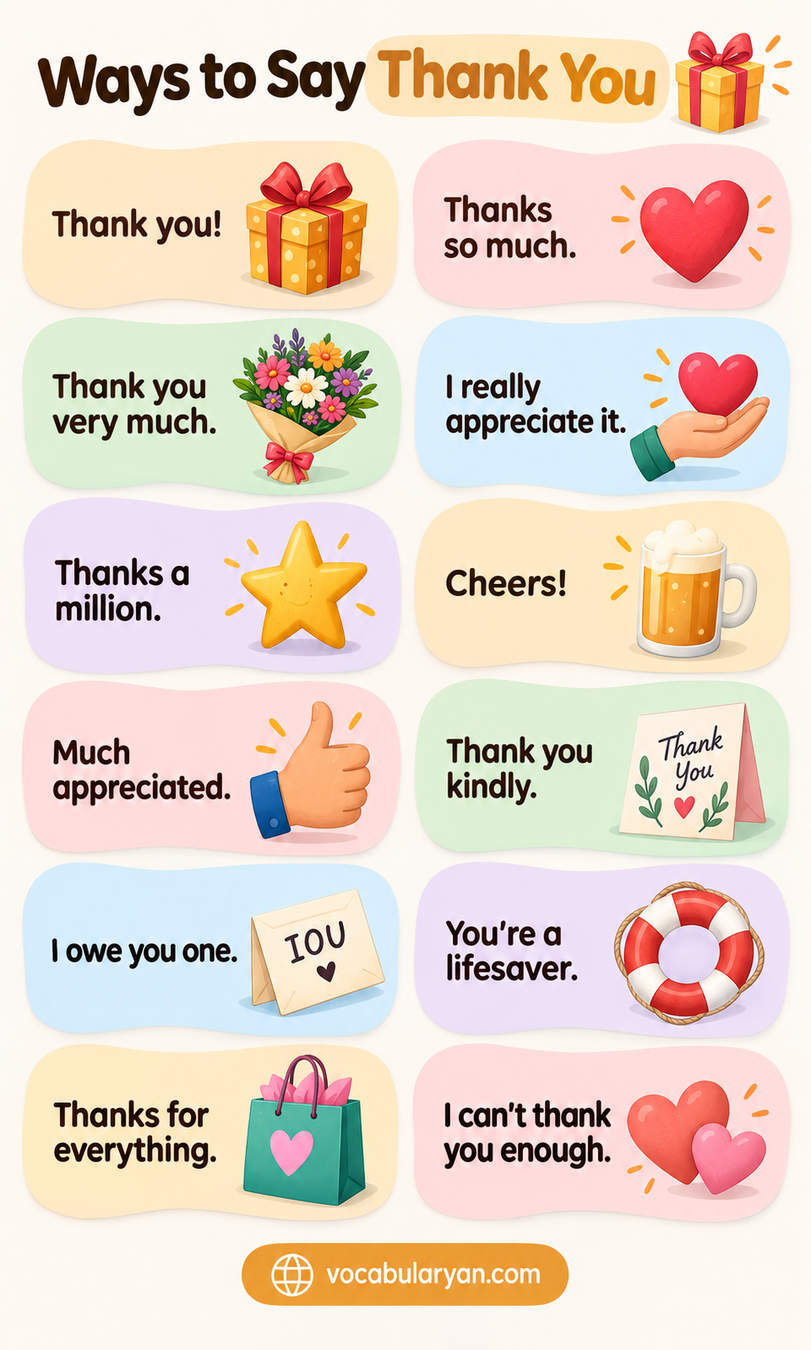
These six phrases fit almost everyone, from a bus driver to a new colleague, and each one changes how big the thanks sound.
Thank you: the full form, and it is right in every situation from a shop to a wedding. It goes with a name or with "for" and the reason.
- Thank you, Priya, the slides look great.
- Thank you for holding the door.
- Oh, thank you, I didn’t think anyone had seen me drop it.
Thanks: the short form, a step more relaxed than "thank you". It fits friends, colleagues, and anyone who does a small job for you, and it sounds fine in speech and in messages.
- Thanks, Dan, I’ll bring the ladder back tomorrow.
- Thanks for the lift.
- Two coffees, please. Thanks.
Thank you so much: the warm form, and it means the person did more than expected. It fits a friend who helped you move or a stranger who gave up a seat.
- Thank you so much for staying late with me.
- I got the job! Thank you so much for the practice interview.
- Thank you so much, that was the last one in the shop.
Thanks a lot: casual and warm, and it fits friends and relaxed colleagues. Said in a flat voice it becomes sarcastic, so smile when you say it.
- Thanks a lot for the notes, Maya.
- Thanks a lot, mate, I’ll pay you back on Friday.
- Thanks a lot for coming all this way.
Thank you very much: a little more formal than "thank you so much", and it fits a shop assistant, a host, or a teacher. It sounds polite rather than emotional.
- Thank you very much for your help today, Mrs Ali.
- That was a lovely dinner, thank you very much.
- Thank you very much, I’ll take the blue one.
That’s very kind of you: thanks that name the person rather than the act, and it fits a small unexpected kindness from anyone.
- That’s very kind of you, but I can carry it myself.
- You saved me a seat? That’s very kind of you, I was sure I’d be standing.
- That’s very kind of you, Dr Okafor, I’ll read it tonight.
Say "thank you" when you are unsure, because it never sounds too small and never sounds too formal.
Casual Ways to Say Thank You to Friends
Casual thanks are for people who know you well, and each one sounds warm, quick, and a little exaggerated on purpose.
Thanks a bunch: friendly and light, and it fits a small favour from a friend or a close colleague. In a formal email it sounds odd.
- Thanks a bunch for feeding the cat.
- Thanks a bunch, Leo, you’re a star.
- Oh, thanks a bunch, I’d forgotten my charger again.
Thanks a million: big thanks for a big favour, common in Ireland and in casual speech everywhere. The reply is "no problem" or "anytime".
- Thanks a million for driving me to the airport at five.
- Thanks a million, Aisha, the kids loved the cake.
- Thanks a million! I owe you a coffee.
Thanks a ton: the American form of "thanks a million", and it fits friends and family.
- Thanks a ton for the ride, Marcus.
- Thanks a ton, Mom, the soup was exactly what I needed.
- Thanks a ton, guys, we’d never have finished on time.
You’re the best: praise that works as thanks, and it fits a friend who did something kind without being asked.
- You’re the best, Sam, I can’t believe you got tickets.
- Thanks for picking up my parcel, you’re the best.
- You’re the best! See you at seven.
You rock: American slang for "you’re great", and it fits close friends and classmates. Keep it out of a message to a manager.
- You rock, Jay, thanks for the playlist.
- You fixed my bike? You rock.
- You rock! Pizza’s on me tonight.
You’re a lifesaver: thanks for help that got you out of trouble, and it fits friends and relaxed colleagues.
- You’re a lifesaver, I left my keys in the office.
- Thanks for covering my shift, you’re a lifesaver.
- You’re a lifesaver, Nadia, the printer hates me.
You made my day: thanks for something that made you happy, and it fits a gift, a message, or a kind word from anyone you know.
- Your card arrived this morning and you made my day.
- Thanks for the flowers, you made my day.
- You made my day, Grandad, I’ll call you tonight.
Keep "you rock" and "thanks a bunch" for friends your own age, and use "thank you so much" with everyone else.
Formal Ways to Say Thank You at Work
Formal thanks fit a manager, a client, a doctor, or a stranger, and they name the reason with "for" or with a full sentence.
Thank you for your time: the standard formal thanks after a meeting, an interview, or a call, and it goes with a title and surname.
- Thank you for your time, Ms Adams, I’ll send the figures by Friday.
- Thank you for your time today, and I look forward to hearing from you.
- Thank you for your time, Dr Okafor, that answers my question.
Thank you for your help with this: polite thanks for work someone did on your task, and it fits a colleague or a supplier in speech and in writing.
- Thank you for your help with this, Ravi, the client is happy.
- Thank you for your help with this, I know it was short notice.
- Hello, Mrs Kaur, thank you for your help with this last week.
I’m very grateful: warm and formal at the same time, and it fits a manager who did something for you or a client who waited.
- I’m very grateful for the extra week on the deadline.
- I’m very grateful to you both for coming in on a Saturday.
- I’m very grateful, Professor Grant, your letter made the difference.
Thank you for your consideration: the closing thanks in a job application or a formal request, and it means "thank you for thinking about it".
- Thank you for your consideration, and I look forward to your reply.
- I have attached my CV. Thank you for your consideration.
- Thank you for your consideration of my request for leave.
Much obliged: old-fashioned formal thanks, still heard from older speakers and in the American South. Between young colleagues it sounds like a joke.
- Much obliged, sir, I’ll return the ladder this evening.
- Much obliged for the directions, we’d have missed the turn.
- Much obliged, Mrs Novak, that was very generous.
Please accept my sincere thanks: the most formal form, and it fits a letter, a speech, or a message to a senior person.
- Please accept my sincere thanks for your support during the review.
- Please accept my sincere thanks, Ambassador, on behalf of the whole team.
- Please accept my sincere thanks for the kind welcome at the campus.
The one form to avoid is "thank you a lot", because "a lot" goes with "thanks" and never with "thank you".
- Thank you a lot for the report, Ms Adams. ❌
"Thanks a lot" and "thank you very much" are the correct forms, and "thank you very much" fits a manager better.
- Thank you very much for the report, Ms Adams. ✅
Every thank you on this page belongs to one of five levels.
| Level | Thanks | Who it fits |
|---|---|---|
| Slang | Cheers, ta, you rock, you legend | Close friends your own age |
| Casual | Thanks a bunch, thanks a million, you’re the best | Friends, family, relaxed colleagues |
| Neutral | Thanks, thank you, thank you so much | Anyone you speak to |
| Formal | Thank you for your time, I’m very grateful | Managers, clients, strangers, older people |
| Very formal | Please accept my sincere thanks, much obliged | Letters, speeches, ceremonies |
Name the reason after "thank you for" at work, because a bare "thanks" to a manager sounds rushed.
Ways to Say Thank You in an Email
An email thank you goes in the first line or the last line, and the phrase changes with what the reader did for you.
Thank you for your prompt reply: the standard thanks when someone answered fast, and it fits a client, a supplier, or a colleague you do not know well.
- Thank you for your prompt reply, the dates work for us.
- Dear Mr Petrov, thank you for your prompt reply to my request.
- Thank you for your prompt reply, I’ll book the room now.
Thanks for getting back to me: the relaxed form of the same thanks, and it fits a colleague or a contact who signs with a first name.
- Hi Sara, thanks for getting back to me so quickly.
- Thanks for getting back to me, Tom, Thursday is fine.
- Thanks for getting back to me about the invoice.
Thank you for the update: thanks for news or a report, and it fits any work email.
- Thank you for the update on the delivery.
- Thank you for the update, Kemi, I’ll pass it on to the team.
- Thank you for the update, and please let me know if the date changes.
Thanks in advance: thanks for a small task the reader has already agreed to do, and it goes at the end of the email. It sounds pushy with a big request or a stranger.
- Could you send the file by noon? Thanks in advance.
- Thanks in advance for signing the form, Ben.
- Thanks in advance for your reply.
Thank you for your attention to this matter: very formal thanks after a request or a complaint, and it fits a letter to a company or a council.
- Thank you for your attention to this matter, and I look forward to your response.
- Please find the photographs attached. Thank you for your attention to this matter.
- Thank you for your attention to this matter, Ms Lopez.
Many thanks: a sign-off that works as thanks, and it fits colleagues and clients. It goes on its own line before your name.
- Many thanks, Ana
- Many thanks for the quick turnaround, Mark
- Many thanks in advance, Dr Malik
Thank you again for everything: the closing thanks in a second or third email about the same help, and it fits a long project or a big favour.
- Thank you again for everything you did during the move.
- Thank you again for everything, Fatima, the launch would have failed without you.
- Thank you again for everything this year, and enjoy the break.
"Thanks in advance" fits a task the reader has already said yes to, and it sounds like an order when the reader has not.
- Thanks in advance for approving my three weeks of leave, Ms Adams. ❌
A big request takes thanks for the reader’s time, because the answer is still open.
- Thank you for considering my request, Ms Adams. ✅
Open with "thank you for your prompt reply" when the reader answered, and close with "many thanks" plus your name.
Ways to Say Thank You for a Gift
Gift thanks name the present, the person, or the surprise, and they fit family, friends, and colleagues who chipped in.
Thank you for the lovely gift: the standard thanks in speech or in a card, and "lovely" changes to "beautiful", "thoughtful", or the name of the present.
- Thank you for the lovely gift, Auntie Rose, I’ve wanted that book for months.
- Thank you for the lovely gift, it’s already on the shelf.
- Thank you for the beautiful gift, we opened it this morning.
You shouldn’t have: the fixed reaction to a gift, and it means "this is more than I expected". It is a happy line, not a complaint.
- Oh, Sam, you shouldn’t have! It’s gorgeous.
- You shouldn’t have, but I’m so glad you did.
- Flowers as well? You shouldn’t have.
How thoughtful of you: thanks for a gift that matched what you like, and it fits a colleague, a neighbour, or a friend of the family.
- How thoughtful of you, you remembered I collect these.
- How thoughtful of you, Mrs Kaur, the girls love it.
- A card in Polish? How thoughtful of you.
I love it: short casual thanks for a gift from someone close, and it goes with the word "thank you" before or after it.
- I love it, thank you! Where did you find it?
- Thanks, Mum, I love it.
- I love it, it’s exactly my colour.
It’s perfect, thank you: the warmest form for a gift that fits, and it works out loud and in a text.
- It’s perfect, thank you, it matches the kitchen.
- It’s perfect, thank you, I’ll wear it on Saturday.
- It’s perfect, thank you both so much.
Say "you shouldn’t have" first and "thank you for the lovely gift" in the card, because the two lines fit different moments.
Ways to Say Thank You for Help
Thanks for help name what the person did, and the size of the phrase matches the size of the job.
Thanks for your help: the everyday form, and it fits a colleague, a shop assistant, or a friend after a small job.
- Thanks for your help with the boxes.
- Thanks for your help, Ella, I’d never have found the file.
- Thanks for your help today, we’ll manage from here.
I couldn’t have done it without you: big thanks for help that made the result possible, and it fits friends, family, and close colleagues.
- I couldn’t have done it without you, Raj, that pitch was half yours.
- Thank you for the tutoring, I couldn’t have done it without you.
- I couldn’t have done it without you, and I mean that.
Thank you for being there: thanks for support during a hard time, and it fits a close friend or a relative rather than a colleague.
- Thank you for being there when Dad was in hospital.
- Thank you for being there, I didn’t want to sit through it alone.
- I know it was a long week. Thank you for being there.
Thanks for having my back: casual thanks for support in a difficult moment, and it fits friends and teammates.
- Thanks for having my back in that meeting.
- Thanks for having my back, Chris, I owe you.
- Thanks for having my back on the pitch today.
You’ve been a big help: warm thanks at the end of a job, and it fits a helper of any age, from a child to a neighbour.
- You’ve been a big help, Tom, go and put your feet up.
- You’ve been a big help this afternoon, thank you.
- You’ve been a big help with the garden, Mrs Ali.
Use "thanks for your help" for a small job and "I couldn’t have done it without you" when the help changed the result.
Ways to Say Thank You for a Favour
A favour is something the person did not have to do, and the thanks name the debt you now feel.
I owe you one: casual thanks that promise a favour back, and it fits friends and relaxed colleagues. The reply is "no problem" or "you don’t owe me anything".
- I owe you one for the lift, Marco.
- Thanks for swapping shifts, I owe you one.
- I owe you one, and I mean a big one.
I owe you big time: the stronger form, and it fits a favour that cost the person real time or money.
- You lent me your car for a week? I owe you big time.
- I owe you big time, Jess, that deposit saved the flat.
- I owe you big time for this, dinner’s on me.
Thanks for covering for me: thanks to someone who did your job or took your place, and it fits work, school, and family.
- Thanks for covering for me on Friday, Nadia.
- Thanks for covering for me with the kids, I’ll be home by eight.
- Thanks for covering for me at the desk, the call ran long.
Thanks for going out of your way: thanks for a favour that took extra effort, and it fits a neighbour, a driver, or a colleague.
- Thanks for going out of your way to drop it off.
- Thanks for going out of your way, I know the shop is nowhere near your flat.
- Thanks for going out of your way for us, Mr Chen.
Say "I owe you one" for a favour you will return, and "thanks for going out of your way" for one you cannot.
Ways to Say Thank You to a Group
Group thanks name everyone at once, and the level of the phrase matches the room.
Thank you all: the standard thanks to a group at the end of a meeting, a class, or a party, and it works at every level.
- Thank you all for coming this evening.
- Thank you all, that’s the end of the session.
- Thank you all for the flowers, they’re beautiful.
Thanks, everyone: a step more relaxed than "thank you all", and it fits colleagues, classmates, and a family dinner.
- Thanks, everyone, see you next week.
- Thanks, everyone, the survey results are in.
- Thanks, everyone, for making the party such a success.
Thank you to everyone who helped: thanks that single out the helpers in a crowd, and it fits a speech, an email, or a message after the event.
- Thank you to everyone who helped set up the hall this morning.
- Thank you to everyone who helped with the fundraiser, we passed the target.
- Thank you to everyone who helped me get back on my feet this year.
Thanks, team: warm thanks from a manager or a captain to a work group or a side, in person or in a message.
- Thanks, team, great week.
- Thanks, team, the client signed this morning.
- Thanks, team, get some rest before Saturday.
Write "thank you all" for a mixed group, and keep "thanks, team" for people who work or play with you.
Ways to Say Thank You on the Phone or in a Text
Phone and text thanks are short, and the reason comes first because the other person cannot see your face.
Thanks!: the default text thanks between friends, and the exclamation mark makes it warm rather than flat.
- Thanks! Got it.
- Thanks! See you at six.
- Thanks! You’re a star.
Thank you for calling: the phone phrase at the end of a work call, and it fits a customer, a patient, or a supplier.
- Thank you for calling, Mrs Lopez, we’ll see you on Tuesday.
- Thank you for calling Rivera Dental, have a good afternoon.
- Thank you for calling, I’ll email the confirmation now.
Thanks for letting me know: thanks for news by text or call, and it fits friends, colleagues, and a school or a clinic.
- Thanks for letting me know, I’ll take the later train.
- Thanks for letting me know about the change, Dr Malik.
- Thanks for letting me know, hope she feels better soon.
Thx and ty: the shortest text forms, for close friends only. Neither one belongs in a message to a teacher or a manager.
- Thx, on my way.
- Ty! Owe you one.
- Thx for the pics.
Thanks so much, speak soon: the friendly close to a call with someone you know, and it means the call is over.
- Thanks so much, speak soon, Ana.
- Thanks so much, speak soon, and give my love to the kids.
- Thanks so much, speak soon, I’ll ring you after the interview.
Keep a text thank you to three words, and end a work call with "thank you for calling" or "thanks for your time".
Ways to Say Thank You in a Card or Note
A written thank you is longer than a spoken one, and it names the gift or the kindness in a full sentence.
Thank you for your kindness: the standard opening line in a card after a loss, an illness, or a hard year, and it fits anyone who helped.
- Thank you for your kindness during Dad’s illness.
- Thank you for your kindness to Ben on his first week at school.
- Thank you for your kindness and the wonderful meals you sent.
With heartfelt thanks: a sign-off for a card, and it goes on its own line before your name.
- With heartfelt thanks, Maria and Tom
- With heartfelt thanks for everything, Aisha
- With heartfelt thanks from all of us at Northfield
I’m so grateful for: the warm line in the middle of a note, and it names the exact kindness after "for".
- I’m so grateful for the weeks you spent helping me study.
- I’m so grateful for your visit last month, it meant a lot to Mum.
- I’m so grateful for the loan, and I’ll repay it by June.
Thank you from the bottom of my heart: the strongest written thanks, and it fits a wedding card, a leaving card, or thanks to a nurse or a teacher.
- Thank you from the bottom of my heart for looking after him.
- Thank you from the bottom of my heart, Mrs Adeyemi, for six wonderful years.
- Thank you from the bottom of my heart, we will never forget your help.
Open a card with "thank you for your kindness" or "thank you for the lovely gift", and close it with "with heartfelt thanks".
Regional Ways to Say Thank You in English
English-speaking countries each keep a few thanks of their own, and using one in the right country earns a smile at once.
British Ways to Say Thank You
Cheers: the everyday British thanks, said for a drink, a lift, a door, or any small favour. It also means "goodbye" at the end of a call.
- Cheers, mate, I’ll get the next round.
- Cheers for the lift, Dave.
- Oh, cheers, I’d have left my umbrella on the bus.
Ta: short British thanks, common in the north of England, and it fits shops, buses, and friends.
- Ta, love, keep the change.
- Ta for the tea.
- Ta very much, I’ll bring it back tomorrow.
Nice one: British slang for "thanks, well done", and it fits a friend who did what you asked.
- Nice one, Pete, I knew you’d sort it.
- You got the tickets? Nice one.
- Nice one, cheers for that.
Thanks ever so much: warm British thanks, a little old-fashioned, and it fits neighbours, shop assistants, and older relatives.
- Thanks ever so much for the jam, Mrs Kaur.
- Thanks ever so much, you’ve been so patient.
- Thanks ever so much for the lift to the station.
American Ways to Say Thank You
Thank you kindly: friendly American thanks from the South, and it fits neighbours, waiters, and strangers who point the way.
- Thank you kindly, ma’am, that’s very generous.
- Thank you kindly for the directions.
- Thank you kindly, folks, drive safe.
Thanks, man: casual American thanks between friends, said to a man or, among younger speakers, to anyone.
- Thanks, man, I’ll get you back on payday.
- Thanks, man, that was a great game.
- Hey, thanks, man, I almost missed the bus.
Thanks, y’all: "thanks" plus "you all", the Southern American thanks to a group of friends or family.
- Thanks, y’all, dinner was wonderful.
- Thanks, y’all for coming out tonight.
- Thanks, y’all, I couldn’t have moved all this alone.
Australian and Irish Ways to Say Thank You
Thanks heaps: Australian casual thanks, and it fits friends, shops, and colleagues.
- Thanks heaps, Liam, the boards fit in the ute.
- Thanks heaps for the lift, mate.
- Thanks heaps, that’s a huge help.
Cheers, mate: shared by Britain and Australia, and it fits any man you speak to casually and, in Australia, anyone at all.
- Cheers, mate, see you at the beach.
- Cheers, mate, I owe you a beer.
- Cheers, mate, that’s the one.
Chur: New Zealand slang for "thanks" or "great", and it fits friends and family.
- Chur, bro, I’ll bring the chips.
- Chur for the ride.
- Chur, that’s sweet as.
Thanks a mil: the Irish short form of "thanks a million", and it fits friends and shops in Ireland.
- Thanks a mil, Sean, I’ll drop it back Sunday.
- Thanks a mil for the lift, lads.
- Thanks a mil, you’re very good.
"Cheers" and "ta" belong to speech and to texts between friends, and in a formal email they sound wrong.
- Cheers for the contract, Ms Adams. (in an email to a client) ❌
A client takes "thank you" or "many thanks", because "cheers" fits a friend and a pub.
- Many thanks for the contract, Ms Adams. ✅
Say "cheers" or "ta" in Britain, "thank you kindly" in the American South, "thanks heaps" in Australia, and "thanks a mil" in Ireland, and say "thank you" everywhere else.
Funny Ways to Say Thank You
Funny thanks are for close friends who know your sense of humour, and each one exaggerates on purpose.
You legend: British and Australian praise that means "you did something brilliant", and it fits a friend who came through for you.
- You legend! Where did you find a plumber on a Sunday?
- Thanks for the lift, you legend.
- You legend, the tickets arrived.
You’re a star: warm British thanks with a smile, and it fits friends, colleagues, and a child who helped.
- You’re a star, Claire, thanks for the cover.
- You brought cake? You’re a star.
- You’re a star, I’ll do the same for you.
You’re an angel: exaggerated thanks for a kindness, common from older speakers and between women friends.
- You’re an angel, thanks for watering the plants.
- You’re an angel, I was about to give up.
- Oh, you’re an angel, love.
I’ll name my first child after you: a joke promise for a huge favour, and it fits a close friend only.
- You found my passport? I’ll name my first child after you.
- I’ll name my first child after you, even if you’re called Bartholomew.
- Thanks for the notes, I’ll name my first child after you.
Save the funny thanks for people who will laugh, because a joke thank you to a stranger reads as sarcasm.
How Do You Reply When Someone Says Thank You?
The reply to a thank you matches its level: a casual thanks gets a casual reply, and a formal thanks gets "you’re welcome" or "my pleasure".
You’re welcome: the standard reply at every level, and it fits a stranger, a customer, or a friend.
- Thank you for the directions. You’re welcome, enjoy your stay.
- Thanks for the lift. You’re welcome, any time.
- Thank you for your time. You’re welcome, Ms Adams.
No problem and no worries: casual replies that mean "it was no trouble". "No worries" is Australian and British, and "no problem" is the American form.
- Thanks for covering. No problem.
- Cheers for the lift, mate. No worries.
- Thanks a bunch! No problem, see you tomorrow.
My pleasure: the polite reply from a host, a waiter, or anyone who enjoyed the job.
- Thank you for dinner. My pleasure, come again soon.
- Thanks for showing me round. My pleasure.
- Thank you for your help with this. My pleasure, Mr Chen.
Don’t mention it: a friendly reply that means the favour was small, and it fits friends and neighbours.
- Thanks for the eggs. Don’t mention it.
- Thank you so much for the lift. Don’t mention it, it was on my way.
- Thanks for last night. Don’t mention it, you’d do the same.
Anytime: a warm casual reply that promises the same help again.
- Thanks for listening. Anytime.
- Thanks for the ride, Marcus. Anytime, man.
- Thanks a million. Anytime, Aisha.
Thank you: the reply when the thanks go both ways, said with the stress on "you".
- Thanks for coming. No, thank you for having us.
- Thank you for the great class. Thank you, you all worked hard.
- Thanks for your order. Thank you, see you next week.
"Please" is the reply in several languages, and in English it is not.
- Thanks for the lift. Please. ❌
"Please" makes a request in English, so the reply to thanks is "you’re welcome" or "no problem".
- Thanks for the lift. You’re welcome. ✅
Reply at the same level as the thanks, and say "you’re welcome" when you are unsure.
More Everyday English Phrases
FAQs
There is no fixed number, because new thanks appear all the time, and this page covers more than seventy that native speakers use today. The core set is small: "thank you", "thanks", "thank you so much", and "I’m very grateful" cover almost every situation. Everything else adds a level, a place, or a mood on top of those four.
No, "thanks" is not rude, and it is the most common form between friends, colleagues, and shop staff. It sounds a step more casual than "thank you", so a manager, an older stranger, or a formal letter takes the full form. When in doubt, say "thank you" and add the reason.
Yes, when the reader did something for you, and the thanks go in the first line or the last line. "Thank you for your prompt reply" opens an email, and "many thanks" closes one. A first email that asks for something takes "thank you for your time" at the end rather than "thanks in advance".
Yes, and "I’m very grateful", "that’s very kind of you", "you’re a lifesaver", and "I owe you one" all do it. The first two fit work and strangers, and the last two fit friends. In a card, "with heartfelt thanks" replaces "thank you" as the sign-off.
A formal thank you fits a manager, a client, an interviewer, a doctor, or anyone you write to for the first time. "Thank you for your time", "I’m very grateful", and "please accept my sincere thanks" are the forms at that level. Between friends the same lines sound cold, so drop to "thanks so much" or "cheers".
Say "you’re welcome" at any level, or "no problem", "no worries", or "anytime" with friends. "My pleasure" fits a host or a waiter, and "don’t mention it" fits a small favour. A reply of "please" is a mistake carried over from other languages.
Start with "you shouldn’t have" or "how thoughtful of you" when you open it, and add "I love it" or "it’s perfect, thank you" once you see what it is. In the card, write "thank you for the lovely gift" and name the present. A gift from a group takes "thank you all" in the room and "thank you to everyone who chipped in" in the message.
Name the exact kindness after "for", and say what it changed for you. "Thanks for the lift" becomes "thanks for the lift on Friday, I’d have missed the interview without you". A name at the start and one fact in the middle turn a fixed phrase into a real message.