
"Yes" is the one reply that fits every question, and that is why a native speaker rarely uses it twice in a row. The ways to say yes in English change with what you agree to: a request, an invitation, a fact, or an opinion. Match the reply to the person and the question, and the everyday replies that fit almost anyone are the first ones to learn.
Common Ways to Say Yes in Everyday English
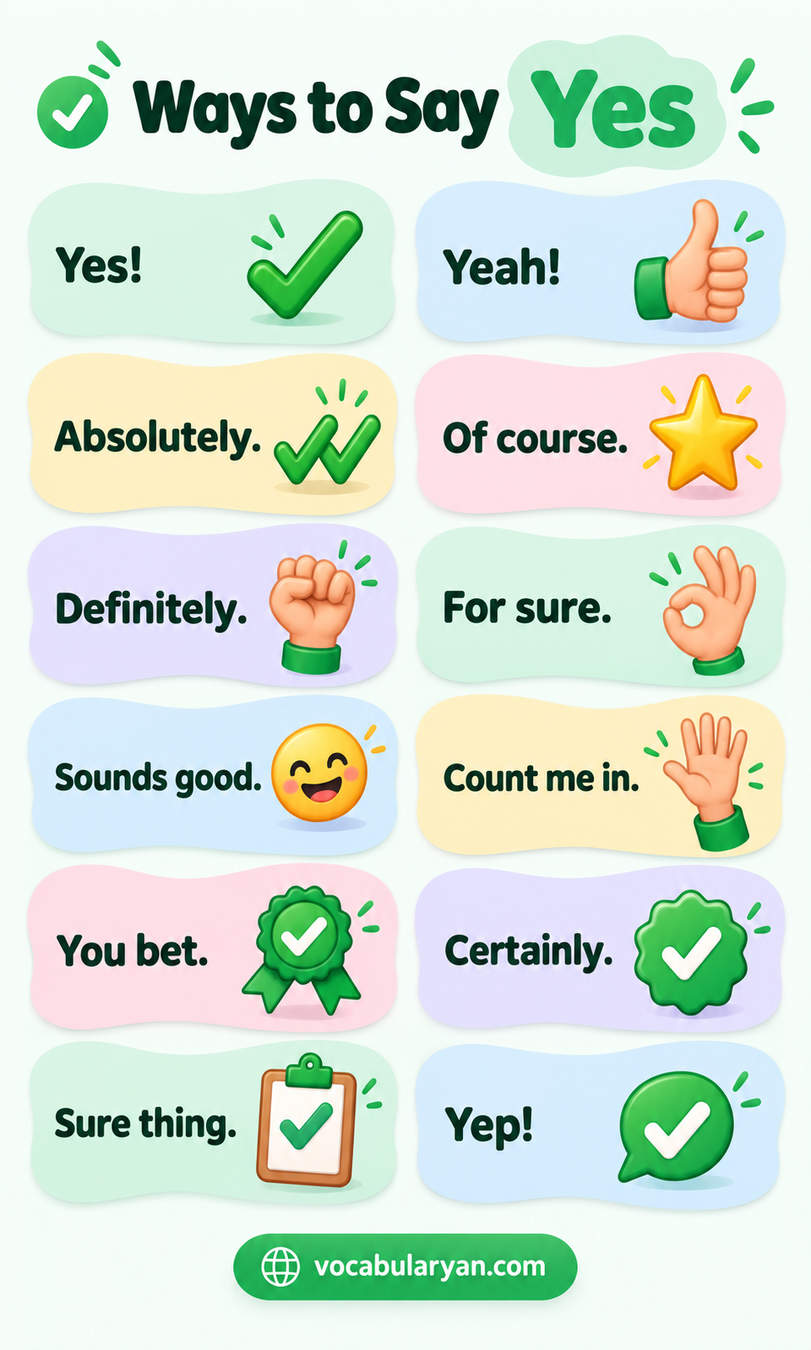
These five replies fit almost any question at home, in a shop, or in class, and each one changes how sure you sound.
Yes: the full form, correct with everyone from a child to a judge. On its own it sounds short, so add a name or a second clause in speech.
- Yes, I’d like the window seat, please.
- Yes, Mum, I’ve done my homework.
- Yes, that’s the right bus for the hospital.
Yeah: the everyday spoken form of "yes", relaxed and friendly. It fits family, friends, and colleagues you know, and it sounds odd in a job interview.
- Yeah, I’m coming, give me two minutes.
- Yeah, we tried that café, the soup was great.
- Did you lock the door? Yeah, twice.
Yep: "yes" with a short, cheerful ending, used for a quick fact or a quick check. Some older listeners hear it as too casual, so keep it for people your own age.
- Yep, the shop’s open till nine.
- Yep, I’ve got the tickets in my bag.
- Is that your car? Yep, the blue one.
Uh-huh: a sound rather than a word, and it means yes only when the question is small. In a longer conversation it also means "I’m listening", so do not use it for anything that needs a real promise.
- Are you still there? Uh-huh, go on.
- Uh-huh, that’s the one I meant.
- Did he ring? Uh-huh, about an hour ago.
That’s right: confirms a fact the other person just stated, so it fits a phone call, a shop, or a form.
- You’re the one who ordered the large size? That’s right.
- That’s right, we moved here in March.
- That’s right, the meeting is on Tuesday, not Monday.
Say "yeah" with people you know and "yes" with everyone else, and add one more clause so the reply does not end too soon.
Casual Ways to Say Yes to Friends
A casual yes between friends sounds quick, warm, and a little playful, and it goes with a first name or a joke.
Sure thing: a bright, friendly yes to a request from a friend or a relaxed colleague, and it promises that you will do it.
- Can you grab my coat? Sure thing.
- Sure thing, I’ll text you the address now.
- Sure thing, boss, one coffee coming up.
Totally: a yes that agrees with an opinion or a plan, and it sounds young and American. In a business meeting it sounds too casual.
- That film was far too long. Totally.
- Totally, let’s leave before the traffic starts.
- Should we invite Sam? Totally, he’d love it.
For sure: a relaxed yes that sounds certain, used for plans and for opinions, in speech and in texts.
- Are you coming to the wedding? For sure.
- For sure, I’ll bring the speaker.
- He’ll be late again, for sure.
You got it: a warm yes to a request, and it fits a friend, a waiter, or a colleague you joke with.
- Two teas and a slice of cake? You got it.
- You got it, I’ll pick the kids up at four.
- Can you fix the lamp tonight? You got it, love.
I’m in: the yes that joins a plan, a game, or a trip, and it is the reply to "who’s coming?"
- Pizza after the match? I’m in.
- If you’re going to the lake on Sunday, I’m in.
- I’m in, as long as someone else drives.
Why not?: a yes to a suggestion that you had not planned, and it sounds relaxed and open rather than sure.
- Another game? Why not?
- Why not? The rain’s stopped anyway.
- Shall we try the new place on the corner? Why not?
Use "sure thing" and "you got it" for a favour, "I’m in" for a plan, and "totally" for an opinion, and keep all four out of a formal reply.
Formal Ways to Say Yes at Work
A formal yes fits a manager, a client, or a customer, and it sounds polite because it is a full word rather than a sound.
Certainly: the standard polite yes to a request at work, in a hotel, or in a shop, and it goes with a short promise of action.
- Could you send me the draft? Certainly, you’ll have it by noon.
- Certainly, sir, I’ll bring the menu straight away.
- Certainly, Dr Rahman, the results are in your inbox.
Absolutely: a strong yes that sounds sure and warm at the same time, and it fits a client as well as a friend.
- Is the deadline still Friday? Absolutely.
- Absolutely, we can arrange a second viewing.
- Would you recommend her for the role? Absolutely, without hesitation.
Definitely: a yes with no doubt in it, and it works at every level from a text to a board meeting.
- Will you be at the launch? Definitely.
- Definitely, the new supplier is cheaper.
- I’ll definitely call you before I leave.
By all means: a very polite yes to a request for permission, and it sounds older and more formal than "go ahead".
- May I open the window? By all means.
- By all means, bring your partner to the dinner.
- By all means, take the seat by the door.
Indeed: a formal yes that agrees with a statement, and it sounds British and a little serious.
- It was a long winter. Indeed it was.
- Indeed, the figures confirm what you said.
- Is Mr Sato the new director? He is indeed.
I’d be happy to: a polite yes to a request that puts your willingness first, and it fits an email, a phone call, or a meeting.
- Could you show the visitors around? I’d be happy to.
- I’d be happy to review the contract this afternoon.
- I’d be happy to, but the earliest slot is Thursday.
The reply that goes wrong most at work is a friend’s yes given to a client.
- Yeah, no probs, I’ll sort it. (to a client on the phone) ❌
"Yeah" and "no probs" put a client at the level of a friend, and a full word plus a time is the polite version of the same reply.
- Certainly, I’ll have it sorted by this afternoon. ✅
Every yes on this page belongs to one of five levels.
| Level | Replies (7) | Who it fits (11) |
|---|---|---|
| Slang | Bet, say less, I’m down, fo sho (31) | Close friends your own age (26) |
| Casual | Yeah, yep, sure thing, totally, for sure, you got it (52) | Friends, family, relaxed colleagues (35) |
| Neutral | Yes, definitely, absolutely, that’s right, no problem, okay (59) | Anyone you know by name (23) |
| Formal | Certainly, I’d be happy to, of course, that works for me (56) | Managers, clients, customers, strangers (39) |
| Very formal | By all means, indeed, I’d be delighted, with pleasure (53) | Guests of honour, interviews, ceremonies (40) |
Answer a client with "certainly" or "I’d be happy to" plus a time, and save "yeah" for the colleague at the next desk.
Ways to Say Yes in an Email
An email yes has to work without your voice, so the reply names what you agree to and when it will happen.
That works for me: the standard yes to a proposed time, date, or plan, and it fits a colleague or a client you know.
- Thursday at ten? That works for me, see you then.
- That works for me, I’ll bring the projector.
- The revised budget works for me, thanks for the update.
Confirmed: a one-word yes to a booking, a date, or a delivery, and it fits a short reply to someone who asked for a check.
- Confirmed, two rooms for the nights of 12 and 13 June.
- Confirmed, the courier will collect at nine.
- Confirmed, see you at the station on Friday.
Happy to: the short email form of "I’d be happy to", and it fits a reply to a request from a colleague.
- Happy to, I’ll send the slides after lunch.
- Happy to join the call, send me the link.
- Happy to help, just let me know the date.
Please go ahead: the yes that gives permission in writing, and it fits a manager replying to a member of the team.
- Please go ahead and order the new chairs.
- Please go ahead and book the venue.
- Yes, please go ahead, the client has approved the design.
I can confirm that: the most formal email yes, used for a fact that needs to be on record, such as a payment, a date, or an attendance.
- I can confirm that the payment was received on 4 May.
- I can confirm that I will attend the hearing on Monday.
- I can confirm that the goods left the warehouse yesterday.
Write "that works for me" for a time, "confirmed" for a booking, and "I can confirm that" for anything that needs to be on record.
Ways to Say Yes When You Agree to a Request
A yes to a request is a promise, so the reply says that you will do it and, where you can, when.
No problem: a friendly yes to a favour or a small request, and it says that the task is no trouble for you.
- Can you cover my shift on Saturday? No problem.
- No problem, I’ll water the plants while you’re away.
- No problem, the printer’s fixed already.
I’m on it: a quick yes that says the work has already started, and it fits a colleague or a friend.
- Someone needs to call the caterer. I’m on it.
- I’m on it, the email will go out in five minutes.
- Can you check the back door? I’m on it.
Consider it done: a confident yes to a request, and it promises that the task is as good as finished.
- Could you get the report to Lena by Monday? Consider it done.
- Consider it done, I’ll drop the keys round tonight.
- One more chair for the guest? Consider it done.
Will do: a short, neutral yes to an instruction, and it works with a manager, a teacher, or a friend.
- Remind me about the dentist tomorrow. Will do.
- Will do, I’ll close the office at six.
- Send my love to your mum. Will do.
Be my guest: a yes that gives permission, and it also means "help yourself". It sounds warm from a host and a little dry from a colleague.
- Can I take the last biscuit? Be my guest.
- Be my guest, the spare room’s made up.
- Mind if I use your charger? Be my guest.
Say "will do" or "I’m on it" to an instruction and "be my guest" to a request for permission, and add a time whenever the task has a deadline.
Ways to Say Yes When You Accept an Invitation
A yes to an invitation thanks the person as well as accepting, so the warmer replies name the pleasure of going.
I’d love to: the warmest common yes to an invitation, and it fits friends, family, and colleagues alike.
- Do you want to come to dinner on Saturday? I’d love to.
- I’d love to, what time should I get there?
- I’d love to see the new exhibition with you.
Count me in: a yes to a group plan, and it says that you want your name on the list.
- We’re doing a beach clean on Sunday. Count me in.
- Count me in for the quiz night.
- If there’s a road trip, count me in.
I wouldn’t miss it: a yes that says the event is one you care about, and it fits a wedding, a birthday, or a performance.
- You’re coming to the show? I wouldn’t miss it.
- I wouldn’t miss it, it’s her first recital.
- I wouldn’t miss it for the world.
I’ll be there: a plain yes to an event with a time and a place, and it works in speech and in a text.
- Seven o’clock at the hall? I’ll be there.
- I’ll be there, save me a seat.
- Don’t worry, I’ll be there early to help set up.
Yes please: the polite yes to an offer of food, a drink, or help, and the "please" is what makes it polite.
- More tea? Yes please.
- Would you like a bag for that? Yes please.
- Yes please, a lift would save me an hour.
Reply "I’d love to" to a friend’s invitation, "I’ll be there" when the plan has a time, and "yes please" to an offer.
Ways to Say Yes With Enthusiasm
An enthusiastic yes says that you are glad they asked, and it comes with a raised voice or an exclamation mark.
A hundred percent: a yes with no doubt at all, said as one word in speech and written as "100%" in a text.
- Do you think we should go for it? A hundred percent.
- A hundred percent, she’s the best person for the job.
- Are you sure you want the red one? A hundred percent.
Without a doubt: a strong yes to a question about an opinion or a choice, and it fits speech at any level.
- Is he the best striker in the league? Without a doubt.
- Without a doubt, this is the better flat.
- I’d choose the coast again, without a doubt.
Hell yes: a loud, excited yes between friends, and it is too strong for work or for anyone older than you.
- Free tickets to the final? Hell yes.
- Hell yes, I’m coming with you.
- Did you pass? Hell yes I did!
A thousand times yes: the yes to a proposal or a dream offer, and it sounds like a film line, so it fits only a huge moment.
- Will you marry me? A thousand times yes.
- Do you want the job in Lisbon? A thousand times yes.
- A thousand times yes, when do we leave?
Let’s do it: a yes that starts the plan at once, and it fits a team, a friend, or a partner.
- Should we book the trip tonight? Let’s do it.
- Let’s do it, I’ll get the paint tomorrow.
- New logo, new website, all of it. Let’s do it.
Give a big yes with "a hundred percent" or "without a doubt", and keep "hell yes" for a friend who will shout it back.
Ways to Say Yes With Conditions
A yes with a condition still counts as a yes, and the condition goes after the yes so that the other person hears the agreement first.
Yes, as long as: the most common conditional yes, and the condition after it is the one thing you need in return.
- Yes, as long as you’re back before midnight.
- Yes, as long as the price stays the same.
- Yes, as long as someone helps me carry it.
Yes, but only if: a firmer condition than "as long as", and it says that the yes disappears if the condition fails.
- Yes, but only if the rain holds off.
- Yes, but only if you clear it with Ravi first.
- Yes, but only if we can leave by ten.
Provided that: the formal conditional yes, and it fits a contract, an email, or a meeting with a client.
- Yes, we can extend the deadline, provided that the deposit is paid this week.
- We’ll deliver on Friday, provided that the road is open.
- I’ll sign, provided that clause four is removed.
On one condition: a conditional yes with a small pause before the condition, and it fits friends and family more than work.
- You can borrow the car, on one condition: fill it up.
- Yes, on one condition, I choose the film.
- I’ll help you move, on one condition: pizza after.
I can, if: a soft conditional yes for a request that depends on time or on someone else.
- I can, if the meeting finishes on time.
- I can, if you send me the file first.
- I can, if Mum agrees to babysit.
Put the yes first and the condition second, and use "provided that" when the condition needs to be in writing.
Ways to Say Yes in a Text
A text yes is short, and the letters and punctuation replace the sound of your voice.
Yesss: "yes" with extra letters, and the more letters you add, the more excited it reads. It fits friends and a partner.
- Yesss, finally a day off!
- Yesss, I’ll be there, can’t wait.
- Yesss, tell me everything.
Defo: the British text short form of "definitely", and it fits friends of any age but not a work message.
- Coming tonight? Defo.
- Defo, I’ll bring the cake.
- We should go again next year, defo.
Yh: the text short form of "yeah", common in British messages between teenagers and friends.
- Yh, I’m outside.
- Yh, it was good, bit long.
- Still on for later? Yh.
Yes pls: "yes please" with the short form of "please", used for an offer in a message between friends.
- Want me to grab you a coffee? Yes pls.
- Yes pls, a lift would be amazing.
- Cake left at the office? Yes pls, save me some.
On it: the text form of "I’m on it", a yes that says the job has started.
- Can you order the taxi? On it.
- On it, back in ten.
- On it, the booking’s done already.
The one-letter yes reads as cold, because it takes less effort than the question did.
- Can you pick me up from the station at six? K. ❌
"K" sounds as if the reader is annoyed, and one word more turns it into a warm yes.
- Can you pick me up from the station at six? Yep, see you there! ✅
Add letters or an exclamation mark to a text yes, and never send "k" to someone who asked you a favour.
Ways to Say Yes to a Group
A group yes says where you stand in front of everyone, so it names you or the whole group.
Yes from me: a yes given in a meeting or a group chat where each person answers in turn.
- Are we all happy with the date? Yes from me.
- Yes from me, the design looks great.
- Yes from me, though I’ll need to leave early.
Same here: a yes that repeats the last person’s answer, and it fits a group of friends or a team.
- I’m free on Friday. Same here.
- Same here, I’d go for the cheaper option.
- Count me in for the walk. Same here.
Count us in: the group form of "count me in", said for a couple, a family, or a team.
- Barbecue at yours on Sunday? Count us in.
- Count us in, the kids will love it.
- If the whole office is going, count us in.
Agreed: a one-word yes that closes a decision in a meeting, and it sounds firm and neutral.
- So we launch in May? Agreed.
- Agreed, let’s move to the next item on the list.
- Agreed, I’ll write it up tonight.
Say "yes from me" when the group answers in turn, and "count us in" when you speak for more than one person.
Regional Ways to Say Yes in English
Each English-speaking country keeps a few yes replies of its own, and two of them mean the opposite of what they look like.
British Ways to Say Yes
Aye: the yes of Scotland, Northern England, and Northern Ireland, and it is normal there in speech at every age.
- Are you from Glasgow? Aye, born and bred.
- Aye, the bus goes past the hospital.
- Aye, I’ll have another, thanks.
Go on then: a British yes to an offer that you pretend to resist, said with a smile about a biscuit, a drink, or a treat.
- One more song? Go on then.
- Go on then, just a small one.
- Go on then, but this is the last game.
Fair enough: a British yes that accepts a reason or a decision, and it sounds calm rather than glad.
- I can’t stay late tonight. Fair enough.
- Fair enough, your plan is shorter.
- Fair enough, that price is better than mine.
American Ways to Say Yes
You bet: a friendly American yes to a request or a question, and the reply to "thank you" as well.
- Can you help me with the boxes? You bet.
- You bet, the store’s open till ten.
- Thanks for the ride! You bet.
Yes ma’am: the polite Southern American yes to a woman, with "yes sir" for a man, and both are normal from a child to a teacher or a customer.
- Did you finish your chores? Yes ma’am.
- Yes ma’am, the table by the window is free.
- Will you be careful on that road? Yes ma’am, I will.
Australian and Irish Ways to Say Yes
Nah yeah: the Australian yes, said when the answer is yes after a moment of doubt. "Yeah nah" is the opposite and means no.
- Was the surf any good? Nah yeah, it was decent.
- Nah yeah, I’ll come, what time?
- Nah yeah, the food was fine.
Too right: a strong Australian yes that agrees with an opinion, and it means "you are completely right".
- We deserve a day off. Too right.
- Too right, that ref was hopeless.
- Too right, it’s the best beach on the coast.
Grand: the Irish yes that means "fine" or "that’s okay", said to plans, offers, and apologies.
- I’ll be ten minutes late. Grand, no rush.
- Tea? Grand, thanks.
- Grand, see you at the church at two.
"Yeah nah" is the trap for a learner in Australia, because the last word is the answer.
- Do you want a lift? Yeah nah, I’ll walk. (meant as yes) ❌
"Yeah nah" means "I see your point, but no", so the yes form puts "yeah" last.
- Do you want a lift? Nah yeah, that’d be great. ✅
Use "aye" in Scotland, "you bet" in the United States, "too right" in Australia, and "grand" in Ireland, and listen for the last word of an Australian answer.
Slang Ways to Say Yes
Slang yes replies come from American internet and street English, and they fit friends under thirty and no one else.
Bet: a one-word yes to a plan or a challenge, and it means "deal" or "okay, let’s see".
- Meet at the courts at six? Bet.
- Bet, see you at eight.
- You think you can beat me? Bet.
Say less: a yes that means "you don’t need to explain, I’m in", and it fits an offer or a plan.
- I’ve got two spare tickets for tonight. Say less.
- Say less, I’m grabbing my keys.
- Free food at Maya’s? Say less.
I’m down: a relaxed yes to a plan, and it means "I want to do that".
- Movie night on Friday? I’m down.
- I’m down, what time does it start?
- If you’re going bowling, I’m down.
Fo sho: "for sure" in a form that began in African American English and spread through music. Keep it for close friends.
- You coming to the party? Fo sho.
- Fo sho, I’ll save you a plate.
- Is this the best track on the album? Fo sho.
Facts: a one-word yes that agrees with an opinion and means "that is true".
- This bus is always late. Facts.
- Facts, the second film was better.
- She’s the hardest worker on the team. Facts.
Reply "bet" to a plan and "facts" to an opinion, and switch to "definitely" the moment a parent or a manager joins the chat.
Funny Ways to Say Yes
A funny yes answers a question whose answer is obvious, or acts out a part for a laugh, and it fits friends and family only.
Is the Pope Catholic?: a joke yes that means "of course, why ask?", said to a question with an obvious answer.
- Do you want a coffee? Is the Pope Catholic?
- Will Dad watch the match? Is the Pope Catholic?
- Are you coming to the free lunch? Is the Pope Catholic?
Aye aye, Captain: a sailor’s yes, said with a salute to a partner, a child, or a bossy friend.
- Take the bins out, please. Aye aye, Captain.
- Aye aye, Captain, the tent is up.
- More sun cream for everyone! Aye aye, Captain.
Your wish is my command: a mock-servant yes, said with a bow to a friend who asked for something small.
- Pass the remote? Your wish is my command.
- Your wish is my command, one hot chocolate.
- Can you drop me at the station? Your wish is my command.
Roger that: a radio yes from pilots and police, used as a joke for "understood, will do".
- Pick up milk on the way home. Roger that.
- Roger that, the cake’s in the oven.
- Meet at the gate at six? Roger that.
Yessiree: a cheerful, old-fashioned American yes, said for fun about something you are proud of.
- Did you finish the whole pizza? Yessiree.
- Yessiree, that’s my garden.
- Is the car finally fixed? Yessiree, runs like new.
Save a funny yes for a question with an obvious answer, and give a plain "yes" to anyone who asked in earnest.
Yes Replies That Sound Rude or Too Weak
Some replies are a yes in form and a no in feeling, and each one says that you agree without wanting to.
Fine: a yes that sounds tired or annoyed, and on its own it says that you have stopped arguing rather than agreed.
- Can we watch my film tonight? Fine.
- Fine, I’ll go to the dinner, but I’m leaving at nine.
- Fine, have it your way.
Whatever: a yes that says "I don’t care", and to a friend it sounds cold and to a parent or a manager it sounds rude.
- Do you want the blue one or the green one? Whatever.
- Whatever, pick the restaurant yourself.
- Can we leave at eight? Whatever.
I guess: a weak yes that says you are not sure, and it is honest when you are not sure and rude when the other person needs a real answer.
- Do you like the new logo? I guess.
- I guess I can come, if nothing else turns up.
- Is the plan okay with you? I guess so.
If I have to: a yes that says that you have no choice, and it makes the other person feel like a burden.
- Will you come to my parents’ for lunch? If I have to.
- If I have to, but I’m not staying long.
- Can you help with the boxes? If I have to.
Yeah, right: a sarcastic yes that means no, and it says that the other person’s claim is not believable.
- I’ll pay you back tomorrow. Yeah, right.
- Yeah, right, and I’m the Queen of England.
- He says he ran a marathon. Yeah, right.
Obviously: a yes that says the question was stupid, and it sounds rude to anyone who asked in good faith.
- Did you remember the passports? Obviously.
- Obviously I’ll be at the wedding, she’s my sister.
- Is the shop shut on Sunday? Obviously.
"Fine" and "I guess" are the two weak replies that a learner gives by accident when the true answer is a happy yes.
- Do you want to come to the party? Fine. ❌
"Fine" sounds like you agreed to stop the other person asking, and a warm reply says that you want to go.
- Do you want to come to the party? I’d love to, thanks for asking. ✅
"Obviously" catches out learners who mean "of course".
- Could you send me the file? Obviously. ❌
"Obviously" calls the question stupid, and "of course" gives the same yes without the insult.
- Could you send me the file? Of course, give me two minutes. ✅
Replace "fine" with "I’d love to", "I guess" with "yes, that works", and "obviously" with "of course", and keep "whatever" for arguments you do not mind losing.
More Everyday English Phrases
FAQs
More than sixty replies mean yes in current English, and the number keeps growing because slang adds a new one every few years. The core set is short: "yes", "yeah", "yep", "definitely", "certainly", and "I’d love to" cover a request, a fact, an opinion, and an invitation at every level. The rest add a place, a level, or a mood to one of those six.
The funny replies answer a question whose answer is obvious or play a role for a laugh: "is the Pope Catholic?", "aye aye, Captain", "your wish is my command", "roger that", and "yessiree". Each one fits friends and family who know your humour. To a stranger or a manager, a joke yes reads as a refusal to answer.
Use a reply that fits the question: "that’s right" for a fact, "I’d love to" for an invitation, "will do" for an instruction, "definitely" for an opinion, and "by all means" for permission. Each one gives a full answer with no "yes" in it. In an email, "that works for me" and "confirmed" do the same.
The most formal replies are "by all means", "indeed", "I’d be delighted", "with pleasure", and "I can confirm that". They fit a client, a guest of honour, a job interview, or a letter, and they sound too heavy between friends. "Certainly" is the fancy yes that also works in everyday speech.
The classic reply is "yes" said more than once, and "a thousand times yes" is the film form of it. "Of course I will", "I thought you’d never ask", and "nothing would make me happier" also answer a marriage proposal. For a business proposal, the reply is "we’d be glad to accept" or "that works for us".
"Fine", "whatever", "I guess", and "if I have to" are the replies that agree while sounding annoyed or bored, and "yeah, right" is a yes that means no. "Obviously" is a yes that calls the question stupid. Each of them fits an argument with a close friend and nothing else.
"Yes sir" and "yes ma’am" are the polite replies to an older person, a teacher, or a customer in the American South. Elsewhere the plain form is "yes" plus the person’s name or title: "yes, Mr Osei". At work, "certainly" and "right away" give the same respect without "sir". "Aye aye, sir" belongs to sailors and to jokes.