
"Thank you" is the one line in English that expects an answer, and "you’re welcome" is the answer that fits everywhere. The other ways to say you’re welcome in English say how big the favour was and how close you are. "No worries" is for a friend, "my pleasure" for a client, and "it was nothing" for a small thing. The everyday replies are the ones to learn first.
Other Ways to Say You’re Welcome in Everyday English
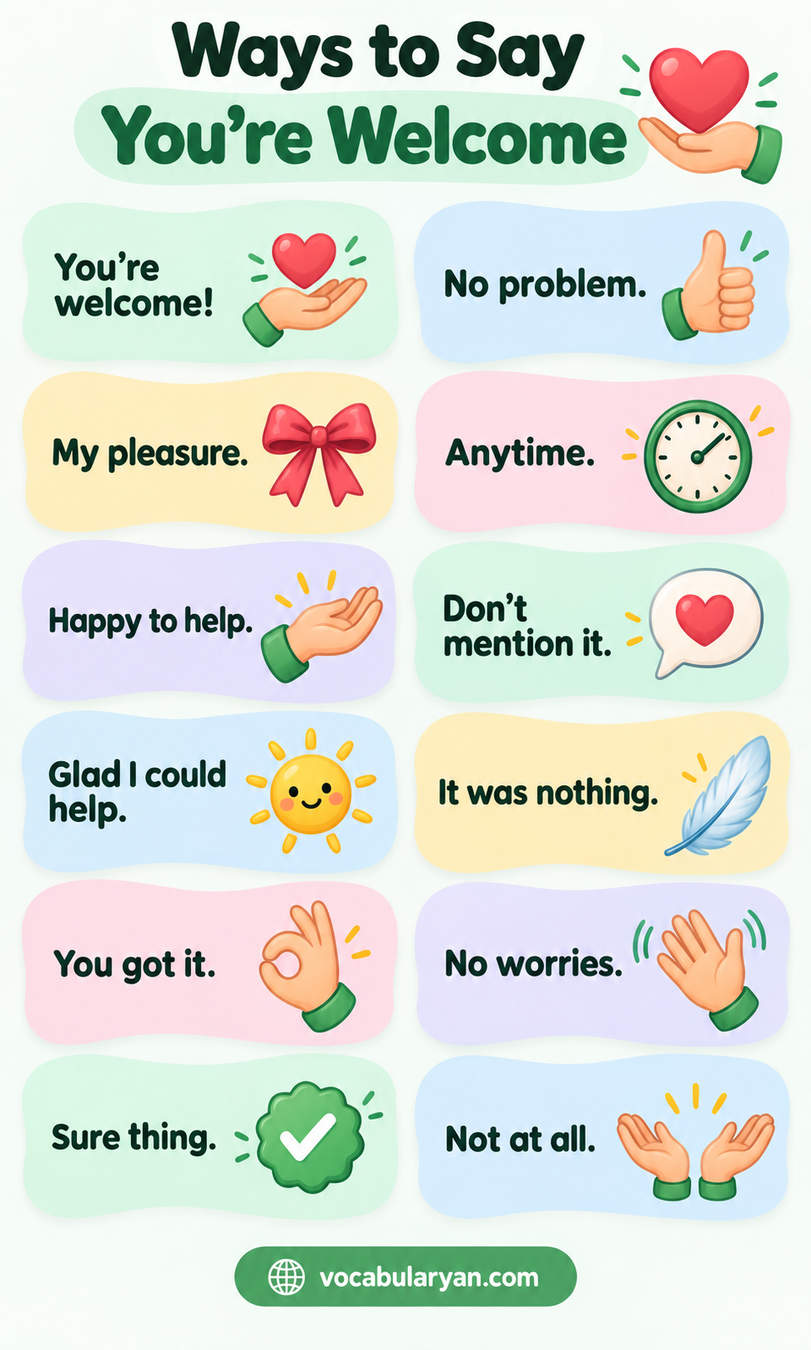
These seven replies fit almost any "thank you", from a neighbour at the door to a colleague at the desk.
You’re welcome: the standard reply, and it is polite at every level from a child to a chief executive. It sounds a little formal between close friends, and that is its only limit.
- You’re welcome, Dan, the keys are on the hook by the door.
- Oh, you’re welcome, it was on my way anyway.
- You’re welcome, Mrs Ahmed, we’ll see you at the same time next week.
You’re very welcome: "you’re welcome" with extra warmth, and it fits a thank-you that sounds heartfelt. With "very" the reply matches a bigger favour.
- You’re very welcome, I’m glad the talk went well.
- You’re very welcome, come back and see us anytime.
- You’re very welcome, Leo, it was a pleasure to have you here.
No problem: the most common casual reply in American English, and it means the favour cost you nothing. It fits friends, family, and colleagues of your own level.
- No problem, I’ll drop the book round on Saturday.
- No problem, mate, that’s what neighbours are for.
- No problem, the file is already in the shared folder.
Sure: a quick, friendly reply for a small favour, and it fits speech more than writing. On its own it sounds a little flat, so a name or a smile goes with it.
- Sure, Nadia, any time you need the car.
- Sure, happy to.
- Sure, and let me know how the interview goes.
Of course: a reply that says the help was natural and needed no thanks, and it fits a friend, a partner, or a colleague you like.
- Of course, you’d have done the same for me.
- Of course, Grandma, I’ll carry the other bag too.
- Of course! What else are brothers for?
Anytime: a reply that offers the same help again, and it fits anyone you will see again, from a classmate to a client.
- Anytime, just message me when you’re ready to move the sofa.
- Anytime, Mr Diaz, the office is open until six.
- Anytime! I loved reading your draft.
Happy to help: neutral and warm, and it fits work, shops, and family alike. It is the reply that sounds right in an email and out loud.
- Happy to help, and the invoice will follow by Friday.
- Happy to help, Priya, the spare charger is yours for the week.
- Happy to help, sir, your table is this way.
Say "you’re welcome" with a stranger and "anytime" or "happy to help" with everyone you know by name.
Casual Ways to Say You’re Welcome to Friends
Casual replies make the favour sound small and the friendship sound relaxed, and each one belongs to people who know you well.
No worries: the friendly reply that says there is nothing to feel bad about, and it fits a friend who thanks you and a friend who says sorry. It is casual in Britain and America and the default in Australia.
- No worries, I was going to the shop anyway.
- No worries, Sam, get the next round.
- No worries! Text me when you land.
Don’t mention it: a reply that says the favour was too small to talk about, and it fits a friend, a neighbour, or an older relative.
- Don’t mention it, the dog loved the walk.
- Don’t mention it, Auntie, I’ll bring the dish back on Sunday.
- Don’t mention it, that’s what flatmates do.
It was nothing: a modest reply after a small favour, and it fits a friend or a colleague who thanks you more than the favour needs.
- It was nothing, honestly, the shop is two doors down.
- It was nothing, Jess, I had the notes already.
- Please, it was nothing, sit down and eat.
You got it: an American reply that means "done" or "yes", and it fits a friend or a relaxed colleague who asked for something small.
- You got it, one coffee with oat milk.
- You got it, I’ll pick Ben up from practice.
- You got it, boss, the slides will be ready by two.
Sure thing: "sure" with extra energy, and it fits friends and relaxed colleagues in speech and in a quick message.
- Sure thing, Amir, see you at nine.
- Sure thing! Grab the seat by the window.
- Sure thing, I’ll send the address in a minute.
Don’t worry about it: a reply that stops the other person feeling guilty, so it fits a favour that cost you time or money.
- Don’t worry about it, you can pay me back next month.
- Don’t worry about it, Tom, the stain came right out.
- Don’t worry about it, the taxi was on the company card anyway.
It’s all good: a relaxed reply, and it fits close friends and younger colleagues. It also answers a "sorry", so one reply covers both in a group chat.
- It’s all good, I found the tickets in my jacket.
- It’s all good, Mia, the party doesn’t start till eight.
- Hey, it’s all good, the lift is on my way.
Answer a friend with "no worries" or "it’s all good", and keep "you’re welcome" for people you have just met.
Formal Ways to Say You’re Welcome at Work
Formal replies fit a manager, a client, or a colleague you do not joke with, and each one sounds calm and polite rather than quick.
My pleasure: the standard formal reply, and it says the help was a pleasure rather than a task. It fits a client, a senior colleague, and every job that serves the public.
- My pleasure, Ms Okafor, the revised figures are attached.
- My pleasure, please call if the contract raises any questions.
- My pleasure, and thank you for your patience this morning.
Not at all: a polite British reply that means "there is nothing to thank me for", and it fits work and older speakers.
- Not at all, Mr Reyes, the report was due anyway.
- Not at all, please take as long as you need with the forms.
- Not at all, it was good to meet the whole team.
Glad I could help: a reply that names the help and sounds warm without sounding casual, so it fits any colleague and any client.
- Glad I could help, the password reset should work now.
- Glad I could help, Sara, let me know how the pitch goes.
- Glad I could help, and the second draft is on its way.
I’m glad I could be of assistance: the longest and most formal reply in an office, and it fits a customer, a senior manager, or a written reply to a complaint.
- I’m glad I could be of assistance, Mrs Novak, your refund will arrive within five days.
- I’m glad I could be of assistance with the visa forms.
- I’m glad I could be of assistance, and please contact me again if anything changes.
Certainly: a formal one-word reply that says "yes, of course", and it fits a request more than a thank-you. From staff it answers a customer who says thanks for a small task.
- Certainly, sir, I’ll have the car brought round.
- Certainly, the minutes will go out this afternoon.
- Certainly, Ms Grant, consider it done.
You’re most welcome: a very formal form of "you’re welcome", and it fits a guest, an older client, or a written thank-you note.
- You’re most welcome, Professor, the library is open to you all week.
- You’re most welcome, we were honoured to host the event.
- You’re most welcome, and do bring your colleagues next time.
One reply that grates in a formal setting is "no problem", because it names a problem that the client never mentioned.
- No problem, Mr Whitmore, the figures are attached. (to a senior client) ❌
"No problem" sounds too casual for a senior client on a first exchange, and "my pleasure" answers the same thank-you at the right level.
- My pleasure, Mr Whitmore, the figures are attached. ✅
Every reply to "thank you" belongs to one of five levels.
| Level | Replies | Who it fits |
|---|---|---|
| Slang | Np, yw, you know it, all good | Close friends in texts |
| Casual | No worries, no problem, sure thing, you got it | Friends, family, colleagues of your level |
| Neutral | You’re welcome, anytime, happy to help, of course | Anyone you know by name |
| Formal | My pleasure, not at all, glad I could help | Managers, clients, customers, strangers |
| Very formal | You’re most welcome, I’m glad I could be of assistance | Guests of honour, complaints, written notes |
Use "my pleasure" with a client and "glad I could help" with a colleague, and save "no problem" for people at your own level.
Ways to Say You’re Welcome to a Customer
A customer’s thank-you gets a reply that offers more help, because the job is not over until the customer leaves happy.
That’s what we’re here for: a reply from a shop, a help desk, or a hotel, and it says the help is the whole job.
- That’s what we’re here for, enjoy the rest of your stay.
- That’s what we’re here for, madam, the exchange is all done.
- That’s what we’re here for! Call again if the app logs you out.
Happy to be of service: a formal reply from staff, and it fits a hotel, a bank, or a restaurant. Between friends it sounds like a joke.
- Happy to be of service, Mr Sato, your car is at the front entrance.
- Happy to be of service, and here is your receipt.
- Happy to be of service, we hope to see you again in December.
Is there anything else I can help you with?: a reply and a question in one, and it closes a call or a visit politely. The customer answers "no, that’s all, thanks".
- You’re welcome. Is there anything else I can help you with today?
- My pleasure. Is there anything else I can help you with before I close the ticket?
- Not at all. Is there anything else I can help you with, or shall I bring the bill?
Thank you for choosing us: a reply that turns the thanks round, and it fits the end of a sale, a flight, or a booking.
- Thank you for choosing us, and have a safe journey home.
- Thank you for choosing us, Ms Bello, your order will ship on Monday.
- Thank you for choosing us, and enjoy the rest of your evening.
Let us know if you need anything else: the closing reply on a chat, an email, or a phone call, and it leaves the door open for the next question.
- You’re very welcome. Let us know if you need anything else.
- Glad I could help. Let us know if you need anything else before the trip.
- My pleasure. Let us know if you need anything else, our line is open until nine.
Answer a customer with "my pleasure" and then an offer of more help, because the offer is what the customer remembers.
Ways to Say You’re Welcome in an Email
An email reply to thanks is one short line at the top of the message, and it matches the level of the greeting the writer chose.
Glad it helped: the reply after you sent a file, a link, or an answer, and it fits a colleague or a client you know.
- Glad it helped, and the updated version is attached.
- Glad it helped, Marta, shout if the numbers still look odd.
- Glad it helped! Let me know what the committee decides.
Always happy to help: warm and neutral, and it fits any colleague. It is the line to use when you want the person to ask you again.
- Always happy to help, and good luck with the presentation.
- Always happy to help, Omar, the template is yours to keep.
- Always happy to help, so please do send the next draft my way.
No thanks needed: a modest written reply for a small favour, and it fits a colleague you write to every week.
- No thanks needed, it took two minutes.
- No thanks needed, Ali, the room was free anyway.
- No thanks needed, I’m glad the photos arrived in time.
It was no trouble at all: a polite reply that makes the favour small, and it fits a client, a parent at school, or a new contact.
- It was no trouble at all, and I hope the move goes smoothly.
- It was no trouble at all, Mrs Kaur, the certificate is in the post.
- It was no trouble at all, thank you for the kind words.
Let me know if there’s anything else: a closing line that follows the reply, and it fits every level from a colleague to a customer.
- Happy to help. Let me know if there’s anything else you need for the audit.
- You’re welcome, Chen. Let me know if there’s anything else before Friday.
- Glad it helped. Let me know if there’s anything else I can do.
Write "glad it helped" to a colleague and "it was no trouble at all" to a client, and end with an offer of more help.
Ways to Say You’re Welcome in a Text
Text replies are two or three words long, and the exclamation mark or the emoji supplies the warmth that your voice supplies in speech.
Np: the short form of "no problem", typed between friends, and it fits a reply to "thx" or "ta".
- Np, see you at 7.
- Np! Tell your mum I said hi.
- Np, the link should work now.
Yw: the short form of "you’re welcome", and it fits a quick reply in a chat with friends or family. In a work chat it looks lazy.
- Yw 🙂 enjoy the film.
- Yw, and don’t forget the charger this time.
- Yw! Let me know what you think of the book.
Anytime!: "anytime" with an exclamation mark, and it is the warmest short text reply for a friend or a family member.
- Anytime! Say hi to the kids.
- Anytime! You’d do the same for me.
- Anytime! Just send the address when you know it.
All good: a relaxed reply in a group chat, and it answers both a thank-you and a sorry.
- All good, I was up anyway.
- All good, the tickets are in my name.
- All good! Get some sleep.
You know it: a playful American reply between close friends, and it means "of course I helped you".
- You know it, Jay. Same time next week?
- You know it! Pizza’s on me next time.
- You know it, we look after each other.
Keep a text reply to one line, and let the exclamation mark do the smiling.
Ways to Say You’re Welcome After a Big Favour
A big favour gets a reply that accepts the thanks rather than brushing it off, because "it was nothing" after a week of help sounds false.
The pleasure is all mine: a warm formal reply that says you gained as much as the other person, and it fits a host, a mentor, or a partner in a project.
- The pleasure is all mine, Elena, your students were a joy to teach.
- The pleasure is all mine, come and stay again next summer.
- The pleasure is all mine, I learned as much as you did.
I’m sure you’d do the same for me: a reply that turns the favour into something between equals, and it fits a friend or a colleague after real help.
- I’m sure you’d do the same for me, so don’t give it another thought.
- I’m sure you’d do the same for me, Raj, that’s what mates are for.
- I’m sure you’d do the same for me if my car broke down.
It was the least I could do: a modest reply after you helped someone in trouble, and it fits family, friends, and colleagues who have helped you before.
- It was the least I could do after everything you did for Dad.
- It was the least I could do, Hana, you covered my shifts all spring.
- It was the least I could do, honestly.
Just returning the favour: a reply that names an earlier favour from the other person, and it fits friends and colleagues who trade help.
- Just returning the favour, you drove me to the airport in March.
- Just returning the favour, Lucy, you proofread my whole thesis.
- Just returning the favour! Now we’re even.
That’s what friends are for: a fond reply after a favour that took real time, and it fits close friends only.
- That’s what friends are for, now go and get some sleep.
- That’s what friends are for, Ade, you’d have done it for me.
- Hey, that’s what friends are for, stop thanking me.
Don’t give it a second thought: a gentle reply that stops the other person feeling in debt, and it fits a friend or a relative after a big favour.
- Don’t give it a second thought, the spare room is yours as long as you need it.
- Don’t give it a second thought, Mum, the bill is paid.
- Don’t give it a second thought, we’re just glad you’re safe.
Accept a big thank-you with "the pleasure is all mine" or "you’d do the same for me", and never brush it off with "it was nothing".
Ways to Say You’re Welcome After a Small Thing
A small favour, such as holding a door or passing the salt, gets a reply that is as small as the favour.
Think nothing of it: a slightly old-fashioned reply that makes the favour tiny, and it fits older speakers, shops, and polite strangers.
- Think nothing of it, the door is heavy for everyone.
- Think nothing of it, madam, your change is here.
- Think nothing of it, I’m going that way too.
It’s nothing: the shortest modest reply, and it fits a stranger on a bus or a colleague who thanks you for a pen.
- It’s nothing, keep the pen.
- It’s nothing, the seat was free anyway.
- It’s nothing, really, the coffee was already made.
No trouble: a brief British reply, and it fits a small favour for a neighbour, a customer, or a colleague.
- No trouble, the parcel was on the step when I got home.
- No trouble, Mrs Ellis, I’ll leave the bin by the gate.
- No trouble, it’s two clicks in the system.
Don’t be silly: a warm reply between friends and family when the thank-you is bigger than the favour, and it sounds rude to a stranger.
- Don’t be silly, it’s one cup of tea.
- Don’t be silly, Grandad, I love driving you to the club.
- Don’t be silly, you don’t need to thank me for a lift.
You don’t need to thank me: a plain reply that says the favour was normal, and it fits anyone you help every day.
- You don’t need to thank me, it’s my job.
- You don’t need to thank me, Noor, the notes are for the whole class.
- You don’t need to thank me for holding a door.
Match a small favour with a small reply, and keep "the pleasure is all mine" for a favour that took real effort.
Ways to Say You’re Welcome When Someone Thanks You for a Gift
The thank-you for a gift gets a reply about the gift itself, and the reply says you are happy the person likes it.
I’m so glad you like it: the standard reply to thanks for a present, and it fits family, friends, and colleagues alike.
- I’m so glad you like it, I wasn’t sure about the colour.
- I’m so glad you like it, Dev, the shop only had one left.
- I’m so glad you like it! It looked like you the moment I saw it.
I hope you enjoy it: the reply when the gift is for later, such as a book, a voucher, or a bottle of wine.
- I hope you enjoy it, the last chapter is the best part.
- I hope you enjoy it, Mrs Lee, the vineyard is near my parents’ village.
- I hope you enjoy it on your birthday weekend.
It’s just a little something: a modest reply that makes the gift small, and it fits a host gift, a thank-you card, or a small present for a colleague.
- It’s just a little something for having us to stay.
- It’s just a little something, Ana, to say well done on the exam.
- Oh, it’s just a little something from the market.
I saw it and thought of you: a warm reply that says the gift was chosen with care, and it fits a close friend or a family member.
- I saw it and thought of you, it’s the same blue as your kitchen.
- I saw it and thought of you, Maya, you always said you wanted one.
- I saw it and thought of you in the airport shop.
I knew you’d like it: a confident reply between people who know each other well, and it sounds like a boast to someone you have just met.
- I knew you’d like it, you’ve talked about that band for years.
- I knew you’d like it, Dad, it’s the same model as your old one.
- I knew you’d like it! Open the second box.
You deserve it: a reply for a gift that marks an achievement, and it fits a graduation, a promotion, or a hard year.
- You deserve it after the year you’ve had.
- You deserve it, Sofia, nobody worked harder for that promotion.
- You deserve it, and so much more.
Reply to thanks for a gift with "I’m so glad you like it", and never with "no problem", because a gift is not a favour.
Ways to Say You’re Welcome to a Group
A group thank-you gets a reply that names everyone, and the level matches the room, from a family dinner to a client meeting.
You’re all very welcome: the standard reply to a room full of thanks, and it fits a host, a teacher, or a manager after an event.
- You’re all very welcome, please take the leftovers home.
- You’re all very welcome, and thank you for coming so far.
- You’re all very welcome, the slides will be in your inbox tonight.
Happy to help, everyone: a warm reply to a team or a class, and it fits a message or the end of a meeting.
- Happy to help, everyone, see you at the next session.
- Happy to help, everyone, the recording is on the shared drive.
- Happy to help, everyone! Good luck on Monday.
It was a team effort: a reply that shares the credit, and it fits a manager or a colleague when a group thanks one person.
- It was a team effort, Lena did most of the design.
- It was a team effort, so thank the whole department.
- Honestly, it was a team effort, I just sent the emails.
Anytime, guys: a casual reply to a group of friends or classmates, and it sounds too relaxed for a client.
- Anytime, guys, the garden is yours whenever you want a barbecue.
- Anytime, guys! Same time next term?
- Anytime, guys, I’ll bring the speaker again.
Answer a group with "you’re all very welcome", and share the credit with "it was a team effort" when the thanks are for a team.
Regional Ways to Say You’re Welcome in English
Each English-speaking country keeps one or two replies of its own, and using the right one sounds local at once.
British Ways to Say You’re Welcome
That’s alright: the everyday British reply, and it fits shops, buses, and neighbours. It is the same "alright" that answers a sorry.
- That’s alright, love, take your time.
- That’s alright, the bus was late anyway.
- That’s alright, Ravi, the keys are under the mat.
No bother: a reply from Scotland, the north of England, and Ireland, and it means the favour caused no trouble at all.
- No bother, I’ll drop the ladder back tomorrow.
- No bother, pet, the shop’s only across the road.
- No bother, the form took a minute.
You’re alright: a casual British reply that means "you don’t need to thank me", said with a wave of the hand.
- You’re alright, mate, get the next one.
- You’re alright, it’s only a pound.
- You’re alright, Kate, I’m parked right outside.
Not a problem, mate: the British and Australian casual reply with "mate", and it fits men and women alike among friends.
- Not a problem, mate, see you at the match.
- Not a problem, mate, the van’s free all weekend.
- Not a problem, mate, I’ll text you the postcode.
American Ways to Say You’re Welcome
You bet: the friendly American reply from the Midwest and the West, and it means "of course". It fits shops, neighbours, and colleagues.
- You bet, the tools are in the truck if you need them.
- You bet, Carla, swing by anytime.
- You bet! Have a good one.
Mm-hmm: the sound that answers a small thank-you in casual American speech, and it counts as a reply between friends and in a shop.
- Thanks for the napkin. Mm-hmm.
- Thank you! Mm-hmm, have a great day.
- Thanks, Ty. Mm-hmm, see you tomorrow.
Absolutely: an energetic American reply that says the help was a full yes, and it fits colleagues, customers, and friends.
- Absolutely, and let me know when the shipment arrives.
- Absolutely, Rosa, the door’s always open.
- Absolutely! It was a fun project.
Australian and Irish Ways to Say You’re Welcome
No worries, mate: the Australian reply at every level, from a barista to a bank manager, and it never sounds too casual there.
- No worries, mate, the board’s yours till Sunday.
- No worries, mate, that’s the last of the boxes.
- No worries, mate, see you at the beach.
Too easy: an Australian reply that means the favour was no effort, and it fits shops, tradespeople, and friends.
- Too easy, the ute’s out the front.
- Too easy, I’ll email the quote tonight.
- Too easy, Liam, grab a chair.
You’re grand: the Irish reply that means "you’re fine, no need to thank me", and it fits friends, shops, and taxis.
- You’re grand, sure it was on my way.
- You’re grand, Niamh, the coat suits you.
- You’re grand, keep the change.
Not a bother: the Irish form of "no bother", and it fits a small favour for anyone from a neighbour to a customer.
- Not a bother, the bags are in the boot.
- Not a bother, Sean, I’ll mind the dog on Friday.
- Not a bother at all, come back any time.
Say "that’s alright" in Britain, "you bet" in America, "no worries" in Australia, and "you’re grand" in Ireland, and "you’re welcome" everywhere else.
Funny Ways to Say You’re Welcome
Funny replies pretend the favour was a huge deal or a paid job, and they belong to close friends who share your sense of humour.
I’ll send you the bill: a joke reply that pretends the favour cost money, and it fits a friend who thanks you for a lift or a tip.
- I’ll send you the bill, my rates went up last week.
- I’ll send you the bill, Priya, and it’s in the post.
- I’ll send you the bill! Cash only.
You owe me one: a playful reply that turns the favour into a debt, and it fits a friend or a sibling who will do you a favour later.
- You owe me one, and I’m thinking pizza.
- You owe me one, little brother.
- You owe me one! Don’t forget it.
I know, I’m amazing: a mock boast, and it fits a close friend who will laugh rather than agree.
- I know, I’m amazing, and modest with it.
- I know, I’m amazing, Sam, tell everyone.
- I know, I’m amazing! Where’s my medal?
Don’t thank me yet: a teasing reply that warns the favour has a catch, and it fits friends and family.
- Don’t thank me yet, you haven’t tasted the cake.
- Don’t thank me yet, Ali, the printer jams every third page.
- Don’t thank me yet, I’m going to ask you to help me move.
Keep the joke replies for people who will laugh, because "you owe me one" to a customer sounds like a real bill.
What Not to Say Instead of You’re Welcome
A few replies feel natural to learners from another language, and each one sounds wrong to an English speaker for a fixed reason.
The first is "please" on its own, which is the direct translation of "bitte", "prego", or "proszę".
- Thank you for the map. Please. ❌
"Please" in English asks for something, so as a reply to thanks it sounds like the start of a request that never comes.
- Thank you for the map. You’re welcome. ✅
The second is "welcome" without "you’re", which sounds like a greeting at a door.
- Thanks for the lift. Welcome. ❌
"Welcome" alone greets a visitor, so the reply to thanks keeps the "you’re" or switches to "no worries".
- Thanks for the lift. You’re welcome, anytime. ✅
The third is "no problem" to a senior client or an older customer, where the word "problem" grates.
- Thank you for staying late, Ms Park. No problem. ❌
"No problem" is right between colleagues, and with a senior client the same thanks gets "my pleasure" or "not at all".
- Thank you for staying late, Ms Park. My pleasure. ✅
The fourth is a bare "yes" or a nod with no words at all, which reads as cold in a shop or an office.
- Thanks so much for your help. Yes. ❌
"Yes" answers a question, not a thank-you, so the reply needs "you’re welcome" or "happy to help".
- Thanks so much for your help. Happy to help. ✅
Never answer thanks with "please" or "yes", and keep "no problem" for people at your own level.
More Everyday English Phrases
FAQs
More than seventy replies to "thank you" are in daily use, and this page covers each one with three sentences. The core set is small: "you’re welcome", "no problem", "no worries", "anytime", "my pleasure", and "happy to help" answer almost every thank-you. The rest change the level, the country, or the size of the favour.
Yes, "you’re welcome" is a fine first line in an email reply, and "happy to help" or "glad it helped" sound a little warmer. To a client or a senior colleague, "my pleasure" or "it was no trouble at all" fits better. End the line with an offer of more help, because that is what a written reply is for.
"You’re welcome" is correct, because it is short for "you are welcome". "Your" is a possessive word, as in "your book", so "your welcome" means the welcome that belongs to you. Say the full form out loud, "you are welcome", and the apostrophe form is the one you need.
No, because "welcome" on its own is a greeting for someone who has just arrived, as in "welcome to the office". As a reply to thanks it sounds like a mistake, and the fix is to add "you’re" or to choose "no worries". In a text, the short form "yw" is the one to use.
The professional replies are "my pleasure", "glad I could help", "not at all", and "happy to help", and each one fits a client, a manager, or a customer. "I’m glad I could be of assistance" is the most formal, and it belongs in writing or in a reply to a complaint. "No problem" fits colleagues of your own level, and with a senior client it sounds too casual.
Yes, "my pleasure" is a polite replacement for "you’re welcome", and it is the standard reply from staff to a customer. It says the help was enjoyable rather than a duty. Between close friends it sounds a little formal, so "no worries" or "anytime" fits better there.
The polite replies are "you’re welcome", "you’re very welcome", "my pleasure", and "not at all", and each one fits a stranger, an older person, or someone senior. Add the person’s name or title, as in "my pleasure, Mrs Ali", and the reply sounds warmer. A polite reply is short, so one line is enough.