
"Sweet dreams" is a bedtime wish, not a farewell for the street, and it is always plural. It is said to someone you are close to, right before they sleep, and it means "I hope you sleep well and dream about good things". The ways to say sweet dreams in English change with the person in the bed: a partner, a child, a friend, or a guest. The everyday wishes fit all of them, so they come first.
Other Ways to Say Sweet Dreams in English
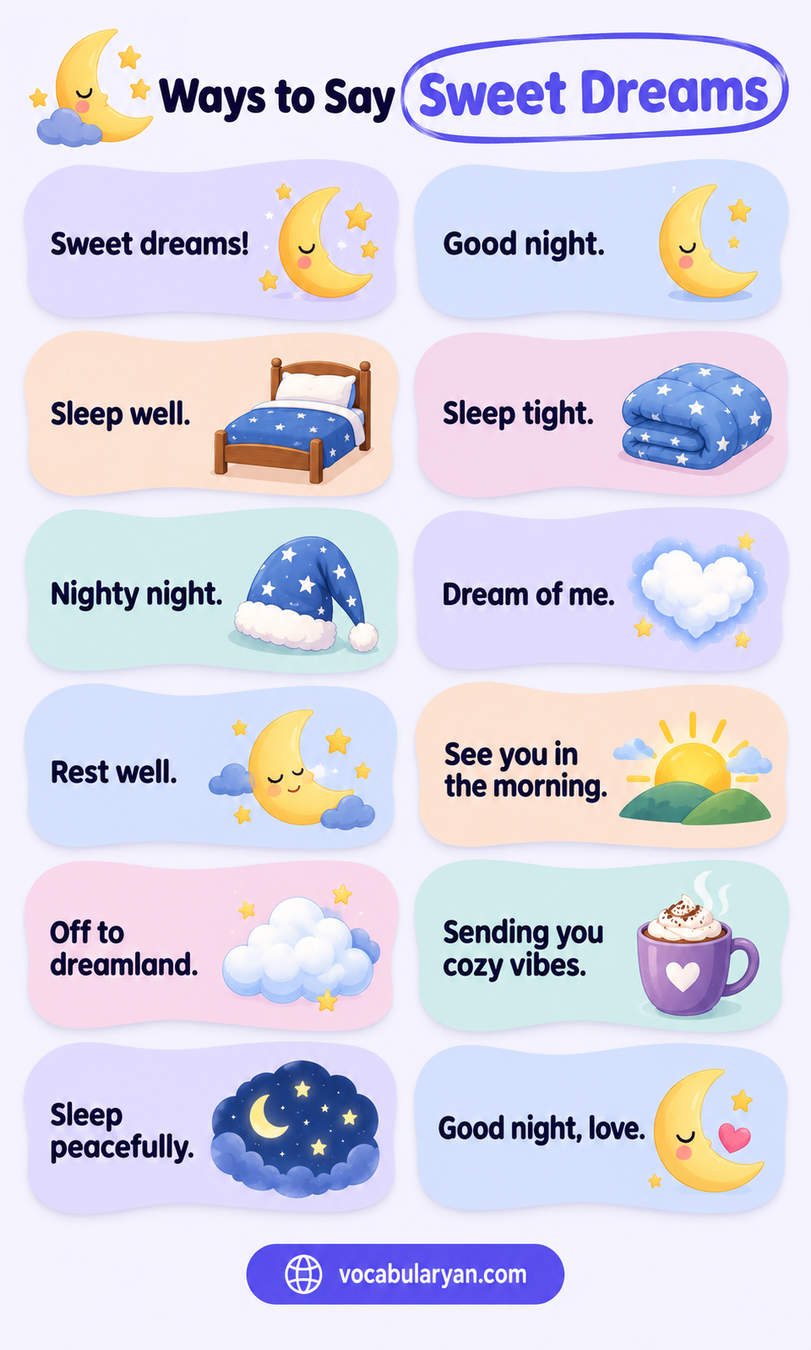
These seven wishes fit almost anyone you are close to, from a partner to a house guest, and each one is said at bedtime.
Sleep well: the most common bedtime wish after "good night", and it works with anyone you know by name. It is neutral, so it fits a friend, a parent, or a guest.
- Sleep well, Dad, I’ll lock the door on my way out.
- Thanks for dinner, sleep well!
- I’m off to bed now, sleep well and don’t forget your alarm.
Sleep tight: a warmer wish than "sleep well", and "tight" here means "soundly", so the wish is for a deep sleep. It fits family, partners, and close friends.
- Sleep tight, love, I’ll bring you tea in the morning.
- Night, Ben, sleep tight.
- Sleep tight, and text me when you land tomorrow.
Rest well: a little more formal than "sleep well", and it fits an older relative, a tired colleague you know well, or a message after a hard day.
- Rest well, Grandma, we’ll visit again on Sunday.
- You’ve earned it, rest well tonight.
- Rest well, and let the nurses do the worrying.
Pleasant dreams: the older, more polite form of "sweet dreams", and it sounds gentle and a little old-fashioned. It fits a grandparent, a guest, or a card.
- Pleasant dreams, Mrs Okoro, breakfast is at eight.
- Good night, everyone, pleasant dreams.
- Pleasant dreams, my dear, I’ll see you in the morning.
Sleep soundly: a wish for a deep sleep with no waking, and it fits someone who has had a bad night or a worried week.
- Sleep soundly, the exam is over now.
- I hope you sleep soundly in the new flat.
- Sleep soundly, little one, Mummy’s just next door.
Have a good night’s sleep: the full, plain wish, and it fits anyone from a friend to a hotel guest.
- Have a good night’s sleep, you’ve got a long drive tomorrow.
- Thanks for coming, have a good night’s sleep.
- Have a good night’s sleep, Priya, and good luck with the interview.
Good night: the plain bedtime farewell, said to anyone at all, and it is the one wish that never sounds too warm. It has a page of its own on this site: Ways to Say Good Night.
- Good night, Sam, see you at seven.
- Good night, all, thanks for a lovely evening.
- Right, good night then, I’m shattered.
Say "sleep well" to anyone you know, and keep "sleep tight" and "pleasant dreams" for people who will smile at the warmth.
Ways to Say Sweet Dreams to Your Partner
Romantic bedtime wishes are for a partner, and each one says "I love you" as well as "sleep well".
Dream of me: the classic flirty wish, and it asks the other person to think about you as they fall asleep. Keep it for a partner, because from a friend it sounds like a confession.
- Dream of me, I’ll be dreaming of you.
- Night, gorgeous, dream of me.
- Dream of me, and tell me all about it at breakfast.
Sweet dreams, my love: "sweet dreams" with a pet name, and the pet name is what makes it romantic. "My love", "darling", and "babe" all fit.
- Sweet dreams, my love, I’ll be home before you wake.
- Turn the light off now, sweet dreams, my love.
- Sweet dreams, my love, thank you for today.
See you in my dreams: a wish and a promise in one, said when you sleep apart.
- See you in my dreams, I’ll call at seven.
- Night, Leo, see you in my dreams.
- See you in my dreams, and in real life on Friday.
Sleep well, beautiful: "sleep well" with a compliment, and "handsome" is the form for a man. Both are said at the bedroom door or in a last message.
- Sleep well, beautiful, you were amazing tonight.
- Sleep well, handsome, don’t stay up reading.
- Right, sleep well, beautiful, I’ll take the dog out.
Sleep tight, sweetheart: the softest of the partner wishes, and it works for a partner of any age, from a first date to a fiftieth anniversary.
- Sleep tight, sweetheart, I’ve set the alarm.
- Sleep tight, sweetheart, and stop worrying about the meeting.
- Night night, sleep tight, sweetheart.
Don’t dream about anyone but me: a playful, flirty wish, and it fits a new relationship where both of you are still joking.
- Don’t dream about anyone but me, okay?
- Sweet dreams, and don’t dream about anyone but me.
- Don’t dream about anyone but me, not even that actor.
Use "sweet dreams, my love" every night, and save "dream of me" for the nights when you want to flirt.
Ways to Say Sweet Dreams to a Child
Bedtime wishes for a child are short, rhyming, and repeated every night, because the repeat is what makes a child feel safe.
Nighty night: the childish form of "good night", said by a parent at the bedroom door. Between adults it is a joke or a very close family habit.
- Nighty night, Ava, sleep well.
- Nighty night, close your eyes now.
- Kiss for Teddy, kiss for you, nighty night.
Night night: the same wish with one syllable fewer, and it is the first goodnight most small children learn to say back.
- Night night, sweetheart, see you in the morning.
- Say night night to Grandpa.
- Night night, the light’s on in the hall.
Sleep tight, don’t let the bed bugs bite: the rhyme every English-speaking child knows, and it is a joke, not a warning, because no bed bugs are expected.
- Sleep tight, don’t let the bed bugs bite!
- Night, Josh, sleep tight, don’t let the bed bugs bite.
- Sleep tight, don’t let the bed bugs bite, and no more stories.
Off to dreamland: a playful way to say "go to sleep now", and dreamland is the place where dreams happen.
- Off to dreamland, little one.
- Right, teeth done, story done, off to dreamland.
- Off to dreamland with you, it’s late.
Sweet dreams, little one: "sweet dreams" with a pet name for a small child, and it is said while tucking in the covers.
- Sweet dreams, little one, Mummy loves you.
- Sweet dreams, little one, there’s nothing under the bed.
- Shh, sweet dreams, little one.
The chart of bedtime wishes for a child puts them in the order of a real bedtime, from the end of the story to the last word at the door.
Pick one wish and say it every night, because a child hears the repeat as "everything is fine".
Ways to Say Sweet Dreams to a Friend
A friend gets a quick, relaxed wish, and most of these come at the end of a chat rather than at a bedroom door.
Get some sleep: the friend’s version of "sweet dreams", and it is half wish, half order. It fits a friend who has stayed up too late with you.
- Get some sleep, you’ve got work at six.
- Right, I’m going, get some sleep.
- Get some sleep, we’ll finish the project tomorrow.
Sleep well, my friend: a warm wish with "my friend" on the end, and it fits an older friend or a message after a serious talk.
- Sleep well, my friend, and thanks for listening tonight.
- Sleep well, my friend, it’ll look better in the morning.
- Night, Kwame, sleep well, my friend.
Get some rest: softer than "get some sleep", and it fits a friend who has been busy, stressed, or up all night with a baby.
- Get some rest, you look exhausted.
- Enjoy the weekend and get some rest.
- Get some rest, and I’ll cover the early shift.
Night, mate: the short, casual wish between friends, and "mate" is British and Australian. "Night, man" and "night, dude" are the American forms.
- Night, mate, cheers for the lift.
- Night, mate, don’t be late tomorrow.
- Right, I’m done, night, mate.
Talk tomorrow, sleep well: the two-part wish that ends a late chat, and it promises that the conversation goes on.
- Talk tomorrow, sleep well!
- Okay, talk tomorrow, sleep well, and stop refreshing your email.
- Talk tomorrow, sleep well, it’s almost one.
End a late night with "get some sleep", and add "my friend" only when the evening was a serious one.
Ways to Say Sweet Dreams to Family
Family bedtime wishes are old habits, and many of them pass from grandparents to grandchildren without changing a word.
Goodnight and God bless: the traditional family wish in Christian homes, and it is said by an older relative at the door or at the end of a call.
- Goodnight and God bless, love.
- Goodnight and God bless, all of you, safe journey tomorrow.
- Nan always says goodnight and God bless, even on the phone.
Sweet dreams, love: "love" here is the British family pet name, said by a mother, a father, or a grandparent to anyone younger.
- Sweet dreams, love, your uniform’s on the chair.
- Sweet dreams, love, I’ll wake you at half six.
- Night, Ellie, sweet dreams, love.
Don’t stay up too late: a wish disguised as a warning, and it is the parent’s goodnight to a teenager with a phone in bed.
- Don’t stay up too late, you’ve got swimming in the morning.
- Night, Dad, don’t stay up too late watching the news.
- Don’t stay up too late, the match will still be there in the morning.
Sleep well, you two: the wish for a couple or for two siblings sharing a room, said by the person who turns off the hall light.
- Sleep well, you two, and no talking.
- Sleep well, you two, we’ll see you at breakfast.
- Night, sleep well, you two.
Lights out: the parent’s signal that bedtime has arrived, and "sweet dreams" comes right after it.
- Lights out, sweet dreams, see you in the morning.
- Right, lights out, it’s half past eight.
- Lights out, boys, I mean it this time.
Keep the family wish your parents used, because the habit counts for more than the words.
Ways to Say Sweet Dreams in a Text
A text wish is short, and a kiss or a repeated letter replaces a warm voice.
gn: the shortest text for "good night", and it fits close friends and partners who text every night.
- gn, talk tomorrow x
- gn, sleep well
- ok gn, my phone’s on two percent
Sweet dreams x: "sweet dreams" with a kiss, and one "x" is friendly, two or three are romantic. British texts carry the "x" far more than American ones do.
- Sweet dreams xx
- Night night, sweet dreams xx
- Long day, off to bed, sweet dreams x
nn: "night night" in two letters, and it is a partner-and-family text more than a friend one.
- nn, love you
- nn xx see you tomorrow
- ok nn, don’t forget the bins
Text me when you wake up: a wish for the morning as much as for the night, and it fits a partner or a friend who is travelling.
- Sweet dreams, text me when you wake up.
- Text me when you wake up, I want to hear how the flight was.
- Night! Text me when you wake up and I’ll send the address.
Sleep well, big day tomorrow: the text for the night before an exam, an interview, or a wedding, and the second half says why you care.
- Sleep well, big day tomorrow, you’re going to be brilliant.
- Sleep well, big day tomorrow! Proud of you already.
- Night, Aisha, sleep well, big day tomorrow.
Send "sweet dreams x" to a partner and "gn" to a friend, and save "nn" for someone who already texts it to you.
Ways to Say Sweet Dreams on the Phone or a Call
A phone wish ends the call as well as the day, so most of these open with "I’ll let you" and close with a promise to ring again.
I’ll let you get some sleep: the polite way to end a late call, and it puts the other person’s rest first rather than your own tiredness.
- I’ll let you get some sleep, it’s nearly midnight there.
- Okay, I’ll let you get some sleep, sweet dreams.
- I’ll let you get some sleep, Mum, thanks for the chat.
I’ll let you go now: the softer form, said when the other person sounds tired, and "sweet dreams" or "sleep well" comes right after it.
- I’ll let you go now, sleep well.
- Right, I’ll let you go now, you’re yawning.
- I’ll let you go now, love, night night.
Sleep well, I’ll call you tomorrow: a wish and a plan in one, and the plan makes the goodbye shorter.
- Sleep well, I’ll call you tomorrow after work.
- Sleep well, I’ll call you tomorrow, same time?
- Okay, sleep well, I’ll call you tomorrow, love you.
Get some rest, we’ll talk tomorrow: the form for a friend or a family member who has had bad news, and it does not ask for anything more tonight.
- Get some rest, we’ll talk tomorrow, there’s nothing to decide tonight.
- Get some rest, we’ll talk tomorrow, okay?
- I know, I know, get some rest, we’ll talk tomorrow.
Sweet dreams, I’ll ring in the morning: the warm goodbye for a partner or a child who is away, and "ring" is British for "call".
- Sweet dreams, I’ll ring in the morning before school.
- Sweet dreams, I’ll ring in the morning, love you lots.
- Night, Grandad, sweet dreams, I’ll ring in the morning.
End a call with "I’ll let you get some sleep" and a plan to call again, because a goodbye with a plan in it is a shorter goodbye.
Ways to Say Sweet Dreams in a Long-Distance Relationship
A long-distance wish names the distance or the time zone, and it is sent by message or said on a video call.
Wish I were there: the wish that says the distance out loud, and it goes before or after "sweet dreams". "Wish I was there" is the casual form.
- Wish I were there, sweet dreams.
- Sleep well, wish I were there to say it properly.
- Wish I were there tonight, three more weeks.
Sleep well, I miss you: the plainest long-distance wish, and both halves are true every night, so it never wears out.
- Sleep well, I miss you, call me when you’re up.
- Sleep well, I miss you more every day.
- Night, Dan, sleep well, I miss you.
Goodnight from my side of the world: a playful wish for a partner in another time zone, and the reply is "good morning from mine".
- Goodnight from my side of the world, enjoy your afternoon.
- Goodnight from my side of the world, it’s already Tuesday here.
- Sweet dreams, or goodnight from my side of the world anyway.
Dream of me till I’m home: "dream of me" with a promise of the return, and it fits a partner who is counting the days.
- Dream of me till I’m home, twelve days to go.
- Night, love, dream of me till I’m home.
- Dream of me till I’m home, and then you won’t need to.
Sleep well, three weeks to go: the countdown wish, and the number changes every night until the flight.
- Sleep well, three weeks to go!
- Sleep well, two weeks to go, I’ve booked the taxi.
- Night night, sleep well, one week to go.
Name the time zone or the number of days, because a long-distance wish with a date in it is a promise.
Ways to Say Sweet Dreams to Someone Who Is Ill or Tired
These wishes are for a person in bed with a cold, a fever, or a hard week, and each one puts rest before everything else.
Rest up: a short, warm order to rest, and it fits a friend with a cold or a colleague you know well.
- Rest up, and don’t even think about work.
- Rest up, mate, the team can manage.
- Take the tablets and rest up, doctor’s orders.
Sleep it off: the wish for a headache, a cold, or one drink too many, and it means sleep will fix it.
- Go to bed and sleep it off, you’ll feel better.
- Sleep it off, I’ll bring you soup at lunchtime.
- Nothing to do now but sleep it off.
Hope you feel better in the morning: the caring form, and it fits a text to a friend who is ill or a word at the bedroom door.
- Night, hope you feel better in the morning.
- Hope you feel better in the morning, sweet dreams.
- Hope you feel better in the morning, and call me if you don’t.
Get a good night’s rest: the wish a nurse, a parent, or a partner says to someone who needs sleep more than talk.
- Get a good night’s rest, the results will be back tomorrow.
- Get a good night’s rest, Mr Ali, the doctor will see you at nine.
- You’ve been up since five, get a good night’s rest.
Hope you sleep better tonight: for someone who slept badly last night, and it says that you remember.
- Hope you sleep better tonight, the fever’s gone down.
- Hope you sleep better tonight, I’ve closed the blinds.
- Night, Lena, hope you sleep better tonight than last night.
Say "rest up" to someone with a cold and "hope you sleep better tonight" to someone who lay awake last night.
Ways to Say Sweet Dreams to a Guest Staying Over
A host’s bedtime wish is polite and practical, and it says where the towels are as well as wishing the guest sleep.
Sleep well, and shout if you need anything: the standard host wish, and "shout" means "call out", not "raise your voice in anger".
- Sleep well, and shout if you need anything, we’re just across the hall.
- Sleep well, and shout if you need anything, the spare blanket’s in the wardrobe.
- Right, sleep well, and shout if you need anything.
Sleep as late as you like: the wish that says there is no morning alarm, and it is a kindness after a long journey.
- Sleep as late as you like, there’s no rush tomorrow.
- Sleep as late as you like, I’ll leave the coffee out.
- You’ve had a long day, sleep as late as you like.
Make yourself at home: the host’s wish for the whole stay, and at bedtime it means "use the kitchen, the bathroom, and the kettle as if they were yours".
- Make yourself at home, and sleep well.
- Night, Sofia, make yourself at home, the fridge is full.
- Make yourself at home, the bathroom’s the first door on the left.
The towels are on the bed, sleep well: practical first, warm second, and it is the wish most hosts say at the top of the stairs.
- The towels are on the bed, sleep well.
- The towels are on the bed, sleep well, and the heating comes on at six.
- Okay, the towels are on the bed, sleep well, see you in the morning.
See you at breakfast: the wish that sets the morning plan, and it fits a guest, a hotel, or a family visit.
- Night, see you at breakfast, it’s at eight.
- See you at breakfast, sleep well.
- See you at breakfast, Uncle Femi, sleep tight.
Tell a guest where the towels are, then say "sleep well", and add "sleep as late as you like" if the next day is free.
Funny Ways to Say Sweet Dreams
Funny bedtime wishes are for close friends and partners who share your jokes, and each one twists a normal wish.
See you on the other side of the pillow: a mock-dramatic goodnight that treats sleep as a journey, and it fits a flatmate or a partner.
- See you on the other side of the pillow, soldier.
- Right, I’m done, see you on the other side of the pillow.
- See you on the other side of the pillow, don’t wake me.
Sleep like a log: a wish for a deep, heavy sleep, and the log is the joke because a log never moves.
- Sleep like a log, you’ve walked twenty miles today.
- I plan to sleep like a log, night all.
- Sleep like a log, and I’ll do the same.
Dream about pizza: a silly wish for a friend, a child, or a partner, and any food or hobby fits in the last word.
- Night, dream about pizza.
- Dream about pizza, or whatever it is you dream about.
- Sweet dreams, or dream about pizza, whichever comes first.
Sweet dreams, don’t snore: the teasing wish for a partner or a flatmate, and the joke works best when the person does snore.
- Sweet dreams, don’t snore, I’ve got an early meeting.
- Night, love, sweet dreams, don’t snore.
- Sweet dreams, don’t snore, or I’m sleeping on the sofa.
Go to bed, it’s past your bedtime: the parent’s line said to an adult friend as a joke, and it is funny because the friend is thirty.
- Go to bed, it’s past your bedtime, old man.
- Right, go to bed, it’s past your bedtime, sweet dreams.
- Go to bed, it’s past your bedtime, you’ve been yawning for an hour.
Keep the jokes for people who laugh at your jokes, because "don’t snore" to a guest sounds like a complaint.
Regional Ways to Say Sweet Dreams
Bedtime wishes change from country to country, and most of the difference is in the pet name that follows the wish.
British Ways to Say Sweet Dreams
Night, love: the everyday British goodnight, and "love" is said to family, to friends, and even to a customer in a shop in the north of England.
- Night, love, I’ll leave the landing light on.
- Night, love, sleep tight.
- Right, night, love, don’t read all night.
Sleep well, pet: "pet" is the north-east English pet name, said in Newcastle and Sunderland to anyone younger or anyone you like.
- Sleep well, pet, your dad’ll wake you.
- Sleep well, pet, you look worn out.
- Night night, sleep well, pet.
Night night, duck: "duck" is the pet name of the East Midlands, and this wish is said in Nottingham, Derby, and Stoke.
- Night night, duck, see you tomorrow.
- Night night, duck, mind the stairs.
- Right, night night, duck, I’m off.
Off to Bedfordshire: a British joke for "off to bed", and Bedfordshire is a real county, so the joke is the name.
- I’m off to Bedfordshire, night all.
- Right, you, off to Bedfordshire, it’s late.
- Off to Bedfordshire for me, sweet dreams.
American Ways to Say Sweet Dreams
Sleep tight, y’all: "sleep tight" with the Southern "you all", said to a family or to a houseful of guests.
- Sleep tight, y’all, breakfast is at seven.
- Sleep tight, y’all, and turn the porch light off.
- Night, kids, sleep tight, y’all.
Get some shut-eye: American slang for "get some sleep", and it fits friends, family, and colleagues on a night shift.
- Get some shut-eye, we’re driving at dawn.
- Get some shut-eye, I’ll take the first watch.
- You need to get some shut-eye, buddy.
Catch some Zs: "Zs" is the sound of sleep in American comics, and "catch some Zs" is a playful wish between friends.
- Go catch some Zs, I’ll finish up here.
- Time to catch some Zs, night.
- Catch some Zs, man, you’ve been up for two days.
Australian and Irish Ways to Say Sweet Dreams
Have a good sleep: the plain Australian wish, and it means the same as "sleep well".
- Have a good sleep, mate, big surf tomorrow.
- Have a good sleep, we’ll leave at six.
- Night, Mel, have a good sleep.
Codladh sámh: the Irish-language wish for "sound sleep", said "cul-la sawv", and it is used in Irish homes and on Irish cards even by people who speak little Irish.
- Codladh sámh, love, see you in the morning.
- Night, Gran, codladh sámh.
- Codladh sámh, everyone, mass is at ten.
Oíche mhaith: Irish for "good night", said "EE-ha wah", and it ends texts and calls in Ireland the way "night night" does in England.
- Oíche mhaith, sleep well.
- Oíche mhaith, Sean, safe home.
- Right, oíche mhaith, I’m wrecked.
Say "night, love" in Britain, "sleep tight, y’all" in the American South, "have a good sleep" in Australia, and "codladh sámh" in an Irish home.
Who Should You Not Say Sweet Dreams To?
"Sweet dreams" is for people you are close to, and to a colleague, a boss, or a new acquaintance it sounds too personal.
Have a good evening: the work farewell at the end of the day, and it is the wish to say to a colleague or a manager instead of any bedtime wish.
- Have a good evening, Mr Patel, see you tomorrow.
- Have a good evening, everyone, thanks for your work today.
- Have a good evening, I’ll send the file first thing.
Enjoy your evening: a step warmer than "have a good evening", and it fits a colleague you like, a client leaving a meeting, or a customer.
- Enjoy your evening, Dr Reyes, safe drive home.
- Enjoy your evening, and thanks for coming in.
- Enjoy your evening, Ms Novak, we’ll speak on Monday.
Get home safe: the caring work farewell for a colleague leaving late or in bad weather, and it says nothing about their bed.
- Get home safe, the roads are icy tonight.
- Get home safe, Tom, and thanks for staying late.
- Night, get home safe, both of you.
"Sweet dreams" to a manager sounds as if you are picturing their bedroom, and that is the problem.
- Sweet dreams, Mr Patel, see you tomorrow. ❌
A manager gets a farewell about the evening, not the night, and "have a good evening" ends the same conversation.
- Have a good evening, Mr Patel, see you tomorrow. ✅
The same rule covers someone you met this week.
- Sleep tight, Ana, nice meeting you. (to a new acquaintance) ❌
"Sleep tight" is for family and partners, and to a new acquaintance a plain farewell fits.
- Good night, Ana, nice meeting you. ✅
The third trap is grammar, because "sweet dreams" is always plural.
- Have a sweet dream! ❌
"Sweet dreams" is a fixed plural wish, so the singular sounds like a wish for exactly one dream.
- Sweet dreams! ✅
Every wish on this page belongs to one of five levels, and the chart of sweet dreams levels from slang to formal puts them in a row.
| Level | Wishes | Who it fits |
|---|---|---|
| Slang | gn, nn, catch some Zs | Close friends and partners who text every night |
| Casual | Sleep tight, night night, get some sleep | Family, partners, close friends |
| Neutral | Sleep well, have a good night’s sleep, good night | Anyone you know by name, a house guest |
| Formal | Rest well, pleasant dreams, have a good evening | Older relatives, a tired colleague you know well, a client |
| Very formal | I hope you rest well, I wish you a restful night | A card, a formal letter, a doctor to a patient |
Say "have a good evening" at work, and keep every bedtime wish for people you would hug goodbye.
How Do You Reply When Someone Says Sweet Dreams?
The reply to a bedtime wish is short: "you too", the same wish returned, or a "thanks" with a wish added to it.
Sweet dreams or sleep well: the reply is "you too", or the same wish returned with a name.
- Sweet dreams. You too, night.
- Sleep well, Sam. Sleep well, Dad.
- Sweet dreams, love. Sweet dreams.
Sleep tight or nighty night: the reply is the second half of the rhyme, or "night night" back.
- Sleep tight! Don’t let the bed bugs bite!
- Nighty night. Night night, Mummy.
- Sleep tight, love. You too, see you in the morning.
Dream of me or see you in my dreams: the reply agrees, or it teases.
- Dream of me. Always.
- See you in my dreams. I’ll be the one in the red dress.
- Dream of me. Always do.
Get some sleep or rest up: the reply is a promise.
- Get some sleep. I will, night.
- Rest up. Doing my best, thanks for the soup.
- Get some rest, we’ll talk tomorrow. Okay, thank you, night.
Sleep well, and shout if you need anything: the reply thanks the host and names the morning.
- Sleep well, shout if you need anything. Thanks so much, see you at breakfast.
- Sleep as late as you like. I’ll be up by nine, promise.
- The towels are on the bed. Perfect, thank you, night.
gn or nn: the reply is the same letters, plus a kiss where you got one.
- gn x gn x
- nn, love you. nn, love you more.
- gn, talk tomorrow. gn, will do.
A reply matches the wish in length, and the chart of sweet dreams and reply pairs lines them up side by side.
Say "you too" or return the wish, and keep the reply to five words, because a long reply keeps the other person awake.
More Everyday English Phrases
- Other Ways to Say Good Night
- Other Ways to Say Have a Nice Day
- Other Ways to Say Take Care
- Other Ways to Say Take It Easy
FAQs
"Sweet dreams" means "I hope you sleep well and your dreams are happy", and it is said at bedtime to someone you are close to. The full form is "I wish you sweet dreams", and the "I wish you" dropped off long ago. It is a wish, not a greeting, so it comes at the end of the evening, never at the start.
Yes, with a partner, a child, or a close friend, because "sweet dreams" is a bedtime farewell in its own right. With a colleague, a shop assistant, or a stranger the answer is no, because "good night" is a farewell for anyone and "sweet dreams" is personal. Most speakers say both together: "good night, sweet dreams".
No, because "sweet dreams" refers to the other person’s bed, and that is too personal for a colleague, a client, or a manager. The work farewell at the end of the day is "have a good evening" or "get home safe". The one workplace where a bedtime wish fits is a hospital or a care home, where a nurse says "rest well" or "get a good night’s rest" to a patient.
"Dream of me" is the standard flirty wish, and "see you in my dreams" and "don’t dream about anyone but me" are the two that follow it. A pet name makes any wish flirtier: "sleep well, gorgeous" or "sweet dreams, handsome". All of them are for a partner or a date, because from a friend they sound like a confession.
Respond with "you too", "sweet dreams" back, or "night, sleep well", and add the person’s name if you like. To "sleep tight" the playful reply is "don’t let the bed bugs bite". A reply of "thank you" on its own is polite but a little cold, so add a wish after it.
Yes, when the man is a partner, a close friend, a brother, or a son, because "sweet dreams" has no gender. The question comes up because "sweet" sounds soft, but "sleep tight" and "sweet dreams" are said to men every night by mothers, partners, and friends. If you do not know him well, "night, sleep well" is the safer wish.
Yes, between partners, close friends, and family, where "nighty night" is a joke or a habit left over from childhood. It sounds like baby talk, so with anyone else "sleep well" or "sweet dreams" is the wish. Many couples say "nighty night" every night and never notice it.
"Sweet dreams" comes from the longer wish "I wish you sweet dreams", and "sweet" here means "pleasant", the older sense of the word, as in "sweet music". The short form has been a bedtime farewell in English since at least the nineteenth century. "Pleasant dreams" is the older twin, and grandparents still say it.