
"No problem" answers two different lines: a "thank you" and a request. After thanks it means "you owe me nothing", and after a request it means "yes, I will do it". Both uses are casual, so the ways to say no problem at work, to a customer, or in an email come from a more polite set, and the everyday phrases come first.
Other Ways to Say No Problem in Everyday English
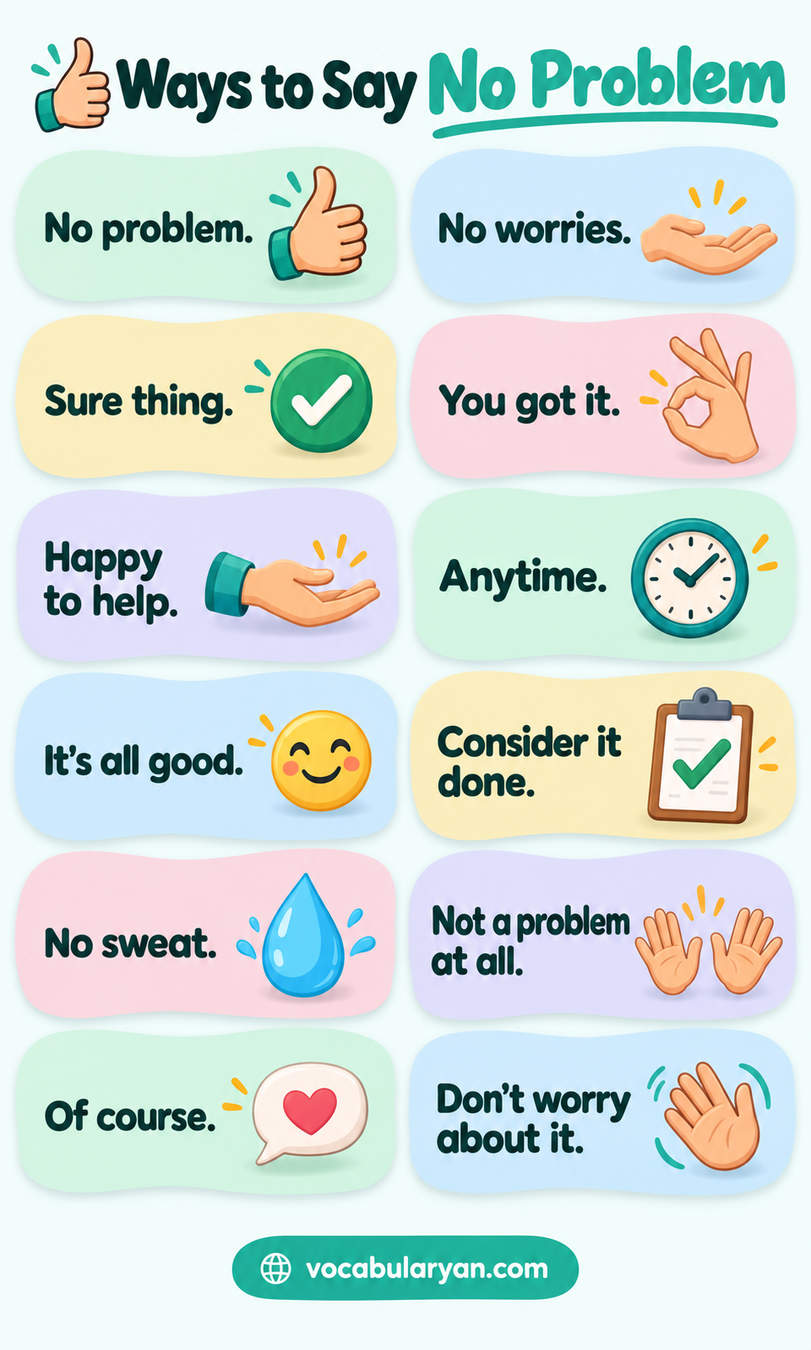
These six replies fit almost anyone, and each one answers a "thank you" without sounding cold.
No problem: the plain reply to thanks for a small favour, and it fits friends, colleagues, and shop staff. It is too relaxed for a formal letter.
- No problem, I was going past the post office anyway.
- Thanks for the lift. No problem, same time tomorrow?
- No problem at all, the door was already open.
No worries: a relaxed reply that means "there is nothing to worry about", and it answers both thanks and an apology. It sounds friendly from a colleague, a waiter, or a neighbour.
- No worries, I’ll send the file again this afternoon.
- Sorry I’m late. No worries, we haven’t started yet.
- No worries, Kai, take the umbrella, I have another one.
You’re welcome: the standard reply to thanks at every level, and it never sounds wrong. With a stranger or a senior person it is the safest choice.
- You’re welcome, Mrs Duarte, I hope the meeting goes well.
- You’re welcome! Enjoy the rest of your trip.
- Thank you for waiting. You’re welcome, it was only a minute.
Don’t mention it: a warm reply that says the favour was too small to need thanks. It fits family, friends, and colleagues you know well.
- Don’t mention it, you’d do the same for me.
- Thanks for feeding the cat. Don’t mention it, she’s good company.
- Don’t mention it, Grandma, I like driving you to the market.
Anytime: a reply that offers the same help again in the future, so it fits a friend or a colleague you want to help twice.
- Anytime, just call if the printer breaks again.
- Thanks for covering my shift. Anytime, Ruth.
- Anytime! The spare key is under the pot if you need it.
Not at all: a polite reply that means "it was not a problem", common in British English and in formal speech.
- Not at all, it was a pleasure to show you around.
- Thank you for your patience. Not at all, take your time.
- Not at all, Dr Haddad, I’m glad the slides were useful.
Say "you’re welcome" when you are unsure, and keep "no problem" for the people you speak to every day.
Casual Ways to Say No Problem to Friends
Casual replies are for people who know you, and each one makes the favour sound smaller than it was.
No biggie: short for "no big deal", and it fits close friends and family. In a work email it sounds childish.
- No biggie, I had the day off anyway.
- Sorry about the coffee on your notes. No biggie, they were a mess already.
- No biggie, you can pay me back next week.
It’s all good: American slang that means "everything is fine", and it answers thanks, an apology, or a worried question.
- It’s all good, I found a parking space right outside.
- Sorry I forgot your birthday. It’s all good, we’ll celebrate on Saturday.
- It’s all good, Dad, the car only has a small scratch.
Don’t sweat it: a friendly way to say "do not worry", and it fits friends who feel bad about asking for help.
- Don’t sweat it, I’ll fix the bike this weekend.
- Sorry for texting so late. Don’t sweat it, I was awake.
- Don’t sweat it, Leo, everyone fails the first driving test.
No big deal: a reply that says the favour cost you nothing, and it fits friends, classmates, and family.
- No big deal, the shop is on my way home.
- Thanks for lending me the notes. No big deal, I’d finished with them.
- No big deal, I’ll just take the later train.
It’s nothing: a modest reply that makes a real favour sound small, and it sounds warm from a friend or a relative.
- It’s nothing, I enjoy cooking for a crowd.
- Thank you for sitting with me at the hospital. It’s nothing, that’s what friends do.
- It’s nothing, honestly, the tickets were free.
No trouble: a calm reply that says the help was not hard, and it fits neighbours, colleagues, and older relatives.
- No trouble, the parcel was already in my hallway.
- Thanks for picking up the kids. No trouble, they were very well behaved.
- No trouble at all, I’ll water the plants while you’re away.
Don’t worry about it: a reply for a friend who apologises or thanks you too much, and it sounds kind rather than dismissive.
- Don’t worry about it, the glass was cheap.
- Sorry I couldn’t come to the party. Don’t worry about it, there’ll be another one.
- Don’t worry about it, Sam, I’ll bring the charger tomorrow.
Use "no biggie" and "don’t sweat it" with friends your own age, and "no trouble" with an older neighbour.
Formal Ways to Say No Problem at Work
Formal replies fit a manager, a client, or a senior colleague, and each one names the help as a pleasure rather than as no trouble.
My pleasure: the most polite reply to thanks, and it fits a client, a guest, or a manager. It says the work was welcome, not just quick to do.
- My pleasure, Ms Farooq, the contract is ready whenever you are.
- Thank you for the tour. My pleasure, come back any time.
- My pleasure, I enjoyed working on the design with your team.
Happy to help: a warm formal reply that fits colleagues, customers, and anyone who asked you for support at work.
- Happy to help, let me know how the interview goes.
- Thanks for the quick reply. Happy to help, Tom.
- Happy to help, and the spare cables are in the top drawer if you need them.
Glad I could help: a reply for after the help is finished, and it fits a colleague, a student, or a client who thanks you for solving a problem.
- Glad I could help, the fix should hold until the new server arrives.
- Thank you for explaining the tax form. Glad I could help, it confuses everyone.
- Glad I could help, Professor Lindqvist, good luck with the paper.
Certainly: a formal "yes" to a request, and it fits a receptionist, a waiter, or an assistant. As a reply to thanks it sounds a little stiff.
- Could you send me the invoice? Certainly, I’ll do that now.
- Certainly, sir, I’ll ask the manager to call you.
- Certainly, the meeting room is free from two o’clock.
It’s the least I can do: a reply that says the favour was small compared with what the other person did for you, and it fits a colleague or a friend who helped you first.
- It’s the least I can do after you covered for me last month.
- Thank you for driving me to the airport. It’s the least I can do, you paid for the tickets.
- It’s the least I can do, Nadia, you trained me when I started.
Of course: a reply that says the help was natural, and it fits a request and a thank you alike. At work it sounds polite and warm.
- Could you check the figures? Of course, I’ll have them by noon.
- Thanks for staying late. Of course, the launch matters to all of us.
- Of course, Mr Yamamoto, the driver will meet you at the station.
"No problem" is singular, and the plural form is one of the most common mistakes in written English.
- No problems, I’ll send the report by Friday. ❌
"Problem" stays singular here, because the reply means "there is no problem here".
- No problem, I’ll send the report by Friday. ✅
A reply that names the work as a duty sounds cold in English, and a thank you deserves a warm answer.
- It’s my duty, Ms Farooq. ❌
"Duty" says you did the work because you had to, so the reply is a phrase that says you wanted to.
- Happy to help, Ms Farooq. ✅
The replies on this page run across five levels, and the table sorts them.
| Level | Replies | Who it fits |
|---|---|---|
| Slang | Np, no prob, no biggie | Close friends your own age |
| Casual | No worries, it’s all good, don’t sweat it | Friends, family, relaxed colleagues |
| Neutral | No problem, you’re welcome, anytime | Anyone you know by name |
| Formal | My pleasure, happy to help, certainly | Managers, clients, customers, strangers |
| Very formal | It was a pleasure helping you, glad to be of assistance | Guests of honour, formal letters, senior officials |
Answer a manager’s thanks with "my pleasure" or "happy to help", and keep "no problem" for colleagues you joke with.
Ways to Say No Problem to a Customer
A reply to a customer makes two promises at once: the help was welcome, and more help is available.
Absolutely: a confident "yes" to a customer’s request, and it fits a shop, a hotel, or a call centre.
- Can I change the delivery address? Absolutely, what is the new one?
- Absolutely, madam, I’ll bring a second menu.
- Absolutely, we can hold the room until six.
Not a problem at all: a reply that says the request is welcome, and it sounds calm and polite on the phone or at a counter.
- Not a problem at all, I’ll print a new receipt for you.
- Sorry to ask again. Not a problem at all, that’s what I’m here for.
- Not a problem at all, the refund will show in three to five days.
I’ll take care of that for you: a reply that answers a request with a promise, and it fits any service job.
- I’ll take care of that for you, Mrs Lee, please take a seat.
- The tap is still dripping. I’ll take care of that for you this afternoon.
- I’ll take care of that for you right away, sir.
Glad to be of assistance: a very formal reply to thanks, and it fits a bank, a hotel desk, or a written reply from a company.
- Glad to be of assistance, and please keep the reference number.
- Thank you for sorting out the booking. Glad to be of assistance, enjoy your stay.
- Glad to be of assistance, Mr Novak, the card will arrive within a week.
It’s what we’re here for: a friendly reply that says helping is the job, and it fits a customer who thanks you for extra effort.
- It’s what we’re here for, so ask as many questions as you like.
- Thanks for staying open a few minutes. It’s what we’re here for.
- It’s what we’re here for, Mrs Kaur, let us know if the size is wrong.
Let me know if there’s anything else: a reply that ends the conversation with an open door, and it goes after "you’re welcome" or "my pleasure".
- My pleasure, and let me know if there’s anything else you need.
- You’re welcome, let me know if there’s anything else I can do.
- Let me know if there’s anything else, I’m on the desk until five.
Answer a customer’s thanks with "my pleasure" or "glad to be of assistance", and answer a customer’s request with "absolutely" or "I’ll take care of that for you".
Ways to Say No Problem in an Email
An email reply is read without your voice, so the phrase has to sound warm on its own, and it stays away from slang.
No trouble at all: a polite written reply to thanks, and it fits a colleague, a client, or a supplier.
- No trouble at all, the updated file is attached.
- Thanks for turning this around so fast. No trouble at all, Priya.
- No trouble at all, and I’ve copied Ben so he has the dates too.
That’s fine: a short written "yes" to a change of plan, and it fits a colleague who moves a meeting or a deadline.
- That’s fine, Thursday at ten works for me.
- Could we push the call to next week? That’s fine, just send a new invite.
- That’s fine, I’ll wait for the final numbers before I start.
That works for me: a reply that agrees to a time, a price, or a plan, and it sounds friendly and professional in the same line.
- That works for me, I’ll book the room.
- Can we meet at the café instead? That works for me.
- That works for me, and I’ll bring the printed copies.
Please don’t hesitate to ask: a formal closing line that follows a reply to thanks, and it fits a client or a new colleague.
- Happy to help, and please don’t hesitate to ask if anything is unclear.
- You’re welcome, please don’t hesitate to ask for the older versions.
- Please don’t hesitate to ask, my door is always open.
It was a pleasure helping you: a very formal written reply, and it fits the last email in a long exchange with a client.
- It was a pleasure helping you with the move, Mr Costa.
- Thank you for all your support this year. It was a pleasure helping you.
- It was a pleasure helping you, and I wish you every success with the launch.
The short text form of "no problem" has no place in a work email.
- Np, I’ll send the slides over. (email to a client) ❌
"Np" is a text abbreviation, so a written reply to a client takes the full phrase.
- Not a problem at all, I’ll send the slides over. ✅
Write "no trouble at all" or "that works for me" in a work email, and save "np" for a message to a friend.
Ways to Say No Problem in a Text
Text replies are short, and the shortest forms of "no problem" live between friends.
Np: the two-letter text form of "no problem", used between friends and in game chat. It is never used in speech.
- Np, see you at 8.
- Thanks for the link! Np 😊
- Np, tell me how it goes.
No prob: "no problem" with the end cut off, and it fits a quick reply to a friend or a sibling.
- No prob, I’ll grab your bag too.
- Thanks for waiting. No prob, I was early.
- No prob, the code is 4471.
It’s cool: a relaxed reply that answers thanks or an apology by text, and it fits friends your own age.
- It’s cool, I wasn’t using the car tonight.
- Sorry I bailed on lunch. It’s cool, next week?
- It’s cool, I’ll ask Mia instead.
All good: a two-word reply that says nothing is wrong, and it fits a friend who worries about a small mistake.
- All good, the file opened fine.
- Sorry, wrong number! All good, no harm done.
- All good, I got your message just now.
You got it: a quick "yes" to a request by text, and it sounds confident and friendly.
- Can you save me a seat? You got it.
- You got it, two tickets, back row.
- You got it, I’ll water the plants on Sunday.
Keep a text reply to one or two words, and add a name only when the thanks came from a group chat.
Ways to Say No Problem When You Agree to a Request
A reply to a request says "yes" and promises the action, and each of these phrases does both in a few words.
Sure, no problem: the everyday "yes" to a small request from a colleague or a friend, and the "sure" makes the reply sound willing.
- Can you lock up tonight? Sure, no problem.
- Sure, no problem, I’ll drop the keys through the letterbox.
- Sure, no problem, one large coffee coming up.
Will do: a short reply that promises the task, and it fits a colleague or a manager who asks for one action.
- Can you send the minutes to the whole team? Will do.
- Will do, I’ll call the supplier before lunch.
- Will do, boss, the van will be back by four.
Consider it done: a confident reply that says the task is as good as finished, and it fits a colleague or a customer.
- Could you book the flights for Monday? Consider it done.
- Consider it done, the sign will be up before the shop opens.
- Consider it done, Mrs Ortiz, I’ll email the confirmation tonight.
I can do that: a plain "yes" that fits a request at work or at home, and it sounds calm and reliable.
- Can you pick Dad up from the station? I can do that.
- I can do that, give me an hour to finish this first.
- I can do that, the spare part is already in the van.
Leave it with me: a reply that takes the whole task off the other person, common in British offices.
- Leave it with me, I’ll speak to the landlord tomorrow.
- I can’t get the projector to work. Leave it with me.
- Leave it with me, Aisha, I know who to ask.
Yes, that’s fine: a polite reply to a request for permission or a change of plan, and it fits a manager or a parent.
- Can I leave early on Friday? Yes, that’s fine, just finish the report first.
- Yes, that’s fine, move the meeting to three.
- Yes, that’s fine, you can borrow the car until Sunday.
Say "sure, no problem" to a small request, and "leave it with me" when you are taking on the whole job.
Ways to Say No Problem When Someone Apologizes
After an apology the reply says the mistake is forgiven, and these phrases are softer than "you’re welcome", which answers thanks only.
That’s okay: the most common reply to a small apology, and it fits anyone from a child to a client.
- Sorry I’m late. That’s okay, the traffic was terrible today.
- That’s okay, Ben, we all forget sometimes.
- That’s okay, the stain came out in the wash.
It’s fine: a short reply that closes the apology, and it fits friends and colleagues. Said in a flat voice it sounds cross, so add a smile or a second line.
- Sorry for the mix-up with the dates. It’s fine, we sorted it in the end.
- It’s fine, honestly, I wasn’t waiting long.
- It’s fine, Mum, the vase was ugly anyway.
No harm done: a reply that says nothing was damaged or lost, and it fits an accident rather than a rude remark.
- Sorry, I bumped your chair. No harm done.
- No harm done, the cup was empty.
- No harm done, we only lost five minutes.
Forget it: a quick reply that asks the other person to stop apologising, and it fits close friends. With a stranger it sounds sharp.
- I’m so sorry about last night. Forget it, we’ve all been there.
- Forget it, Jack, it was a joke.
- Forget it, the shirt was old.
These things happen: a kind reply to an apology for an accident, and it fits colleagues, neighbours, and customers.
- Sorry, the order went to the wrong address. These things happen, thanks for telling me.
- These things happen, don’t feel bad about it.
- These things happen, Mrs Ahmed, we’ll replace the glass today.
Never mind: a reply that means "it does not matter", and it fits a small mistake between friends or family.
- Sorry, I forgot the milk. Never mind, I’ll get some later.
- Never mind, the film starts again at nine.
- Never mind, love, it’s only a scratch.
Answer an apology with "that’s okay" or "no harm done", and keep "forget it" for a close friend.
Ways to Say No Problem to a Group
A group reply speaks for you and your team at once, and it fits a meeting, a message thread, or a room full of guests.
Our pleasure: "my pleasure" for a team, and it fits a company, a family, or any group that helped together.
- Our pleasure, come back and see us next summer.
- Thank you all for the welcome. Our pleasure, the room is yours for the week.
- Our pleasure, the whole team enjoyed the project.
You’re all welcome: a reply to thanks from several people at once, and it fits a class, a tour group, or a table of guests.
- You’re all welcome, safe journey home.
- Thanks for the lesson, Miss. You’re all welcome, see you on Thursday.
- You’re all welcome, and the leftover cake is in the kitchen.
Glad we could help: a team reply for after the work is done, and it fits a message to a client or a group of neighbours.
- Glad we could help, the road should stay clear all winter now.
- Thanks to everyone who came on Saturday. Glad we could help.
- Glad we could help, and call the office if the alarm goes off again.
Anytime, guys: a casual reply to a group of friends or teammates, and it offers the same help again.
- Anytime, guys, the van is free next weekend too.
- Thanks for helping us move! Anytime, guys.
- Anytime, guys, just bring the pizza next time.
Reply to a group with "our pleasure" at work and "anytime, guys" with friends.
Regional Ways to Say No Problem in English
Each English-speaking country keeps a few replies of its own, and the right one wins a smile from a local.
British Ways to Say No Problem
No bother: the British and Irish form of "no trouble", and it fits neighbours, shopkeepers, and colleagues.
- No bother, I’ll drop the parcel round after work.
- Thanks for holding the door. No bother, love.
- No bother, the kettle’s already on.
No probs: the British short form of "no problem", used in speech and in texts between friends.
- No probs, I’ll see you at the station.
- Cheers for the lift. No probs, mate.
- No probs, I’ve got a spare charger.
That’s alright: the everyday British reply to thanks and to an apology, said with a small shrug.
- Thanks ever so much. That’s alright, it was on my way.
- Sorry about the noise last night. That’s alright, we were up anyway.
- That’s alright, take the last biscuit.
American Ways to Say No Problem
Sure thing: a confident American "yes" to a request, and it also answers thanks between friends.
- Can you grab me a water? Sure thing.
- Thanks for the ride! Sure thing, text me when you’re home.
- Sure thing, I’ll have the numbers ready by the meeting.
You bet: an American reply that means "of course", and it fits both thanks and a request. It sounds warm and a little old-fashioned.
- Thanks for fixing the fence. You bet, neighbour.
- Will you be at the game? You bet.
- You bet, the pie will be on the table at six.
No sweat: American slang that says the task cost no effort, and it fits friends and relaxed colleagues.
- No sweat, I’ll finish the slides tonight.
- Thanks for carrying that upstairs. No sweat, it was lighter than it looked.
- No sweat, man, the tickets were cheap.
Australian and Irish Ways to Say No Problem
No worries, mate: the Australian original, said to friends and strangers alike, and it answers thanks, an apology, and a request.
- No worries, mate, the surf’s better in the morning anyway.
- Sorry, is this your seat? No worries, mate, take it.
- No worries, mate, I’ll bring the boat round at seven.
No dramas: the Australian cousin of "no worries", and it says the request caused no fuss.
- No dramas, I’ll swap shifts with you.
- Thanks for waiting. No dramas, the coffee here is good.
- No dramas, the ute can carry all of it.
Too easy: an Australian reply to a request that says the task is nothing, and it fits a shop, a café, or a friend.
- Two flat whites, please. Too easy.
- Too easy, I’ll book the campsite tonight.
- Thanks for the hand with the tent. Too easy, mate.
Not a bother: the Irish form of "no bother", warm and friendly, and it fits neighbours and shops.
- Not a bother, I’ll mind the dog while you’re away.
- Thanks a million. Not a bother, Siobhan.
- Not a bother, the bus stops right outside.
Grand: the Irish word for "fine", and as a reply it means "that is no problem". It fits friends, colleagues, and shop staff.
- Can I pay by card? Grand, tap it there.
- Sorry I’m a bit late. Grand, we’ve only just sat down.
- Grand, I’ll see you at the match, so.
Say "no bother" in Britain and Ireland, "sure thing" in America, and "no worries" or "too easy" in Australia.
Funny Ways to Say No Problem
Funny replies are for people who laugh with you, and each one adds a joke to a plain "no problem".
No problemo: "no problem" with a fake Spanish ending, said as a joke between friends. Keep it out of any message a manager will read.
- No problemo, I’ll bring the snacks.
- Thanks for the tickets! No problemo, amigo.
- No problemo, the dog can stay with us.
Easy peasy: a playful reply that means "very easy", and it fits children, friends, and parents.
- Can you open this jar? Easy peasy.
- Easy peasy, the homework took me ten minutes.
- Easy peasy, I’ll have the tent up before you find the pegs.
Piece of cake: an idiom that says the task was no effort at all, and it fits friends and relaxed colleagues.
- Thanks for fixing the website. Piece of cake, it was one missing comma.
- Piece of cake, I’ll paint the fence on Saturday.
- Piece of cake, the exam was shorter than the practice paper.
I’ll add it to your tab: a joke that pretends to charge the other person for the favour, and it fits close friends.
- Thanks for the lift again. I’ll add it to your tab.
- I’ll add it to your tab, that’s three coffees you owe me now.
- I’ll add it to your tab, and I take payment in cake.
Anything for you: a warm, slightly dramatic reply for a partner, a best friend, or a child.
- Thanks for coming all this way. Anything for you.
- Anything for you, sweetheart, even a four a.m. airport run.
- Anything for you, but you’re buying lunch.
Save "no problemo" and "I’ll add it to your tab" for friends who will laugh, because a joke to a customer reads as a mistake.
How Do You Reply When Someone Says No Problem?
"No problem" closes a small exchange, and the reply to it is short: a second thanks, a friendly word, or the next part of the conversation.
Thanks again: the most common reply, and it fits any level. It repeats the thanks once and ends the exchange.
- No problem. Thanks again, see you Monday.
- My pleasure. Thanks again, Mr Ruiz, have a good evening.
- No worries. Thanks again, I owe you one.
Cheers: the British one-word reply, and it works as thanks and as goodbye at the same time.
- No bother. Cheers, mate.
- No probs. Cheers, see you tomorrow.
- That’s alright. Cheers, then.
I appreciate it: a warm reply that fits a colleague or a stranger who helped you with something real.
- No problem at all. I appreciate it, the deadline was tight.
- Happy to help. I appreciate it, Dana.
- Don’t mention it. I appreciate it all the same.
Great, thanks: the reply after "no problem" answers a request, and it moves the conversation on.
- Sure, no problem. Great, thanks, I’ll send the address.
- Will do. Great, thanks, that’s one less job for me.
- Consider it done. Great, thanks, Priya.
You’re a star: a British reply that praises the helper, and it fits friends and friendly colleagues.
- No worries, it’s done. You’re a star.
- Leave it with me. You’re a star, Omar.
- No trouble at all. You’re a star, thank you.
Answer "no problem" with "thanks again" or "great, thanks", and then move on, because a third round of thanks sounds stiff.
More Everyday English Phrases
FAQs
The replies that fit most situations are "no worries", "you’re welcome", "don’t mention it", "anytime", and "my pleasure". "No worries" fits friends and colleagues, "you’re welcome" fits anyone, and "my pleasure" fits a customer or a manager. After a request the "yes" forms are "sure thing", "will do", and "consider it done".
Yes, between friends, family, and colleagues "no problem" is a normal reply to thanks, and nobody hears it as rude. Some older speakers, most of all in America, prefer "you’re welcome", because "no problem" names a problem that never existed. With a customer or a senior person, "my pleasure" or "happy to help" is the safer reply.
"No problem" is the only correct form, and "no problems" is a mistake in speech and in writing. The phrase means "there is no problem with that", so the noun stays singular. The same rule applies to "not a problem" and "no trouble".
Yes, in an email to a colleague you know well, "no problem" reads as friendly and natural. In an email to a client, a manager, or a stranger, the better replies are "not a problem at all", "happy to help", or "no trouble at all". The text forms "np" and "no prob" never go in a work email.
The difference is small, and both replies are casual. "No worries" sounds a little warmer and also answers an apology, while "no problem" answers thanks or a request. In Australia "no worries" is the standard reply at every level, and in Britain and America it fits friends and colleagues.
The professional replies to thanks are "my pleasure", "happy to help", "glad I could help", and "not at all". The professional replies to a request are "certainly", "of course", and "I’ll take care of that for you". Each one says the help was welcome, which is the message a client or a manager wants to hear.
"Not a problem" answers a request that the other person expects to be difficult, and it says the request is welcome. It sounds a step more polite than "no problem", so it fits a customer, a colleague, or a neighbour. The longer form "not a problem at all" is the version for the phone and for email.