
"Good job" is praise for a finished task, and in American English it is the praise adults say to each other more than any other. The ways to say good job in English change with the listener: a manager needs "excellent work", a friend needs "way to go", and a child needs to hear what was good. The everyday forms come first, because they fit almost anyone.
Common Ways to Say Good Job in Everyday English
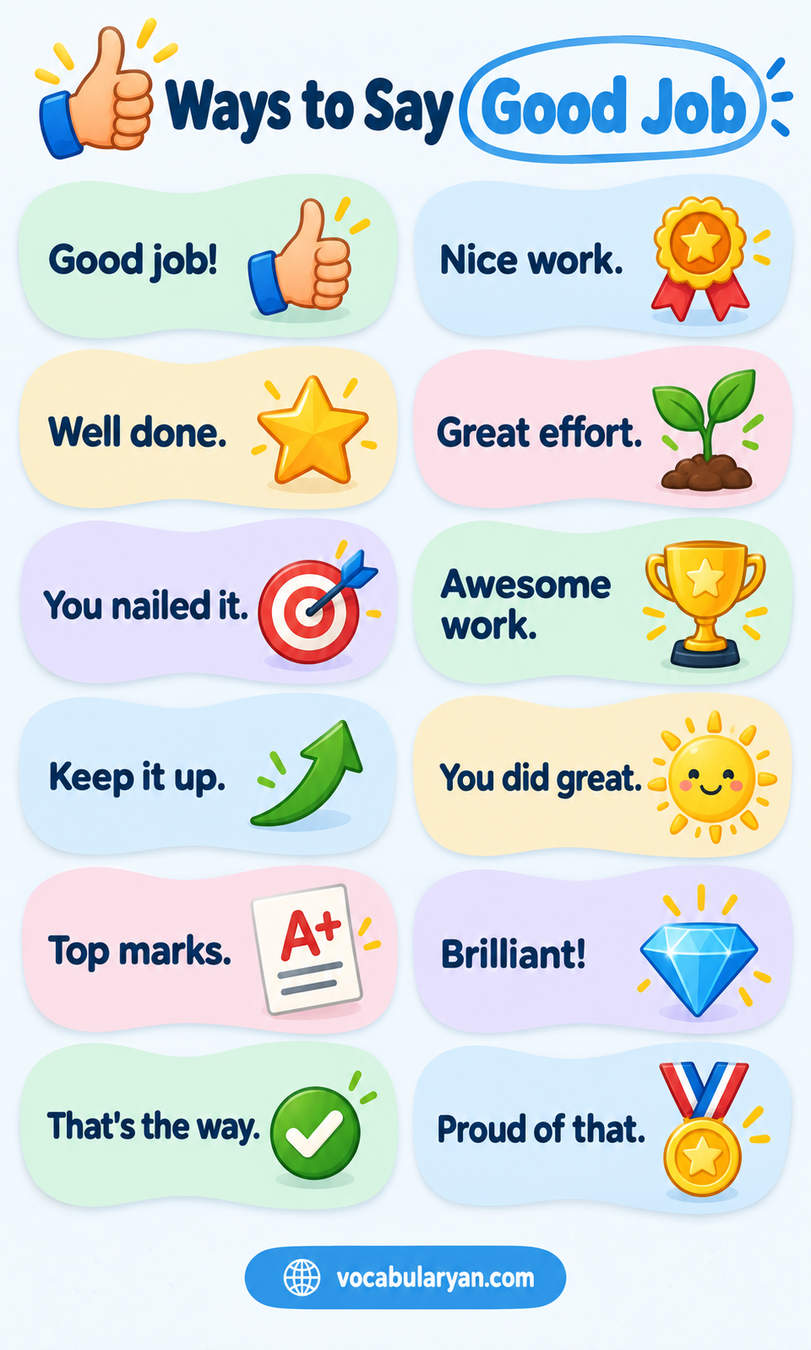
These six phrases fit a neighbour, a classmate, a colleague, or a family member, and each one is safe at almost every level.
Good job: the standard American praise for a task done well, and it fits anyone junior to you or equal to you. To a boss it sounds like a school report, so save it for peers, friends, and children.
- Good job on the garden, it looks completely different.
- That was a good job, Ali, the customer left happy.
- Good job, everyone, we finished a day early.
Great job: warmer and louder than "good job", and it fits a friend, a child, or a colleague after a real success. "Great" means the result went past what you expected.
- Great job on your driving test, I knew you’d pass.
- You did a great job with the twins today, they’re both asleep.
- Great job, Rosa, the client signed this afternoon.
Nice job: relaxed praise for something small and done well, common between colleagues and friends in American English. It sounds calm rather than excited.
- Nice job on the slides, they were easy to follow.
- Nice job, Kai, the shelves are straight this time.
- That was a nice job of parking, the space was tiny.
Good work: "good job" with the focus on the work itself rather than the person, and it fits a manager, a teacher, or a coach. In British English it is more common than "good job".
- Good work on the audit, Priya, nothing was missed.
- Good work, team, the site is back online.
- That’s good work for a first attempt, keep going.
Nice work: a friendly, neutral phrase for a colleague or a friend, and it fits speech and messages equally well.
- Nice work on the logo, the blue version is my favourite.
- Nice work, Sam, you fixed it in ten minutes.
- I read the draft last night, nice work.
Great work: a step warmer than "nice work", and it fits a manager praising an employee or a colleague praising a colleague.
- Great work on the launch, the numbers speak for themselves.
- Great work, Hana, your report went straight to the board.
- That was great work under pressure, thank you.
"Well done" fits the same moments, and it is the standard British form; the well done page covers it in full. Say "nice work" when you are unsure, because it sounds warm without sounding like a teacher.
Casual Ways to Say Good Job to Friends
Casual praise is for people who know you well, and each phrase here sounds happy, quick, and personal.
Way to go: American praise for a friend who has just succeeded at something, and it is said with real energy. It fits speech and texts, and it sounds strange in a formal email.
- Way to go, Jess, first place!
- You passed? Way to go!
- Way to go on the promotion, drinks are on you.
Good for you: praise for a decision or a step forward in someone’s life rather than for a task. Said flat it can sound sarcastic, so say it warmly and mean it.
- You finally quit that job? Good for you.
- Good for you for saying no, that took courage.
- She’s running her first marathon on Sunday, good for you, Nadia.
You did it: the phrase for a goal someone worked toward for a long time, and it fits a friend, a partner, or a child.
- You did it! I never doubted you for a second.
- After three tries, you did it, the licence is yours.
- You did it, Marco, the whole class is going to celebrate.
That’s awesome: casual American praise for news or a result, and it fits close friends and family.
- You got the flat? That’s awesome!
- That’s awesome, Leo, when do you start?
- Your song has ten thousand plays, that’s awesome.
I knew you could do it: praise that says you believed in the person before the result, and it fits a friend, a child, or a student after a hard test.
- I knew you could do it, all those late nights paid off.
- You made the team! I knew you could do it.
- I knew you could do it, Dad, and now you can text me back properly.
Keep "way to go" and "that’s awesome" for friends, and use "great job" with everyone else.
Formal Ways to Say Good Job at Work
Formal praise fits an employee, a senior colleague, a client, or a student in a written report, and each phrase names the quality of the work.
Excellent work: the standard formal praise from a manager to an employee, and it fits a review, a meeting, or an email.
- Excellent work on the quarterly report, Daniel.
- This is excellent work, and I’ll say so to the director.
- Excellent work, all of you, the audit passed without a single note.
Outstanding: praise for work that went far past the normal standard, and it fits a manager or a teacher. Use it for one piece of work rather than every week.
- Your presentation was outstanding, the client asked for a copy.
- Outstanding result, Mei, the highest score in the department.
- That was an outstanding piece of writing.
Impressive work: formal praise that says the work surprised you in a good way, and it fits a colleague or an employee you do not know well.
- Impressive work on the redesign, the load time halved.
- That’s impressive work for someone in their first month.
- Impressive work, Dr Rao, the paper reads beautifully.
You exceeded expectations: the language of a performance review, and it means the result was better than the goal. It fits a manager speaking to an employee, never a friend.
- You exceeded expectations this quarter, and the bonus reflects that.
- On the training project you exceeded expectations at every stage.
- The whole team exceeded expectations, and the client noticed.
That was first-class work: a very formal British phrase for work of the highest quality, and it fits a senior manager, a professor, or a client.
- That was first-class work, Mrs Okonjo, thank you.
- The legal team’s review was first-class work from start to finish.
- That was first-class work on a very tight deadline.
Great job on the presentation: the way to praise a colleague or a boss without sounding like a teacher, because the praise goes to the task, not the person.
- Great job on the presentation, the case study was the strongest part.
- Great job on the pitch, Ahmed, the questions at the end were all positive.
- Great job on the workshop, I’ll use half of it with my own team.
Couldn’t have done it better myself: warm praise between equals, and it means the work matches your own best standard. It fits a colleague, a trainee, or a family member.
- I read your proposal twice, couldn’t have done it better myself.
- Couldn’t have done it better myself, and I’ve been doing this for twenty years.
- The way you handled that complaint, couldn’t have done it better myself.
"Good job" said upward to a manager is the most common mistake in the office, because it sounds like a teacher marking homework.
- Good job on the strategy, Mr Osei. (to your director) ❌
Praise to a senior person goes to the work, not the person, and a full sentence sounds respectful.
- That was a strong strategy, Mr Osei, the timeline made it very clear. ✅
Every phrase for praise belongs to one of five levels.
| Level | Phrases | Who it fits |
|---|---|---|
| Slang | You’re killing it, you crushed it, props | Close friends your own age |
| Casual | Way to go, nice one, good for you | Friends, family, relaxed colleagues |
| Neutral | Nice work, great job, good work | Anyone you know by name |
| Formal | Excellent work, impressive work, well done | Employees, students, clients |
| Very formal | First-class work, you exceeded expectations, exemplary | Reviews, reports, senior people |
Say "excellent work" to an employee, "great job on the presentation" to a boss, and keep "good job" for peers and children.
Ways to Say Good Job in an Email
Email praise goes in the first line, names the task, and is short enough to read in one glance.
Great work on the report: the standard email opener for praising a colleague, with the task named after "on". A detail in the second line makes it sound sincere.
- Hi Lena, great work on the report, the summary table was exactly what the board wanted.
- Great work on the proposal, Tom. The pricing section answered every question they had.
- Great work on the onboarding pack, three new starters have already said thanks.
Thank you for your excellent work on: formal praise for an employee or a supplier, and it pairs thanks with the praise so the reader feels valued.
- Dear Ms Park, thank you for your excellent work on the merger documents.
- Thank you for your excellent work on the festival, the feedback forms were full of praise.
- Thank you for your excellent work on the audit, everything was ready before the deadline.
Congratulations on a job well done: a formal, finished-sounding phrase for the end of a project, and it fits a manager writing to a person or a team.
- Congratulations on a job well done, the site launched without a single error.
- Hi all, congratulations on a job well done this quarter.
- Congratulations on a job well done, Yusuf, the client has already asked for phase two.
I want to recognise your work on: the phrase for praise that other people will read, because "recognise" means the praise is public and on record.
- I want to recognise your work on the safety review, which the whole plant now follows.
- Team, I want to recognise Sara’s work on the new booking system.
- I want to recognise your work on the grant, it brought in the largest award we’ve had.
Kudos on: short, semi-formal praise common in American offices, and "kudos" means credit or praise. It fits a message to a colleague, and it sounds too light for a very senior reader.
- Kudos on the demo, Ravi, the room was silent in a good way.
- Kudos on hitting the target a week early.
- Kudos on the article, I’ve shared it with the whole floor.
Write the task after "on", add one detail you noticed, and stop there.
Ways to Say Good Job to a Child
Praise for a child works best when it names the effort or the action, because the child then knows what to do again.
You did it all by yourself: praise for a child’s first success without help, and it means the child owns the result.
- You did it all by yourself, look at those laces!
- The whole puzzle, and you did it all by yourself.
- You did it all by yourself, and it only took two tries.
I’m proud of you: warm praise for effort or courage, and it fits a parent or a grandparent. Say it for the trying as well as for the winning.
- I’m proud of you for going up on that stage.
- You shared your toys today, I’m proud of you.
- I’m proud of you, whatever the score says tomorrow.
Look at that: praise said while pointing at the drawing, the tower, or the tidy room, and it gets the child to look at the result too.
- Look at that, you used every colour in the box.
- Wow, look at that tower, it’s taller than you.
- Look at that, the bed is made and the books are on the shelf.
You worked so hard on that: praise for effort rather than talent, and it means the trying was the good part. It fits a child who struggled and finished anyway.
- You worked so hard on that spelling list, and it paid off.
- I saw you practising all week, you worked so hard on that.
- You worked so hard on that sandcastle, let’s take a photo before the tide comes.
High five: praise and a hand slap together, and it fits a small win with a small child or a joke with a teenager.
- Goal! High five!
- High five for finishing your vegetables.
- You remembered your lunchbox, high five.
"You’re so smart" praises a fixed quality, and a child who hears it learns to fear a hard task.
- You got them all right, you’re so smart. ❌
Praise for effort or method names what the child can repeat next time.
- You got them all right, you checked every answer. ✅
Name the action or the effort, add "I’m proud of you" for courage, and keep "good boy" and "good girl" for the very young.
Ways to Say Good Job to a Student
Classroom praise is short, comes straight after the answer, and says whether the answer was right or on its way.
That’s right: the plain confirmation of a correct answer, and it fits every age of student.
- That’s right, Omar, the past tense of "go" is "went".
- Seven times eight is fifty-six, that’s right.
- That’s right, and can anyone tell me why?
Exactly: a stronger confirmation than "that’s right", and it means the answer matched the model answer word for word.
- Exactly, the comma goes before "but".
- Exactly, Lucia, that’s the definition I was looking for.
- Exactly right, and that’s the whole rule in one sentence.
You’re on the right track: praise for an answer that is partly right, and it means the student should keep going in the same direction.
- You’re on the right track, now check the ending of the verb.
- Good start, you’re on the right track with the first paragraph.
- You’re on the right track, Ben, think about what happens after the war.
Good try: praise for a wrong answer that was a reasonable guess, and it keeps the student willing to answer again.
- Good try, but the answer is Lisbon, not Madrid.
- Good try, Ana, you were only one letter out.
- That was a good try, who wants to add to it?
That’s much better: praise for a second attempt that improved, and it fits writing, pronunciation, or a redone exercise.
- That’s much better, the "th" sound is right now.
- Second draft, and that’s much better, the argument is in order.
- That’s much better, Kofi, all the capital letters are in place.
Confirm a right answer with "exactly", keep a half-right answer alive with "you’re on the right track", and say "good try" after a wrong one.
Ways to Say Good Job to a Team or Group
Group praise names everyone at once, and the first word sets the level for the room.
Great work everyone: the standard praise for a work group at the end of a meeting, a shift, or a project, and it fits speech and messages.
- Great work everyone, the store opened on time.
- Great work everyone, let’s break for lunch.
- Hi all, great work everyone on yesterday’s event.
Congratulations to the whole team: formal praise for a finished project, and it fits a senior manager, a client, or a company announcement.
- Congratulations to the whole team on the award.
- Congratulations to the whole team, the bridge opened this morning.
- Congratulations to the whole team for the best quarter in our history.
We couldn’t have done it without you: praise that gives the group the credit for a shared result, and it fits a leader speaking to volunteers, staff, or players.
- We couldn’t have done it without you, every one of you.
- Thank you, volunteers, we couldn’t have done it without you.
- We couldn’t have done it without you, and the patients know it too.
Thank you all for your hard work: praise and thanks in one line, and it fits an email or a speech after a long, tiring project.
- Thank you all for your hard work this month, take Friday afternoon off.
- Thank you all for your hard work on the move, the new office is ready.
- Thank you all for your hard work, the inspection report was perfect.
Let’s hear it for: the phrase for asking a crowd to clap for a person or a group, and it fits a party, a match, or a school hall.
- Let’s hear it for the kitchen staff!
- Let’s hear it for Maya, our new champion.
- Let’s hear it for the under-twelves, unbeaten all season.
Use "great work everyone" in the room, "congratulations to the whole team" in writing, and "let’s hear it for" when you want applause.
Ways to Say Good Job in a Text
Text praise is one or two words, and the exclamation mark marks the warmth.
Congrats: the short form of "congratulations", and it is the most common text praise for a result: a job, a pass, a move, a baby.
- Congrats on the new job!!
- Congrats, you two, when’s the party?
- Saw the results, congrats!
Nailed it: American praise for something done perfectly, and it fits a friend after an interview, a speech, or a recipe.
- Nailed it! How did the interview go after that?
- Just watched your talk, nailed it.
- You nailed it, the cake looks like the photo.
Proud of you: the text form of "I’m proud of you", and it fits a partner, a sibling, or a close friend after something hard.
- Proud of you, that took guts.
- Proud of you for finishing, whatever the time was.
- Just heard, proud of you x
Well deserved: praise for a reward someone earned, and it fits a promotion, a prize, or a holiday after a hard year.
- Promotion! Well deserved.
- Well deserved, nobody worked harder this year.
- Enjoy the beach, well deserved.
Send "congrats" for news, "nailed it" for a performance, and "proud of you" for effort.
Ways to Say Good Job for a Specific Skill
Praise that names the skill is remembered longer than general praise, and each phrase here has a space for the thing you noticed.
I like the way you: praise that names an action, and it fits a colleague, a child, or a student.
- I like the way you kept calm when the projector died.
- I like the way you used the quotes in your essay.
- I like the way you asked before touching your brother’s toys.
You handled that well: praise for a difficult moment, and it fits an angry customer, a hard question, or a mistake fixed fast.
- You handled that well, he came in shouting and left smiling.
- You handled that well, Zara, the question was designed to trip you up.
- The delay was not your fault, and you handled that well.
That was a smart move: praise for a decision, and it fits chess, business, sport, or a friend who chose the right moment.
- That was a smart move, switching to the earlier flight.
- That was a smart move, saving the best slide for the end.
- Selling before the prices dropped, that was a smart move.
You explained that so well: praise for teaching or speaking, and it fits a colleague after a demo or a student after a presentation.
- You explained that so well, even the finance team followed it.
- You explained that so well, can you do the same for the new starters?
- You explained that so well, I finally understand the offside rule.
Your timing was perfect: praise for a joke, a pass, a drum fill, or a decision made at exactly the right moment.
- Your timing was perfect, the room laughed before you finished the line.
- Your timing was perfect on that final pass.
- Your timing was perfect, the offer came in the day before the price rise.
Say what you saw, because "you handled that well" teaches more than "good job".
Ways to Say Good Job for Effort
Effort praise fits a person who worked hard whatever the result, and each phrase names the work, the time, or the progress.
Your hard work paid off: praise for a result that came after long effort, and it fits a student after an exam or a colleague after a long project.
- Your hard work paid off, the offer letter came this morning.
- Six months of training, and your hard work paid off at the finish line.
- Your hard work paid off, Ines, the shop is full.
You’ve come a long way: praise for progress over months or years, and it fits a learner, a patient, or a new employee.
- You’ve come a long way since your first lesson.
- You’ve come a long way, a year ago you couldn’t walk up those stairs.
- Look at this draft, you’ve come a long way as a writer.
You’re really improving: praise for progress that is still going on, and it fits sport, music, language, or any skill practised weekly.
- You’re really improving, your serve has real power now.
- You’re really improving, that was your best reading yet.
- Every week the code gets cleaner, you’re really improving.
I can see how much work you put into this: praise that says the effort is visible, and it fits a homework project, a report, or a handmade gift.
- I can see how much work you put into this, every page has sources.
- I can see how much work you put into this quilt, thank you.
- I can see how much work you put into this, and so will the judges.
"Keep it up" and "keep up the good work" fit this group too, and the keep it up page covers them. Praise the hours as well as the result, because a person who hears "your hard work paid off" works hard again.
Regional Ways to Say Good Job in English
Every English-speaking country keeps a few praise phrases of its own, and the right one in the right country sounds like a local.
British Ways to Say Good Job
Nice one: the everyday British praise for a small success or a favour, and it fits friends, colleagues, and shop staff. It also means "thanks".
- Nice one, Dave, that’s the printer working again.
- You got the tickets? Nice one!
- Nice one, mate, I owe you a pint.
Top job: casual British praise for a task finished well, and it fits a builder, a colleague, or a friend who helped.
- Top job on the fence, it’ll last years.
- Top job, lads, the hall’s spotless.
- That’s a top job, Claire, the client’s thrilled.
Brilliant: the British word for "great", and it fits news, work, or a plan. On its own it is praise, and with "work" it is formal praise.
- Brilliant, you passed first time!
- Brilliant work on the newsletter, Sanjay.
- That’s brilliant, when do you move?
Well played: praise from sport that now fits any clever move, and it goes with a smile between friends and colleagues.
- Well played, you got the last seat on the train.
- Well played, Sir, that was a difficult negotiation.
- Well played, the surprise party worked.
American Ways to Say Good Job
You nailed it: the fuller form of "nailed it", and it fits a friend or a colleague after a performance that went exactly right.
- You nailed it, the whole room stood up.
- You nailed it, Grace, every note was in tune.
- The interview? You nailed it, they called an hour later.
Attaboy: old American praise for a boy, a man, or a dog, and it sounds like a coach or a grandfather. "Attagirl" is the form for a girl or a woman.
- Attaboy, Jake, that’s the way to hit it.
- Attaboy! First goal of the season.
- Attagirl, Emma, you finished the whole lap.
Right on: casual American praise from the 1970s that still means "exactly right" or "good for you".
- You told him no? Right on.
- Right on, that’s the answer I was hoping for.
- Right on, Sam, the band sounded tight tonight.
Australian and Irish Ways to Say Good Job
Good on you: the Australian praise for a good deed or a success, said "good on ya" in speech, and it fits everyone from a child to a boss.
- Good on you for helping her with the bags.
- Good on ya, mate, first place!
- Good on you, Liam, the whole street’s talking about the garden.
You beauty: Australian praise shouted at a moment of success, in sport, at work, or in the kitchen.
- You beauty! He’s caught it!
- You beauty, the car started.
- You beauty, Mel, that’s the deal signed.
Fair play to you: Irish praise for a person who did something hard or fair, and it fits friends, family, and colleagues.
- Fair play to you, Sean, that was a long drive.
- Fair play to you for telling the truth.
- Fair play to you, the exams are done and you passed the lot.
Good man yourself: warm Irish praise for a man who has just done something well, and "good woman yourself" is the form for a woman.
- Good man yourself, Paddy, the roof’s fixed.
- Good woman yourself, Niamh, that’s the best cake I’ve had all year.
- Good man yourself, you found the keys.
Say "nice one" in Britain, "you nailed it" in America, "good on you" in Australia, and "fair play to you" in Ireland.
Slang Ways to Say Good Job
Slang praise is for close friends your own age, and each phrase here is current with younger speakers.
You’re killing it: slang praise for someone who is doing very well over a period of time, at work, in sport, or in a new city.
- You’re killing it at the new job, three clients in a month.
- You’re killing it, that’s your fifth run this week.
- Saw the photos, you’re killing it in Lisbon.
You crushed it: slang praise for one performance done very well, and it fits a speech, a race, or an exam.
- You crushed it in there, the panel loved you.
- You crushed it, personal best by two minutes.
- The gig? You crushed it, the crowd sang every word.
Props: short for "proper respect", and it means credit for a job done well. It fits a text or a group chat, and it goes with "to".
- Props to Ana for organising the whole trip.
- Props, that presentation was smooth.
- Big props for cooking for twelve people.
Slay: slang praise from music and fashion that means "you did that perfectly", common with younger speakers.
- You wore the red dress? Slay.
- Slay, that speech was everything.
- She got the job and the flat in one week, slay.
Keep "slay" and "you crushed it" for friends your own age, and keep every slang phrase out of a work email.
Funny Ways to Say Good Job
Funny praise is for people who know your humour, and each phrase plays on a reward that is far too big for the task.
Take a bow: praise that treats a small success like a stage performance, and it fits a friend or a colleague after a joke or a fix.
- You fixed the printer? Take a bow.
- Take a bow, that was the best pun of the week.
- Take a bow, Chef, the pasta was perfect.
Somebody give this person a raise: joke praise that pretends the task deserves more money, and it fits colleagues and friends after a favour.
- She brought coffee for the whole desk, somebody give this person a raise.
- Somebody give this person a raise, the meeting finished early.
- Somebody give this man a raise, he found the remote.
Show-off: teasing praise for a friend who did something well and knows it, said with a grin.
- Three languages on one menu, show-off.
- Show-off, the rest of us are still on level two.
- Nice parking, show-off.
Save the joke praise for people who will laugh, because "show-off" to a stranger sounds like an insult.
How Do You Reply When Someone Says Good Job?
A reply to praise accepts it in a few words, and a longer reply passes some of the credit to other people.
Thank you and thanks: the reply at every level, and it fits a boss, a friend, or a child.
- Excellent work on the report. Thank you, Ms Park.
- Nice one! Thanks, Dave.
- Great job! Thanks, I’m really pleased with it.
That means a lot: the reply for praise from someone you respect, and it says the praise mattered to you.
- Outstanding result. That means a lot coming from you.
- Proud of you. That means a lot, Mum.
- Impressive work. Thank you, that means a lot.
It was a team effort: the reply that shares the credit, and it fits a leader or anyone praised for a group project.
- Congratulations on the launch. Thank you, it was a team effort.
- Great work on the event. It was a team effort, Sara did most of it.
- You crushed it. It was a team effort, honestly.
I learned from the best: a warm reply to praise from a teacher, a mentor, or a parent, and it returns the praise to them.
- That’s much better. I learned from the best.
- Your timing was perfect. I learned from the best, Coach.
- You handled that well. I learned from the best, thanks.
Accept praise with "thank you", add "that means a lot" for someone senior, and share it with "it was a team effort" when others helped.
More Everyday English Phrases
FAQs
The phrases native speakers use most instead of "good job" are "great job", "nice work", "great work", "well done", and "way to go". A manager says "excellent work" to an employee, a friend says "nice one" or "you nailed it", and a parent says "I’m proud of you". The strongest praise of all names what was good: "you handled that well".
The professional forms are "excellent work", "impressive work", "that was first-class work", and "you exceeded expectations". Each one goes to an employee or a student, and each names the quality of the work. To a boss or a senior colleague, praise the task instead: "great job on the presentation".
The difference is mostly geography: "well done" is the standard British praise, and "good job" is the standard American one. "Well done" also sounds a little more formal, and "good job" fits effort and progress as well as a finished task. Both are correct everywhere, and both sound like a teacher when said to a boss.
Yes, and the praise works better when it names the effort or the action. "You worked so hard on that" and "you did it all by yourself" tell the child what to repeat, while "good job" on its own says only that you approve. Praise for a fixed quality, such as "you’re so smart", teaches a child to avoid hard tasks.
Name one detail you noticed, because a general "good job" said the same way every time sounds automatic. "Your opening slide was excellent" or "you handled that question well" proves you paid attention. Praise also sounds more sincere when it matches the size of the task, so save "outstanding" for work that was.
Yes, in American English "good job" is said so much that it can sound automatic, in the same way "fine" answers "how are you". It is still correct, and it still pleases a child or a colleague. Swapping in "nice work", "great job on the report", or "you’re really improving" keeps the praise fresh.
The cool forms are "you nailed it", "you crushed it", "you’re killing it", "props", and "nice one", and each one belongs to friends rather than to an office. "Slay" is the newest and fits only a close friend group. In a text, "nailed it" or "congrats" with an exclamation mark is the coolest form that also sounds natural.