
"I appreciate it" is the middle step between "thanks" and a full thank-you, and it fits almost anyone. What the person did decides the stronger phrase: "that means a lot" for support, "you’re a lifesaver" for a rescue, "I owe you one" for a favour. Each of the ways to say I appreciate it in English names the value of the act, and the everyday phrases come first.
Common Ways to Say I Appreciate It in Everyday English
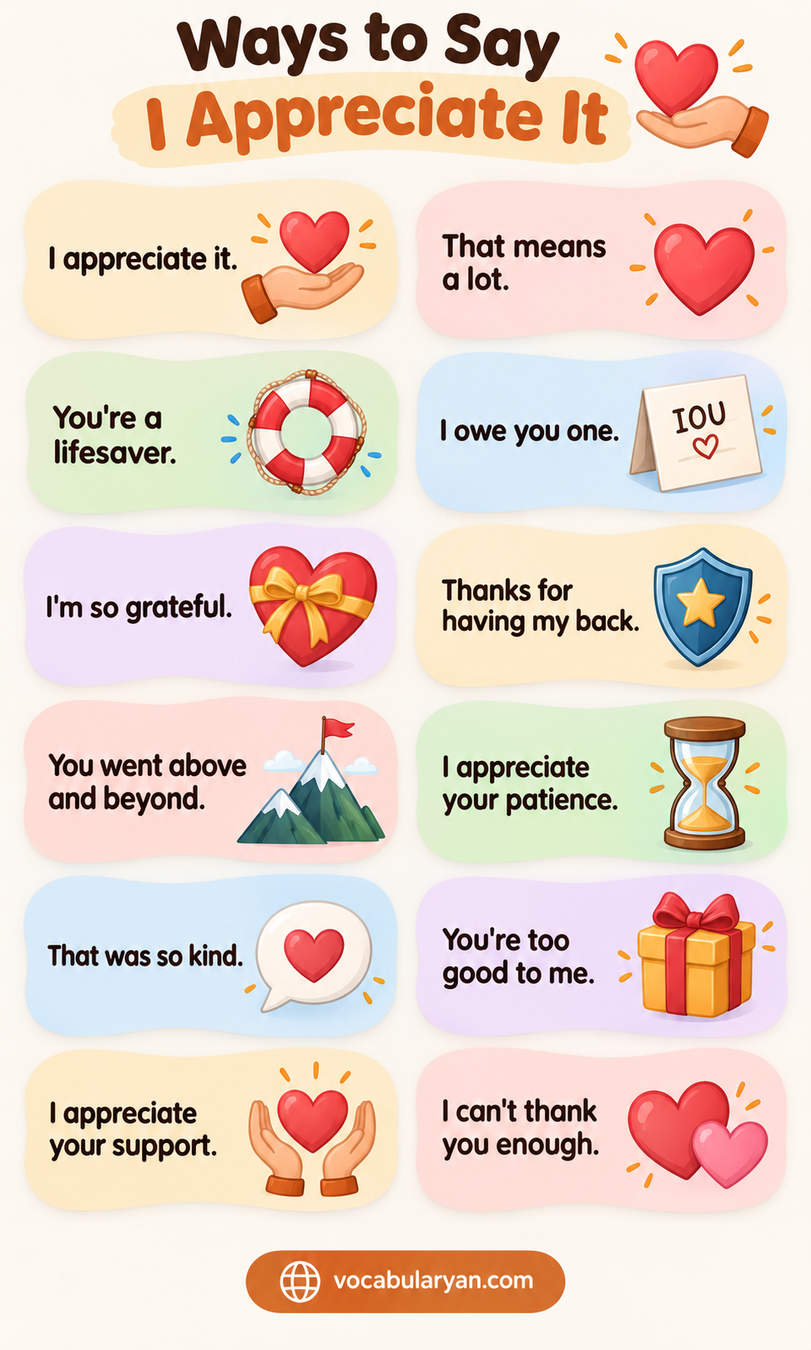
These six phrases fit almost everyone, from a neighbour to a manager.
I really appreciate it: the standard form, one step warmer than "I appreciate it". It fits a colleague, a friend, a shop assistant, or a stranger who held a door.
- I really appreciate it, Nadia, the report looks so much better now.
- Thanks for the lift, I really appreciate it.
- You didn’t have to bring the parcel round, but I really appreciate it.
That means a lot: a warm phrase for support, kind words, or a gift, and it fits friends, family, and colleagues you know well. It says that the act touched you.
- That means a lot, Ben, I was nervous about the talk.
- Thank you for coming to the show, that means a lot to me.
- Honestly, that means a lot, I didn’t expect anyone to remember.
I appreciate your help: the plain form that names the help, and it fits work, school, and a service desk. The word "help" makes the thanks specific.
- I appreciate your help with the visa forms, Mr Osei.
- Thanks again, I appreciate your help today.
- I appreciate your help, and I’ll send the final version by Friday.
Much appreciated: a short, neutral phrase without "I", and it fits a quick message or the end of a request. In a card or a speech it sounds too brief.
- Could you send the file by noon? Much appreciated.
- Thanks for covering my shift, much appreciated.
- Coffee on my desk again, much appreciated, Tom.
I’m grateful: a step more serious than "I appreciate it", and it fits real help at a hard time. It goes with "for" and the thing the person did.
- I’m grateful for everything you did while Dad was in hospital.
- I’m grateful for your patience with all my questions.
- I’m so grateful you were there.
That’s very kind of you: a polite phrase for an offer or a small favour, and it fits a stranger, a neighbour, or an older person.
- That’s very kind of you, but I can carry the bags myself.
- You saved me a seat? That’s very kind of you.
- That’s very kind of you, Mrs Lam, the soup smells wonderful.
Say "I really appreciate it" when you are unsure, and add "that means a lot" when the help was personal.
Casual Ways to Say I Appreciate It to Friends
Casual phrases are for people who know you well, and each one sounds quick, warm, and a little playful.
I owe you one: a promise to return the favour, and it fits a friend or a close colleague after a real favour. With a boss or a customer it sounds too familiar.
- Thanks for picking up the kids, I owe you one.
- I owe you one, mate, that lift saved me an hour.
- You covered for me again? I owe you one.
You’re a lifesaver: a phrase for a rescue from a real problem, such as a lost ticket, a missed train, or a deadline. For a small favour it sounds too big.
- You’re a lifesaver, I left my wallet on the bus.
- You’re a lifesaver! The printer works again.
- Thanks for the notes, you’re a lifesaver.
You’re a star: a British casual phrase for a friend or a colleague who did a small favour, and it sounds warm and light.
- You’re a star, Lucy, the cake is perfect.
- Thanks for waiting, you’re a star.
- You’re a star for sorting out the tickets.
You’re the best: a fond phrase for a friend, a partner, or a sibling, and it fits a text as well as speech.
- You’re the best, thanks for the soup.
- You got the last two seats? You’re the best!
- Seriously, you’re the best, I’ll pay you back on Friday.
I can’t thank you enough: a strong phrase for a big favour or a hard week, and it fits friends, family, and colleagues you trust.
- I can’t thank you enough for driving all that way.
- I can’t thank you enough, the kids loved the weekend.
- Honestly, I can’t thank you enough for listening last night.
You didn’t have to do that: a phrase for a gift or a favour that was more than you expected, and it sounds surprised and pleased. The reply is "I wanted to".
- You didn’t have to do that, but I’m so glad you did.
- Breakfast in bed? You didn’t have to do that.
- You didn’t have to do that, Ravi, the book must have cost a fortune.
Keep "you’re a star", "you’re the best", and "I owe you one" for friends, and use "I really appreciate it" with everyone else.
Formal Ways to Say I Appreciate It at Work
Formal phrases fit a manager, a client, or a senior colleague, and each one names what the person gave: time, effort, patience, or support.
Thank you for your time: the standard formal phrase after a meeting, an interview, or a call, and it fits anyone senior to you.
- Thank you for your time today, Ms Adams.
- Thank you for your time, I know the schedule was tight.
- Thank you for your time and for the detailed answers.
I’m grateful for your support: a warm formal phrase for someone who backed you on a project, a decision, or a difficult month.
- I’m grateful for your support on the new proposal.
- I’m grateful for your support during the audit.
- I’m grateful for your support, and I’ll keep you updated on progress.
I appreciate your patience: the formal phrase for a delay, a mistake, or a long wait, and it fits a client or a colleague who had to wait.
- I appreciate your patience while we fixed the login issue.
- I appreciate your patience, the revised quote is attached.
- I appreciate your patience with the extra questions.
Your help has been invaluable: a very formal phrase for a colleague or a partner whose help made the difference, and it fits a report or a speech.
- Your help has been invaluable to the whole team this year.
- Your help has been invaluable, and the launch would not have happened without it.
- Dr Okafor, your help has been invaluable on this study.
I’m much obliged: an older formal phrase for a favour, still heard in polite British English and in the American South. It sounds a little old-fashioned to younger speakers.
- I’m much obliged to you for the introduction.
- Much obliged, sir, I’ll return the ladder tomorrow.
- I’m much obliged for your quick reply.
Please accept my sincere thanks: the most formal phrase on this page, and it fits a letter, a speech, or a message to a senior official.
- Please accept my sincere thanks for your generous donation.
- Please accept my sincere thanks on behalf of the whole department.
- Please accept my sincere thanks for hosting the visit.
I appreciate you taking the time: a formal phrase for someone busy who made room for you, and it fits an interview or a mentor.
- I appreciate you taking the time to read my draft.
- I appreciate you taking the time to explain the process.
- I appreciate you taking the time, I know how busy the quarter has been.
The one phrase to avoid with a manager after a favour is "I owe you one", because it puts you on the level of a close friend.
- Thanks for approving the leave, I owe you one, Ms Adams. ❌
"I owe you one" is a promise between equals, so with a manager the phrase names the help instead.
- Thanks for approving the leave, I really appreciate it, Ms Adams. ✅
Each phrase of thanks on this page is spoken at one of five levels of formality.
| Level | Phrases | Who it fits |
|---|---|---|
| Slang | Ta, you’re a star, you’re the best | Close friends your own age |
| Casual | I owe you one, you’re a lifesaver, you shouldn’t have | Friends, family, relaxed colleagues |
| Neutral | I really appreciate it, that means a lot, much appreciated | Anyone you know by name |
| Formal | Thank you for your time, I appreciate your patience, I’m grateful for your support | Managers, clients, customers |
| Very formal | Please accept my sincere thanks, your help has been invaluable | Officials, donors, speeches |
Name the thing the person gave, such as time or patience, and the phrase sounds formal at once.
Ways to Say I Appreciate It in an Email
An email phrase of thanks goes in the first line or the last line, and the form changes with the relationship.
Thank you for your quick reply: the standard opening line when someone answered fast, and it fits a colleague or a client.
- Thank you for your quick reply, the dates work for us.
- Hi Sara, thank you for your quick reply on the invoice.
- Thank you for your quick reply, I’ve booked the room for Tuesday.
I appreciate your prompt response: the more formal form of "thank you for your quick reply", and it fits a supplier, a lawyer, or a bank.
- I appreciate your prompt response to my request.
- Dear Mr Petrov, I appreciate your prompt response regarding the contract.
- I appreciate your prompt response, and I have signed the form as asked.
Thanks in advance: a closing line for a request that the reader has not yet done, and it fits a colleague you know. With a stranger it sounds pushy.
- Could you check the figures before Friday? Thanks in advance.
- Thanks in advance for your help with the slides.
- Thanks in advance, Omar, I know it’s short notice.
Thank you for your understanding: a closing line after bad news, a delay, or a change of plan, and it fits a customer or a client.
- The office will close early on Friday. Thank you for your understanding.
- Thank you for your understanding while we move to the new system.
- We’re sorry for the delay, and thank you for your understanding.
I appreciate your flexibility: a phrase for someone who changed a date, a plan, or a price to suit you, and it fits a client or a colleague.
- I appreciate your flexibility on the delivery date.
- I appreciate your flexibility, the new time suits the whole team.
- Thanks again, and I appreciate your flexibility with the budget.
Thanks so much for your help with this: a warm closing line for a colleague who worked on a shared task, and "with this" names the task.
- Thanks so much for your help with this, the client is happy.
- Thanks so much for your help with this, Kemi, I’ll take it from here.
- Great work today, and thanks so much for your help with this.
"Thanks in advance" is a trap when the reader has not agreed to help yet.
- Dear Ms Adams, thanks in advance for approving my request. (first email to a senior person) ❌
"Thanks in advance" assumes a yes, so a first request to a senior person ends with a softer line.
- Dear Ms Adams, I would be grateful if you could consider my request. ✅
Open a reply with "thank you for your quick reply", and close a request with "thanks in advance" only when the reader is a colleague you know.
Ways to Say I Appreciate It to a Colleague for Help
These phrases thank a colleague who solved a problem, shared work, or covered for you, and each one names the help.
Thanks for stepping in: a phrase for a colleague who took over a task while you were away.
- Thanks for stepping in while I was at the dentist.
- Thanks for stepping in on the call, you handled it well.
- I saw the notes, thanks for stepping in at short notice.
I couldn’t have done it without you: a warm phrase after a shared success, and it fits a colleague who did a real share of the work.
- I couldn’t have done it without you, the pitch went perfectly.
- Honestly, I couldn’t have done it without you, Marco.
- The launch is live, and I couldn’t have done it without you.
Thanks for having my back: a casual phrase for a colleague who defended you or covered a mistake, and it fits people you trust.
- Thanks for having my back in the meeting.
- Thanks for having my back when the numbers were wrong.
- I know you covered for me, thanks for having my back.
I appreciate you covering for me: the plain form for a colleague who took your shift, your class, or your desk.
- I appreciate you covering for me on Thursday.
- I appreciate you covering for me, I’ll return the favour next week.
- Thanks, Jess, I appreciate you covering for me at the front desk.
Thanks for pointing that out: a phrase for a colleague who spotted a mistake before it became a problem.
- Thanks for pointing that out, the total was wrong.
- Thanks for pointing that out, I’ll fix the date on the invoice.
- Good catch, thanks for pointing that out before it went to print.
Thank a colleague by naming what they did, because "thanks for stepping in" sounds more real than "thanks".
Ways to Say I Appreciate It to a Friend for Support
Support phrases thank a friend for time, kind words, or company during a hard week, and each one says that the friend mattered.
I appreciate you: the personal form, and it thanks the person rather than the act. It fits a close friend, a partner, or a family member, and it sounds strange with a stranger.
- I appreciate you, you know that, right?
- Thanks for listening tonight, I appreciate you.
- I appreciate you more than I say.
Thanks for being there: a phrase for a friend who stayed close during a bad time, and it fits speech, a text, or a card.
- Thanks for being there when Mum was ill.
- Thanks for being there, it made the week easier.
- I didn’t say it at the time, but thanks for being there.
Thanks for checking in: a phrase for a friend who sent a message to ask how you were, and it fits a text reply.
- Thanks for checking in, I’m doing better today.
- Thanks for checking in, the exam went fine in the end.
- Hey, thanks for checking in, I needed that.
It means the world to me: the strongest form of "that means a lot", and it fits a friend or family member after real support. For a small favour it sounds too big.
- You flew all this way? It means the world to me.
- It means the world to me that you came to the funeral.
- Thank you for reading every chapter, it means the world to me.
I’m lucky to have you: a fond phrase for a friend, a partner, or a sibling who is always there.
- I’m lucky to have you, Aisha.
- I’m lucky to have you as a friend, thanks for tonight.
- Honestly, I’m lucky to have you in my corner.
You made my day: a phrase for a small kindness that changed a bad day, such as a message, a coffee, or a compliment.
- You made my day with that message.
- The card arrived, you made my day.
- Thanks for the cake, you made my day.
Say "I appreciate you" to a friend who helped you through a hard time, and keep "I appreciate it" for a favour.
Ways to Say I Appreciate It to a Boss
A phrase of thanks to a manager stays polite and short, and it names the chance, the trust, or the time the manager gave.
Thank you for the opportunity: the standard phrase for a new project, a promotion, or a chance to lead, and it fits an email or a meeting.
- Thank you for the opportunity to lead the new account.
- Thank you for the opportunity, I won’t let the team down.
- Thank you for the opportunity to present at the conference.
I appreciate your trust: a phrase for a manager who gave you a task with real responsibility.
- I appreciate your trust in me on this project.
- I appreciate your trust, and I’ll keep you updated every week.
- I appreciate your trust with the client meeting tomorrow.
Thank you for your guidance: a phrase for a manager or a mentor who gave advice or trained you.
- Thank you for your guidance this year, I’ve learned a lot.
- Thank you for your guidance on the report structure.
- Thank you for your guidance, the interview went well because of it.
I’m grateful for the feedback: a phrase for a review or a correction, and it sounds open rather than defensive.
- I’m grateful for the feedback, and I’ll rework the second half.
- I’m grateful for the feedback on my presentation style.
- I’m grateful for the feedback, it was exactly what I needed to hear.
Thank you for believing in me: a warm phrase for a manager who backed you for a role or a project, and it fits a leaving speech or a thank-you card.
- Thank you for believing in me when I was new.
- Thank you for believing in me and for pushing for the promotion.
- Thank you for believing in me, it changed my career.
Thank a manager for the chance, the trust, or the advice, and keep the promise of a returned favour out of it.
Ways to Say I Appreciate It to a Customer
A phrase of thanks to a customer is polite and warm, and it names the business, the patience, or the loyalty the customer gave.
Thank you for your business: the standard phrase after a sale or a service, and it fits a receipt, an email, or a counter.
- Thank you for your business, we hope to see you again.
- Thank you for your business this year, Mr Diaz.
- Thank you for your business, your order will arrive on Tuesday.
We appreciate your loyalty: a phrase for a customer who has come back many times, and it fits a letter or a special offer.
- We appreciate your loyalty, so here is a discount on your next visit.
- We appreciate your loyalty over the past five years.
- We appreciate your loyalty, and we’ve added a gift to your parcel.
Thank you for your patience: the phrase for a customer who waited, in a shop, on the phone, or for a delivery.
- Thank you for your patience, the manager is free now.
- Thank you for your patience during the delay.
- Thank you for your patience, your table is ready.
Thank you for choosing us: a warm phrase at the start or the end of a service, and it fits a hotel, an airline, or a shop.
- Thank you for choosing us for your stay.
- Thank you for choosing us, and enjoy the flight.
- Thank you for choosing us, we know you had other options.
We value your feedback: a phrase for a customer who wrote a review or a complaint, and it fits a reply from a company.
- We value your feedback, and we’ve passed it to the kitchen team.
- We value your feedback on the new app.
- We value your feedback, thank you for taking the time to write.
Thank a customer with "we", because the thanks comes from the whole business and not from one person.
Ways to Say I Appreciate It in a Text
Text phrases are short, and an exclamation mark replaces the warmth of your voice.
Thanks so much!: the default text phrase between friends, and the exclamation mark makes it warm rather than flat.
- Thanks so much! Got the address.
- Thanks so much! You saved my morning.
- Just landed. Thanks so much! for the lift to the airport.
Appreciate it: the short form with "I" dropped, and it fits a text or a quick word between friends and colleagues. In a formal email it sounds too short.
- Appreciate it, see you at six.
- Got the file, appreciate it.
- Appreciate it, mate, I’ll bring the drinks.
Ta: the British one-word thanks, used in texts and shops between people who know each other.
- Ta, love, see you Sunday.
- Ta for the lift!
- Cheers, ta, that’s perfect.
Cheers: a casual British and Australian phrase that means thanks, and it fits a text or a quick word. It is not a formal phrase.
- Cheers, Dan, got it.
- Cheers for the tickets!
- Cheers, I’ll pay you back tomorrow.
Thanks a mil: the Irish and casual short form of "thanks a million", used in texts between friends.
- Thanks a mil, Sean, you’re a legend.
- Thanks a mil for the loan.
- Got home safe, thanks a mil for the lift.
Keep a text phrase to three words, and add an exclamation mark when the favour was real.
Ways to Say I Appreciate It for a Gift or a Favour
A phrase for a gift names the gift or the thought behind it, and a phrase for a favour names the favour, because "I appreciate it" alone can sound flat.
I love it: the standard phrase for a gift you like, and it fits friends and family. It goes before "thank you" or after it.
- I love it, the colour is perfect.
- Thank you, I love it, how did you know?
- I love it! Where did you find it?
That was so thoughtful: a phrase for a gift or a favour chosen with your needs in mind.
- That was so thoughtful, thank you for the tea set.
- That was so thoughtful of you to remember the date.
- That was so thoughtful, I’d been looking for that book for months.
You shouldn’t have: a phrase for a gift that was more than you expected, and it means the opposite of the words: you are pleased.
- You shouldn’t have, but thank you, it’s beautiful.
- Flowers again? You shouldn’t have!
- You shouldn’t have spent so much, Grandma.
Thank you for thinking of me: a phrase for a gift or a message from someone who did not need to send one.
- Thank you for thinking of me while you were away.
- Thank you for thinking of me, the card made me smile.
- Thank you for thinking of me for the job, I’d love to apply.
I’ll never forget this: a strong phrase for a favour that changed a hard situation, and it fits family and close friends.
- I’ll never forget this, thank you for lending us the car.
- I’ll never forget this, you kept us going all winter.
- Honestly, I’ll never forget this.
How can I ever repay you?: a phrase for a big favour, and it is a question in form only. The reply is "don’t mention it" or "you’d do the same for me".
- How can I ever repay you? You drove through the night.
- How can I ever repay you for this?
- Thank you, how can I ever repay you?
"You shouldn’t have" catches learners out, because it looks like a complaint.
- You shouldn’t have. (said with a frown, handing the gift back) ❌
"You shouldn’t have" is a fixed phrase of pleased surprise, so it goes with a smile and the gift stays in your hands.
- You shouldn’t have! Thank you, I love it. ✅
Name the gift or the favour in the phrase, and the thanks sounds personal at once.
Ways to Say I Appreciate It When Someone Goes Out of Their Way
These phrases thank someone who did more than the job asked, and each one names the extra effort.
Thank you for going above and beyond: the standard phrase for extra effort, and it fits a colleague, a nurse, a teacher, or a service worker.
- Thank you for going above and beyond for my mother this week.
- Thank you for going above and beyond on the client visit.
- Thank you for going above and beyond, the room was ready two hours early.
Thanks for going the extra mile: a warmer form of "above and beyond", and it fits a colleague or a shop that solved a problem.
- Thanks for going the extra mile with the delivery.
- Thanks for going the extra mile, Priya, the client noticed.
- Thanks for going the extra mile to find the right size.
You went out of your way: a phrase that names the extra journey, time, or trouble the person took.
- You went out of your way to drop this off, thank you.
- I know you went out of your way to help, and I’m grateful.
- You went out of your way for a stranger, that’s rare.
I know that wasn’t easy: a phrase for a favour that cost the person time, money, or stress.
- I know that wasn’t easy, thank you for talking to the landlord.
- I know that wasn’t easy with the weather, thanks for coming.
- I know that wasn’t easy, and I’m grateful you did it.
Thank you for taking the time: a phrase for someone busy who stopped to help, and it fits a doctor, a mentor, or a stranger.
- Thank you for taking the time to walk me to the station.
- Thank you for taking the time to explain the results.
- Thank you for taking the time, I know you had a train to catch.
Say "above and beyond" at work and "you went out of your way" everywhere else, and name the extra effort in the same breath.
Ways to Say I Appreciate It to a Group
A group phrase thanks everyone at once, and the level of the phrase matches the room.
Thank you all: the standard phrase for a team, a class, or a room of guests, and it fits a meeting or an email.
- Thank you all for coming on such a wet evening.
- Thank you all for the hard work this quarter.
- Thank you all, the event would not have happened without you.
I appreciate everyone’s effort: a formal phrase for a team after a project, and it fits a manager speaking to staff.
- I appreciate everyone’s effort on the launch.
- I appreciate everyone’s effort over the past two weeks.
- I appreciate everyone’s effort, and the client has already sent praise.
Thanks, everyone: a casual phrase for friends or colleagues at the end of a meeting, a game, or a party.
- Thanks, everyone, same time next week.
- Thanks, everyone, that was a great session.
- Thanks, everyone, drive safely.
Thanks, guys: a casual phrase for a group of friends or classmates of any gender, and it sounds too relaxed in a formal email.
- Thanks, guys, I couldn’t have moved the sofa alone.
- Thanks, guys, best birthday ever.
- Thanks, guys, see you at practice.
We couldn’t have done it without you: a warm phrase from a team to its helpers, sponsors, or volunteers.
- We couldn’t have done it without you, so thank you to every volunteer.
- We couldn’t have done it without you, the donations covered the whole trip.
- To the kitchen team, we couldn’t have done it without you.
Write "thank you all" for a work group, and keep "thanks, guys" for friends.
How Do You Reply When Someone Says I Appreciate It?
The reply to "I appreciate it" is short, and it says that the help was no trouble or that you were happy to give it.
You’re welcome: the standard reply at every level, and it fits a stranger, a colleague, or a friend.
- I appreciate it. You’re welcome, any time.
- Thanks for the help. You’re welcome, Priya.
- I really appreciate it. You’re very welcome.
No problem: the casual reply between friends and relaxed colleagues, and it says the favour cost you nothing.
- I appreciate it. No problem, happy to help.
- Thanks for the lift. No problem, it’s on my way.
- Much appreciated. No problem at all.
My pleasure: the polite reply from staff or a host, and it fits a shop, a hotel, or a dinner.
- Thank you for your help. My pleasure, enjoy your stay.
- I appreciate your time. My pleasure, Mr Chen.
- Thanks for dinner. My pleasure, come again soon.
Any time: a casual reply that promises the same help again, and it fits friends and colleagues.
- I owe you one. Any time, mate.
- Thanks for covering. Any time, you’d do the same.
- I appreciate it. Any time, just ask.
Don’t mention it: a warm reply that plays down the favour, and it fits friends and neighbours.
- How can I ever repay you? Don’t mention it.
- Thanks for the soup. Don’t mention it, get better soon.
- I appreciate you. Don’t mention it, that’s what friends are for.
Happy to help: the neutral reply at work, and it fits a colleague, a customer, or a client.
- Thanks for the quick reply. Happy to help.
- I appreciate your patience. Happy to help, let me know if anything else comes up.
- Thank you for your time. Happy to help, good luck with the launch.
Return "I appreciate it" with "you’re welcome" or "happy to help", and keep the reply to four words or fewer.
More Everyday English Phrases
FAQs
Yes, "I appreciate it" works in place of "thank you" in most situations, and it sounds a little warmer because it names your feeling about the help. In a very formal letter "thank you" or "please accept my sincere thanks" fits better. The two phrases also pair well: "Thank you, I appreciate it."
The professional forms name what the person gave: "thank you for your time", "I appreciate your patience", "I’m grateful for your support", and "your help has been invaluable". In an email, "I appreciate your prompt response" and "thank you for your understanding" are the most common. "I owe you one" and "you’re a lifesaver" stay out of work messages to a manager or a client.
The difference is the object: "I appreciate it" thanks the action, and "I appreciate you" thanks the person. "I appreciate you" is warmer and more personal, so it fits a friend, a partner, or a family member after real support. With a colleague or a stranger, "I appreciate it" is the safe choice.
The difference is that "thank you" is a fixed phrase of politeness, and "I appreciate it" says that the help had value to you. "Thank you" fits every level, from a shop to a wedding speech. "I appreciate it" sounds a little more personal, and it fits a favour, a kind word, or extra effort.
Yes, "I appreciate it" is a natural reply to a compliment, and it sounds modest and warm. "That means a lot" and "that’s kind of you to say" are the other two common replies. "I know" is the reply to avoid, because it sounds proud.
"Please accept my sincere thanks" is the most formal phrase, and it fits a letter, a speech, or a message to a senior official or a donor. "Your help has been invaluable" and "I am deeply grateful for your support" are the next two. "I’m much obliged" is formal too, but it sounds old-fashioned to younger speakers.
"I really appreciate it" is the everyday form, and "I truly appreciate it" is the formal form. For a big favour, "I can’t thank you enough", "it means the world to me", and "I’ll never forget this" go further. "I appreciate it a lot" is correct too, but far less common.
The reply is "you’re welcome", "no problem", "happy to help", or "any time", and it stays short. "My pleasure" fits staff and hosts, and "don’t mention it" fits friends and neighbours. Four words or fewer is the rule.