
"Stop it" is an order, and the words around an order make it softer or harder. A friend who is teasing you gets "cut it out", a child gets "that’s enough", and a colleague gets "could we pause there?". The ways to say stop it in English change with the person in front of you and with how serious you are, and the everyday forms come first.
Common Ways to Say Stop It in Everyday English
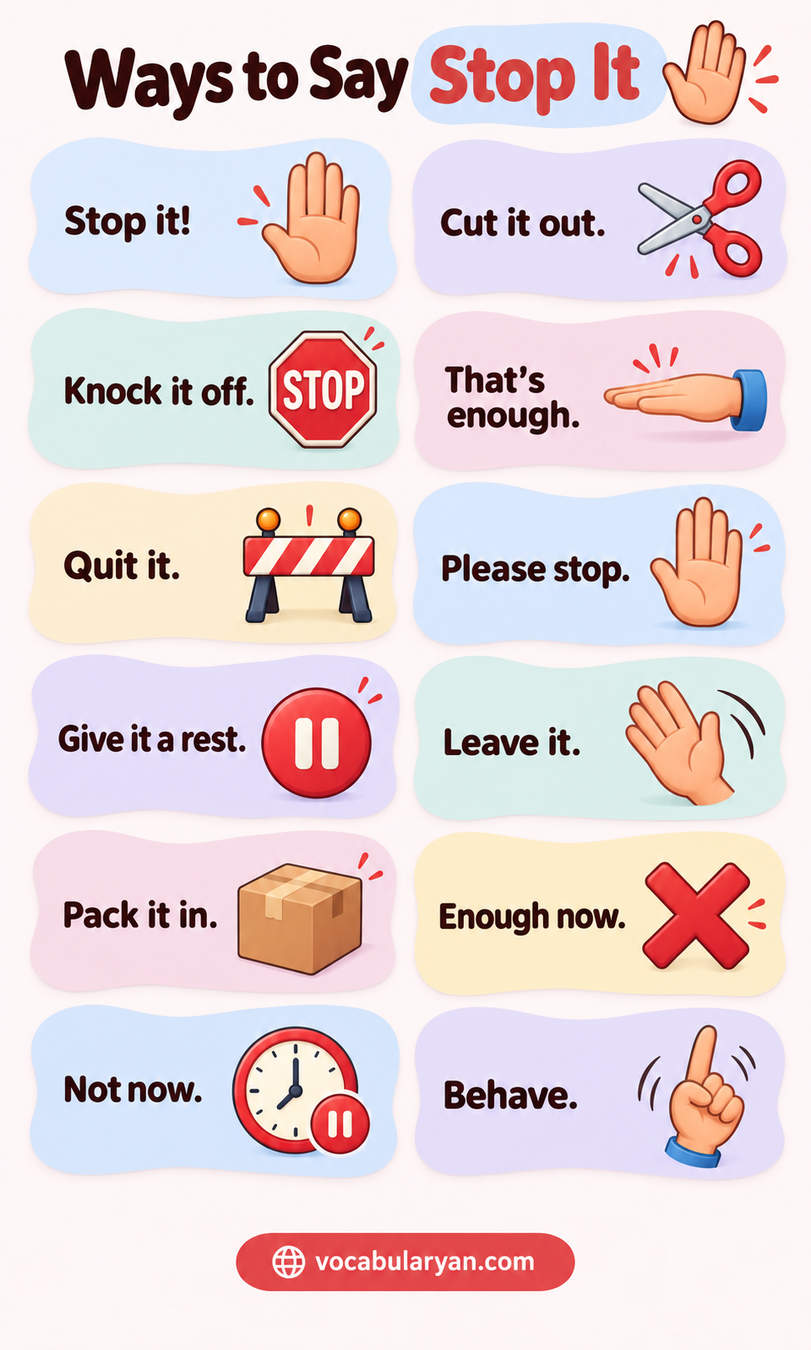
These five forms cover most moments at home, from a small annoyance to a real one.
Stop it: the plain order, and the voice decides how strong it is. Said with a smile it is a joke, said flat it is a warning.
- Stop it, Ali, you’ll break the chair if you keep leaning back like that.
- Mum, stop it, you’re embarrassing me in front of my friends.
- Oh, stop it, the film wasn’t that bad.
Stop: one word, and it is the form for a moment that cannot wait, such as a car, a child near a road, or a hand near a hot pan.
- Stop! There’s a bike coming.
- Just stop for a second and listen to me.
- Stop, you’re going to spill it all over the floor.
Please stop: "stop" with "please" in front, and the "please" turns it into a request rather than an order. It fits a partner, a flatmate, or a colleague you know well.
- Please stop tapping the table, I can’t concentrate.
- Could you please stop sending me those videos at midnight?
- Please stop, I’ve heard this story three times today.
Stop that: "that" names the action you can both see, so this form fits a child pulling a dog’s tail or a friend poking you.
- Stop that, Leo, the dog doesn’t like it.
- Hey, stop that! Those are my chips.
- Stop that right now, or we’re going home.
That’s enough: the words for a joke, a fight, or a noise that went on too long. The level is neutral, so it works with children and adults.
- That’s enough, you two, finish your dinner.
- Okay, that’s enough about my haircut, thank you.
- That’s enough now, the neighbours can hear you.
Say "stop it" to the people closest to you, and add "please" the first time you say it to anyone else.
Ways to Say Stop It to a Friend Who Is Joking
A friend who teases you gets a short casual form, said with half a smile and no anger in it.
Cut it out: the most common casual form in American English, now heard everywhere, and it fits a friend who is teasing or tickling you.
- Cut it out, Jess, I know I said it wrong, you don’t need to keep doing the voice.
- Will you cut it out? I’m trying to park.
- Cut it out! You’ll make me laugh in the middle of the exam.
Knock it off: a step firmer than "cut it out", and it fits a friend whose joke has gone on one minute too long.
- Knock it off, Sam, she’s not laughing any more.
- Guys, knock it off, the baby’s asleep.
- I’m serious, knock it off with the nicknames.
Quit it: short and American, and it fits siblings and school friends. In an office it sounds childish.
- Quit it, Danny, give me back my phone.
- Quit it! That tickles.
- Oh, quit it, you know I didn’t mean that.
Give it a rest: for a friend who has told the same joke too many times, and the words ask for a break, not a permanent end.
- Give it a rest, Tom, we all know you beat me at chess.
- Can you give it a rest about the wedding for one evening?
- Give it a rest, mate, she said no.
Okay, okay, enough: the laughing form, for a friend who has made you laugh so hard that you need a break. The repeated "okay" is part of the joke.
- Okay, okay, enough, my face hurts from laughing.
- Okay, okay, enough, I believe you, you saw a shark.
- Okay, okay, enough with the photos, put the phone away.
Use "cut it out" for the first joke too many, and "knock it off" once the smile has gone.
Ways to Say Stop It to a Child
A child needs short words and a calm voice, so these forms are short and the same every time.
Stop that now: "now" added to "stop that", and the "now" means there is no second warning. Say it low and slow rather than loud.
- Stop that now, Ella, the paint stays on the paper.
- I’ve asked once already, stop that now.
- Stop that now, please, your brother is crying.
Hands to yourself: the words for hitting, grabbing, or poking, and they name the fix rather than the fault. The line is heard in every primary classroom.
- Hands to yourself, Max, we don’t push in the line.
- Both of you, hands to yourself until the bus comes.
- Hands to yourself in the shop, please, those glasses break.
We don’t do that: a soft form for a young child, and the "we" makes it a family rule rather than a personal complaint.
- We don’t do that, sweetheart, we don’t throw food.
- We don’t do that to the cat, gentle hands.
- No, Sofia, we don’t do that in the library.
Leave your sister alone: "leave" plus a person means "stop bothering them", and the name can change to a brother, a friend, or the dog.
- Leave your sister alone, she’s doing her homework.
- Jack, leave your sister alone and come and set the table.
- I won’t say it again, leave your sister alone.
I’m counting to three: the final warning before a consequence, and it works only if something happens at three. The line belongs to parents and teachers alike.
- I’m counting to three, and then the tablet goes away. One…
- Shoes on, please. I’m counting to three.
- I’m counting to three, Ben, get down from there.
Keep the words short with a child, and repeat the same form each time so it means the same thing each time.
Ways to Say Stop It to a Pet
A dog or a cat learns single words, so every form here is short and said the same way each time.
No: the one word every pet learns first, said in a low firm voice, and never shouted twice in a row.
- No, Biscuit, that’s my dinner, not yours.
- No! Off the sofa.
- A firm no and then a treat when he stops works better than shouting.
Leave it: the command for a dog that is about to pick something up, from a chicken bone to a shoe.
- Leave it, Rex, that’s not food.
- Good boy, leave it, and now come here.
- Leave it! The hedgehog isn’t a toy.
Drop it: the command for something already in the mouth, and it is the pair to "leave it".
- Drop it, Bella, that’s my sock.
- Drop it now, and you can have the ball back.
- She won’t drop it unless you show her a treat first.
Off: one word for a dog on the furniture, on the bed, or jumping up at a guest, and it is different from "down", which means "lie down".
- Off, Charlie, the guests don’t want mud on their trousers.
- Off the table, Mitzi, now.
- Say off once and point at the floor.
Ah-ah: a warning sound rather than a word, used the second before a pet does something wrong, and cats and dogs both understand it.
- Ah-ah, leave the plant alone.
- Ah-ah! Not the curtains.
- One ah-ah and she sat straight back down.
A full sentence to a dog is noise, because the dog hears the first word and nothing after it.
- Rex, stop it, you know you’re not allowed to chew the shoes. ❌
A pet learns a single word for a single action, so the command is the short one you have used before.
- Rex, leave it. ✅
Pick one word for each action, such as "leave it" for the floor and "off" for the furniture, and keep that word for the whole of the pet’s life.
Firm Ways to Say Stop It When You Mean It
These forms are for the moment when the joke is over and you need the other person to believe you.
I need you to stop: "I need" instead of a bare order, and the result is calm and serious. It fits a partner, a colleague, or a grown child.
- I need you to stop talking about my weight, it isn’t funny to me.
- Look at me. I need you to stop and listen.
- I need you to stop calling the house after ten.
I said stop: the second time you say it, and "I said" reminds the person that the first request was ignored.
- I said stop, and I meant it.
- I said stop! Put the scissors down.
- No, Marcus, I said stop, that’s the last time.
Stop right there: the form for a person who is walking, reaching, or halfway through a sentence you do not want to hear.
- Stop right there, I know what you’re going to say.
- Stop right there and keep your hands where I can see them.
- Stop right there, that gate is locked for a reason.
Do not do that again: the full form "do not" instead of "don’t", and the long form sounds slower and more serious.
- Do not do that again, Ryan, I’m not joking.
- You scared her. Do not do that again.
- Do not do that again without asking me first.
Back off: the words for a person who is too close, in your space, or pushing you about a decision. It is rude in a calm setting and right in a tense one.
- Back off, I’m not signing anything today.
- Back off, mate, give her some room.
- I told him to back off and he finally left.
Drop your voice rather than raising it, and say "I need you to stop" once before "I said stop".
Polite Ways to Say Stop It at Work
At work the request takes a question or a "let’s" form, because a bare order sounds like a parent.
Could we pause there?: a question that stops a discussion without blaming anyone, and it fits a meeting, a call, or a manager. The reply is "of course".
- Could we pause there? I think we’ve lost the main question.
- Sorry, Dan, could we pause there for a second?
- Could we pause there and come back after lunch?
Let’s leave it there: the form for closing a discussion that has gone on too long, and "let’s" makes it a shared decision.
- Let’s leave it there for today and pick it up on Monday.
- Okay, let’s leave it there, I think we agree on the main aim.
- Let’s leave it there before anyone says something they regret.
Would you mind not doing that?: the politest way to name an annoying habit, from humming to tapping a pen, at the next desk.
- Would you mind not doing that while I’m on the phone?
- Sorry, Priya, would you mind not eating at my desk?
- Would you mind not copying the whole team on every reply?
I’d rather we didn’t: the soft "no" to a plan or a joke, and it stops the action without the word "stop" at all.
- I’d rather we didn’t share those numbers before the board sees them.
- I’d rather we didn’t joke about that in front of the client.
- Thanks, but I’d rather we didn’t go ahead this week.
Let’s park that: office English for "let’s stop discussing this for now", and it promises a return to the question later.
- Let’s park that and look at the budget first.
- Good question, let’s park that until Ana is back.
- Let’s park that for now, we’re out of time.
"Stop it" said to a manager or a customer is the one form on this page that can cost you, because it is the order a parent gives a child.
- Stop it, Mr Hale, we’ve already agreed the price. ❌
An order to a customer sounds like a parent to a child, so the same request takes a question form.
- Mr Hale, could we pause there? We’ve already agreed the price. ✅
Every form on this page belongs to one of five levels, from slang to very formal.
| Level | Phrases (7) | Who it fits (11) |
|---|---|---|
| Slang | Chill, lay off, allow it (24) | Close friends your own age (26) |
| Casual | Cut it out, knock it off, quit it, give it a rest (49) | Friends, family, siblings (25) |
| Neutral | Stop it, please stop, that’s enough (35) | Partners, children, people you know well (40) |
| Formal | Could we pause there, would you mind not, let’s leave it there (62) | Colleagues, managers, clients (29) |
| Very formal | Please refrain from, I must ask you to stop (43) | Emails, complaints, official letters (36) |
Ask a question at work, because "could we pause there?" gets the same result as "stop it" and keeps the relationship.
Ways to Say Stop It in an Email
An email has no voice, so the written forms are polite, full, and name the exact behaviour.
Please refrain from: the standard written form, followed by an -ing verb, and it fits a colleague, a supplier, or a member of the public.
- Please refrain from contacting my team directly about invoices.
- We ask that all visitors refrain from using phones in the ward.
- Please refrain from replying to all on this thread.
I must ask you to stop: a step firmer, for a second or third email about the same behaviour, and "must" means you have no choice.
- I must ask you to stop sending marketing messages to this address.
- I must ask you to stop parking in the disabled bay outside the office.
- With respect, I must ask you to stop contacting my client at home.
Please stop sending: the plain form for unwanted messages, and it works because it names the exact thing to stop.
- Please stop sending the weekly report to my personal email.
- Please stop sending invoices for a service we cancelled in March.
- Could you please stop sending the same reminder twice a day?
Going forward, please don’t: office English that stops a habit without blame, and "going forward" means "from now on".
- Going forward, please don’t book the meeting room without checking the calendar.
- Going forward, please don’t share the draft outside the project team.
- Going forward, please don’t copy the client on internal notes.
I’d appreciate it if this stopped: the soft form for a friend, a neighbour, or a colleague whose goodwill you want to keep, and "appreciate" softens the whole line.
- I’d appreciate it if this stopped, as the noise is keeping the children awake.
- I know it isn’t on purpose, but I’d appreciate it if this stopped.
- I’d appreciate it if this stopped before the next review.
A casual spoken form in an email reads as anger, because the reader adds a voice the writer never meant.
- Hi Mark, quit it with the reply-alls, thanks. ❌
"Quit it" in writing sounds like a shout, so the email form is "please refrain from" or "going forward, please don’t".
- Hi Mark, going forward, please don’t reply to all on these threads. ✅
Name the exact behaviour in the email, and write "please refrain from" the first time and "I must ask you to stop" the second.
Ways to Say Stop It to a Stranger
With a stranger "excuse me" or "sorry" goes in front, and the words stay polite until you are ignored.
Excuse me, please stop: the polite full form for a person on a train, in a queue, or at your door.
- Excuse me, please stop leaning on my seat.
- Excuse me, please stop filming, my children are in the shot.
- Excuse me, please stop, that’s my bag you’re moving.
Leave me alone: the form for a stranger who keeps talking, walking behind you, or asking, and it needs no "please".
- Leave me alone, I’ve already said I’m not interested.
- Please just leave me alone, I’m waiting for my friend.
- Leave me alone or I’ll call the staff.
Don’t touch that: a fast warning for a hand on your bike, your child, or your property, and it is right to say it loudly.
- Don’t touch that, it’s not yours.
- Hey! Don’t touch that, the paint is wet.
- Don’t touch that, please, it’s very old.
Sorry, could you not?: the British form that sounds polite and means "stop that now", and the missing verb at the end is on purpose.
- Sorry, could you not? My daughter’s asleep.
- Sorry, could you not put your feet on the seat?
- Sorry, could you not? That’s my coffee.
"Shut up" to a stranger is the fastest way to start a fight, because it insults the person rather than naming the action.
- Shut up, some of us are trying to work here. ❌
"Shut up" is an insult rather than a request, and a stranger hears it as a challenge.
- Excuse me, please stop, some of us are trying to work here. ✅
Put "excuse me" in front with a stranger, and move to "leave me alone" only after the polite form has failed.
Ways to Say Stop It to a Group
A group form names everyone at once, and it is the teacher’s, the coach’s, and the parent’s tool.
Settle down: the words for a noisy class, a wedding table, or a car full of children, and they ask for quiet rather than silence.
- Settle down, everyone, we’ve got a lot to get through.
- Right, settle down, the film’s about to start.
- Settle down in the back, or we’re stopping the car.
That’s enough, all of you: "all of you" added to "that’s enough", and it stops a group argument without picking one person to blame.
- That’s enough, all of you, nobody is getting the last slice.
- That’s enough, all of you, back to your desks.
- I mean it, that’s enough, all of you.
Everyone, stop: the emergency form for a group, and it needs a loud voice and a raised hand.
- Everyone, stop what you’re doing and look at the door.
- Everyone, stop! Someone’s hurt.
- Everyone, stop talking for one minute, please.
Let’s stop there: the coach’s or the trainer’s form at the end of a session, and it fits a rehearsal, a class, or a workout.
- Let’s stop there for today, good work, everybody.
- Okay, let’s stop there and stretch.
- Let’s stop there, we’ll run the last scene again tomorrow.
Say "settle down" for noise and "that’s enough, all of you" for a fight, and save "everyone, stop" for danger.
Playful Ways to Say Stop It When Someone Flatters You
This "stop it" is a way of accepting a compliment, and the speaker wants the other person to carry on.
Stop it, you: the classic reply to praise, said with a wave of the hand and a smile, and it means "thank you, keep going".
- Stop it, you, it’s just an old dress.
- Oh, stop it, you, I only baked one cake.
- Stop it, you! You’ll make me blush.
Oh, stop: the shorter form, and the "oh" is what makes it a joke rather than a request.
- Oh, stop, you say that to everyone.
- Oh, stop, it wasn’t that good a speech.
- Oh, stop! Now I’m going red.
You’re too kind: the polite form of the same joke, and it fits an older colleague or a stranger who has praised you.
- You’re too kind, I had a lot of help with it.
- Thank you, you’re too kind, but the team did most of the work.
- You’re too kind, it’s only a small garden.
Get out of here: American, and it means "I don’t believe you" said with delight. It fits friends and family only.
- Get out of here, you did not get the job!
- Get out of here, this is the best you’ve ever cooked.
- Get out of here, nobody reads my poems.
Shut up!: between close friends this is joy, not rudeness, and the rising voice is what changes the meaning. Never say it to anyone senior.
- Shut up! You’re getting married?
- Shut up, it was not that funny.
- Shut up, I do not look like a film star.
Say "stop it, you" to a friend who praises you, and "you’re too kind" to anyone else.
Ways to Say Stop It in a Text
A text has no face and no voice, so spelling and capitals stand in for a smile or a frown.
stop: one lower-case word, and between friends it means "you’re making me laugh" as much as "stop".
- omg stop, I’m at work, I can’t laugh here
- stop, that photo is terrible
- no stop, you’re being too nice
STOP: capitals mean either a shout or delight, and the words after them decide which one.
- STOP sending me spoilers, I haven’t watched it yet
- STOP I’m crying laughing
- STOP calling, I’m in a meeting
pls stop: "please" shortened, and it fits a friend who keeps sending memes or messages at the wrong time.
- pls stop texting me at 3am
- pls stop, my boss can see my screen
- pls stop with the puns, I’m begging you
stahp: a joke spelling of "stop", used when a friend is being too funny or too kind, and never in a serious message.
- stahp, you’re the sweetest
- stahp I’m going to wake the whole train laughing
- stahp it’s not my birthday yet
Write "stop" in lower case for a laugh, and "please stop" in full when you are serious.
Regional Ways to Say Stop It in English
Each English-speaking country has a few "stop it" forms of its own, and the level changes with the country.
British Ways to Say Stop It
Pack it in: the everyday British form for a child, a friend, or a colleague who is messing about, and it is firm but not angry.
- Pack it in, you two, I’m trying to drive.
- Oi, pack it in, that’s not funny any more.
- Will you pack it in with the singing?
Give over: northern English for "stop it", and it fits both a joke and a compliment.
- Give over, Dave, you’ve never run a marathon in your life.
- Oh, give over, it’s only a bit of rain.
- Give over, I’m not that clever.
Leave it out: London English, and it means "stop that" to a friend who is pushing a joke or an argument too far.
- Leave it out, mate, he’s had a bad week.
- Leave it out, will you? I’ve said sorry.
- Oh, leave it out, that never happened.
Behave: one word, British, and it fits a friend who is being cheeky or a child who is being silly. The joke form is "behave yourself".
- Behave, you, we’re in a restaurant.
- Behave! Your gran can hear you.
- Ha, behave, you know I didn’t mean it like that.
American Ways to Say Stop It
Lay off: American for "stop bothering someone", and it takes "me" or a name after it.
- Lay off, I said I’d do it after dinner.
- Lay off him, he’s only been here a week.
- Tell your brother to lay off the teasing.
Cool it: American slang for "calm down and stop", and it fits an argument that is getting loud.
- Cool it, both of you, this isn’t the place.
- Hey, cool it, the kids are listening.
- Just cool it for a minute and let me explain.
Zip it: American for "stop talking", and it is playful or rude depending on the voice.
- Zip it, I’m listening to the score.
- Zip it, Tyler, the teacher can hear you.
- Okay, zip it, here she comes.
Australian and Irish Ways to Say Stop It
Pull your head in: Australian for "stop showing off and mind your own business", and it fits a mate who has gone too far.
- Pull your head in, Jono, nobody asked you.
- He told the boss to pull his head in and got sent home.
- Mate, pull your head in, she’s upset.
Would you ever stop: Irish, and it means "stop it" to a friend and "I don’t believe you" to a compliment. Said fast, it sounds like one word.
- Would you ever stop, I look terrible in that photo.
- Ah, would you ever stop, it’s only a scratch.
- Would you ever stop going on about the match?
Go away out of that: Irish, said "g’way outta that", and it is the answer to praise or to a story you do not believe.
- Go away out of that, you never met the president.
- Ah, go away out of that, it was nothing.
- Go away out of that, sure I’ve had it years.
Say "pack it in" in Britain, "knock it off" in America, "pull your head in" in Australia, and "would you ever stop" in Ireland.
Slang Ways to Say Stop It
Slang forms belong to friends your own age, and each one sounds wrong to a parent or a boss.
Chill: one word for "calm down and stop", and it fits a friend who is stressed, angry, or over-excited.
- Chill, it’s only a game.
- Bro, chill, she’ll text back.
- Chill with the questions, I’ll tell you everything.
Ease up: "stop pushing so hard", and it fits a friend who is teasing, arguing, or driving too fast.
- Ease up on him, he’s new.
- Ease up, I said I’d pay you back Friday.
- Ease up on the brakes, you’re going to stall.
Allow it: London slang, and it means "stop it, leave it alone". It is common under thirty and unknown to most older people.
- Allow it, man, I’m not going out tonight.
- Allow it, he didn’t mean anything by it.
- Just allow it, it’s not worth the argument.
Dead it: London slang for "stop that conversation now", and it fits a friend who keeps bringing up the same argument.
- Dead it, I don’t want to talk about her.
- Dead it, bro, the whole table can hear you.
- Can we dead it with the ex talk?
Keep "chill", "allow it", and "dead it" for friends, and say "please stop" to everyone else.
Funny Ways to Say Stop It
A funny form is for a friend who has made you laugh too hard, and the joke is the big words.
Stop, I can’t breathe: the words for a joke that has gone on until you are out of breath, and they are a compliment to the joker.
- Stop, I can’t breathe, that impression is too good.
- Stop, I can’t breathe, tell me she didn’t say that.
- Stop, I can’t breathe! My stomach hurts.
Halt, in the name of the law: a line from old films, said in a deep voice to a friend who is stealing your chips or crossing the room.
- Halt, in the name of the law! Put the biscuit down.
- Halt, in the name of the law, nobody leaves before the washing-up.
- Halt, in the name of the law, that’s my chair.
Cease and desist: the words of a lawyer’s letter, used as a joke between friends, and it is funny only because it is so formal.
- Cease and desist with the singing, we’ve got neighbours.
- I hereby order you to cease and desist from stealing my fries.
- Cease and desist, sir, the joke is over.
Whoa there, cowboy: an American joke form for a friend who is going too fast, in a car, a story, or a plan.
- Whoa there, cowboy, you’ve only known her a week.
- Whoa there, cowboy, finish one story before you start the next.
- Whoa there, cowboy, slow down, the shops don’t close till six.
Use the funny forms with a friend who is laughing already, because to anyone else "cease and desist" sounds like a threat.
How Do You Reply When Someone Says Stop It?
The reply to "stop it" either agrees and stops or asks what the problem is, and its level matches the request.
Stop it or please stop: the reply is a short apology, and the action stops in the same breath.
- Please stop tapping. Sorry, I didn’t realise I was doing it.
- Stop it. Okay, okay, I’ve stopped.
- Stop it, Mum. Fine, I’ll leave you alone.
Cut it out or knock it off: the reply from a friend is a laugh, a fake apology, or a small defence.
- Cut it out! Alright, alright, I’m done.
- Knock it off, Sam. What? I didn’t do anything.
- Quit it. Fine, but you started it.
That’s enough or I said stop: the reply is quiet, because the other person is serious, and an excuse makes it worse.
- That’s enough. Sorry. It won’t happen again.
- I said stop. Okay. I’m sorry, I didn’t know it upset you.
- I need you to stop. You’re right, I’ll stop.
Could we pause there?: the reply at work agrees at once, and the reason can come later.
- Could we pause there? Of course, go ahead.
- Let’s leave it there. Fair enough, I’ll send my notes tomorrow.
- Would you mind not doing that? Not at all, sorry about that.
Stop it, you: the reply repeats the compliment, because the "stop it" was never a request.
- Stop it, you. No, I mean it, you look great.
- Oh, stop. I won’t, it was the best cake at the party.
- Give over. I’m serious, you should sell them.
Answer a serious "stop it" with "sorry" and nothing else, and answer a joking one with a joke.
More Everyday English Phrases
FAQs
"Cut it out", "knock it off", and "that’s enough" are the three most common replacements, and each one fits a different person. "Cut it out" and "knock it off" are for friends and family, "that’s enough" is for a child or a group, and at work the same request becomes "could we pause there?". A pet gets one word, such as "leave it" or "off".
Add "please" or turn it into a question: "please stop", "could you stop, please?", or "would you mind not doing that?". The question forms are the polite ones, because they leave the other person a way to agree without losing face. With a stranger, "excuse me" goes in front.
"Could we pause there?", "let’s leave it there", and "let’s park that" are the spoken forms in a meeting, and "please refrain from" is the written form in an email. None of them uses the word "stop", and that is the reason they sound professional. "I must ask you to stop" is the firmest line that is still polite.
"I need you to stop" is firm and calm, and "I said stop" is the form for the second time. Both work better in a low voice than a loud one. "Stop right there" and "back off" are for a moment of danger or a person who is too close.
No, not between friends, family, or colleagues who joke together, because it belongs to the casual level. It becomes rude with a manager, a customer, or a stranger, since it sounds like an order to a child. With those people the request is "could you stop, please?" or "would you mind not doing that?".
"Chill", "ease up", "cool it", and "lay off" are the American slang forms, and "allow it" and "dead it" are London slang for the same request. All of them are for friends your own age. "Quit it" and "knock it off" are casual rather than slang, so they fit a wider group of people.
No, not as a bare order, because "stop it" to a boss or a customer sounds like a parent talking to a child. The same request in a question form works: "could we pause there?", "would you mind if we didn’t?", or "I’d rather we didn’t". For a serious problem, "I need you to stop" said calmly is still acceptable, and an email with "I must ask you to stop" can follow it.