
Negative words express unfavorable feelings, traits, actions, conditions, or outcomes. This collection contains 560 distinct headwords, from common choices such as angry and cruel to formal terms such as pernicious and reprehensible.
A precise vocabulary set separates temporary feelings from personality traits, harmful behavior, poor conditions, failed outcomes, communication, performance, risk, and trust. It also shows when a term is mild, intense, informal, insulting, or dependent on context.
Negative Words List
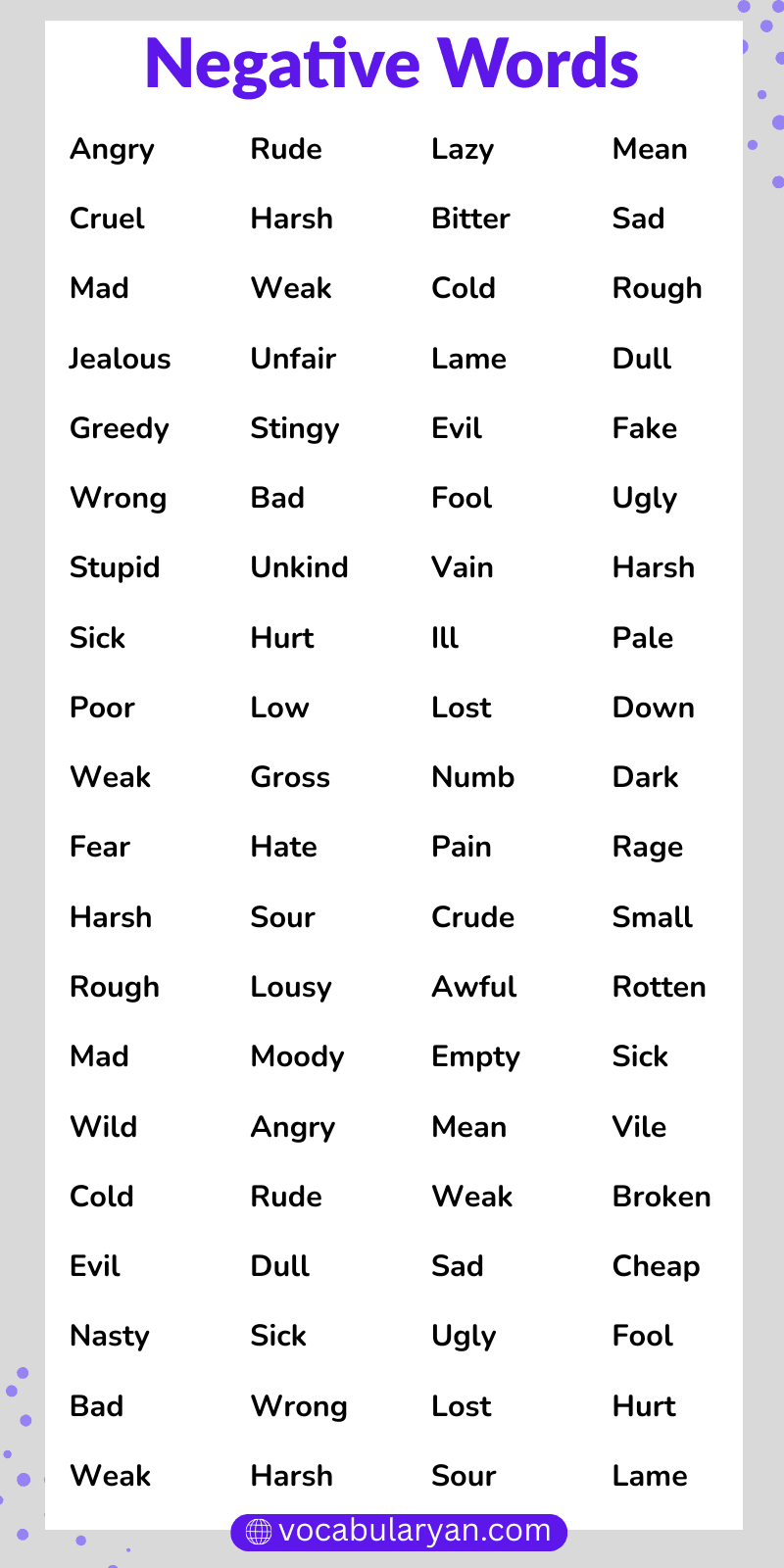
A negative words list includes vocabulary with an unfavorable meaning or connotation. The words may describe emotions, people, actions, objects, conditions, communication, quality, risk, or results. The A-Z inventory contains 560 normalized headwords, while the category sections repeat selected terms only when repetition supports comparison or learning.
Common Negative Words
These common negative words appear frequently in conversation, news, workplace communication, and everyday writing. Each points to a specific kind of problem, feeling, judgment, or behavior.
| Angry | Annoyed | Anxious | Awful |
| Bad | Bitter | Boring | Bossy |
| Careless | Cold | Cruel | Difficult |
| Dishonest | Disappointed | Dreadful | Envious |
| Exhausted | Fake | Faulty | Fearful |
| Foolish | Frustrated | Greedy | Harsh |
| Hostile | Impatient | Impolite | Insecure |
| Irritating | Jealous | Lazy | Mean |
| Messy | Miserable | Nasty | Nervous |
| Offensive | Pessimistic | Reckless | Rude |
| Sad | Selfish | Spiteful | Stubborn |
| Toxic | Unfair | Unkind | Worried |
Mild and Strong Negative Words
Intensity changes the force of a negative word. Annoyed is milder than angry, while furious is much stronger. The exact degree still depends on the sentence, the speaker, and the situation.
| Mild | Strong | Very Strong |
| Annoyed | Angry | Furious |
| Uneasy | Anxious | Terrified |
| Unpleasant | Dreadful | Horrendous |
| Blunt | Rude | Abusive |
| Tired | Weary | Exhausted |
| Messy | Filthy | Disgusting |
| Disappointing | Disastrous | Devastating |
| Doubtful | Pessimistic | Hopeless |
For a larger intensity range, compare strong negative words in English.
Negative Words by Meaning
Meaning-based groups make negative vocabulary easier to choose. The groups below separate feelings, personality, behavior, situations, appearance, communication, performance, risk, and trust so that similar terms are not treated as interchangeable.
Negative Words for Feelings
- Annoyed: Mildly bothered or irritated.
- Anxious: Worried and uneasy about what may happen.
- Ashamed: Distressed by guilt or embarrassment.
- Bitter: Angry because of hurt or unfairness.
- Disappointed: Unhappy because expectations were not met.
- Envious: Unhappy because another person has something desired.
- Frustrated: Upset because progress is blocked.
- Hopeless: Believing that improvement is unlikely.
More emotion vocabulary appears in the collection of negative feeling adjectives.
Negative Words for Personality
- Arrogant: Acting as though one is better than others.
- Callous: Showing little concern for another person’s pain.
- Conceited: Having an excessively high opinion of oneself.
- Cynical: Expecting selfish motives or bad outcomes.
- Dishonest: Unwilling to tell the truth.
- Greedy: Wanting more than is fair or necessary.
- Manipulative: Using hidden pressure to control others.
- Selfish: Giving little attention to other people’s needs.
For deeper person-description vocabulary, use the dedicated list of negative words to describe someone.
Negative Words for Actions and Behavior
- Abandon: Leave a person, duty, or place without support.
- Betray: Break trust or loyalty.
- Blame: Hold someone responsible, sometimes unfairly.
- Cheat: Act dishonestly to gain an advantage.
- Deceive: Cause someone to believe something false.
- Harass: Repeatedly trouble, pressure, or intimidate.
- Insult: Speak or act in a way that offends.
- Undermine: Weaken confidence, authority, or progress.
Writers can also compare negative words for writers by function and tone.
Negative Words for Situations and Outcomes
- Chaotic: Completely disordered and hard to control.
- Dangerous: Likely to cause harm or serious risk.
- Delayed: Late or held back.
- Disastrous: Causing severe damage, loss, or failure.
- Dysfunctional: Not working in a healthy or effective way.
- Oppressive: Unfairly restrictive or difficult to endure.
- Stressful: Causing mental or emotional pressure.
- Unfair: Not just, equal, or reasonable.
Negative Words for Appearance and Condition
- Broken: Damaged and unable to work properly.
- Defective: Containing a fault or weakness.
- Dirty: Unclean or morally unfair, depending on context.
- Filthy: Extremely dirty or offensive.
- Hideous: Extremely unpleasant to look at.
- Messy: Untidy, disorganized, or confusing.
- Rotten: Decayed, spoiled, or morally bad.
- Shabby: Worn, neglected, or of poor quality.
Appearance-based words can be especially hurtful when applied to people. Use a factual condition word whenever it communicates the point more accurately.
Negative Words for Communication and Attitude
- Abrasive: Harsh or unfriendly in speech or manner.
- Acerbic: Sharp and severely critical in tone.
- Condescending: Speaking as though another person is less capable.
- Contemptuous: Showing strong disrespect or scorn.
- Dismissive: Treating an idea or person as unworthy of attention.
- Patronizing: Appearing helpful while treating someone as inferior.
- Sarcastic: Using cutting irony to mock or criticize.
- Tactless: Speaking without enough care for another person’s feelings.
Negative Words for Quality and Performance
- Defective: Containing a fault that prevents proper use.
- Faulty: Incorrect, damaged, or based on an error.
- Flawed: Containing a weakness or imperfection.
- Inaccurate: Not correct or exact.
- Inefficient: Wasting time, effort, or resources.
- Mediocre: Only average when a better standard is expected.
- Substandard: Below an accepted level of quality.
- Unreliable: Not consistently dependable or accurate.
Negative Words for Risk and Harm
- Dangerous: Likely to cause harm or serious loss.
- Deadly: Capable of causing death or severe destruction.
- Harmful: Causing physical, emotional, social, or practical damage.
- Hazardous: Involving a significant risk of harm.
- Pernicious: Causing serious harm gradually or subtly.
- Poisonous: Containing or producing a substance that can cause injury.
- Toxic: Poisonous, damaging, or severely unhealthy.
- Volatile: Likely to change suddenly or become dangerous.
Negative Words for Relationships and Trust
- Betray: Break a person’s trust or loyalty.
- Deceitful: Intending to mislead through dishonesty.
- Dishonest: Unwilling to tell the truth or act fairly.
- Disloyal: Failing to remain faithful to a person or group.
- Manipulative: Using hidden pressure or deception to control others.
- Mistrustful: Unwilling to trust because of suspicion.
- Unfaithful: Not loyal to a partner, promise, or duty.
- Untrustworthy: Not deserving confidence or trust.
Negative Words from A to Z
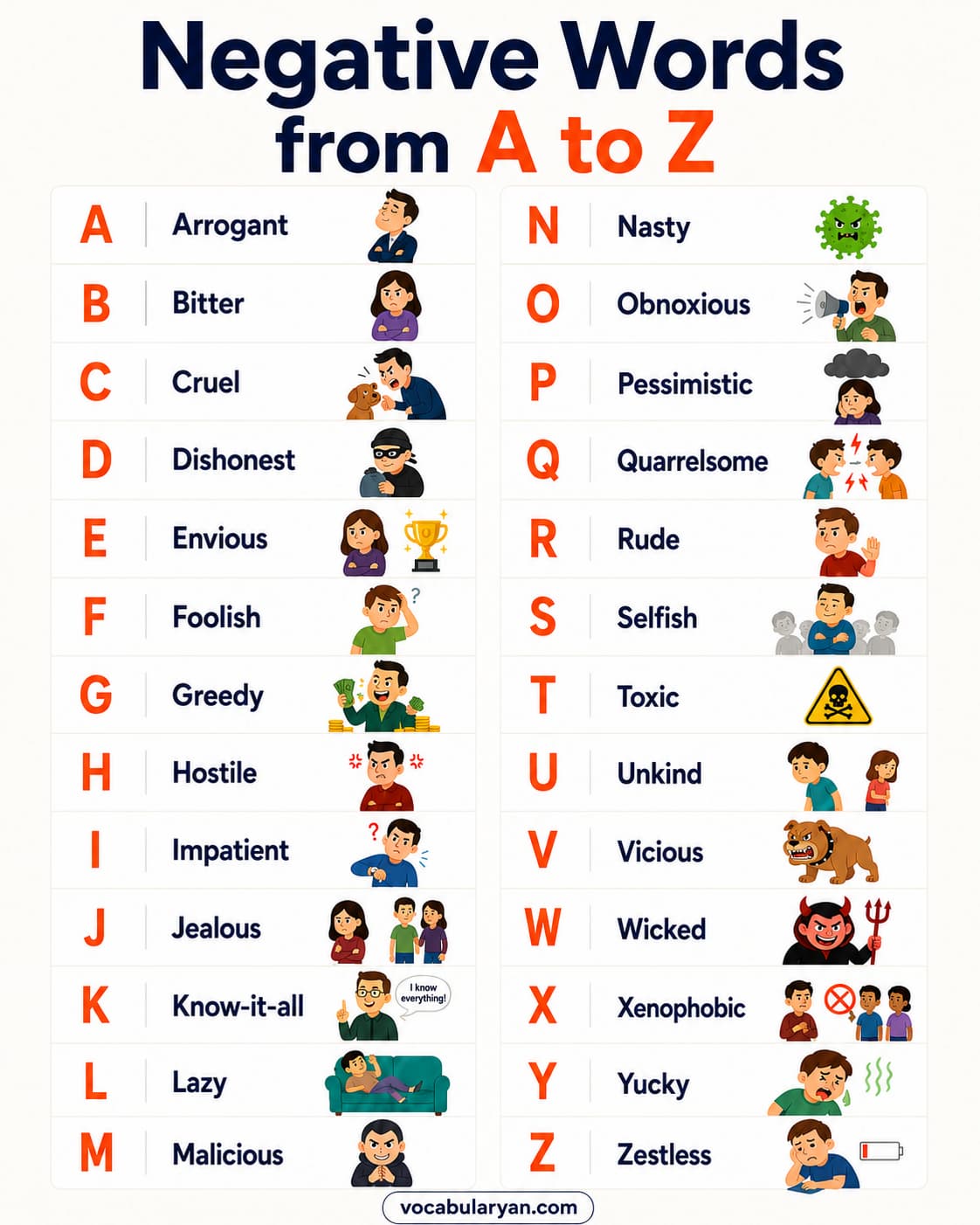
The A-Z inventory mixes adjectives, nouns, and verbs because negative words are not limited to one part of speech. Each of the 560 entries appears once in this canonical list. Inflected or related forms are counted separately only when they serve a distinct grammatical role or meaning.
| Letter | Negative Words |
| A | Abandon, Abhorrent, Abject, Abrasive, Abrupt, Absurd, Abuse, Abusive, Abysmal, Acerbic, Acrimonious, Adverse, Afraid, Aggravating, Aggressive, Agitated, Agonizing, Aimless, Alarming, Alienated, Aloof, Angry, Annoyed, Antagonistic, Anxious, Apathetic, Appalling, Apprehensive, Argumentative, Arrogant, Ashamed, Atrocious, Awful, Awkward |
| B | Bad, Baffling, Banal, Barbaric, Barren, Belligerent, Berserk, Betray, Biased, Bigoted, Bitter, Bizarre, Blame, Bleak, Blundering, Blunt, Boastful, Boorish, Boring, Bossy, Brash, Broken, Brutal, Burdensome |
| C | Callous, Capricious, Careless, Catastrophic, Caustic, Chaotic, Chauvinistic, Cheap, Cheat, Childish, Clingy, Cliquish, Clueless, Clumsy, Cluttered, Coarse, Cocky, Coercive, Cold, Cold-hearted, Combative, Complacent, Complicated, Compulsive, Conceited, Condescending, Confusing, Contemptible, Contemptuous, Controlling, Convoluted, Corrosive, Corrupt, Cowardly, Cranky, Crass, Creepy, Crooked, Crude, Cruel, Cynical |
| D | Damaging, Dangerous, Deadly, Deceitful, Deceive, Deceptive, Defeated, Defective, Defiant, Deficient, Dejected, Delayed, Demanding, Deplorable, Depraved, Depressed, Derogatory, Deserted, Desolate, Despairing, Desperate, Despicable, Despondent, Destructive, Detestable, Detrimental, Devastating, Devious, Diabolical, Difficult, Dilapidated, Dire, Dirty, Disagreeable, Disappointed, Disappointing, Disastrous, Discouraged, Discriminatory, Disdainful, Disgraceful, Disgusting, Dishonest, Disingenuous, Disloyal, Dismal, Dismissive, Disorganized, Disrespectful, Disruptive, Dissatisfied, Distraught, Distressed, Disturbing, Domineering, Doubtful, Dreadful, Duplicitous, Dysfunctional |
| E | Eerie, Egocentric, Egotistical, Embarrassing, Embittered, Emotionless, Empty, Endangered, Enraged, Envious, Erratic, Erroneous, Estranged, Evasive, Evil, Exasperated, Excruciating, Exhausted, Exploitative |
| F | Fail, Failure, Faithless, Fake, Fallacious, Faltering, Famished, Fanatical, Fatal, Fatigued, Faulty, Fearful, Fearsome, Feckless, Feeble, Fiendish, Filthy, Finicky, Flaky, Flawed, Flimsy, Flippant, Foolhardy, Foolish, Forbidding, Foreboding, Forgetful, Foul, Fragile, Frantic, Fraudulent, Frustrated, Furious, Futile |
| G | Galling, Garbled, Garish, Garrulous, Gaudy, Gaunt, Ghastly, Glib, Gloomy, Gluttonous, Grating, Greasy, Greedy, Grim, Grimy, Gross, Grotesque, Grouchy, Gruesome, Guilty, Gullible |
| H | Haphazard, Hapless, Harass, Hard-hearted, Harmful, Harsh, Hasty, Hateful, Haughty, Hazardous, Heartbreaking, Heartless, Hectic, Heinous, Helpless, Hideous, Hollow, Hopeless, Horrendous, Horrible, Hostile, Humiliating, Hurtful, Hypocritical |
| I | Idiotic, Ignorant, Ill-mannered, Ill-tempered, Illegal, Illegible, Illicit, Illogical, Immature, Immoral, Impatient, Impertinent, Impetuous, Impolite, Impossible, Impractical, Improper, Imprudent, Impulsive, Inaccessible, Inaccurate, Inadequate, Inappropriate, Inattentive, Incapable, Incoherent, Incompatible, Incompetent, Incomplete, Inconsiderate, Inconsistent, Incorrect, Indecisive, Indifferent, Inefficient, Inferior, Insecure, Insensitive, Insincere, Insult, Irresponsible, Irritating |
| J | Jaded, Jealous, Jeering, Jittery, Joyless, Judgmental, Junky |
| K | Killjoy, Klutzy, Knavish, Knotty |
| L | Lackadaisical, Lackluster, Lame, Languid, Laughable, Lawless, Lazy, Lecherous, Lethal, Lethargic, Lifeless, Listless, Loathsome, Lonely, Lost, Lousy, Ludicrous, Lying |
| M | Malevolent, Malicious, Malignant, Manipulative, Materialistic, Mean, Meddlesome, Mediocre, Melodramatic, Menacing, Merciless, Messy, Mindless, Miserable, Miserly, Misleading, Mistrustful, Mocking, Monstrous, Moody, Morbid, Muddled, Mundane |
| N | Nagging, Naive, Narrow-minded, Nasty, Nauseating, Needy, Nefarious, Neglectful, Negligent, Nervous, Nettlesome, Nightmarish, Noisy, Nonsensical, Nosy, Noxious |
| O | Objectionable, Obnoxious, Obscene, Obstinate, Obstructive, Odious, Offensive, Ominous, Opportunistic, Oppressive, Overbearing, Overconfident, Overcritical, Overdramatic, Overloaded, Overrated, Overwhelming, Overzealous |
| P | Painful, Panicked, Paranoid, Parasitic, Passive-aggressive, Pathetic, Patronizing, Pedantic, Peevish, Perilous, Pernicious, Pessimistic, Petty, Petulant, Phony, Pitiful, Pointless, Poisonous, Pompous, Possessive, Prejudiced, Pretentious, Pushy |
| Q | Quarrelsome, Querulous, Questionable, Quibbling, Quitter |
| R | Rancid, Rash, Rebellious, Reckless, Redundant, Regretful, Reject, Reluctant, Remorseful, Repellent, Repetitive, Reprehensible, Repressive, Repugnant, Repulsive, Resentful, Restless, Restrictive, Ridiculous, Rigid, Rotten, Rude, Ruthless |
| S | Sad, Sarcastic, Savage, Scary, Scathing, Scheming, Scornful, Self-centered, Self-important, Self-righteous, Selfish, Shabby, Shallow, Shameful, Shocking, Shoddy, Short-tempered, Sickening, Sinister, Sleazy, Slimy, Sloppy, Sluggish, Smug, Sneaky, Snobbish, Spiteful, Squalid, Stagnant, Stingy, Stressful, Stubborn, Suspicious |
| T | Tacky, Tactless, Tasteless, Tedious, Temperamental, Tense, Terrible, Terrified, Terrifying, Thoughtless, Threatening, Timid, Tired, Tiresome, Toxic, Traumatic, Treacherous, Troublesome, Turbulent, Tyrannical |
| U | Ugly, Unacceptable, Unappealing, Unbearable, Uncaring, Uncomfortable, Uncooperative, Uncouth, Underhanded, Undermine, Undesirable, Uneasy, Unfair, Unfaithful, Unfavorable, Unfriendly, Ungrateful, Unhappy, Unhealthy, Unhelpful, Unjust, Unkind, Unpleasant, Unreliable, Unsafe, Unsatisfactory, Unscrupulous, Unsightly, Unstable, Unsuccessful, Untrustworthy, Unwanted, Useless |
| V | Vacuous, Vague, Vain, Vapid, Vengeful, Venomous, Vexing, Vicious, Vile, Villainous, Vindictive, Violent, Volatile, Vulgar |
| W | Warped, Wary, Wasteful, Wayward, Weak, Weary, Weepy, Whining, Wicked, Withdrawn, Witless, Woeful, Worried, Worrisome, Worthless, Wrathful, Wretched, Wrong |
| X | Xenophobic |
| Y | Yappy, Yawning, Yelling, Yucky |
| Z | Zealot, Zealotry |
Letter-specific collections are available for words that start with D, T, and W.
Negative Words with Meanings and Examples
Meanings become easier to remember when a word appears in a natural sentence. The 80 entries below focus on common, formal, easily confused, or high-value terms and use concise definitions with adult, everyday examples.
| Word | Meaning | Example Sentence |
| Abhorrent | Causing strong disgust or moral rejection. | The inquiry described the deliberate abuse as abhorrent. |
| Abrasive | Harsh in manner or communication. | His abrasive reply turned a routine meeting into an argument. |
| Acerbic | Sharp and severely critical in tone. | Her acerbic review relied more on ridicule than evidence. |
| Aimless | Lacking a clear purpose or direction. | The meeting became aimless after the agenda was abandoned. |
| Alienated | Isolated or made to feel disconnected from others. | Several employees felt alienated after decisions were made without consultation. |
| Anxious | Worried or uneasy about possible trouble. | Mina felt anxious while waiting for the medical results. |
| Apathetic | Showing little interest or concern. | The committee seemed apathetic despite repeated complaints from residents. |
| Apprehensive | Anxious about something that may happen. | Residents were apprehensive about the proposed rent increase. |
| Arrogant | Acting as though one is better than others. | The manager sounded arrogant when he dismissed every suggestion. |
| Belligerent | Hostile and ready to argue or fight. | A belligerent customer refused to lower his voice. |
| Biased | Unfairly favoring one side, person, or viewpoint. | The panel rejected the report because its sample was biased. |
| Bigoted | Strongly prejudiced against a person or group. | The company condemned the bigoted remarks. |
| Bitter | Angry and resentful after hurt or disappointment. | He remained bitter about being excluded from the decision. |
| Bleak | Cold, empty, or without much hope. | The report presented a bleak outlook for the struggling business. |
| Boorish | Rude and insensitive in social behavior. | His boorish interruptions embarrassed the entire table. |
| Callous | Unconcerned about another person’s pain. | Her callous remark ignored how deeply the loss had affected him. |
| Capricious | Changing suddenly without a clear or reasonable cause. | Capricious policy changes made long-term planning difficult. |
| Careless | Not giving enough attention to risk or detail. | A careless calculation caused the team to miss its deadline. |
| Caustic | Severely critical, cutting, or sarcastic. | The editor removed the caustic personal attack from the review. |
| Chaotic | Completely disordered and difficult to control. | The office became chaotic after the system failed. |
| Coercive | Using threats or pressure to force action. | The agreement was criticized for its coercive terms. |
| Complacent | Too satisfied to notice danger or needed improvement. | The team became complacent after several easy wins. |
| Conceited | Excessively proud of one’s abilities or appearance. | His conceited comments made cooperation difficult. |
| Contemptuous | Showing strong disrespect or scorn. | Her contemptuous tone made constructive discussion impossible. |
| Controlling | Trying to direct other people’s choices too strongly. | A controlling colleague objected to every independent decision. |
| Cruel | Deliberately causing pain or showing no mercy. | The cruel joke targeted a colleague who could not defend herself. |
| Cynical | Expecting selfish motives or dishonest behavior. | A cynical response dismissed every promise as insincere. |
| Deceitful | Dishonest in a way intended to mislead. | The advertisement was deceitful about the product’s limitations. |
| Defiant | Openly resisting authority or instruction. | The employee remained defiant after receiving a formal warning. |
| Demanding | Requiring too much time, effort, or attention. | The project was demanding, especially during the final week. |
| Deplorable | Deserving strong condemnation or disapproval. | Inspectors found the building in deplorable condition. |
| Derogatory | Insulting or expressing a low opinion of someone. | The moderator removed the derogatory comment. |
| Despondent | Deeply discouraged and without much hope. | He felt despondent after the third rejection. |
| Detrimental | Causing harm, damage, or disadvantage. | Constant interruptions were detrimental to concentration. |
| Disastrous | Causing severe damage, failure, or loss. | The rushed launch proved disastrous for customer trust. |
| Disingenuous | Not candid, sincere, or straightforward. | The apology sounded disingenuous because it avoided responsibility. |
| Dismissive | Treating a person or idea as unimportant. | Her dismissive response ended a discussion that needed attention. |
| Disrespectful | Showing a lack of respect. | Interrupting the speaker repeatedly was disrespectful. |
| Domineering | Trying to control others in an overbearing way. | His domineering style prevented the team from making decisions. |
| Dreadful | Extremely bad, unpleasant, or frightening. | The hotel received dreadful reviews for cleanliness and service. |
| Duplicitous | Deliberately deceptive in words or actions. | The investigation exposed a duplicitous effort to hide the payments. |
| Egocentric | Focused mainly on oneself and one’s own needs. | His egocentric approach ignored the concerns of the wider team. |
| Envious | Wanting an advantage or possession another person has. | She felt envious of her colleague’s promotion. |
| Erratic | Unpredictable and inconsistent. | The machine’s erratic performance made production planning impossible. |
| Excruciating | Extremely painful or difficult to endure. | The patient described the untreated pain as excruciating. |
| Exhausted | Extremely tired and without energy. | After three consecutive night shifts, he was exhausted. |
| Exploitative | Taking unfair advantage of people or resources. | Workers rejected the exploitative contract terms. |
| Fallacious | Based on mistaken or invalid reasoning. | The argument was fallacious because it treated correlation as proof. |
| Faulty | Defective or based on an error. | The conclusion rested on faulty data. |
| Feckless | Lacking responsibility, determination, or effectiveness. | Feckless leadership allowed the problem to worsen. |
| Flippant | Not showing proper seriousness or respect. | Her flippant answer upset people affected by the closure. |
| Fraudulent | Involving intentional deception for gain. | The bank blocked several fraudulent transactions. |
| Frustrated | Upset because an effort is blocked or unsuccessful. | Customers grew frustrated when support requests went unanswered. |
| Glib | Fluent and confident but shallow or insincere. | His glib reassurance offered no practical solution. |
| Gullible | Too ready to believe unlikely claims. | The scam targeted gullible buyers with false promises. |
| Haphazard | Lacking order, consistency, or careful planning. | Files were stored in a haphazard way that slowed the audit. |
| Hostile | Unfriendly, antagonistic, or threatening. | The discussion became hostile after personal accusations began. |
| Hypocritical | Claiming standards that one does not follow. | It seemed hypocritical to demand punctuality while arriving late. |
| Impatient | Unwilling to wait calmly. | She became impatient when the delayed train had no updated arrival time. |
| Impetuous | Acting quickly without considering the consequences. | An impetuous purchase exhausted the emergency budget. |
| Inconsiderate | Not thinking about other people’s needs or feelings. | Playing loud music at midnight was inconsiderate. |
| Insensitive | Not recognizing or caring about another person’s feelings. | The announcement was insensitive to employees facing layoffs. |
| Lackadaisical | Showing little effort, care, or enthusiasm. | A lackadaisical response delayed the repair for weeks. |
| Malevolent | Wishing or intending to cause harm. | The message contained a malevolent threat. |
| Manipulative | Influencing people through hidden pressure or deception. | The message was manipulative because it used guilt to force agreement. |
| Mistrustful | Unwilling to trust because of suspicion. | After repeated errors, clients became mistrustful of the figures. |
| Nefarious | Wicked, dishonest, or criminal. | The scheme used nefarious methods to obtain private data. |
| Negligent | Failing to take reasonable care. | The maintenance team was negligent in ignoring the leaking pipe. |
| Obnoxious | Extremely unpleasant or offensive. | His obnoxious behavior made other passengers move away. |
| Obstructive | Deliberately preventing progress or cooperation. | An obstructive manager withheld the approvals needed to proceed. |
| Patronizing | Appearing kind while treating someone as inferior. | The patronizing explanation annoyed the experienced staff. |
| Pernicious | Causing serious harm gradually or subtly. | Persistent misinformation had a pernicious effect on public trust. |
| Pessimistic | Expecting bad results. | She was pessimistic about the proposal after two failed trials. |
| Querulous | Habitually complaining in an irritable way. | The querulous customer rejected every proposed solution. |
| Reckless | Ignoring serious risks or consequences. | A reckless decision exposed the company to avoidable losses. |
| Reprehensible | Deserving strong blame or condemnation. | Falsifying safety records was reprehensible. |
| Resentful | Angry because of unfair treatment or a perceived wrong. | He felt resentful after doing extra work without recognition. |
| Ruthless | Showing no pity when pursuing a goal. | The ruthless competitor spread rumors to damage a rival. |
| Unreliable | Not consistently dependable or accurate. | The supplier became unreliable after missing three delivery dates. |
| Vindictive | Seeking revenge in a cruel or unreasonable way. | The dismissal appeared vindictive rather than performance-based. |
How Negative Connotation Changes Meaning
Negative connotation is the unfavorable feeling or judgment a word suggests beyond its literal meaning. Two words can refer to a similar fact while creating different impressions.
Word choice therefore changes tone. Persistent may praise determination, while stubborn criticizes refusal to change. Inexpensive describes a low price neutrally, while cheap may suggest poor quality or stinginess.
| Less Negative or Positive | Negative Alternative | Difference | |
| Persistent | Stubborn | Both resist giving up, but stubborn criticizes inflexibility. | |
| Confident | Arrogant | Both show self-belief, but arrogant suggests superiority. | |
| Inexpensive | Cheap | Both mean low in price, but cheap may suggest poor quality. | |
| Curious | Nosy | Both seek information, but nosy suggests intrusion. | |
| Direct | Blunt | Both speak plainly, but blunt suggests insensitivity. | |
| Careful | Suspicious | Both show caution, but suspicious expects dishonesty or danger. | |
| The team gave a dominant performance in the final. ✅ | |||
| Dominant is always a negative personality word. ❌ | |||
Negative Words to Use Carefully
Some negative words are accurate only in a particular context. Dominant can praise a sports performance, but domineering criticizes a person who controls others. Plain may describe a simple design without criticizing it.
Personal labels also carry more force than descriptions of behavior. That comment was rude focuses on one action, while you are rude judges the whole person.
| Use Carefully: A precise negative word describes the real problem without exaggerating, diagnosing, or insulting. |
- Check the context: Words such as dominant, cheap, plain, sick, old, and weak are not negative in every sentence.
- Match the intensity: Do not use furious for mild annoyance or disastrous for a small inconvenience.
- Avoid casual insults: Stupid, ugly, worthless, and pathetic can humiliate people and should not be used carelessly.
- Describe behavior when possible: Specific wording such as dishonest claim or disrespectful reply is usually clearer than a broad personal attack.
- Respect register: Informal words such as yucky, bossy, and nosy may sound unsuitable in academic or professional writing.
- Avoid clinical labels as insults: Medical and psychological terms should not be used as casual judgments about another person.
FAQs
What is a negative word?
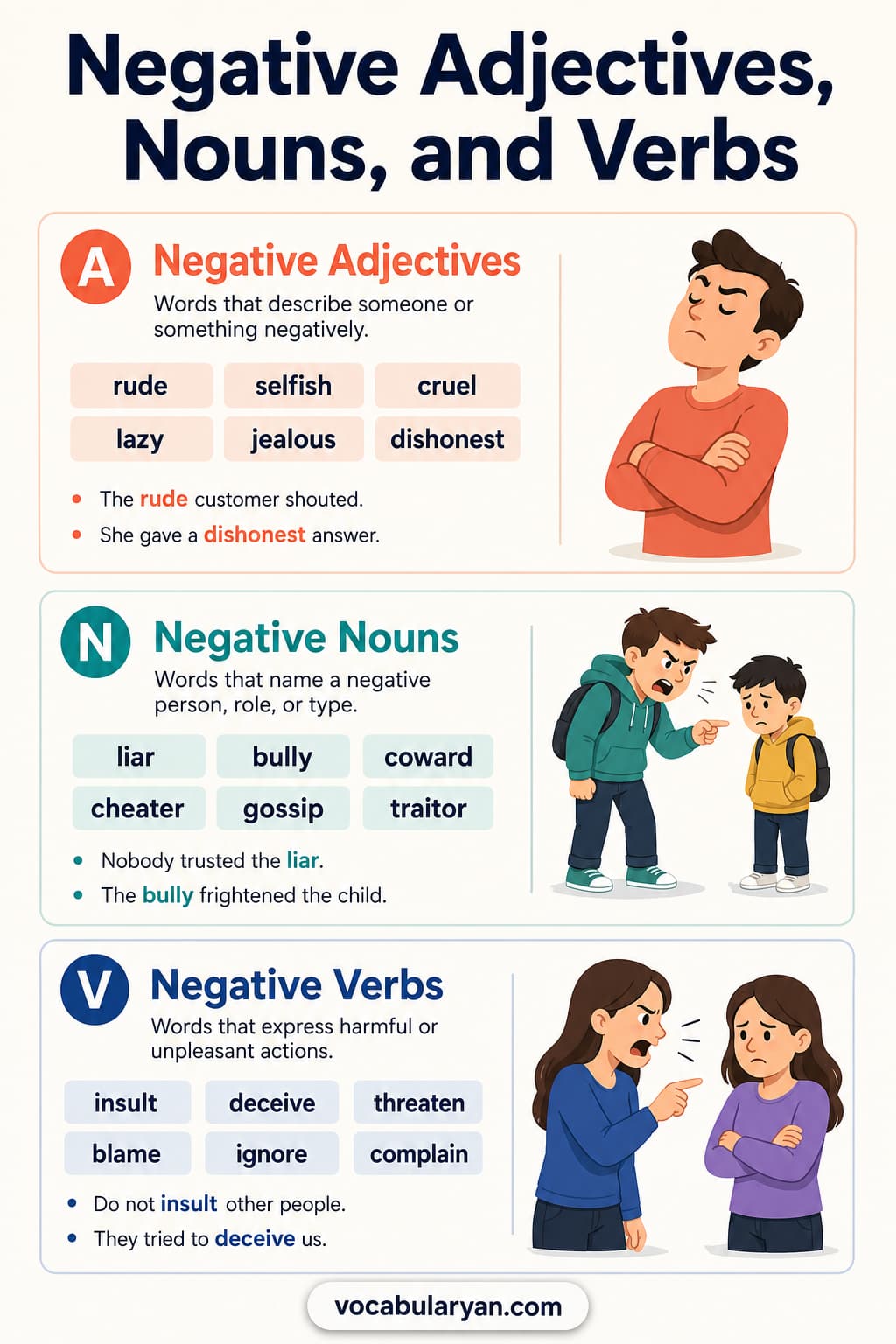
A negative word has an unfavorable meaning or connotation, such as cruel, failure, anxious, or reject. Negative words can be adjectives, nouns, or verbs. They differ from grammatical negatives such as not and never, which change a statement from affirmative to negative.
What are examples of negative words?
Common examples include angry for a feeling, arrogant for a personality trait, betray for an action, disastrous for an outcome, and filthy for a condition. The canonical A-Z inventory contains 560 distinct headwords.
What are negative words to describe a person?
Words such as rude, selfish, arrogant, manipulative, dishonest, and callous describe unpleasant traits or behavior. Choose a word that matches observable conduct rather than using a broad insult. A longer set appears in negative words to describe someone.
What is a negative connotation?
A negative connotation is an unfavorable association attached to a word beyond its literal definition. Stubborn and persistent both suggest not giving up, but stubborn carries criticism.
Can a word be negative in one context and neutral in another?
Yes. Dominant is often positive in a sentence about a strong performance, but it may sound negative when it describes controlling behavior. Context determines the judgment.
What is the difference between mild and strong negative words?
Mild words express limited criticism or discomfort, while strong words signal greater intensity or harm. Annoyed is milder than angry, and furious is stronger than both.