
"I think so" answers a yes-or-no question with a yes that is not certain: you believe the answer is yes, and you have not checked. That small doubt is what the other ways to say I think so change. "I believe so" keeps the same doubt but sounds more polite, "pretty sure" makes the yes stronger, and "I suppose so" makes it weaker. The everyday replies come first.
Common Ways to Say I Think So in Everyday English
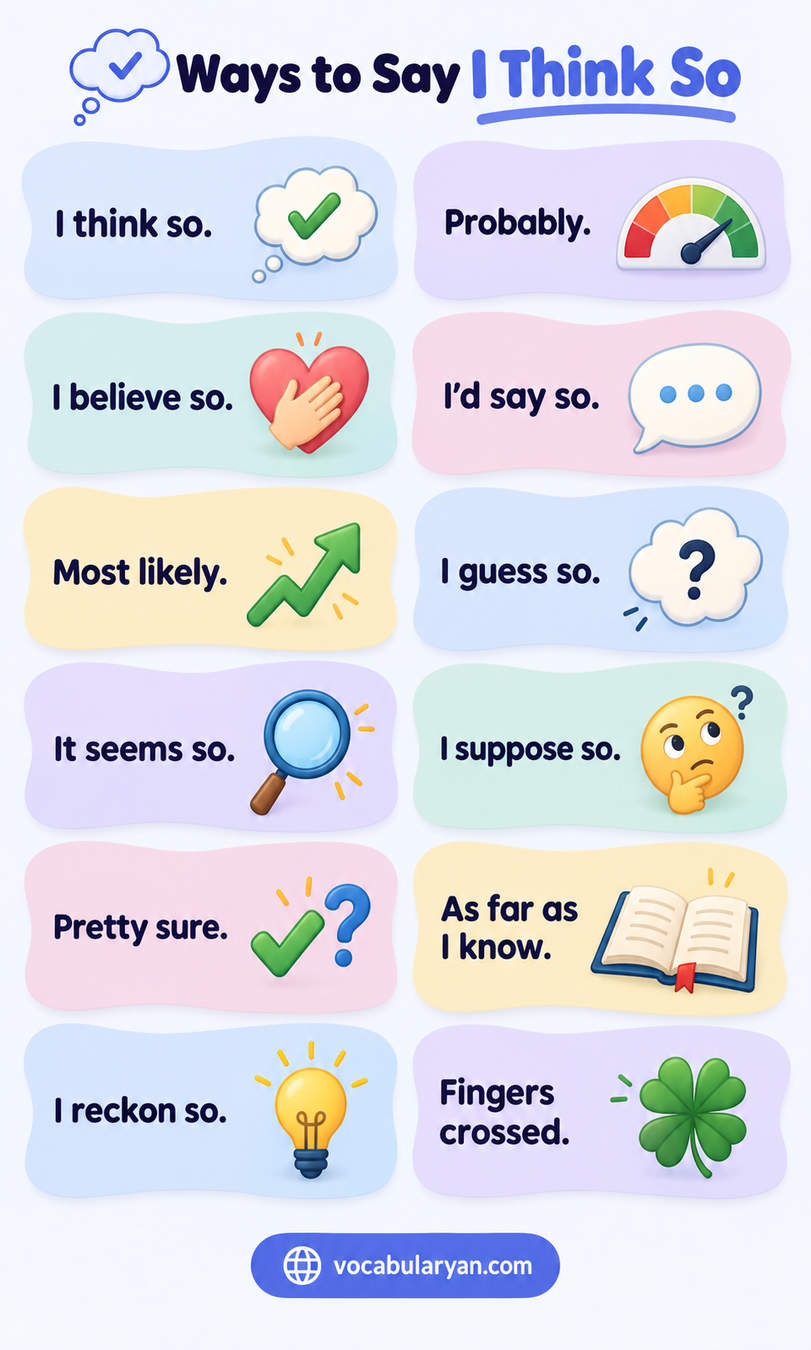
These six replies give a soft yes to almost any question, and each one fits a neighbour, a colleague, or a friend.
I believe so: the same soft yes as "I think so", one step more polite. It fits a stranger, a customer, or a colleague.
- Is the pharmacy open on Sundays? I believe so, until noon.
- I believe so, though the timetable changed last month.
- Has the parcel arrived? I believe so, there was a box by the door this morning.
I’d say so: a soft yes that comes from your own judgement rather than from a fact you checked. The reply fits questions about quality, size, or feeling.
- Is this enough food for eight people? I’d say so, with some left over.
- I’d say so, yes, the blue one suits you better.
- Was the meeting a success? I’d say so, everyone signed up for the trial.
I suppose so: yes with a shrug in it. The reply is used when you agree without much interest, so keep it away from an offer you are glad to receive.
- Can we take the bus instead of walking? I suppose so, if it’s still raining.
- I suppose so, though I’d rather stay in tonight.
- Is the old laptop worth fixing? I suppose so, it only needs a new battery.
I guess so: the American cousin of "I suppose so", and it fits friends and family. It sounds unsure and a little unwilling at the same time.
- Are you coming to the barbecue? I guess so, if I finish work on time.
- I guess so, but I’m not excited about it.
- Do these shoes go with the dress? I guess so, they’re the right colour.
Looks like it: a soft yes based on what you can see right now. The reply fits weather, traffic, and queues.
- Is the train delayed again? Looks like it, the board says twenty minutes.
- Looks like it, the lights are all off in the office.
- Did the paint dry overnight? Looks like it, it’s not sticky any more.
Seems like it: close to "looks like it", and it fits a yes you reached from small signs rather than from a direct look.
- Is Dan annoyed with me? Seems like it, he hasn’t replied all day.
- Seems like it, the café was full every time I walked past.
- Are they moving house? Seems like it, there’s a van outside again.
As far as I know: yes, with a warning that you have not checked recently. The reply fits facts that change, such as prices, dates, and who works where.
- Is Maria still the manager there? As far as I know, yes.
- As far as I know, the museum is free on Thursdays.
- Does the ten o’clock bus still run? As far as I know it does.
Say "I believe so" when you are unsure of the fact, and "I’d say so" when the question asks for your opinion.
Casual Ways to Say I Think So to Friends
Casual soft-yes replies are short, relaxed, and spoken with a smile, and they fit friends, family, and classmates.
Yeah, I think so: "I think so" with "yeah" in front, and the most common casual form in speech. It sounds friendly rather than doubtful.
- Is Priya coming tonight? Yeah, I think so, she said she’d be late though.
- Yeah, I think so, the film starts at nine.
- Did we leave the keys with your mum? Yeah, I think so, she had them at lunch.
Pretty sure: short for "I’m pretty sure", and it is a stronger yes than "I think so". It fits a fact you remember well.
- Is the gym open on bank holidays? Pretty sure, I went last Easter.
- Pretty sure the party’s at Kemi’s place, not Sam’s.
- Was that the last episode? Pretty sure, the credits went on for ages.
I reckon: a casual "I think so" in British, Australian, and Southern American English. It sounds warm.
- Will it rain later? I reckon, look at those clouds.
- I reckon we’ll be there by six if the traffic’s okay.
- Is that enough charcoal? I reckon so, we’ve only got four burgers.
Should be: a soft yes about something that is meant to happen. It fits plans, deliveries, and anything with a fixed time.
- Is the bakery open yet? Should be, it opens at seven.
- Should be fine, I checked the tyres yesterday.
- Will Tom be back for dinner? Should be, his shift ends at five.
Kinda: "kind of" said fast, and a yes with a little doubt about how true it is. It fits a question where the answer is yes and no at once.
- Do you like the new flat? Kinda, the kitchen’s tiny though.
- Kinda, I understood most of the lecture.
- Is she your girlfriend now? Kinda, we haven’t really talked about it.
Use "pretty sure" when your yes is strong, and "kinda" when the honest answer is half yes.
Formal Ways to Say I Think So at Work
Formal soft-yes replies fit a manager, a client, or a meeting, and each one names how you reached the yes.
I would say so: the full form of "I’d say so", and it fits a meeting or a call with a client. It gives a yes based on your own judgement.
- Is the budget realistic for a six-month project? I would say so, given last year’s costs.
- I would say so, the team has handled bigger launches.
- Will the design pass the safety review? I would say so, it meets every standard we tested.
To the best of my knowledge: a formal "as far as I know", and it fits facts you were told rather than facts you checked yourself. It goes at the start of the sentence.
- Has the supplier been paid? To the best of my knowledge, yes, on the fifteenth.
- To the best of my knowledge, no one has raised a complaint.
- Is the licence still valid? To the best of my knowledge it runs until March.
My understanding is that yes: a careful yes that names its source as what you were told. It fits a question from a manager about work you did not do yourself.
- Is the contract signed? My understanding is that yes, legal returned it on Monday.
- My understanding is that yes, the client has approved the new dates.
- Are the new hires starting in June? My understanding is that yes, all three of them.
I’m inclined to think so: a very formal soft yes, and it fits a senior person giving an opinion in a meeting. It sounds thoughtful rather than doubtful.
- Should we delay the launch? I’m inclined to think so, the test results are not ready.
- I’m inclined to think so, though I’d like to hear the finance view.
- Is the merger good for the staff? I’m inclined to think so, in the long run.
I expect so: a formal yes about something you expect to happen. It fits a question about a deadline, an arrival, or an outcome.
- Will the report be ready by Thursday? I expect so, the last section is being edited now.
- I expect so, the courier has been reliable all year.
- Is the director joining the call? I expect so, her assistant confirmed this morning.
As far as I can tell: a formal yes based on what you have looked at so far. It fits data, documents, and anything you are still checking.
- Is the data complete? As far as I can tell, yes, all twelve regions are in.
- As far as I can tell, the figures match the invoice.
- Has the bug been fixed? As far as I can tell, the error hasn’t come back since the update.
"I guess so" is a friendly reply among friends, and it is the wrong reply to a request from a manager, because it sounds unwilling.
- Can you cover the front desk on Friday? I guess so. ❌
"I guess so" means "yes, but I don’t want to", so a manager hears a complaint rather than an agreement.
- Can you cover the front desk on Friday? Yes, that works, I’ll move my two o’clock. ✅
Every soft-yes reply on this page belongs to one of five levels, and the levels from slang to very formal run like this.
| Level | Replies | Who it fits |
|---|---|---|
| Slang | Prolly, probs, kinda, sounds about right | Close friends in texts |
| Casual | I guess so, pretty sure, looks like it, I reckon | Friends, family, relaxed colleagues |
| Neutral | I think so, I believe so, as far as I know | Anyone, in speech and in writing |
| Formal | I would say so, to the best of my knowledge, I expect so | Managers, clients, work emails |
| Very formal | I’m inclined to think so, that would appear to be the case | Senior meetings, reports, legal replies |
Give a manager "I believe so" or "I expect so", and keep "I guess so" for friends.
Ways to Say I Think So in an Email
A written soft yes needs a reason or a promise to check, because the reader cannot hear your voice.
I believe that is correct: the standard written form of "I think so" in a reply to a question about a fact. It fits a client, a colleague, or a customer.
- I believe that is correct, the invoice was sent on 3 May.
- Yes, I believe that is correct, though I will confirm with the warehouse.
- I believe that is correct, and I have attached the original order for reference.
As far as I’m aware, yes: a written yes with a warning that the fact was true the last time you checked.
- As far as I’m aware, yes, the office is open on the bank holiday.
- As far as I’m aware, yes, Mr Diaz still handles the account.
- As far as I’m aware, yes, but the policy was updated recently, so please check the portal.
That should be the case: a written yes about something that is meant to be true. It fits rules, systems, and schedules.
- That should be the case, the discount applies to all orders over fifty pounds.
- That should be the case, though the system sometimes takes a day to update.
- Yes, that should be the case for every account opened after January.
I expect so, but I will confirm: a yes with a promise attached, and it fits any question where the reader needs to act on your answer.
- I expect so, but I will confirm with the venue this afternoon.
- I expect so, but I will confirm and reply by the end of the day.
- Is the room free on Tuesday? I expect so, but I will confirm with facilities.
Yes, I think so, though I’d like to double-check: the plain form, kept in an email when you write to someone you know well. The second half keeps the yes honest.
- Yes, I think so, though I’d like to double-check the dates before I send them out.
- Yes, I think so, though I’d like to double-check with Lena first.
- Yes, I think so, though I’d like to double-check the price list from last year.
Write a soft yes in an email with a reason or a date for checking, because a bare "I think so" leaves the reader waiting.
Ways to Say I Think So When You Are Almost Sure
These replies leave a little doubt, but the yes in each one is much stronger than "I think so".
I’m pretty sure: the most common stronger form, and it fits friends, family, and relaxed colleagues.
- I’m pretty sure the shop closes at nine on Fridays.
- Is that Ravi’s car? I’m pretty sure, it has the same dent.
- I’m pretty sure we’ve met before, at Leo’s wedding.
Almost certainly: yes with the doubt shrunk to almost nothing. It fits a fact you know well and have not checked today.
- Will the flight be full? Almost certainly, it’s the last one before the holiday.
- Almost certainly, the bank is closed on Sundays.
- Is that the right platform? Almost certainly, the sign says London.
I’d bet on it: a casual strong yes that compares the answer to a bet you expect to win. It fits friends and sport.
- Will Jess be late? I’d bet on it, she’s never on time.
- I’d bet on it, the price goes up in January every year.
- Is the café still there? I’d bet on it, it’s been open since I was a kid.
The scale from doubt to confidence runs like this: "I suppose so", then "I think so", then "pretty sure", then "almost certainly".
Say "pretty sure" when you remember the fact well, and keep "almost certainly" for the moment when only a check is missing.
Ways to Say I Think So When You Have Real Doubt
These replies lean towards yes and make the doubt bigger, so the listener knows not to rely on the answer.
I’m not sure, but I think so: the honest form, and the first half warns the listener before the yes arrives.
- Is the library open late tonight? I’m not sure, but I think so.
- I’m not sure, but I think so, the sign said until nine.
- Does the bus stop near the hospital? I’m not sure, but I think so.
Possibly: a yes with real doubt, and it is close to a coin toss. The reply fits a question you cannot answer well.
- Will you need a visa? Possibly, it depends on how long you stay.
- Possibly, though I haven’t seen the latest rules.
- Is the road closed for the parade? Possibly, it was last year.
I hope so: a yes you want to be true rather than a yes you know. It fits plans, results, and good news.
- Will the rain stop before the match? I hope so, we’ve waited all week.
- I hope so, the doctor said the results look fine.
- Is the package coming today? I hope so, I need it for the party.
Don’t quote me, but yes: a yes with a request not to repeat it, and it fits friends and colleagues when you are guessing.
- Is Omar leaving the company? Don’t quote me, but yes, I heard he’s got an offer.
- Don’t quote me, but yes, the deadline moved to Friday.
- Was the old owner a musician? Don’t quote me, but yes, there were photos of a band on the wall.
"Maybe" is the one reply here that is not a yes at all, because it gives yes and no the same weight.
- Is the deadline this Friday? (to a client) Maybe. ❌
A client hears "maybe" as "I don’t know", so the honest soft yes names the doubt and a time for checking.
- Is the deadline this Friday? I believe so, and I’ll confirm by noon. ✅
Say "I hope so" when you want the answer to be yes, and "possibly" when the doubt is real.
Ways to Say I Think So About a Fact
A soft yes about a fact names where the fact came from: your memory, something you read, or something you were told.
If I remember rightly: a soft yes from memory, and it fits dates, names, prices, and directions. It goes before or after the fact.
- Is the museum closed on Mondays? If I remember rightly, yes.
- If I remember rightly, the recipe uses brown sugar, not white.
- Was it 2019 when they moved? If I remember rightly, it was the spring.
Last I heard: a soft yes about news that changes. It fits people, jobs, and plans.
- Is Nadia still in Berlin? Last I heard, yes.
- Last I heard, the shop was still for sale.
- Are they getting married in June? Last I heard, the date was the twelfth.
I believe it is: a polite soft yes to a question with "is it", and the "it" repeats the question.
- Is the water safe to drink? I believe it is, the hotel said so.
- I believe it is, though the label is in Portuguese.
- Is the bridge open again? I believe it is, the buses are using it.
Name the source of your yes, because "if I remember rightly" and "last I heard" both warn the listener to check.
Ways to Say I Think So About a Plan
A soft yes about a plan says the plan is on, and it leaves room for the plan to change.
That’s the plan: yes, the plan exists, and it sounds warm and a little playful. It fits friends and colleagues.
- Are you driving up on Friday? That’s the plan, if the car is fixed.
- That’s the plan, we leave at six and stop for breakfast.
- Still moving in September? That’s the plan, the lease starts on the first.
I should be: a soft yes about your own movements, and it fits any question with "will you be".
- Will you be at the game? I should be, work finishes at four.
- I should be home by seven if the train’s on time.
- Are you free next weekend? I should be, let me check with Ana.
All being well: a British soft yes that means "yes, if nothing goes wrong", and it fits travel and big plans.
- Will you make it to the wedding? All being well, yes.
- All being well, the roof will be finished by Friday.
- Are you flying out on Monday? All being well, the flight’s at ten.
Unless something comes up: yes, with a warning that plans change. It fits friends and family.
- Are you coming to lunch on Sunday? Unless something comes up, yes.
- Unless something comes up, I’ll be there at eight.
- Still on for the walk? Unless something comes up at work.
Reply "that’s the plan" to a friend, and "I expect so" to a manager, because both give a yes that leaves room for change.
Ways to Say I Think So in a Text
Text replies to a yes-or-no question are short, and spelling and punctuation do the work of your voice.
Yep, I think so: the friendliest text form, and "yep" makes the yes warmer than "yes".
- Is the café still open? Yep, I think so, till ten.
- Yep, I think so, Sam said he booked it.
- Do we need tickets? Yep, I think so, I’ll check the site.
Prolly: a text spelling of "probably", and it fits close friends only.
- You coming tonight? Prolly, depends on work.
- Prolly, is Jay driving?
- Will the shop have milk this late? Prolly, the big one does.
Pretty sure 👍: "pretty sure" with a thumbs-up, and the emoji makes the yes friendly rather than cold.
- Is it the 5th? Pretty sure 👍
- Pretty sure 👍 she said the red door.
- Parking is free after six, right? Pretty sure 👍
Should be!: a text soft yes about a plan or a delivery, and the exclamation mark makes it warm.
- Will you be back before the film? Should be! Train’s at five.
- Should be! I’ll text when I’m close.
- Does the park have toilets? Should be! There’s a café by the gate.
Think so, will check: a soft yes with a promise, and it fits any text where the other person needs the real answer.
- Is the meeting at ten? Think so, will check and let you know.
- Think so, will check the email when I get to my desk.
- Does the hotel take dogs? Think so, will check before we book.
Keep a text soft yes to three words, and add "will check" when the other person needs to rely on it.
Ways to Say I Think So to a Group
A group soft yes speaks for the room or asks the room to correct you, and it fits meetings, classes, and group chats.
I think we all agree: a soft yes that speaks for the whole group, and it fits the end of a discussion.
- I think we all agree that the June date is too early.
- I think we all agree, so shall we move on?
- Is the new logo better? I think we all agree it is.
That’s my understanding, unless anyone knows otherwise: a careful yes that leaves room for the group to correct it, and it fits a meeting or a work chat.
- Is the client happy with the draft? That’s my understanding, unless anyone knows otherwise.
- That’s my understanding, unless anyone knows otherwise, the launch is still on the ninth.
- That’s my understanding, unless anyone knows otherwise, so I’ll book the room.
Sounds right to me: a casual group yes, and it fits a chat where one person has answered and you agree.
- Six people and two cars? Sounds right to me.
- Sounds right to me, I’ll bring the cake.
- Meet at the station at nine? Sounds right to me.
I think that’s right, isn’t it?: a soft yes with a question at the end, and it asks the group to confirm.
- The report is due on Monday, I think that’s right, isn’t it?
- I think that’s right, isn’t it? The bus leaves from Bay 4.
- We agreed on ten per person, I think that’s right, isn’t it?
Say "I think we all agree" only when the room has answered, and add "unless anyone knows otherwise" when you want to be corrected.
Regional Ways to Say I Think So
Each English-speaking country keeps a few soft-yes replies of its own, and each one fits its home country best.
British Ways to Say I Think So
I should think so: a British soft yes, and it is used in two ways. Said flat, it means "I think so"; said with force, it means "I should hope so".
- Will the plumber come today? I should think so, he said before four.
- I should think so, the shop’s been there for years.
- Are they paying you for the extra hours? I should think so, too!
I dare say: an older British soft yes that means "I think so, though I have no proof", and it fits older speakers and polite speech.
- Will the shop be busy? I dare say, it’s the first day of the sale.
- I dare say you’re right about the price.
- Does he miss the old house? I dare say he does.
I’d imagine so: a soft yes based on what makes sense rather than on a fact, common across Britain.
- Will the roads be icy tonight? I’d imagine so, it’s below zero.
- I’d imagine so, most places close early on Christmas Eve.
- Do they deliver this far out? I’d imagine so, the van comes past every day.
American Ways to Say I Think So
I guess: "I guess so" with the "so" dropped, and it fits friends and family across the United States.
- Are we done here? I guess, unless you want another coffee.
- I guess, though I’d have picked the other one.
- Is this the right exit? I guess, the sign said downtown.
I’d say yeah: a relaxed American soft yes for friends, and "yeah" keeps it casual.
- Is that enough gas to get there? I’d say yeah, it’s only forty miles.
- I’d say yeah, the game starts at seven.
- Do you think she’ll say yes? I’d say yeah, she’s been smiling all week.
Sounds about right: an American soft yes to a number, a time, or a story you cannot check but believe.
- Twenty dollars for parking? Sounds about right for downtown.
- Sounds about right, the trip took us four hours too.
- He says he ran ten miles? Sounds about right, he trains every morning.
Australian and Irish Ways to Say I Think So
Reckon so: the Australian short form of "I reckon so", said to friends, workmates, and strangers alike.
- Will the surf be up tomorrow? Reckon so, the wind’s changing.
- Reckon so, the pub does food till nine.
- Is the road open after the flood? Reckon so, the trucks are getting through.
Yeah, I’d say so: the most common Irish soft yes, and "I’d say" opens most Irish guesses.
- Is the match still on with this rain? Yeah, I’d say so.
- Yeah, I’d say so, the shop opens at eight.
- Will Ciara be at the party? Yeah, I’d say so, she loves a party.
Sure, I suppose: an Irish soft yes with a shrug, and "sure" at the front is an Irish habit rather than a strong yes.
- Will we go for one drink? Sure, I suppose, just the one.
- Sure, I suppose it’ll be grand.
- Is the old road quicker? Sure, I suppose it is, on a Sunday.
Use "I should think so" in Britain, "I guess" in the United States, "reckon so" in Australia, and "I’d say so" in Ireland.
Slang Ways to Say I Think So
Slang soft-yes replies belong to close friends your own age, and they sound wrong in any message a manager reads.
Yeah, probs: "yeah" plus "probs", the British slang soft yes in speech and text.
- You staying for the second half? Yeah, probs.
- Yeah, probs, if the rain holds off.
- Is Dev bringing his guitar? Yeah, probs, he never leaves it at home.
Chances are: a slang soft yes that means "the odds say yes", and it fits friends and relaxed colleagues.
- Will the shop be sold out by noon? Chances are, it was last time.
- Chances are she’s already left.
- Is the film any good? Chances are, the reviews were great.
Keep "probs" and "ten to one" for friends, and give a manager "I believe so".
Funny Ways to Say I Think So
Funny soft-yes replies are for friends who know your humour, and each one makes a joke of the guessing.
Signs point to yes: a joke reply borrowed from a fortune-telling toy, and it fits a silly question between friends.
- Will there be cake at the party? Signs point to yes.
- Signs point to yes, Nan’s been baking since eight.
- Is he going to ask her out? Signs point to yes, he’s bought a new shirt.
Last time I checked: a teasing yes to a question with an obvious answer, and it fits friends and family.
- Are you still my brother? Last time I checked.
- Last time I checked, the sea was still wet.
- Is the shop open on a Tuesday? Last time I checked, yes.
I’ll go out on a limb and say yes: a joke reply to a question where yes is the only real answer, and the joke is the fake bravery.
- Will Grandad want a cup of tea? I’ll go out on a limb and say yes.
- I’ll go out on a limb and say yes, the cat wants feeding.
- Does Leo want to come to the pizza place? I’ll go out on a limb and say yes.
Save the funny replies for a question that is half a joke, because "signs point to yes" to a serious question sounds rude.
When I Think So Sounds Unsure and a Firm Answer Is Needed
The trap with "I think so" is that it means "I did not check", so some questions need a firm yes, a firm no, or a promise to check.
Yes, I checked: the firm yes for a question about your own work, and it says the fact was tested, not remembered.
- Did you send the invoice? Yes, I checked, it went out at ten.
- Yes, I checked, the door is locked and the alarm is on.
- Is the file backed up? Yes, I checked this morning.
Let me check and come back to you: the honest reply when you are not sure and the listener needs the truth. It fits work, shops, and calls.
- Is the room booked for Tuesday? Let me check and come back to you in ten minutes.
- Let me check and come back to you, the system’s been slow today.
- Does the policy cover water damage? Let me check and come back to you by email.
I’m not certain, so I’d rather not guess: a firm refusal to give a soft yes, and it fits money, safety, and legal questions.
- Is the wiring safe to use? I’m not certain, so I’d rather not guess, call an electrician.
- I’m not certain, so I’d rather not guess, the accountant will know.
- Can I take both tablets together? I’m not certain, so I’d rather not guess, ask the pharmacist.
The trap opens when a question asks about something you did yourself, because "I think so" then means you did not check.
- Did you lock the back door? I think so. ❌
Your own action is a fact you can check, so the reply is a firm yes, or an offer to go and look.
- Did you lock the back door? Yes, I locked it at six. ✅
The decision path is short: a question about your own action gets a firm answer, a question about a fact you were told gets a soft yes.
Give a firm "yes" or "no" for anything you did yourself, and keep "I think so" for facts you were told.
More Everyday English Phrases
- Other Ways to Say I Disagree
- Other Ways to Say I Don’t Think So
- Other Ways to Say I Agree
- Other Ways to Say I Understand
FAQs
The closest one is "I believe so", because it keeps the same soft yes and works with anyone. "I’d say so" fits a question about your opinion, "pretty sure" makes the yes stronger, and "I suppose so" makes it weaker. Friends also hear "yeah, I think so", "looks like it", and "I reckon".
"I believe so" is the standard formal form, and "I would say so" fits a meeting or a client call. For a fact you were told rather than checked, "to the best of my knowledge" and "my understanding is that yes" name the source of the answer. "I’m inclined to think so" is the most formal of the set and fits a senior speaker in a meeting.
"Think so" and "yep, I think so" are the most common text forms, and both fit friends. "Pretty sure" with a thumbs-up gives a stronger yes, and "prolly" or "probs" gives a slang yes to close friends. When the other person needs to rely on the answer, "think so, will check" is the honest form.
"Yes, I think so" means the answer is yes and the speaker is not fully certain. The "yes" comes first, so it sounds a little stronger than "I think so" alone, and it fits a fact you remember but have not checked today. A question about your own action, such as "did you send it?", needs a plain "yes" instead.
"I think so too" is the reply that agrees with an opinion, such as "the film was too long". The short forms are "me too", "same here", and "so do I", and all three fit friends and colleagues. In a formal setting the reply is "I agree" or "I share that view".
The reply depends on how much you need the answer. When the answer is enough, "great, thanks" or "okay" closes the question. When you need a firm answer, ask "can you check?" or "are you sure?", and the other person will confirm or go and look.
"I suppose so", "I guess so", and "possibly" are the softest, and each one warns the listener not to rely on the answer. "I’m not sure, but I think so" names the doubt before the yes, and "I hope so" gives a yes you want rather than a yes you know. "Don’t quote me, but yes" fits friends when you are guessing.