
"I love you" is said to a partner, a parent, a child, and a best friend, and the same three words fit all four. The other ways to say I love you change with the person. "I’m in love with you" belongs to a partner alone, "love ya" belongs to a friend, and "I love you to the moon and back" belongs to a child. The phrases for a partner come first.
Romantic Ways to Say I Love You to a Partner
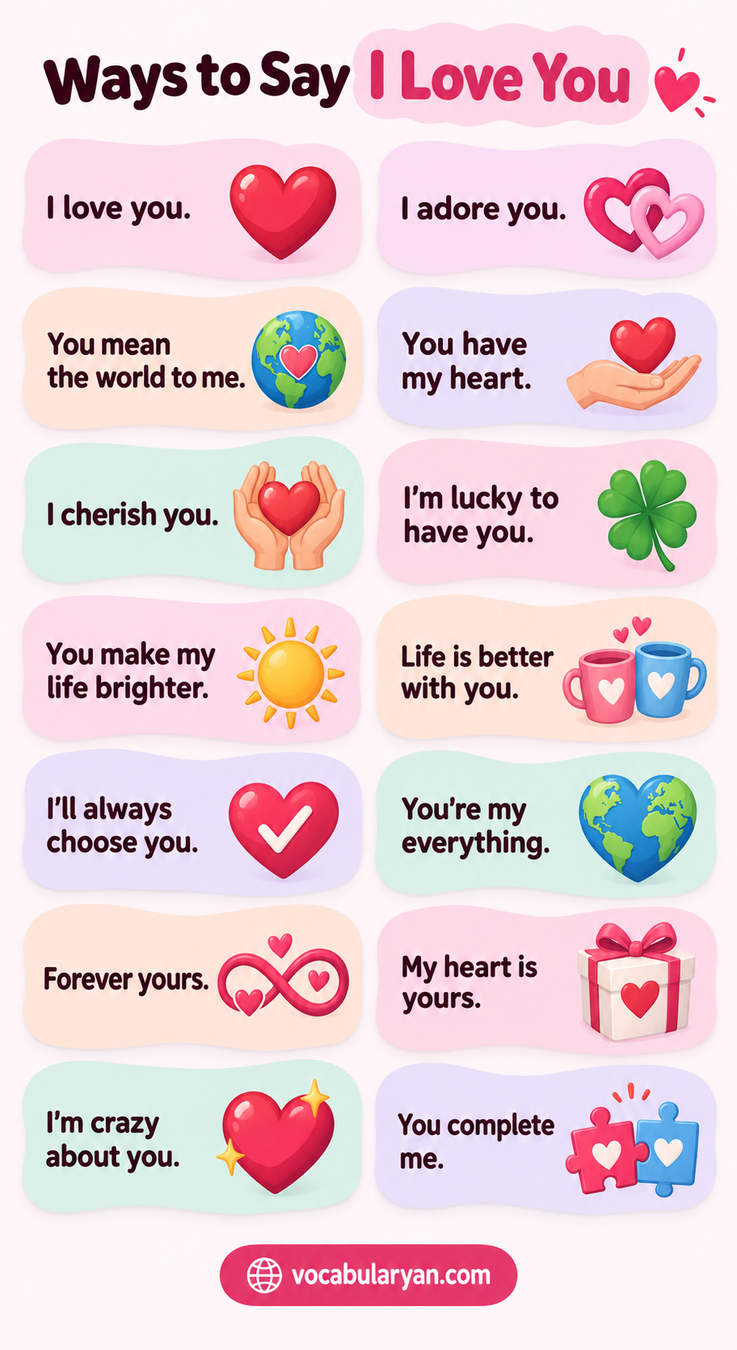
These phrases are for a boyfriend, a girlfriend, or a partner, and each one says a little more than the three words alone.
I love you so much: the most common way to make "I love you" stronger, and it fits a partner at any stage after the first "I love you".
- I love you so much, you know that, right?
- I just wanted to say I love you so much before you get on the plane.
- After ten years, I love you so much more than on the day we met.
I’m in love with you: romantic love, and nothing else. It says that your feelings have moved past friendship, and it is never said to a parent, a child, or a friend.
- I’m in love with you, and I have been for months.
- I didn’t plan this, but I’m in love with you.
- She looked at him across the table and said, "I’m in love with you."
I adore you: warmer and a little more tender than "I love you", and it fits a partner in a quiet moment or in a card.
- I adore you, and I always will.
- Come here, I adore you, you silly man.
- The last line of the letter was short: "I adore you."
You’re the love of my life: one of the strongest lines in English, and it fits a long relationship, a wedding speech, or an anniversary.
- You’re the love of my life, and I’m so glad I said yes.
- Twenty years on, and you’re the love of my life still.
- I don’t say it enough, but you’re the love of my life.
You mean the world to me: it says how much the person means to you, and it fits a partner, a close friend, or a family member. With a partner it sounds romantic, and with a friend it sounds grateful.
- You mean the world to me, and I’d do anything for you.
- Thank you for sitting with me at the hospital, you mean the world to me.
- I know we argue, but you mean the world to me.
I’m so lucky to have you: thanks and love in one line, and it fits a partner after a hard week or a kind act.
- I’m so lucky to have you, thank you for picking up the kids again.
- Every morning I wake up and think, I’m so lucky to have you.
- I’m so lucky to have you in my corner.
You’re my everything: a very strong line, and it fits a partner or a spouse. To a new partner it sounds too much, so save it for a relationship that is already deep.
- You’re my everything, and I don’t want to imagine life without you.
- He wrote it on the cake in blue icing: "You’re my everything."
- I mean it, Ana, you’re my everything.
I love you more every day: it says that the love is growing, and it fits an anniversary, a long-distance call, or the end of a hard year together.
- I love you more every day, even on the days we don’t talk.
- Happy anniversary, Sam, I love you more every day.
- It’s strange, but I love you more every day than the day before.
Say "I love you so much" any day of the week, and keep "you’re the love of my life" for a moment that deserves it.
Ways to Say I Love You to Your Husband or Wife
A married couple say "I love you" every day, so these phrases keep it fresh after years together.
I love you more: the playful answer to "I love you", and between a husband and wife it turns into a small game with no winner.
- I love you. I love you more.
- She texted "I love you more" before he’d even replied.
- I love you more, and that’s final.
You’re my best friend: it says that the marriage is friendship as well as love, and it is common in wedding speeches and anniversary cards.
- Ten years married, and you’re my best friend still.
- You’re my best friend, and I’m so glad I get to come home to you.
- He said it in front of everyone: "You’re my best friend, Meera."
I’d marry you all over again: a line for an anniversary or a quiet evening, and it says that the choice was right.
- I’d marry you all over again, same church, same song.
- If you asked me today, I’d marry you all over again.
- Even after that holiday, I’d marry you all over again.
I love our life: it names the home, the routine, and the family you have built together, and it fits an ordinary evening rather than a big day.
- I love our life, you know, even the messy bits.
- Sitting here with you and the dog, I love our life.
- I love our life, and I don’t want to change a thing.
Tell your husband or wife "you’re my best friend" out loud, because after years together it is the line that gets forgotten.
Ways to Say I Love You in a New Relationship
Before the full three words, these phrases say that your feelings are real without saying "love" too soon.
I really like you: the standard line in the first weeks of dating, and it says that you want the relationship to continue.
- I really like you, and I’d like to see you again.
- I don’t want to rush anything, but I really like you.
- Just so you know, I really like you, Dan.
I’m falling for you: a step past "like" and a step before "love", and it fits the moment your feelings start to change.
- I’m falling for you, and it’s scaring me a little.
- I think I’m falling for you, is that okay?
- She said it on the walk home: "I’m falling for you."
I’m crazy about you: strong feelings said in a light way, and it fits a new relationship or a text after a good date.
- I’m crazy about you, in case that wasn’t obvious.
- Last night was perfect, I’m crazy about you.
- He grinned and said, "I’m crazy about you, you know."
I can’t stop thinking about you: it says that the person is on your mind, and it fits a text the morning after a date.
- I can’t stop thinking about you since Saturday.
- Sorry for the late message, I can’t stop thinking about you.
- I can’t stop thinking about you, when can I see you again?
I have feelings for you: the careful, honest form, and it fits a moment when you are not sure the other person feels the same.
- I have feelings for you, and I needed to tell you.
- I know we said we’d stay friends, but I have feelings for you.
- I have feelings for you, and I hope that doesn’t change anything.
Use "I really like you" first, "I’m falling for you" next, and leave "I love you" for the moment you are sure.
Ways to Say I Love You to Your Mum or Dad
These phrases fit a parent, and most of them mix love with thanks for the years of care.
Love you, Mum: the everyday form between a parent and a grown child, said at the door, at the end of a call, or in a text. "Mom" is the American spelling.
- Love you, Mum, I’ll ring you on Sunday.
- Love you, Mum, thanks for the soup.
- Bye, love you, Mum, say hi to Dad.
Thank you for everything: thanks that means love, and it fits a birthday, a graduation, or a wedding speech about a parent.
- Thank you for everything, Dad, I wouldn’t be here without you.
- Thank you for everything you did for us when money was tight.
- I don’t say it enough, so thank you for everything.
You’re the best dad: direct praise, and it fits a card, a text on Father’s Day, or a hug after a favour.
- You’re the best dad, and I mean it.
- Happy birthday, you’re the best dad a kid could ask for.
- Thanks for driving all that way, you’re the best dad.
I’m so lucky to have you as my mum: a full sentence for a card or a speech, and it fits a parent who has had a hard year.
- I’m so lucky to have you as my mum, happy Mother’s Day.
- Every day I think, I’m so lucky to have you as my mum.
- I’m so lucky to have you as my mum, and the kids feel the same.
Say "love you, Mum" at the end of every call, because parents count those two words.
Ways to Say I Love You to a Child
Love to a child is said big and said every day, and these phrases are the ones children hear at bedtime and at the school gate.
I love you to the moon and back: the classic line for a young child, and it fits bedtime, a card, or a hug at the door.
- Night night, I love you to the moon and back.
- She kissed his forehead and whispered, "I love you to the moon and back."
- I love you to the moon and back, now go and brush your teeth.
I love you no matter what: it says that the love does not depend on behaviour or results, and it fits a child after a bad day or a bad mark.
- I love you no matter what, even when you break the window.
- You didn’t pass, and that’s okay, I love you no matter what.
- I love you no matter what, you know that, don’t you?
I’m so proud of you: praise that a child hears as love, and it fits a school play, a match, or a hard thing done well.
- I’m so proud of you for telling the truth.
- You did it! I’m so proud of you.
- I’m so proud of you, and Grandma will be too.
Love you, sweetheart: an endearment plus the short form, and it fits a young child at bedtime or a teenager on the way out of the door. "Sweetheart" is used by both parents.
- Love you, sweetheart, sleep well.
- Love you, sweetheart, text me when you get there.
- Off you go, love you, sweetheart.
Tell a child "I’m so proud of you" as many times as "I love you", because children hear the two as the same thing.
Ways to Say I Love You to a Friend
Friends say "I love you" too, and these phrases keep the meaning warm without sounding romantic.
Love you, man: the casual American form between male friends, and the "man" keeps it light. "Love you, mate" is the British and Australian form.
- Love you, man, thanks for tonight.
- Love you, man, drive safe.
- He hugged him at the airport and said, "Love you, man."
Love ya: the shortest casual form, said or texted to a close friend at the end of a chat.
- Okay, gotta go, love ya!
- Love ya, see you Friday.
- Thanks for listening, love ya.
You’re like a sister to me: it names the friend as family, and it fits a long friendship. "Brother" is the male form.
- You’re like a sister to me, you know that.
- Twenty years of friendship, and you’re like a sister to me.
- You’re like a sister to me, so of course I’ll be there.
I’m always here for you: love as a promise, and it fits a friend in trouble. It means "call me at any hour".
- I’m always here for you, whatever happens with the job.
- You don’t have to explain, I’m always here for you.
- I’m always here for you, day or night.
I appreciate you: thanks and love in one, and it is common between friends and colleagues who help each other. It sounds warm without sounding romantic.
- I appreciate you, Jo, thanks for covering my shift.
- Just wanted to say I appreciate you.
- I appreciate you more than you know.
The line to avoid with a friend is "I’m in love with you", because it changes the friendship into a romance.
- I’m in love with you, Priya, thanks for helping me move. (to a friend) ❌
"In love with" means romantic love, so to a friend the same warmth takes "love you" or "I appreciate you".
- Love you, Priya, thanks for helping me move. ✅
Say "love you" or "love you, man" to a friend, and keep "in love with" for a partner.
Ways to Say I Love You to Family
These phrases fit a whole family at once, or a relative you do not see every week.
Love you all: the group form, said at the end of a family call or a family chat message.
- Bye, everyone, love you all!
- Thanks for a lovely weekend, love you all.
- Love you all, see you at Christmas.
Give my love to: the way to send love to someone who is not there, and it goes at the end of a call or a letter.
- Give my love to Grandad, tell him I’ll visit soon.
- Give my love to the kids.
- Take care, and give my love to your mum.
Lots of love: the standard warm closing for a message or a card to family, and it is also said out loud on a call.
- Lots of love from all of us here.
- Happy birthday, Auntie Rose, lots of love.
- Okay, I’ll let you go, lots of love, bye.
Use "love you all" at the end of a family call, and "give my love to" for anyone who is not on the line.
Ways to Say I Love You in a Text
A love text is short, and the spelling and the kisses at the end do the work of your voice.
Ily: the letters of "I love you", used between teenagers and close friends in texts only. Never say it out loud and never write it to a parent.
- ily, see you tmrw
- thanks for today ily
- ily more, night
Love u: the text spelling of "love you", used with a partner, a friend, or a sibling in a quick message.
- Love u, home in ten.
- Good luck today, love u.
- Love u, don’t forget the keys.
Love you, night x: the standard last text of the day to a partner, and the "x" at the end is a kiss. Two or three x’s make it warmer.
- Love you, night x
- Sleep well, love you, night xx
- Early start tomorrow, love you, night x
Thinking of you: love in a text on a hard day, and it fits a partner, a parent, or a friend before an exam or an operation.
- Thinking of you today, good luck in there.
- Thinking of you, call me after.
- Just thinking of you, no reason.
Text "love you" plus an x to a partner, and keep "ily" for friends your own age.
Ways to Say I Love You in a Card or Letter
A card ends with a closing line before your name, and these phrases are written, not spoken.
All my love,: the warmest standard closing for a card to a partner, a parent, or a child, and it goes on its own line before your name.
- Happy anniversary, darling. All my love, Tom
- Get well soon, Mum. All my love, Sarah
- I hope the new house is everything you wanted. All my love, Nan
With love,: a softer closing that fits a friend, a relative, or a colleague you are close to.
- Congratulations on the baby! With love, the whole team
- Thank you for the flowers. With love, Ruth
- Happy birthday, Uncle Pete. With love, Kemi and the boys
Love always,: a closing for a partner or a family member, and it says that the love does not change.
- Twenty years and counting. Love always, Ben
- Miss you every day, Grandad. Love always, Ellie
- Thank you for being you. Love always, Mum
With all my heart,: the strongest written closing, and it fits a wedding card, an anniversary letter, or a note in a ring box.
- I choose you, today and every day. With all my heart, Maya
- Happy fiftieth anniversary, Mum and Dad. With all my heart, your daughter
- You are my whole world. With all my heart, J
A written closing sounds strange out loud, so keep it on paper.
- Bye, Mum, all my love! (said at the door) ❌
"All my love" is a written closing, so at the door the same feeling takes "love you".
- Bye, Mum, love you! ✅
Close a card with "all my love" for family and "with love" for a friend.
Ways to Say I Love You on the Phone
"I love you" on a call comes right before "bye", and these phrases are the ones that end a call between people who love each other.
Love you, bye: the most common end to a family call in English, said as one breath. The "bye" is part of the phrase.
- Okay, love you, bye.
- Right, I’m going, love you, bye!
- Speak tomorrow, love you, bye.
Love you, talk soon: a warmer end that promises the next call, and it fits a partner or a parent in another city.
- Love you, talk soon, Dad.
- I’ll let you sleep, love you, talk soon.
- Love you, talk soon, and good luck tomorrow.
I love you, take care: it adds a small worry to the love, and it fits a call to someone who is ill, travelling, or far from home.
- I love you, take care, and don’t work too hard.
- I love you, take care of yourself out there.
- Bye, Grandma, I love you, take care.
End a family call with "love you, bye", because in English the two words go together.
Ways to Say I Love You in a Few Words
The short forms fit every day, and each one is the full phrase cut down to two words or one.
Love you: "I love you" without "I", and it is the most common spoken form between family and friends. To a partner it sounds everyday rather than deep.
- Love you, see you tonight.
- Night, love you.
- Thanks, love you, bye.
Always: one word that answers "do you love me?" or "you’ll be there?", and it fits a partner or a parent.
- Do you still love me? Always.
- You’ll come to the show? Always.
- She squeezed his hand and said, "Always."
Me too: the short reply to "I love you", and it is accepted between people who say it every day. In a serious moment "I love you too" is the fuller answer.
- Love you! Me too, bye.
- I love you, you know. Me too.
- Love you, night. Me too, night.
Every phrase belongs to one of five levels.
| Level | Phrases | Who it fits |
|---|---|---|
| Slang | Ily, luv ya, love ya | Close friends your own age, in texts |
| Casual | Love you, love you man, you’re the best | Family, friends, a partner every day |
| Neutral | I love you, I love you so much, I’m so proud of you | Anyone you love, in speech or writing |
| Formal | With love, all my love, I love you very much | Cards, letters, speeches |
| Very formal | With all my heart, you’re the love of my life | Wedding vows, anniversaries, big speeches |
Say "love you" every day and "I love you" when you want the full weight of the words.
Ways to Say I Love You Without Saying It
Most love between people who live together is said in small lines about food, sleep, and getting home safe.
Text me when you get home: care said as an instruction, and it fits a partner, a child, or a friend leaving late at night.
- Text me when you get home, okay?
- Have a good night, and text me when you get home.
- Text me when you get home, it’s late.
Drive safe: the same care at the car door, and it is the most common goodbye between family members in a car.
- Drive safe, and call me if the snow gets bad.
- Bye, drive safe, love you.
- Drive safe, there’s a lot of traffic on the ring road.
Have you eaten?: the question a parent or a partner asks at the end of a long day, and it means "I’m looking after you".
- Have you eaten? There’s pasta in the fridge.
- You look tired, have you eaten?
- Have you eaten? I can make you something.
I saved you some: food kept back for someone, and it says "I thought about you" in six words.
- I saved you some cake from the party.
- Dinner’s on the side, I saved you some.
- I saved you some of the good coffee.
I’ve got you: support said in three words, and it fits a partner or a friend in a hard moment.
- Don’t worry about the rent this month, I’ve got you.
- Take your time, I’ve got you.
- I’ve got you, just breathe.
Say "text me when you get home" and "drive safe" without thinking, because they mean "I love you" in daily life.
Regional Ways to Say I Love You in English
English-speaking countries each keep a few love phrases of their own, and the short casual forms change the most.
British Ways to Say I Love You
Love you to bits: the warm British form for a partner, a child, or a friend, and it means "very much".
- Love you to bits, you daft thing.
- Nan, I love you to bits.
- Love you to bits, thanks for the lift.
Love you loads: the British "love you a lot", said to family and friends and written in texts.
- Love you loads, see you at the weekend.
- Bye, Mum, love you loads.
- Love you loads, good luck in the exam.
You’re my other half: the British name for a partner or a spouse, and it says that the two of you are one whole.
- You’re my other half, I’m no good without you.
- He always says, "You’re my other half," when she asks why he waited up.
- Ten years, and you’re my other half still.
American Ways to Say I Love You
Love you tons: the American "love you loads", used with family, friends, and children.
- Love you tons, Mom, I’ll call Sunday.
- Bye, sweetie, love you tons.
- Love you tons, thanks for the ride.
Love you, man: the American form between male friends, said with a hug or a handshake.
- Love you, man, get home safe.
- Congrats on the new job, love you, man.
- Love you, man, see you at Thanksgiving.
I love you a bunch: a light American form for a child or a partner, and it sounds warm and playful.
- I love you a bunch, now go to sleep.
- I love you a bunch, kiddo.
- She signed the card "I love you a bunch".
Australian and Irish Ways to Say I Love You
Love ya, mate: the Australian form between friends, and "mate" keeps it from sounding romantic.
- Love ya, mate, thanks for coming down.
- Love ya, mate, catch you next week.
- Cheers for the help, love ya, mate.
I’m mad about you: common in Ireland and Britain for a partner, and it means "I’m crazy about you".
- I’m mad about you, always have been.
- She laughed and said, "I’m mad about you, you eejit."
- I’m mad about you, you know that.
Use "love you to bits" in Britain, "love you tons" in America, and "love ya, mate" in Australia, and say "I love you" everywhere.
Funny Ways to Say I Love You
Funny love lines are for a partner or a friend who laughs with you, and each one puts love next to something small.
I love you more than pizza: the standard joke line, and it means "a lot", because pizza is the thing nobody gives up.
- I love you more than pizza, and that’s saying something.
- Happy birthday, I love you more than pizza.
- He wrote "I love you more than pizza" on the fridge in magnets.
You’re my lobster: from a well-known sitcom, and it means "my partner for life", because lobsters were said to mate for life. It fits a partner who knows the show.
- You’re my lobster, deal with it.
- She put "you’re my lobster" on the anniversary cake.
- You’re my lobster, and I’m yours.
I tolerate you: a joke that means the opposite, said between partners or siblings with a straight face.
- I tolerate you, most days.
- Happy anniversary, I tolerate you.
- Fine, I tolerate you, now pass the remote.
I’d share my fries with you: food is the joke again, and it says "you’re special", because sharing fries is a big deal. "Chips" is the British word.
- I’d share my fries with you, and I don’t say that to everyone.
- You’re the only person I’d share my fries with.
- I’d share my fries with you, that’s how much I love you.
Keep the funny lines for a partner or a friend who jokes back, because "I tolerate you" said to the wrong person sounds cold.
How Do You Reply When Someone Says I Love You?
The reply to "I love you" is the same words with "too", and the short forms get short replies.
I love you too: the full reply, and it fits a partner, a parent, or a child in any moment.
- I love you. I love you too.
- I’m in love with you. I love you too, and I have been for ages.
- Night, I love you. I love you too, sleep well.
Love you too: the everyday reply to "love you", said at the door and on the phone.
- Love you, bye! Love you too, bye!
- Love you, Dad. Love you too, son.
- Love you loads. Love you too, see you Sunday.
I know: a joke reply from a famous film, and between partners it is a tease. To a new partner it sounds cold, so use it only with someone who laughs.
- I love you. I know.
- I love you, you idiot. I know, I love you too.
- She said "I know" and then kissed him anyway.
I love you more: the playful reply that turns into a game, common between partners and between a parent and a child.
- I love you. I love you more. No, I love you more!
- Love you, Mum. I love you more, sweetheart.
- I love you more, and you can’t beat that.
That means a lot: the honest reply when you are not ready to say the words back, and it fits a new relationship.
- I think I love you. That means a lot, and I’m not far behind.
- I love you. That means a lot to me, thank you for saying it.
- That means a lot, and I need a little time.
The spelling of the reply trips up writers in a text.
- I love you to! ❌
"Too" means "also", and it takes two o’s, so the reply is "I love you too".
- I love you too! ✅
Reply "I love you too" or "love you too", and use "that means a lot" when you are not there yet.
More Everyday English Phrases
- Other Ways to Say I Miss You
- Other Ways to Say Thinking of You
- Other Ways to Say I Care About You
- Other Ways to Say I’m Proud of You
FAQs
More than sixty are in daily use, and this page covers each one with three sentences, but the set that most people use is small. "I love you", "love you", "I love you so much", and "I’m in love with you" cover a partner, and "love you" plus a name covers family and friends. The rest add a level, a place, or a joke on top of those four.
The most common are "I’m in love with you", "I adore you", "you’re the love of my life", "you mean the world to me", and "I love you more every day". "I’m in love with you" says romantic love, and "I adore you" sounds tender. "You’re the love of my life" is the strongest and fits an anniversary or a wedding speech.
Yes, and most love between people who live together is said that way. "Text me when you get home", "drive safe", "have you eaten?", and "I saved you some" all mean "I love you" in daily life. A cup of tea made without being asked says it too.
"I love you" is the full form and fits a serious moment, and "love you" is the everyday form for the end of a call or a text. Between family members "love you" is more common, because it is said several times a day. To a partner "I love you" with the "I" sounds deeper.
Say it when you are sure and when you can accept any reply, and not before. Most couples in English-speaking countries say it between one and three months in, but there is no rule. Before that, "I really like you" and "I’m falling for you" say the same feeling at a safer level.
"I love you to the moon and back", "I love you a bunch", "love you to bits", and "I love you more than pizza" are the cute forms. The first three fit a child or a partner, and the pizza line is a joke for a partner or a friend. "You’re my lobster" is cute for a partner who knows the show it comes from.
Write "love you" with an x at the end, or "thinking of you" on a hard day, and keep it to one line. "Love you, night x" is the standard last text of the day to a partner. "Ily" and "love u" are for friends your own age and sound too casual to a parent.
Whoever feels it first and is ready to hear any reply, because there is no rule about gender or age. If the other person is not ready, the honest reply is "that means a lot", and that is not a rejection. Saying it in person is the norm, and a text is for a couple who have already said it out loud.