
An apology in English names the problem, and "sorry" on its own names nothing. The ways to say sorry in daily English add the missing part: "sorry about that" for a small slip, "I apologise for the delay" for a late email, "I was wrong" for a real mistake. The size of the mistake and the person in front of you decide the phrase, and the everyday apologies come first.
Common Ways to Say Sorry in Everyday English
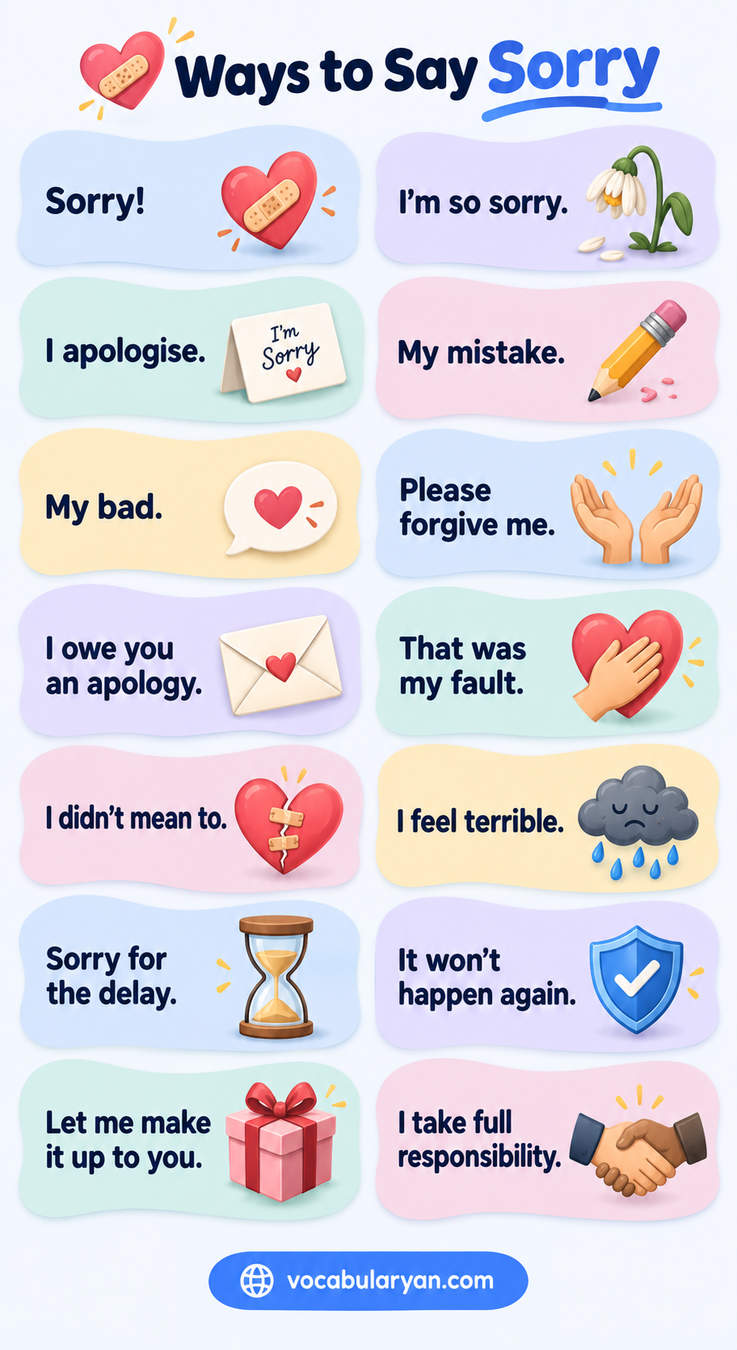
These seven apologies cover small slips with anyone at all, from a stranger in a queue to a colleague at the next desk.
Sorry: the one word for a small slip, a wrong turn, or a step on someone’s foot. On its own it fits speech more than writing.
- Sorry, I didn’t see you there.
- Oh, sorry, was that your seat?
- Sorry, I’ve taken your pen by mistake, here it is.
I’m sorry: the full form, and it fits every level from a friend to a boss. Say it slowly and with eye contact when the mistake was real.
- I’m sorry, I forgot to send the form yesterday.
- I’m sorry about the noise last night, we had guests.
- I’m sorry, Mrs Ali, the doctor is running twenty minutes behind today.
I’m so sorry: "so" makes the apology stronger, and it fits a mistake that cost someone time, money, or feelings.
- I’m so sorry, I completely forgot your birthday.
- I’m so sorry about the mix-up with the tickets.
- I’m so sorry, I didn’t mean to wake the baby.
Sorry about that: relaxed and friendly, and it fits a small problem that has just been fixed. It sounds too light for a serious mistake.
- Sorry about that, the call dropped for a second.
- I sent you the wrong file, sorry about that.
- Sorry about that, the dog gets excited with visitors.
My mistake: a short apology that also takes the blame, and it fits a friend, a colleague, or a shop. It sounds a little more grown-up than "my bad".
- My mistake, the meeting is at three, not two.
- Oh, my mistake, I gave you the wrong change.
- That was my mistake, I read the date wrong.
Oops, sorry: "oops" is the sound of a small accident, and "sorry" follows it at once. It fits a dropped cup or a wrong button, never a real hurt.
- Oops, sorry, I pressed send too early.
- Oops, sorry, I stepped on your bag.
- Oops, sorry! Wrong door.
I didn’t mean to: an apology that says the harm was an accident, and it goes after "sorry" rather than alone.
- Sorry, I didn’t mean to interrupt you.
- I didn’t mean to upset her, it was a joke.
- Sorry, I didn’t mean to grab your coat, they look the same.
Say "sorry about that" for a slip that is already fixed, and "I’m so sorry" when the other person lost something.
Ways to Say Sorry to a Friend
Apologies between friends sound relaxed and honest, and most of them name the fault in plain words.
My bad: American casual slang for "that was my fault", and it fits close friends and small slips. Keep it out of work and out of any email.
- My bad, I thought you said Tuesday.
- Oh, my bad, I ate your leftovers.
- My bad, I’ll get the next round.
I messed up: a plain admission of a bigger mistake, and it fits a friend or a family member when "sorry" alone is too small.
- I messed up, I should’ve called you back.
- I know I messed up with the tickets, let me fix it.
- Okay, I messed up. What can I do?
Sorry, man: "sorry" with "man" or "mate" sounds warm and quick between friends. It fits a missed call or a late arrival.
- Sorry, man, I fell asleep and missed your text.
- Sorry, man, I can’t make it tonight after all.
- Sorry, mate, I forgot to bring your charger.
I feel awful: an apology that names your own guilt, and it fits a friend you let down. Follow it with the reason.
- I feel awful about missing your show.
- I feel awful, I didn’t know it was your last day.
- I feel awful for snapping at you earlier.
Don’t be mad: a playful apology that comes before a confession, and it fits close friends and siblings only.
- Don’t be mad, but I broke your mug.
- Okay, don’t be mad, I told Sam about the party.
- Don’t be mad, I’m going to be an hour late.
That came out wrong: an apology for words that sounded harsher than you meant, and it fits a friend or a partner mid-conversation.
- Sorry, that came out wrong, I meant the plan, not you.
- That came out wrong, let me try again.
- Wait, that came out wrong, I’m not angry with you.
Let me make it up to you: an offer to repair the harm, and it follows an apology rather than replacing it.
- I’m sorry I missed dinner, let me make it up to you on Saturday.
- Let me make it up to you, coffee’s on me all week.
- I know I let you down, let me make it up to you.
Say what you did before you say "sorry", because a friend forgives a named mistake faster than a bare apology.
Formal Ways to Say Sorry at Work
Formal apologies name the problem and the fix, and they use "apologise" rather than "sorry" in most sentences.
I apologise: the standard formal apology in speech and writing, and it fits a manager, a client, or a stranger. The American spelling is "apologize".
- I apologise, the figures in the slide are from last year.
- I apologise for the interruption, there’s an urgent call for you.
- I apologise, Mr Chen, the room was double-booked.
My apologies: a short formal apology for a small slip at work, and it works well at the start of a message.
- My apologies, I sent that to the wrong address.
- My apologies for the noise, the builders are in today.
- My apologies, I misread your name on the list.
I’d like to apologise for: a full apology that names the fault, and it fits a meeting or a call with someone senior.
- I’d like to apologise for how I spoke in the meeting.
- I’d like to apologise for the delay with your order.
- I’d like to apologise for missing the deadline on Friday.
I owe you an apology: an opening line for a serious apology, and it means that a fuller apology is coming next.
- I owe you an apology for what I said last week.
- Priya, I owe you an apology. I should have asked you first.
- I owe you an apology, the mistake in the invoice was mine.
I sincerely apologise: the strongest formal apology, and it fits a client, a customer, or a boss after a real failure.
- I sincerely apologise for the error in your contract.
- I sincerely apologise, this should never have happened.
- On behalf of the team, I sincerely apologise for the confusion.
I take full responsibility: an apology that accepts the blame in full, and it fits a leader or anyone whose mistake affected others.
- I take full responsibility for the missed shipment.
- The data was wrong, and I take full responsibility.
- I take full responsibility, and I’ve already started fixing it.
Please accept my apologies: a very formal apology for writing or a speech, and it fits a letter, a client, or an official.
- Please accept my apologies for the late response.
- Please accept my apologies, Dr Okafor, for the missed appointment.
- Please accept my apologies for any trouble this has caused.
The one apology to keep away from a manager or a client is "my bad", because it treats a work error as a joke between friends.
- My bad, I sent the client the wrong price. ❌
"My bad" is casual slang, and at work the same slip takes "I apologise" and a fix.
- I apologise, I sent the client the wrong price and I’ve corrected it. ✅
Every apology on this page belongs to one of five levels.
| Level | Apologies | Who it fits |
|---|---|---|
| Slang | My bad, soz, sry | Close friends your own age |
| Casual | Sorry about that, my mistake, I messed up | Friends, family, relaxed colleagues |
| Neutral | Sorry, I’m sorry, I’m so sorry | Anyone at all |
| Formal | I apologise, my apologies, I owe you an apology | Managers, clients, strangers |
| Very formal | I sincerely apologise, please accept my apologies | Customers, officials, letters |
Use "I apologise" with a manager and "I sincerely apologise" with a client, and put the fix in the same sentence.
Ways to Say Sorry in an Email
An email apology goes in the first line, names the problem in a few words, and moves to the fix at once.
Sorry for the late reply: the most common email apology, and it fits a colleague or a client after a few days of silence.
- Sorry for the late reply, I was out of the office until today.
- Sorry for the late reply, here are the dates you asked for.
- Hi Tom, sorry for the late reply, the week got away from me.
Apologies for the delay: the formal form of "sorry for the late reply", and it fits a customer or anyone senior.
- Apologies for the delay, the signed copy is attached.
- Apologies for the delay in getting back to you about the quote.
- Dear Ms Adams, apologies for the delay, we needed one more approval.
I apologise for any confusion: the apology for an unclear or wrong email, and it goes before the corrected version.
- I apologise for any confusion, the correct time is 2 p.m.
- I apologise for any confusion caused by my last message.
- I apologise for any confusion, the attachment is now the right one.
Sorry to bother you: a polite apology for taking someone’s time, and it opens a request or a reminder.
- Sorry to bother you again, did you get a chance to look at the draft?
- Sorry to bother you on a Friday, one quick question.
- Sorry to bother you, but the link in your email isn’t working.
Sorry for the short notice: the apology for a request or a change that arrives late, and it fits meetings and invitations.
- Sorry for the short notice, can we move the call to Thursday?
- Sorry for the short notice, but the venue has changed.
- Sorry for the short notice, the client wants the slides tonight.
Please disregard my last email: the fixed line for an email sent by mistake, and "apologies" goes in front of it.
- Apologies, please disregard my last email, it went to the wrong list.
- Please disregard my last email, the correct file is attached here.
- Sorry, please disregard my last email, I hit send too early.
"If" turns an apology into a question, and in an email it reads as a way to avoid the blame.
- I’m sorry if my email upset anyone. ❌
"If" says that the upset is not certain, so the apology names the fact instead.
- I’m sorry that my email upset the team. ✅
Write "sorry for the late reply" to a colleague and "apologies for the delay" to a client, and put the fix in the next line.
Ways to Say Sorry to a Customer
A customer apology uses "we" for the company, names the problem, and offers a fix in the same breath.
We’re sorry for the inconvenience: the standard customer apology for a delay, a fault, or a closed service, in speech and in writing.
- We’re sorry for the inconvenience, the lift will be back in service by noon.
- We’re sorry for the inconvenience, your refund has been processed.
- We’re sorry for the inconvenience caused by the delay to your train.
We apologise for any inconvenience caused: the fully formal form, and it fits a notice, a letter, or a recorded message.
- We apologise for any inconvenience caused by the roadworks.
- The store will close early today, and we apologise for any inconvenience caused.
- We apologise for any inconvenience caused during the system update.
Please accept our sincere apologies: the strongest customer apology, and it fits a complaint or a serious failure.
- Please accept our sincere apologies for the damaged parcel.
- Please accept our sincere apologies, Mr Petrov, and a voucher for your next visit.
- Please accept our sincere apologies for the error on your bill.
I understand your frustration: an apology that agrees with the customer’s feeling, and it fits a call or a chat before the fix.
- I understand your frustration, and I’m sorry for the wait.
- I understand your frustration, let me look into this right now.
- I understand your frustration, Mrs Kaur, this shouldn’t have happened twice.
Let me put this right: an apology that moves to action, and it fits any customer who is still angry after "sorry".
- I’m sorry about the mix-up, let me put this right for you.
- Let me put this right, I’ll send a replacement today.
- Let me put this right, the charge will be refunded within two days.
Say "we’re sorry for the inconvenience" to a customer, and say what you will do next in the same sentence.
Ways to Say Sorry for Being Late
An apology for lateness comes first, before the excuse, and a short reason after it is enough.
Sorry I’m late: the standard apology on arrival, and it fits a meeting, a class, or dinner with friends.
- Sorry I’m late, the bus didn’t come.
- Sorry I’m late, everyone, please carry on.
- Sorry I’m late, Grandma, the traffic was terrible.
Sorry to keep you waiting: the polite apology when someone has been waiting for you, and it fits a customer, a client, or a date.
- Sorry to keep you waiting, Mr Lewis, the doctor will see you now.
- Sorry to keep you waiting, the last call ran over.
- Sorry to keep you waiting, have you been here long?
Sorry for the wait: the shorter form used in shops, cafés, and on the phone.
- Sorry for the wait, what can I get you?
- Sorry for the wait, your table is ready now.
- Sorry for the wait, the line was busy this morning.
I’m running late: the message you send before you arrive, and "sorry" goes at the start or the end.
- Sorry, I’m running late, order without me.
- I’m running late, sorry, ten minutes at most.
- I’m running late, the train stopped between stations, sorry!
Thanks for your patience: a thank-you that works as an apology after a long wait, and it fits a customer or a group.
- Thanks for your patience, we’re ready to begin.
- Thanks for your patience, the system is back up now.
- Sorry for the delay, and thanks for your patience, everyone.
"Sorry" takes a full clause or "for" plus a noun, and "for late" is neither.
- Sorry for late, the traffic was bad. ❌
"Late" is an adjective, so it needs "I’m" in front of it or "the delay" instead.
- Sorry I’m late, the traffic was bad. ✅
Say "sorry I’m late" to a room and "sorry to keep you waiting" to one person who waited for you.
Ways to Say Sorry for a Mistake
An apology for a real mistake takes the blame in plain words, and each of these lines does that in one sentence.
That was my fault: the plainest way to take the blame, and it fits work, home, and friends alike.
- That was my fault, I forgot to lock the door.
- That was my fault, not yours, I gave you the wrong address.
- The double booking, that was my fault, sorry.
I was wrong: an apology for a wrong opinion, a wrong decision, or an argument, and it fits a partner or a colleague.
- I was wrong about the route, we should’ve listened to you.
- I was wrong, and I’m sorry I argued with you about it.
- Okay, I was wrong, the shop does close at five.
I got that wrong: softer than "I was wrong", and it fits a fact, a number, or a name you misread.
- I got that wrong, the total is 240, not 420.
- Sorry, I got that wrong, her name is Naomi.
- I got that wrong in the email, the meeting is on Monday.
I should have checked: an apology that names what you failed to do, and it fits a mistake caused by rushing.
- I should have checked the address before I posted it.
- Sorry, I should have checked with you first.
- I should have checked the dates, my mistake.
It won’t happen again: a promise that follows an apology, and it fits a manager, a teacher, or a customer.
- I’m sorry I missed the call, it won’t happen again.
- It won’t happen again, I’ve set two alarms.
- I apologise for the late report, it won’t happen again.
There’s no excuse for that: a serious apology that refuses to blame anything else, and it fits a hurt colleague or a partner.
- I shouted at you in front of the team, and there’s no excuse for that.
- There’s no excuse for that, I’m sorry.
- I forgot our anniversary, there’s no excuse for that.
Take the blame with "that was my fault" before you give the reason, because the reason after "but" cancels the apology.
Ways to Say Sorry to a Partner or Family Member
Apologies at home name the hurt and ask for forgiveness, and they sound warm rather than formal.
I’m sorry I hurt you: the direct apology for an argument or a harsh word, and it fits a partner, a parent, or a close friend.
- I’m sorry I hurt you, I didn’t think before I spoke.
- I’m sorry I hurt you, Mum, I know you were only trying to help.
- I’m sorry I hurt you, can we talk about it?
I didn’t mean to hurt you: the apology for harm you caused by accident, and it follows "I’m sorry" rather than replacing it.
- I’m sorry, I didn’t mean to hurt you with that comment.
- I didn’t mean to hurt you, I was tired and it came out wrong.
- I didn’t mean to hurt you, but I see now that I did.
Please forgive me: a serious request after a real wrong, and it fits a partner or a parent, not a colleague.
- Please forgive me, I should have told you the truth.
- I know I let you down, please forgive me.
- Please forgive me, Dad, I was young and stupid.
Can you forgive me?: the same request as a question, and it leaves the other person free to say "not yet".
- I’m sorry for everything, can you forgive me?
- Can you forgive me for missing the wedding?
- I was wrong, can you forgive me?
I wish I could take it back: an apology that names regret, and it fits words said in anger.
- I wish I could take it back, I didn’t mean any of it.
- I’m so sorry, I wish I could take it back.
- I wish I could take it back, you didn’t deserve that.
I was out of line: an apology for crossing a line, and it fits a partner, a sibling, or a friend after an argument.
- I was out of line last night, I’m sorry.
- I know I was out of line, and you had every right to be angry.
- I was out of line at dinner, sorry for embarrassing you.
Say "I’m sorry I hurt you" first, and ask "can you forgive me?" only after the other person has had time to answer.
Ways to Say Sorry When You Interrupt or Bump Into Someone
These three apologies fit a small physical or verbal slip, and each takes two or three words.
Sorry, go on: the apology for talking over someone, and "go on" hands the turn back.
- Sorry, go on, you were saying?
- Oh, sorry, go on, I didn’t mean to cut in.
- Sorry, go on, I’ll ask after.
Sorry to interrupt: the polite apology before you break into a conversation or a meeting.
- Sorry to interrupt, there’s a call for you on line two.
- Sorry to interrupt, but the taxi is here.
- Sorry to interrupt, can I add one thing?
Oh, sorry!: the apology for bumping into someone, and it takes a quick smile and a step back.
- Oh, sorry! I didn’t see you behind me.
- Oh, sorry! Are you okay?
- Oh, sorry! My fault, the corridor’s so narrow.
Ways to Say Sorry for Someone’s Loss
A condolence uses "sorry" without "apologise", because you did not cause the loss.
I’m so sorry for your loss: the standard condolence in speech and in a card, and it fits anyone who has lost a person.
- I’m so sorry for your loss, your father was a kind man.
- I’m so sorry for your loss, Elena, please let me know if I can do anything.
- I’m so sorry for your loss, we’re all thinking of you.
I’m so sorry to hear that: the reply to bad news of any size, from a lost job to a death in the family.
- I’m so sorry to hear that, how is your mum doing?
- I’m so sorry to hear that, take all the time you need.
- Oh, I’m so sorry to hear that, when did it happen?
My condolences: the formal condolence, and it fits a colleague, a client, or a card.
- My condolences, I was so sorry to hear about your father.
- Please accept my condolences, Mr Diaz.
- My condolences, I only met your grandmother once, and she was lovely.
"Apologise" means you caused the harm, so it is wrong in a condolence.
- I apologise for your loss. ❌
You did not cause the death, so the phrase is "sorry", never "apologise".
- I’m so sorry for your loss. ✅
Ways to Say Sorry in a Text
A text apology is short, and it names the slip in the same message so the reader is not left guessing.
Sorry!!: "sorry" with two exclamation marks, and the marks make it warmer rather than louder. It fits a friend and a small slip.
- Sorry!! Just saw your message.
- Sorry!! Wrong chat.
- Sorry!! I’ll be there in five.
Sry: the shortest text form of "sorry", used by younger speakers with close friends only.
- Sry, phone died.
- Sry I missed your call, on the bus.
- sry can’t tonight, next week?
Soz: British text slang for "sorry", and it fits close friends and a slip that does not matter much.
- Soz, running late again.
- Soz, forgot to reply!
- Soz, mate, I’ve got work.
Sorry, just seen this: the apology for a late reply to a message, and it fits friends and relaxed colleagues.
- Sorry, just seen this, yes, I’m free Friday.
- Sorry, just seen this! Still need a lift?
- Sorry, just seen this, my phone was on silent.
Sorry, I got held up: the apology for a late arrival or a missed plan, and it gives the reason in three words.
- Sorry, I got held up at work, leaving now.
- Sorry, I got held up, save me a seat.
- Sorry, I got held up with the kids, can we do seven instead?
Keep a text apology to one line, and write "sorry" in full to anyone older than your friends.
Regional Ways to Say Sorry in English
Each English-speaking country keeps a few apologies of its own, and the level of each one changes with the country.
British Ways to Say Sorry
Ever so sorry: a warm British apology for a small slip, and it fits a shop, a neighbour, or a colleague. It sounds friendly, not formal.
- Ever so sorry, I’ve taken your place in the queue.
- Ever so sorry, love, the café’s closing.
- I’m ever so sorry, I thought this was my coat.
Sorry, sorry: "sorry" said twice, the British way to pass through a crowd or squeeze past a table.
- Sorry, sorry, can I just get past?
- Sorry, sorry, that’s my stop.
- Sorry, sorry, mind your feet.
I beg your pardon: an older formal apology, and today it fits a stranger, an older person, or a moment of real embarrassment.
- I beg your pardon, I thought you were someone else.
- I beg your pardon, madam, I didn’t see the pram.
- Oh, I beg your pardon, is this seat taken?
American Ways to Say Sorry
Pardon me: the polite American apology for a small slip or for passing someone, and it fits strangers and shops.
- Pardon me, I need to grab that bag.
- Pardon me, ma’am, you dropped your glove.
- Pardon me, I didn’t catch your name.
My fault: the plain American form of "my bad", and it fits friends, family, and relaxed colleagues.
- My fault, I set the alarm for p.m.
- Totally my fault, I read the email wrong.
- My fault, guys, I’ll buy the coffees.
Ope, sorry: a Midwestern American apology, said when you bump into someone or reach past them, and it fits any stranger.
- Ope, sorry, just gonna sneak past you.
- Ope, sorry, didn’t see you there.
- Ope, sorry, was that your foot?
Australian and Irish Ways to Say Sorry
Sorry, mate: the Australian everyday apology for friends and strangers alike, and it fits a shop, a bus, or a beach.
- Sorry, mate, is this yours?
- Sorry, mate, I’m in your spot.
- Sorry, mate, didn’t see the queue.
Sorry for your trouble: the Irish condolence, said at a funeral or a wake, and it means "sorry for your loss".
- Sorry for your trouble, Mary, he was a great man.
- I’m sorry for your trouble, Sean, we’ll miss him at the club.
- Sorry for your trouble, the whole street is thinking of you.
Say "ever so sorry" in Britain, "pardon me" in America, "sorry, mate" in Australia, and "sorry for your trouble" at an Irish funeral.
How Do You Reply When Someone Says Sorry?
The reply to an apology matches its size: a small slip gets "no worries", and a real hurt gets "thank you for saying that".
No worries: the most common reply to a small apology, and it fits friends, colleagues, and strangers.
- Sorry I’m late. No worries, we’ve only just sat down.
- Oops, sorry! No worries, it’s only water.
- Sorry about the mix-up. No worries, it’s sorted now.
Don’t worry about it: a warm reply that closes the matter, and it fits a friend or a colleague.
- Sorry for the late reply. Don’t worry about it, I was away too.
- I’m so sorry about the mug. Don’t worry about it, I’ve got ten.
- Sorry, my mistake. Don’t worry about it, it happens.
It happens: the reply that says the slip is normal, and it fits a forgotten name or a small delay.
- Sorry, I forgot your name. It happens, I’m Leo.
- Sorry I missed the call. It happens, I’ll send it by email.
- My bad, wrong file. It happens, send the other one.
Apology accepted: the formal reply, and it fits work or a serious apology at home.
- I owe you an apology. Apology accepted, let’s move on.
- I’m sorry I hurt you. Apology accepted, but I need some time.
- I sincerely apologise for the error. Apology accepted, please send the corrected copy.
No harm done: the reply when nothing was lost, and it fits a bump, a spill, or a wrong number.
- Oh, sorry! No harm done, I wasn’t looking either.
- Sorry, wrong number. No harm done, have a good day.
- Sorry about the coffee. No harm done, it missed the laptop.
Thank you for saying that: the reply to a serious apology, and it accepts the words without pretending the hurt was small.
- I was out of line. Thank you for saying that.
- I’m sorry I hurt you. Thank you for saying that, it means a lot.
- There’s no excuse for what I did. Thank you for saying that, I know it wasn’t easy.
Reply to a small apology in two words, and reply to a serious one with "thank you for saying that" before anything else.
More Everyday English Phrases
FAQs
The count keeps growing, because slang forms such as "soz" and "sry" appear every few years, and this page teaches more than sixty in use today. Six of them cover most of daily life: "sorry", "I’m so sorry", "sorry about that", "my mistake", "I apologise", and "I’m sorry for your loss". The rest add a level, a place, or a size of mistake on top of those six.
Say "I apologise" or "my apologies" and name the problem in the same sentence. "I apologise for the delay" and "my apologies for the confusion" are polite in speech and in writing. With a customer or a client, "please accept my apologies" is the most polite form of all.
"I apologise", "my mistake", "that was my fault", "I was wrong", and "I take full responsibility" all work as an apology with no "sorry" in them. "I apologise" is the formal choice, and "my mistake" is the casual one. "Let me make it up to you" and "it won’t happen again" also work, because each one accepts the blame and offers a fix.
Yes, "my bad" is too casual for a manager, a client, or a customer, because it treats the error as a joke between friends. It fits a colleague you joke with and nobody more senior than that. At work the same slip takes "my mistake" with a colleague and "I apologise" with anyone senior.
Name the hurt with "I’m sorry I hurt you", and say it was not on purpose with "I didn’t mean to hurt you". Ask for forgiveness with "can you forgive me?" Then add "I was out of line" or "I wish I could take it back" when you said something in anger. "Sorry" on its own sounds too small for a partner, so name what you did.
Say sorry when you caused a problem for someone, however small, and say it before the reason. A bump, a late reply, a wrong date, and a harsh word all need an apology at once. A problem you did not cause takes "I’m sorry to hear that" or "sorry for your loss", which are sympathy, not blame.
Yes, in Britain "sorry" opens a request, passes someone in a crowd, asks for a repeat, and reacts to being bumped, so you hear it far more than the number of real mistakes. "Sorry?" alone means "please say that again", and "sorry, sorry" means "let me past". Most of those uses are politeness rather than an apology, and "no worries" answers all of them.
Yes, when the mistake was yours, and "I apologise" or "we’re sorry for the inconvenience" is the form to use. An apology in business names the problem and the fix in one sentence, and it never uses "if". Say sorry once, fix the problem, and do not repeat the apology in every later message.